

Every bespoke suit starts with a pattern cut just for you, then hand-basted at the first fitting so the cloth reshapes to your posture before final stitching.

Wedding suits get three fitting stages, timed to finish about two weeks before the big day so late changes in fit are never a problem.

Made-to-measure starts from an existing block pattern, then adjusts shoulders, sleeves, and waist to your frame tailored fit, faster turnaround.

A timely alteration can add years to a garment's life; taking in a waist or re-cuffing trousers is often cheaper than buying new.

Our visiting service brings fabric books, measurements, and consultation straight to you in London full bespoke, no trip to Sussex needed.

Ladies' bespoke uses its own pattern logic dart placement and waist suppression cut for the female form, not adapted from a men's block.

A bespoke shirt is measured across a dozen-plus points, including shoulder slope, so the collar sits flat all day without gaping or twisting.

The waistcoat's back panel is traditionally satin, not outer cloth an old tailoring habit that also lets it adjust easily via a back strap.

Team uniforms are cut from one master pattern with individual sizing layered in, keeping every jacket matched in cut and colour batch.

Dandylion Style is a bespoke tailoring house based in Ardingly, West Sussex a quiet studio in the English countryside where every stitch we make is made by hand. But our clients live anywhere from Brighton to Belgravia, from London boardrooms to New York weddings, and we travel to meet them wherever the fitting needs to happen.
We built Dandylion on a simple belief: that a truly great suit is 90% patience and 10% flair. The patience shows up in the details full pattern-drafting, multiple fittings, 8 to 12 weeks of thoughtful construction, and cloth sourced only from the finest British mills. The flair shows up wherever you want it to in a lining nobody else will see, a contrast button, a bold cuff detail, or a colour palette that feels distinctly, unmistakably you.
We've been proud to be recognised for that approach twice by LUXlife (2022 and 2023), by the Mid-Sussex Applauds awards, and featured in Vogue, on BBC Radio Sussex, on FOX5NY, and in SussexWorld. But the recognition we care about most is the client who comes back for a second suit. And a third. And who sends their best friend.
That's the Dandylion story: quiet refinement, honest craftsmanship, and a personal service that feels less like a transaction and more like a proper afternoon with someone who cares.
Without question, the two cornerstones of any professional wardrobe are navy blue and charcoal grey. Navy is a master of versatility, brilliant at conveying trust and approachability. Charcoal, on the other hand, projects a quiet authority and deep sophistication. Together, they form an essential foundation for any gentleman aiming to dress with intent.
Call us to talk through the right suit colour for your role.
Choosing the right suit colour is much like selecting the right tool for a job; it sets the entire tone for every professional interaction you have. The colours you wear don’t just broadcast a message to others—they have a subtle influence on your own mindset, giving you a quiet boost of confidence and focus when you need it most.
Think of your suit as a crucial piece of your personal brand. Before you’ve even uttered a word, a well-chosen colour has already begun to communicate your professionalism and intent.
This guide is designed to be your definitive resource for navigating the world of professional tailoring. We’ll go beyond the simple rules and dive into the psychology behind key colours. You’ll learn not just what to wear, but why certain shades are far more effective in specific environments, from a high-stakes boardroom negotiation to a creative client pitch.
At the very core of an effective business wardrobe are two non-negotiable colours. Once you master these, you have a powerful and versatile foundation on which to build an impactful collection of suits.
This infographic breaks down the core concepts of these two indispensable business suit colours.
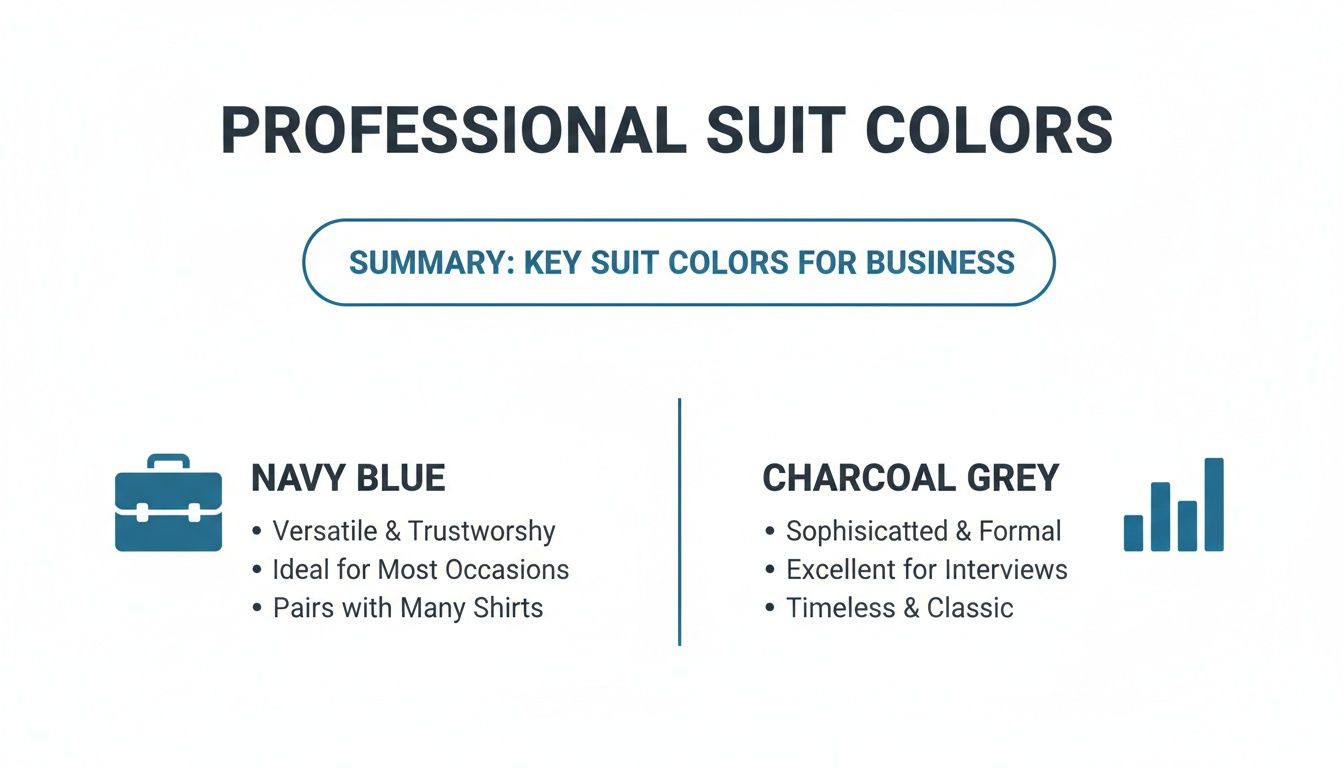
As you can see, the visualisation neatly links navy suits to versatility (represented by the briefcase) and charcoal suits to authority (the graph icon), reinforcing their primary roles in your wardrobe.
Ultimately, the goal is to build a strategic rotation that serves you and your career ambitions. But the visual impact of your suit is only part of the story. A well-chosen fragrance subtly contributes to your overall professional image, completing the picture. For a deeper dive, explore this definitive guide to office for men perfume. When paired with the right colour and fabric—something you can learn more about in our detailed article on the https://dandylionstyle.co.uk/best-fabrics-for-suits—it creates a truly polished and complete presence.
If a professional wardrobe were a finely tuned orchestra, the navy suit would be its first violin. It’s the undisputed champion of business attire, a garment so profoundly versatile that its value is almost impossible to overstate. A well-tailored navy suit can carry a gentleman from a critical client presentation in the morning to an impromptu networking dinner in the evening without missing a single beat.
This adaptability is its greatest strength. Unlike starker colours, navy has a unique warmth and depth that makes it universally flattering across different skin tones and professional settings. It feels formal without being severe, professional without ever being dull.
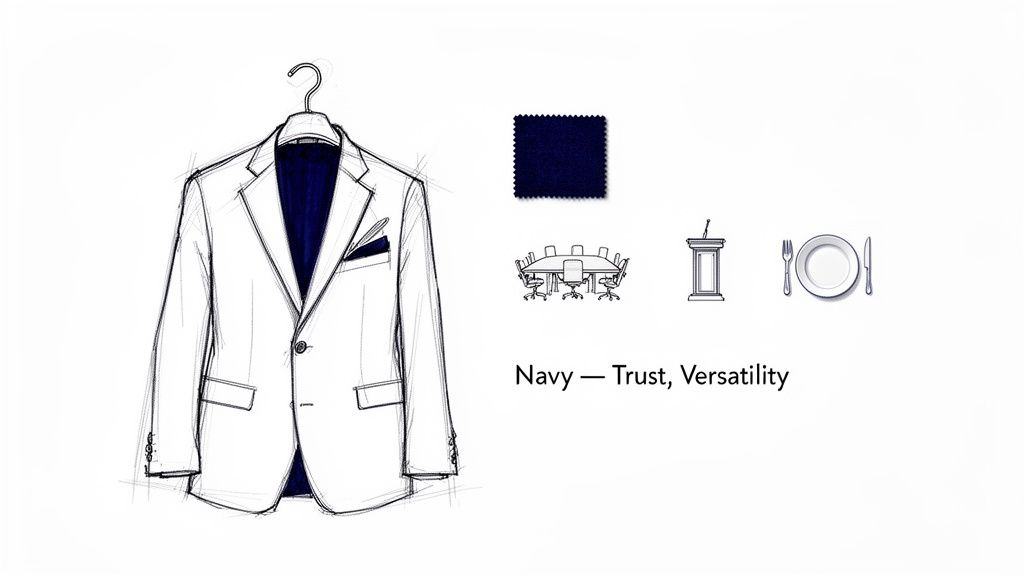
Beyond its practical side, the real power of navy lies in its psychological impact. The colour blue is consistently associated with feelings of trust, stability, and quiet confidence. When you wear a navy suit, you’re subconsciously signalling reliability and competence to those around you, making it one of the most effective suit colours for business negotiations or building client rapport.
It’s a colour that commands respect through calmness rather than intimidation. This makes it an ideal choice for professionals in nearly every field, from the high-stakes worlds of finance and law to the creative industries of marketing and consulting.
In the UK, the navy suit reigns supreme as the go-to choice for business professionals, constantly praised for its adaptable and professional appeal. This preference is a perfect fit for the needs of executives across Sussex and London, where our bespoke navy suits at Dandylion Style—crafted from fine British wool and mohair—offer that crucial refined edge. In fact, a recent style report highlighted that blue shades, navy included, are favoured by 30% of men nationwide for boosting confidence in professional settings.
The true artistry of the navy suit emerges in how you style it. Its neutral base acts as a perfect canvas for a wide array of shirts, ties, and accessories, allowing you to fine-tune your message for any occasion.
This chameleon-like quality means a single navy suit can generate dozens of distinct, appropriate looks. You can explore our dedicated guide for more ways to style a men’s navy suit for different effects. The shirt does heavy lifting in each of these combinations, so its fit matters as much as its colour. A bespoke shirt with the right collar shape for your face and a body cut to sit cleanly under the jacket ensures the pairing works as a complete picture, not just a colour match.
While navy is the cornerstone, the choice of fabric and the precision of the fit are what elevate it from a simple uniform to a personal statement of excellence. A bespoke navy suit from Dandylion Style ensures the garment works in perfect harmony with your physique and professional needs.
At Dandylion Style, we often guide clients towards a classic worsted wool for a year-round navy suit. Its durability and smooth finish are unmatched. For those seeking something with a bit more character, a mohair blend offers a subtle sheen and excellent crease resistance—ideal for the travelling professional.
The bespoke process allows for complete personalisation, from the choice of lining to the style of the lapels and the finish of the buttons. Every single detail is considered. This ensures your navy suit is not just another garment in your wardrobe, but a reliable partner in your professional journey. a true cornerstone of your personal brand.This is the experience at the heart of our bespoke suits in West Sussex where every commission begins with the fabric and colour conversation, then moves through pattern drafting, fittings, and finishing until the suit is unmistakably yours.
If a navy suit is the versatile diplomat in your wardrobe, then the charcoal grey suit is its commanding general. It’s the colour you reach for when you need your presence alone to convey weight, seriousness, and unwavering competence. For any gentleman in a leadership role or navigating the conservative worlds of finance, law, or corporate governance, a charcoal suit isn’t just a choice; it’s an essential asset.
Where navy builds rapport by being approachable, charcoal establishes respect through sheer gravitas. This deep, rich grey is inherently mature and grounded, stripping away any potential for flashiness and leaving only pure, understated authority. It sends a clear signal: you are a serious individual whose words carry significance.
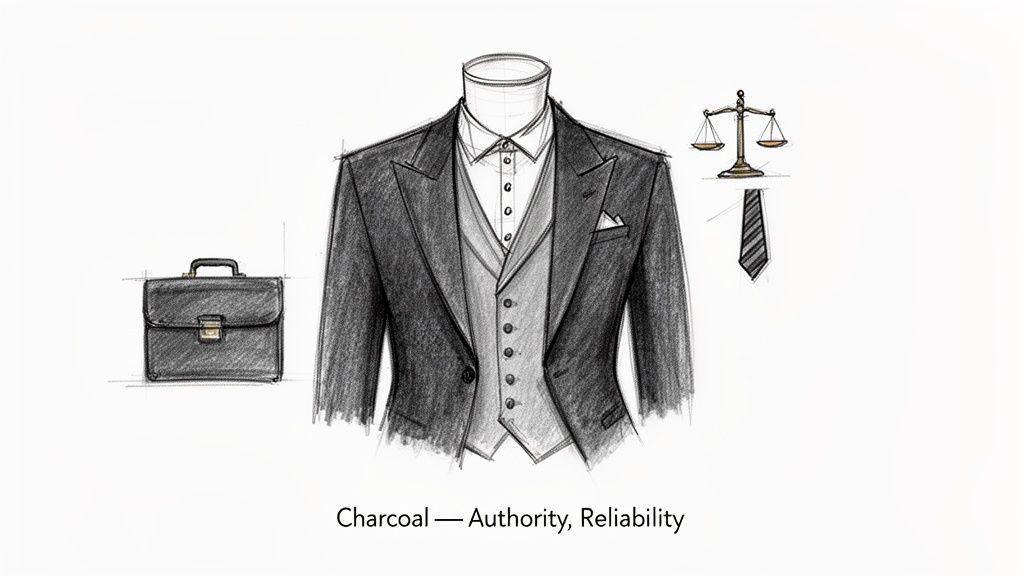
Charcoal grey is the definitive colour for moments that demand a powerful first impression. Think of a critical negotiation, a major courtroom appearance, or a presentation to the board of directors. In these scenarios, you want your attire to be a silent supporter of your expertise, and charcoal does this with unmatched poise.
Its power lies in its subtlety. It’s a strong colour that doesn’t need to shout, making it a more refined and often more modern choice than a solid black suit for daytime business. It projects an image of a seasoned professional who is in complete control.
Interestingly, while navy often leads in popularity, charcoal grey suits hold a firm second place in UK business wardrobes, prized for their sophistication. In fact, conservative dress codes, where charcoal excels, are prevalent in 40% of the top 100 happiest UK workplaces. This makes the hue’s authoritative tone a staple for professionals who require a look of steadfast competence. You can explore more data on how workplace dress codes affect professional perception.
Not all greys are created equal, and understanding their hierarchy is key to dressing strategically. The spectrum of grey offers different levels of formality, each suited to specific contexts.
Think of it like this: charcoal is for closing the deal, mid-grey is for the day-to-day work of getting there, and light grey is for celebrating the win at a summer networking event.
Pairing a charcoal suit correctly is about creating a look that is both powerful and polished. The goal is to complement its inherent authority, not compete with it. A classic white shirt is its most effective partner, creating a sharp, clean contrast that looks exceptionally professional. For a slightly softer, yet still formal approach, a light blue shirt also works beautifully. You can learn more about this classic combination by checking out our guide on whether grey and blue go together.
When it comes to ties, you can either maintain a conservative tone with deep navy, burgundy, or forest green, or add a subtle touch of personality with a textured silver or dark purple tie.
For our clients at Dandylion Style, a bespoke three-piece charcoal suit is often commissioned as a cornerstone of their professional wardrobe. The addition of a waistcoat elevates the formality, creating an almost unbreakable look of authority that is perfect for senior executives. A bespoke waistcoat in the same charcoal or in a tonal contrast like silver-grey or deep navy transforms the two-piece into something more commanding. It’s also practical: removing the jacket for a working session still leaves a sharp, polished layer that maintains your authority.
Crafted from a premium British wool or a rich flannel, the suit becomes more than just clothing. it’s a carefully constructed tool for professional success, designed to project trust and command respect from the moment you enter the room.
Book a consultation to choose cloth, colour and fit for your professional wardrobe.
Once you’ve built a solid foundation with navy and charcoal, the real fun begins. It’s time to start introducing other colours and patterns, moving beyond the essentials to build a wardrobe with more nuance and personality. This is where your personal style truly starts to take shape.
This isn’t about collecting colours just for the sake of it. Each new addition should have a purpose. A black suit, for instance, plays by a completely different set of rules than a brown one, while patterns bring an entirely new layer of visual language to the table.
The black suit is probably the most misunderstood garment in a gentleman’s wardrobe. It’s an undisputed classic for formal evening wear, but its place in a business setting is a source of constant debate. The truth is, its starkness can often feel too severe for the office, creating a harsh contrast that reads more funereal than professional in the light of day.
Even so, opinions in UK business circles remain divided. While some younger professionals feel a confidence boost in black, it’s generally less favoured by senior figures. Interestingly, research shows that black ties with blue suits are popular for instilling confidence at 30%, with this preference concentrated in London and the South East—regions where we at Dandylion Style frequently create black-tie and wedding attire alongside our business commissions. For grooms navigating the question of navy versus charcoal versus black for their wedding day, our wedding suit tailoring in West Sussex guides you through the colour decision in the context of your venue, season, and bridal party ensuring the choice works for photographs as well as the occasion itself.
The key takeaway is context. A bespoke black dinner suit is an essential part of a complete wardrobe for formal occasions. For a client meeting on a Tuesday morning, however, a deep charcoal grey will almost always project a more refined and appropriate sense of authority.
For too long, the brown suit was unfairly sidelined in corporate life, but it has made a powerful and stylish comeback. Far from being dated, a beautifully tailored brown suit conveys warmth, approachability, and a quiet, earthy confidence that will set you apart from the sea of blue and grey.
Brown works particularly well in less formal or more creative business environments. If you’re in marketing, architecture, or a creative consultancy, a rich chocolate or tobacco brown signals a modern, forward-thinking mindset. When you’re ready to expand your palette, don’t overlook the classic appeal of the color brown, both for suits and for complementary accessories.
It looks fantastic paired with light blue or cream shirts and can be styled with knitted ties for a contemporary, textured feel. For anyone looking to confidently add this colour to their rotation, our guide on styling a brown suit offers plenty more ideas.
Introducing patterns is the final frontier in elevating your professional wardrobe. When chosen with care and executed perfectly, subtle patterns like pinstripes or checks add a sophisticated layer of personality without ever compromising on professionalism.
The success of a patterned suit hinges entirely on two things: subtlety and fit. A bespoke tailor ensures the pattern is matched flawlessly at every seam and that the scale of the pattern complements your build. It’s this meticulous attention to detail that transforms a patterned suit from potentially busy to undeniably distinguished.
True sartorial intelligence isn’t just about owning beautiful suits; it’s about deploying the right one for the right mission. A well-chosen suit colour acts as a silent partner, subtly influencing perceptions and setting the tone before you even speak. The same navy suit that builds rapport in a sales pitch might feel too casual for a high-stakes legal proceeding, proving that context is everything.
Understanding how to match your suit to the occasion is what separates a man who simply wears suits from a gentleman who understands style. It’s a strategic skill that empowers you to navigate any professional environment with confidence, ensuring your attire always supports and never distracts from your objective. This strategic approach scales beyond the individual. For firms that want a unified professional image, our corporate tailoring service can outfit entire teams in a coordinated palette typically anchored in navy and charcoal ensuring every member projects the same standard of professionalism across client meetings, conferences, and public appearances.
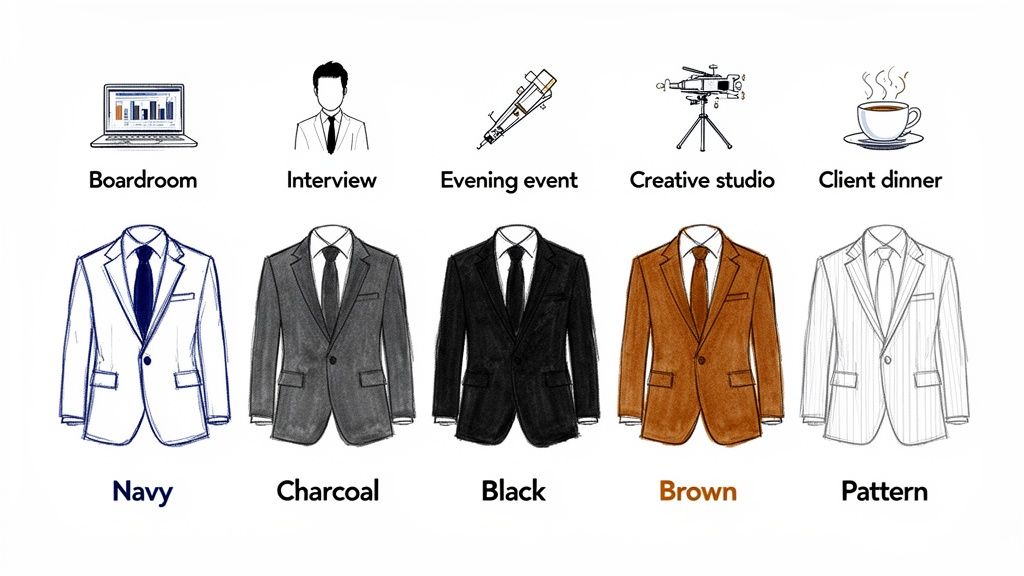
When the setting is formal and the stakes are high, your suit must communicate unwavering authority and seriousness. This is the natural territory of the charcoal grey suit. Its deep, sober tone projects maturity and competence, making it the ideal choice for environments like boardrooms, legal consultations, or critical financial presentations.
A navy suit is a strong alternative, though it projects a slightly more approachable, collaborative energy. For these pivotal moments, the goal is to eliminate distractions. Your suit should be a backdrop of pure professionalism, allowing your expertise to take centre stage. For London-based executives who need that level of precision on short notice, our bespoke tailoring service in London offers private consultations in the city helping you select the right shade of charcoal or navy and build a suit calibrated to your boardroom environment.
In a sales or client-facing role, your objective is different. You need to build trust and establish a connection—and do it quickly. This is where the navy blue suit truly shines. Its inherent warmth and association with stability make it one of the most effective suit colours for business when building rapport is a priority.
Navy feels less rigid than charcoal, creating a more open and engaging atmosphere. It suggests you are both reliable and approachable, a perfect combination for winning new business. A rich, well-fitted navy suit paired with a crisp shirt signals that you are confident, organised, and ready to collaborate.
For a job interview, your attire must strike a perfect balance between respect for the occasion and confidence in your abilities. Both navy and charcoal grey are the undisputed champions here. They are the safest and most professional choices, ensuring you are judged on your merits, not your wardrobe.
Your interview suit should be memorable for its impeccable fit, not its colour. If you already own a navy or charcoal suit that’s close to right but not quite there perhaps the jacket pulls slightly or the trousers break too much professional clothing alterations can sharpen the fit in time for the interview. A small investment in tailoring can make an off-the-rack suit look remarkably more polished. A conservative choice shows you understand professional norms and are serious about the opportunity. It’s a sign of respect for your potential employer.
Choosing one of these classic colours demonstrates sound judgment from the very first moment. If you’re looking for more guidance, be sure to read our complete guide on what to wear for an interview.
The industry you work in plays a massive role in defining appropriate business attire. What works in a creative agency would feel completely out of place in a traditional bank.
Ultimately, building a strategic suit rotation allows you to select the perfect garment for any professional scenario, turning your wardrobe into a powerful tool for your career. These principles apply equally to women in professional roles. A navy trouser suit or charcoal blazer-and-skirt combination carries the same authority, and our ladies bespoke tailoring applies the same colour strategy selecting shades that project the right message for each client’s industry and position.
Igor is the founder and master tailor behind Dandylion Style, a luxury bespoke tailoring house nestled in the heart of Ardingly, West Sussex. With a deep-rooted passion for classic gentlemen’s tailoring and an unwavering eye for craftsmanship, Igor has built a reputation for creating one-of-a-kind garments that are as personal as they are refined.
He specialises in cutting from the finest British fabrics, transforming materials like tweed, cashmere, and fine wools into impeccably fitted suits that truly reflect the wearer’s character. Igor’s philosophy is built on a calm, considered, and collaborative process, offering honest guidance as he walks each client through their journey to finding the perfect suit colours for business. His expertise ensures every detail—from cloth choice to finishing touches—is thoughtfully selected to create a garment that feels both personal and timeless.
Navigating the nuances of professional attire can bring up plenty of questions. Here are some straightforward answers to the queries we hear most often, designed to help you choose the right suit colours with confidence and purpose.
For a job interview, your safest and strongest options are navy blue or charcoal grey. These colours are the undisputed gold standard of professionalism, projecting confidence without causing a distraction.
Navy suggests trustworthiness and stability, while charcoal conveys maturity and sophistication. Both are conservative, respected choices that ensure the interviewer’s focus remains squarely on your skills and qualifications. Stick to a simple two-piece suit and let your abilities—not your attire—make the crucial first impression.
For any professional building a foundational wardrobe, three well-fitting suits is the ideal starting point. Begin with the two absolute essentials: a versatile navy blue and an authoritative charcoal grey. These two alone will see you through the vast majority of business scenarios.
For your third suit, you could add a mid-grey for less formal days or perhaps a suit with a very subtle pattern, like a faint pinstripe, to introduce some variety. This core rotation allows each suit to rest properly between wears, which is crucial for extending its lifespan and ensuring you always have a sharp, appropriate option ready to go. Building that three-suit rotation doesn’t require a full bespoke commitment from day one. A made-to-measure suit offers the same precision of fit and fabric choice at a more accessible price point. an ideal way to establish your navy and charcoal foundation before investing in a fully bespoke third piece.
Light-coloured suits—think light grey, beige, or stone—are best kept for specific circumstances. They’re most at home during the warmer summer months, at business events held outdoors, or within more relaxed, creative industries where the dress code is more flexible.
In a traditional corporate setting, however, they can come across as a bit too casual, especially for important client meetings. Always gauge your specific workplace culture and the formality of the day before reaching for a lighter shade. When in any doubt, navy or charcoal is always the safer and more professional bet.
Absolutely. A pinstripe suit remains a powerful and entirely professional choice, though its modern form is all about subtlety. The pinstripe that works today is thin, elegant, and understated—a far cry from the bold, brash stripes of decades past.
A navy or charcoal suit with a faint, tonal pinstripe adds a sophisticated layer of visual interest, projecting an image of quiet confidence and authority. The key is to ensure the pattern is subtle and the fit is impeccable. Get that right, and it’s a brilliant option for any executive wardrobe.
When you find a piece of clothing you absolutely love, getting the fit just right is the final, transformative touch. But how much should you expect to pay? In the UK, alteration costs can be as modest as £15 for a simple trouser hemming, or climb to £150 and beyond for something more involved, like restructuring a suit jacket. The final bill really comes down to the complexity of the job, the type of fabric, and the skill of your tailor.
Prices depend on fabric and construction, so call and describe the job.
Call 07961 314 637
Trying to figure out what you might pay for alterations can feel like a shot in the dark, but there are some reliable cost drivers to keep in mind. Think of this as your cheat sheet for estimating tailoring costs before you even step into the studio.
The single biggest factor is complexity. Simple, quick jobs like shortening sleeves or hemming a pair of trousers will always be the most affordable. On the other hand, tasks that require deconstruction and rebuilding—like reshaping the shoulders of a jacket or completely relining a coat—demand a great deal more skill and time, and the price will reflect that.
Then, you have to consider the fabric. Working with delicate materials like silk, chiffon, or anything with an intricate pattern requires a far more careful and experienced hand than sturdy cotton or denim. This extra care and precision are naturally factored into the cost.
It’s also worth remembering that location influences price. As with many services, tailors in major hubs like London often have higher overheads and charge more than their counterparts in smaller towns or regional areas like Sussex.
This guide will give you a solid ballpark figure for what to expect for both gentlemen’s and ladies’ garments. Of course, knowing the cost is only half the battle; finding the right artisan is just as important. For those in the South East, our guide to finding expert tailors near you is a fantastic place to start. Alternatively, you can go straight to our clothing alterations service in West Sussex for a direct consultation. we’ll assess your garment, give you an honest quote, and let you know exactly what’s achievable before any work begins.
Think of a tailor not just as someone who sews, but as a sculptor for fabric. The cost reflects the time, precision, and artistry required to reshape a garment to fit your unique form perfectly.
Ultimately, investing in alterations can make an off-the-rack garment look and feel bespoke, which not only extends its life in your wardrobe but also gives you a serious confidence boost. A great tailor transforms clothing, ensuring every piece you own works for you, not against you.
Ever wondered why hemming a pair of simple trousers might cost you £15, yet reshaping the shoulders of a suit jacket can climb towards £150? The answer goes far beyond a simple price list; it’s rooted in the core principles of craftsmanship: time, complexity, and the materials themselves. Understanding these factors will help you see alteration quotes not as arbitrary figures, but as a fair reflection of the skill involved.
Think of your tailor as a skilled artisan. Just as a sculptor carefully chips away at marble, a tailor meticulously deconstructs and reconstructs fabric. A simple job is like a quick, confident sketch, while a complex one becomes a detailed masterpiece requiring hours of focused effort.
The price of any alteration is a direct measure of the tailor’s time and expertise. A few key elements will always influence that final cost:
A tailor’s bill is essentially the story of the work performed. Every pound corresponds to a minute spent, a seam unpicked, a stitch perfected, or a tricky fabric tamed. It’s an investment in precision.
The UK alterations market shows just how these factors play out in real terms. While basic adjustments are quite accessible, complexity quickly adds to the cost. For example, general clothing alterations can range from a few pounds for a button replacement to well over £100 for the intricate job of relining a jacket.
A simple trouser shortening might start at just £10, but if you want to retain the original designer hem on a pair of jeans, expect to add another £10–£15 for that extra, detailed work. Similarly, the moment a garment is lined, the complexity multiplies, often adding £10–£30 to the bill for the additional labour.
Ultimately, the cost reflects the transformation. When you pay for a complex alteration, you’re not just buying a service; you’re investing in the expertise needed to make a garment truly yours. This is especially true when considering the significant difference between simple off-the-rack adjustments and the deep craftsmanship involved in high-end tailoring, which you can read more about in our guide to understanding bespoke tailoring costs.
Alright, we’ve talked about the craft and complexity that sets alteration prices. But let’s get down to brass tacks: what can you actually expect to pay? Knowing the ballpark figures for common jobs gives you a much clearer picture before you even step into a tailor’s studio.
While our world revolves around gentlemen’s tailoring, a well-rounded guide must include pricing for ladies’ wear, especially for something as frequently altered as a dress. Here’s a look at what you might budget for getting that perfect fit.
To give you a practical sense of the market, I’ve put together a table showing typical alteration costs. You’ll notice a clear difference between London prices and what you might find in other regions, like here in Sussex. The complexity of the job—driven by fabric, construction, and details like beading or linings—is the real game-changer.
| Garment & Alteration Type | Average Cost (Sussex & UK Regions) | Average Cost (London) | Notes on Complexity |
|---|---|---|---|
| Suit Jacket Sleeve | £20 – £30 | £25 – £35 | Lengthening is more complex and depends on available seam allowance. |
| Suit Jacket Sides | £30 – £45 | £40 – £50 | Taking in is standard; letting out is only possible with extra fabric. |
| Suit Trouser Hem | £15 – £30 | £20 – £40 | A machine finish is cheaper; a hand-stitched hem on lined trousers costs more. |
| Suit Trouser Waist | £15 – £25 | £20 – £30 | A standard job, but complex waistbands with extenders cost more. |
| Dress Hem (Simple) | £20 – £35 | £25 – £40 | For a single-layer dress, like a simple cocktail or day dress. |
| Dress Hem (Complex) | £80 – £150+ | £100 – £200+ | For multi-layered gowns, bridal wear, or dresses with delicate fabrics. |
| Dress Bodice/Sides | £40 – £70 | £50 – £85 | Beading, boning, or intricate seams significantly increase the time and cost. |
| Dress Straps | £15 – £30 | £20 – £35 | Simple shortening is quick; redesigning or reconstructing straps is more involved. |
These figures are, of course, estimates for 2026. For London-based professionals weighing alteration costs against investing in something made properly from the start, our bespoke tailoring service in London offers private consultations in the capital where you can compare the cost of altering an existing wardrobe against commissioning pieces that fit from the first wearing. A job’s final cost always comes down to the time and skill required. A simple cotton dress and a beaded silk gown might both need hemming, but the work involved is worlds apart.
Let’s break down some of the most frequent requests I see and why they’re priced the way they are.
For a gentleman, the suit is the foundation of a polished wardrobe, and the right fit makes all the difference. You can turn an off-the-rack garment into something that looks truly bespoke with just a few key tweaks.
Jacket Sleeves: Shortening or lengthening sleeves is perhaps the most common request, typically running £20–£35. Lengthening is always trickier, as it depends entirely on how much fabric the manufacturer left inside the seam.
Jacket Side Seams: To achieve that sharp, defined silhouette, we can take in the side seams. This job usually costs around £30–£50. Letting a jacket out is less common, as it’s only an option if there’s sufficient inlay fabric to work with. One way to extend the life of a suit jacket that’s become slightly tight is to wear it open over a bespoke waistcoat. A waistcoat provides structure and a polished layer beneath the jacket, allowing you to leave the jacket unbuttoned without looking undone. a practical styling solution while you decide whether to alter or commission a new jacket.
Trouser Hemming: This can be a simple fix or a delicate task. A basic machine-finished hem might only be £15–£20, but for finer trousers that are lined or require an invisible hand-finish, you’re looking at £25–£40.
Trouser Waist: Adjusting the waistband is a standard alteration, usually priced between £15–£30. It’s a straightforward job that makes a huge difference in comfort and appearance.
This infographic gives you a great visual for how two seemingly similar jobs can vary so much in price. If you find yourself budgeting for three or four of these adjustments on the same suit, it’s worth considering whether a made-to-measure suit would be more cost-effective. When sleeve, side, and trouser alterations add up to £80–£120 on top of the purchase price, a suit cut to your measurements from the start often represents better value and the fit will be superior.

As you can see, the moment you introduce delicate fabrics, multiple layers, or hand-finishing, the time and skill required—and therefore the cost—go up.
Dresses and gowns are the most frequently altered items in womenswear, and for good reason. A perfect fit is non-negotiable for formal events, and especially for a wedding day.
A wedding dress is more than fabric; it’s a memory in the making. Alterations ensure it fits the moment as perfectly as it fits you, making the investment worthwhile. The same principle applies to the groom. A wedding suit that needs significant post-purchase alteration is a sign it wasn’t right to begin with. Working with a dedicated wedding suit tailor in West Sussex means the suit is built to your measurements from day one and any final adjustments are minor refinements, not costly reconstructions.
Here are some typical prices you can expect for dress alterations:
Hemming: For a simple cocktail dress, you can expect to pay £20–£40. But when we talk about evening or bridal gowns with multiple layers, horsehair braids, and delicate fabrics, the price can climb from £80 to well over £200. It’s incredibly time-consuming work.
Taking in the Bodice/Side Seams: Adjusting the fit through the bust and waist is a detailed job, often costing £40–£85. The price is influenced by any boning, beading, or complex seam work that needs to be navigated.
Strap Adjustments: Shortening a pair of simple straps might be a £15–£35 job. However, if the straps need to be completely rebuilt or repositioned, which can affect the entire structure of the bodice, the cost could approach £100. For women who regularly invest in alterations to get formal or professional pieces to fit, our ladies bespoke tailoring offers an alternative: garments designed around your body from the first fitting, in fabrics and silhouettes chosen specifically for you eliminating the cycle of buying and then paying again to fix the fit.
Having these figures in mind helps you create a realistic budget for achieving that flawless fit. If you’d like to dive deeper into the different variables, you can read more about how much alterations cost on our blog.
It’s easy to think of alterations as just another expense, a frustrating little add-on to the price of a new garment. I’ve seen many clients fall into this trap. But the truth is, seeing a tailor is one of the smartest investments you can make—in your confidence, your appearance, and the very future of your wardrobe. It’s a shift from thinking about cost to understanding true value.
Think about it this way: a simple £40 alteration can take an off-the-rack £500 suit and make it look and feel like it was made just for you. That’s incredible value compared to splashing out on an entirely new garment. When your clothes fit you perfectly, you carry yourself differently. That kind of poise and self-assurance? Genuinely priceless.
The power of a perfect fit goes so much deeper than just looking good. When a dress or jacket drapes on your frame exactly as it should, it moves with you. It highlights your best features and, just as importantly, it simply feels right. That little boost of confidence can make all the difference, whether you’re walking into a boardroom, celebrating at a wedding, or just going about your day And when you’re ready to move beyond altering off-the-rack pieces, commissioning a bespoke suit in West Sussex eliminates the need for most alterations entirely every measurement is taken from the start, so the fit is built into the garment from the first cut.
This mindset is also a powerful stand against disposable fashion, which is something we feel strongly about here at Dandylion Style. By choosing to alter, you’re extending the life of your clothes. You’re choosing quality over quantity. This value-driven approach scales to organisations too. For businesses outfitting their teams, our corporate tailoring service ensures every suit is fitted correctly from the start reducing the ongoing cost of individual alterations across the team while maintaining a consistent, professional standard.That beautifully tailored piece becomes a trusted staple in your wardrobe, not just another fleeting trend destined for the back of the cupboard.
Alterations are the bridge between a good wardrobe and a great one. You are not just paying for a service; you are investing in the potential of every garment you own, making each one work harder for you.
This way of thinking is catching on across the UK. With a staggering 300,000 tonnes of clothing ending up in landfill every year, more and more people are looking for sustainable ways to manage their wardrobes. It’s no surprise that alteration services have seen a 15% jump in recent years. After all, spending £20 to tailor a favourite dress makes far more sense than buying a new one for both your bank account and the planet. This logic applies to everyday staples too. Rather than altering the collar, cuffs, and body of an off-the-rack shirt that was never designed for your proportions, a bespoke shirt built to your neck, sleeve, and torso measurements needs no post-purchase work at all and lasts significantly longer because nothing is being forced to fit.
Choosing to alter rather than replace is an act of both financial savvy and environmental responsibility. It’s about getting the absolute maximum value out of your clothes while cutting down on waste. To get the best results from the start, knowing how to take accurate body measurements can make the whole process smoother and reduce the amount of work needed. Ultimately, investing in a perfect fit for key pieces, like those we create with our bespoke dress tailoring service, is an investment that pays you back for years.
Book an appointment and we’ll tell you what’s achievable before any work begins.
Book an AppointmentStepping into a tailor’s studio for the first time can feel like entering a different world—one filled with bolts of cloth, chalk marks, and the quiet hum of expertise. It’s easy to feel a little out of your depth.
However, the best results always come from a partnership. When an informed client and a skilled tailor work together, the outcome is far more than just an altered garment; it becomes a piece that truly fits you. To get there, you need to ask the right questions before any scissors touch fabric.
First, let’s cover the nuts and bolts. Never assume a timeline or the number of fittings, as this can vary enormously depending on the garment’s complexity and the tailor’s schedule.
Before you commit, get a clear picture of the journey ahead:
Beyond the timeline and cost, you need to feel confident in your tailor’s ability to handle your specific garment. Not every tailor specialises in every type of fabric or construction.
A great tailor welcomes your questions. It’s a sign of respect for their craft and shows you’re invested in achieving a brilliant result. This open conversation is the hallmark of a true professional.
Don’t be shy about asking about their experience, especially with challenging materials. A question like, “Have you worked with this kind of delicate silk or structured, lined wool before?” is perfectly reasonable and shows you care about the details.
Finally, and this is crucial, always ask what you need to bring to your fittings. For gentlemen, this is almost always the dress shoes you’ll wear with the suit to get the trouser break perfect. For ladies altering a dress, it means bringing the exact shoes and undergarments you plan to wear. This ensures the hem falls perfectly and the bodice sits flawlessly. Being prepared makes every fitting more productive and is the secret to a superior final fit.
Call us about timings, especially for weddings and events.
Call 07961 314 637Dress alteration costs reflect the time, skill, and complexity involved. A simple hem on a cotton dress is quick, but hemming a multi-layered bridal gown with delicate fabric is highly time-consuming. Factors like intricate beadwork, boning in the bodice, or working with slippery silks increase the labour and risk, which raises the price. You are not just paying for sewing; you are investing in the expertise required to meticulously deconstruct and reconstruct a garment to fit you perfectly without damaging it.
It depends on the dress and the required alterations. For a simple adjustment like shortening straps or a basic hem, altering is almost always cheaper and more sustainable than buying new. However, if a garment needs extensive resizing or a complete overhaul, the costs can approach or even exceed the price of a new, well-fitting dress. It’s best to get a quote from a tailor first to weigh the cost against the sentimental or monetary value of the original piece.
The timeline for dress alterations varies significantly. A simple job like hemming trousers or shortening sleeves might be done in a few days to a week. However, more complex work, such as adjusting a suit jacket’s shoulders or altering a formal gown, can take two to three weeks or longer, especially during peak seasons. Bridal alterations are the most involved and often require at least a month, involving multiple fittings to ensure a perfect result for the special day.
Letting a dress out is possible, but it depends entirely on the seam allowance—the extra fabric inside the seams. Most off-the-rack garments have very little, typically around half an inch, which allows for only a minor size increase. A skilled tailor can sometimes add hidden panels of matching fabric to the side seams or back to increase the size more significantly, but this is a complex and more costly alteration. It is always easier to make a garment smaller than larger.

Igor is the founder and Master Tailor behind Dandylion Style. With a lifelong passion for the art of bespoke tailoring, Igor’s work is driven by a singular philosophy: the pursuit of the perfect fit. He has a deep appreciation for classic British fabrics, specialising in crafting distinguished gentlemen’s suits, elegant wedding attire, and refined casual wear from the finest tweed, cashmere, and wool. From his studio in Ardingly, Sussex, Igor combines meticulous attention to detail with a personal approach, offering a travelling tailor service to clients across Sussex and London.
For me, tailoring is about more than just clothes; it’s about crafting confidence. The right fit can completely change how a person feels and carries themselves.
Whether undertaking a full bespoke commission or a crucial alteration, every stitch reflects Igor’s commitment to quality and craftsmanship. His goal is to create garments that feel less like clothing and more like a second skin. You can learn more about the man behind the brand and his unique sartorial vision on our website.
At Dandylion Style, we believe a perfect fit is the foundation of true style. Whether you need a simple adjustment or a complete bespoke creation, our focus is on timeless craftsmanship and personal service. Discover our tailoring services.


