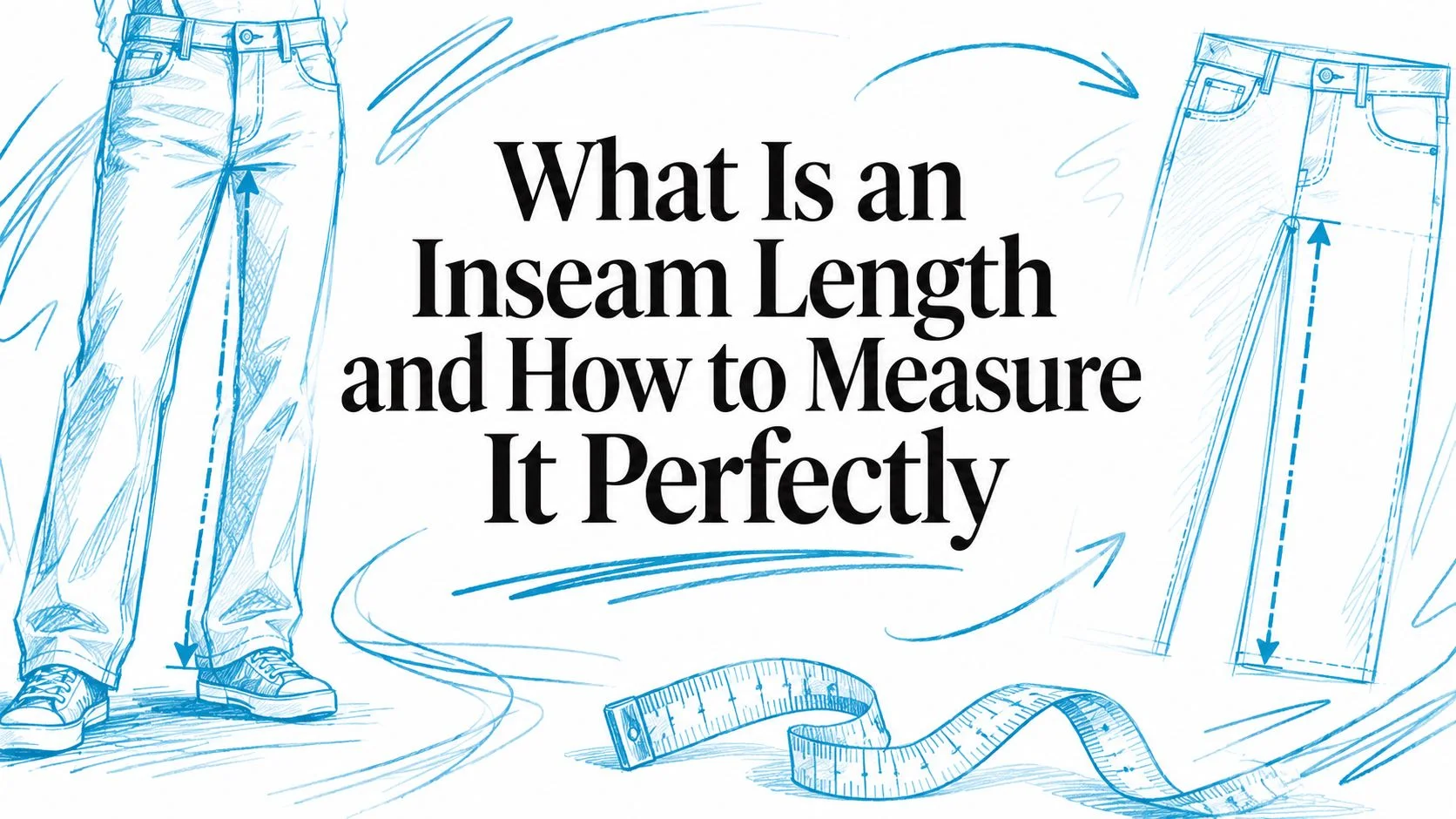
An inseam length is the measurement from the crotch seam down the inner leg to the hem, and in UK tailoring it's commonly called the inside leg. If a pair of trousers fits your waist but pools on your shoes, the inseam is usually the number that needs attention.
You can think of it as the trouser's steering wheel. Waist size holds the garment in place, but inseam decides where the cloth ends, how it breaks over the shoe, and whether the line of the leg looks sharp or slouched. In British fitting rooms, that one measurement does more work than most shoppers realise, because it helps separate a decent fit from a balanced one.
Key Takeaways on Inseam Length
Buying trousers that fit the waist but bunch at the ankle is a common frustration. The fix usually starts with the inseam, not the waistband, because inseam length is the vertical measurement from the crotch seam to the hem, and in the UK it's usually called the inside leg. UK size guides often separate waist from leg length, which is why two men with the same waist can still need different trouser lengths.
The most useful thing to remember is that inseam controls silhouette, break, and drape. That's why a tailor cares about it so much. A leg that ends too low can puddle over the shoe, while a leg that ends too high can look short and unfinished.
Practical rule: measure inseam along the inner seam with the body standing naturally, or use a pair of trousers that already fits well.
UK retailers commonly encode lengths in simple categories, such as Short, Regular, and Long. In the data provided, John Lewis uses women's inside leg categories like Short 76 cm, Regular 81 cm, and Long 86 cm, while M&S uses men's trouser lengths such as Short 28 in, Regular 30 in, and Long 32 in. Those labels make shopping easier, but they're only helpful if you know your actual inside leg first.
The rest of the fit comes down to context. A business trouser, a jean, and a formal trouser can all use the same inseam in different ways, because the hem finish, shoe type, and amount of break change the final look. That's the tailor's job, and it starts with the leg length.
Understanding What an Inseam Length Is
Inseam is the cleanest way to describe the length of a trouser leg because it follows the line that matters most in wear, the inner leg from crotch to hem. In UK garment language, that's the inside leg, and it sits alongside other standard sizing points used in both ready-to-wear and tailoring.
A first fitting often shows why tailors rely on it. Waist size tells you where the trouser sits, but inseam tells you how far the leg travels before it meets the shoe. That distance shapes the finished line of the garment. A pair can sit neatly at the waist and still look wrong if the inside leg is too long or too short.
Bespoke work has always depended on measurements that can be repeated cleanly on the board and in the cutting room. Inseam survived because it separates leg length from rise, so it is easier to reproduce in a workshop or on a size chart. As clothing moved from bespoke-only making into industrial mass production, measurable numbers became the shared language of fit, and modern UK charts still keep waist and inside leg apart for that reason. For a clear breakdown of how suit components are named and grouped, see Dandylion Style's guide to suit parts.
How inseam differs from other trouser measurements
Outseam runs along the outside of the leg, while rise measures the distance from the crotch seam to the waistband. Those numbers matter, but they answer different questions. Inseam answers the question most shoppers care about, where the hem will finish on the body.
A tailor reads the inside leg the way a carpenter reads a straightedge. It shows whether the finished line will land where it should, and whether the trouser will fall cleanly over the shoe.
That is why inseam became the number that lasted across factories, retailers, and bespoke rooms. It is repeatable, easy to test, and directly tied to the way trousers break and drape once they are worn.
How to Measure Your Inseam Accurately
The first reliable method is to measure the body. Stand naturally in the shoes you expect to wear, then place a soft tape measure at the crotch point and run it straight down the inner leg to the hem position you want. Industry guidance stresses the seam line, because posture and stance can change the effective inner-leg distance, so don't twist the tape around the body or guess from waist size alone. For a suit-specific measuring routine, Dandylion Style's guide to measuring yourself for a suit gives a useful frame.
The second method is to measure a trouser that already fits well. Lay it flat, smooth the leg, and measure from the crotch stitching down the inner seam to the hem edge. That's often the easiest way to cross-check a body measurement, especially if you already like how one pair sits on your shoe. If you want another practical reference point, Cedar & Lily's fit tips cover a similar garment-based approach.
Reading retailer size labels
UK retailers often translate inseam into simple length labels. In the verified data, John Lewis uses women's inside leg categories of Short 76 cm, Regular 81 cm, and Long 86 cm, while M&S uses men's Short 28 in, Regular 30 in, and Long 32 in for many trousers. Those labels are useful for comparison, but they only work if you already know your own number.
Measure the leg you'll actually wear, not the one you think sounds right on paper.
A few details matter more than people expect. Measure with a natural stance, not military straight, because a locked knee can distort the result. If you plan to wear thicker-soled shoes, include them in the decision, since the same inseam can look different with trainers, loafers, or Oxfords.
How Inseam Length Affects Different Trouser Styles
The same inseam can look sharp in one trouser and awkward in another. A shorter inside leg can give chinos and jeans a clean modern finish with little to no break, while a longer one can work better in business trousers where a modest fold over the shoe feels more formal. The number hasn't changed, but the visual result certainly has.
Formal trousers need a more exact conversation with the tailor. The hem has to fall in a calm, uninterrupted line over the shoe, especially when the outfit depends on a polished silhouette. In that setting, the inseam isn't just a sizing label, it becomes part of the outfit's rhythm, because it affects how the cloth meets patent shoes, lace-ups, or slim dress footwear. If you're comparing style categories and fit priorities, choose between XL and XXL is a reminder of how differently brands can describe the same basic concept of size.
Style changes the meaning of the same measurement
In casual clothing, a slightly shorter inseam often looks deliberate. In business wear, the same number can look too relaxed if the trouser has no crease or the hem sits too high. Bespoke tailoring gives the most control, because the tailor adjusts inseam alongside rise, thigh, and hip so the trouser reads as one coherent shape.
The internal fitting logic matters too, and Dandylion Style's guide to how suit trousers should fit is a helpful companion if you're judging break and hem length. A good tailor won't chase a fixed number for every client. They'll use the number as a starting point, then judge how the cloth behaves once the trouser is on the body.
Fit insight: waist size tells you if the trouser will close. Inseam tells you whether it will look right once it does.
That's why inseam is best understood as a style tool, not just a measurement. It shifts with occasion, shoe choice, cloth weight, and the amount of break you want.
Tailoring Details That Interact with Inseam
Many people assume inseam alone decides the finish, but a tailor sees several moving parts at once. Break is the fold where the hem meets the shoe, and it can range from no break to a fuller fold depending on style. A trouser with the right inseam can still look wrong if the break is too heavy for the cloth or too sharp for the occasion.
Hem allowance, cuffs, and pleats
Hem allowance is the spare fabric inside the hem that leaves room for later adjustment. Bespoke makers usually leave more of it than ready-to-wear brands, because a client's fit can change and the hem may need to be revised. Cuffs, or turn-ups, add weight to the bottom of the leg and change how the trouser hangs, while pleats affect how fabric falls from the waistband through the thigh and down to the hem.
Those details matter because the leg doesn't hang in isolation. A trouser with pleats may need a different visual balance from a flat-front trouser, even if the inseam is identical. A cuff can shorten the visual line slightly by adding structure at the hem, which is why tailors think about the whole garment rather than one number on a tape.
A practical alterations resource, Dandylion Style's guide to alteration costs, can help clients understand the kind of work a hem change may involve. The key lesson is that inseam lives inside a system. Waist, rise, cuff, break, and hem allowance all affect the final line, and the tailor balances them rather than treating any one number as absolute.
Common Inseam Fit Problems and How to Fix Them
A client often spots an inseam problem before they can name it. Trousers that pool heavily at the ankle usually mean the leg is too long, while trousers that ride up and show too much sock or ankle are often too short. Those faults look different, but both come back to the same measurement.
A long inseam can usually be corrected by hemming, and a skilled tailor will try to preserve the original hem allowance where possible so the garment can be adjusted again later. A short inseam is less forgiving. If there's no extra cloth to let out, you may need a different trouser rather than a simple alteration.
What a tailor looks for at the bench
A tailor also checks whether both legs behave the same way. One side can appear longer if the wearer stands with a hip dropped or one knee locked. That's not a flaw in the body, it's part of how posture affects the line of the trouser, so the cut has to account for it.
If one leg looks right and the other doesn't, don't blame the tape measure first. Check stance, shoe height, and where the waistband actually sits.
At a fitting, bring the shoes you plan to wear most often with the trousers. That detail helps the tailor judge whether the hem should skim, break lightly, or sit cleaner above the shoe. If the fit feels wrong in the mirror, point to the exact spot, because “too long” and “too much bunching” are not always the same fix.
The clearest troubleshooting habit is to compare the trouser on the body with a well-fitting pair at home. If one pair falls neatly and another collapses on the shoe, the inseam difference is usually visible before any alteration begins.
Preparing for a Bespoke Trouser Fitting
A bespoke trouser fitting is not just about length, it's about how the leg sits in motion, at rest, and in the shoes you'll wear. A tailor will assess inseam alongside rise, thigh, knee, and calf proportions, because those measurements work together to shape the final line. For broader measurement context, Dandylion Style's bespoke suit measurements page is a useful reference.
Bring the right shoes, and bring the undergarments and belt you'll normally use. Those details affect where the waistband sits, which changes how the inseam falls from the body. If your lifestyle involves long periods seated, mention that too, because the same trouser can feel different when a client spends most of the day at a desk or travelling.
What to expect from the process
Bespoke work usually moves through fittings, with the inseam refined as the garment takes shape. Dandylion Style's published process allows 8 to 12 weeks for completion, which gives room for careful adjustment rather than rushed hemming. That timeline suits clients whose proportions don't fit neatly into a standard size bracket, especially when one leg needs a different reading from the other.
The best preparation is simple. Wear the shoes you'll use most, know whether you want a cleaner or fuller break, and be ready to say where the cloth feels wrong. The tailor will translate that into length, balance, and finish.
Frequently Asked Questions About Inseam Length
Does inseam change with weight fluctuation? It can change indirectly, because body shape affects where trousers sit and how the leg falls. The inside leg itself is a fixed measurement from crotch to hem, but if your stance, waist position, or shoe choice changes, the apparent fit can shift. That's why a tailor checks the whole garment on the body, not just the number on the label.
How do I convert inches to centimetres for inseam? Use the retailer's chart rather than guessing, because UK brands often mix both systems. In the verified data, examples include 28 in, 30 in, and 32 in for men's lengths at M&S, and 76 cm, 81 cm, and 86 cm for women's lengths at John Lewis. Cross-checking against a chart is safer than doing rough mental maths.
Is inseam different in men's and women's tailoring? The measurement itself is the same, but the way brands present it can differ. UK size guides commonly separate waist from inside leg in both men's and women's ranges, yet the labels and size blocks may vary by retailer. That's why the actual inside leg is more useful than the size name on the tag.
How do I measure inseam for cropped or wide-leg trousers? Measure to the point where you want the hem to finish, not automatically to the floor. Cropped cuts need a deliberate stop above the shoe, while wide-leg trousers can hide a little more length because the cloth falls differently. A fitting with the intended shoes on is the safest way to judge the final look.
Who is Igor? Igor is the founder of Dandylion Style, a bespoke tailoring house that works on suits, alterations, and personal fit adjustments. His approach is practical and measurement-led, which makes him a strong point of contact if you want help with trouser length, balance, or a more precise fitting.
If your trousers fit at the waist but still look wrong at the hem, Dandylion Style can help you refine the inside leg, break, and overall line with a proper fitting. Visit Dandylion Style to arrange a consultation and get measured for trousers that sit cleanly on your shoes and suit the way you dress.
Key Takeaways The Core Two: Navy blue and charcoal grey are the essential, non-negotiable suit colors for any professional wardrobe. Navy offers versatility and approachability, while charcoal projects authority and seriousness. Context is Crucial: The best suit color...
When you find a piece of clothing you absolutely love, getting the fit just right is the final, transformative touch. But how much should you expect to pay? In the UK, alteration costs can be as modest as £15 for a simple trouser hemming, or climb to £150 and beyond...
Getting the right pink shirt and tie combination is the mark of a well-dressed man. It’s a detail that separates the novices from those who truly understand their wardrobe. For a look that’s classic and can’t miss, pair your pink shirt with a navy, grey, or burgundy...
Key Takeaways For those seeking a quick overview, this section summarises the essential rules and recommendations for incorporating turn-up trousers into your wardrobe. Sartorial Purpose: Turn-ups add weight to the trouser hem, ensuring a cleaner, sharper drape,...
Deciding what colour tie to wear with a pink shirt is a common style query I hear from clients. For a classic, professional look that never fails, your safest and most effective choices are navy blue and charcoal grey. If you're heading to a more contemporary or...
You've just picked up a newly finished bespoke suit, and the cloth still has that clean, disciplined line only a real fitting room can give it. The temptation is to put it straight in the wardrobe and trust the label to do the rest. That's where expensive...
Book Your Tailoring Consultation
Looking for a suit or garment made specifically for you?
At Dandylion Style, we create bespoke and made-to-measure
garments tailored to your individual shape, style and occasion.
From suits and shirts to dresses, waistcoats and alterations,
our experienced tailors can help you create something truly unique.