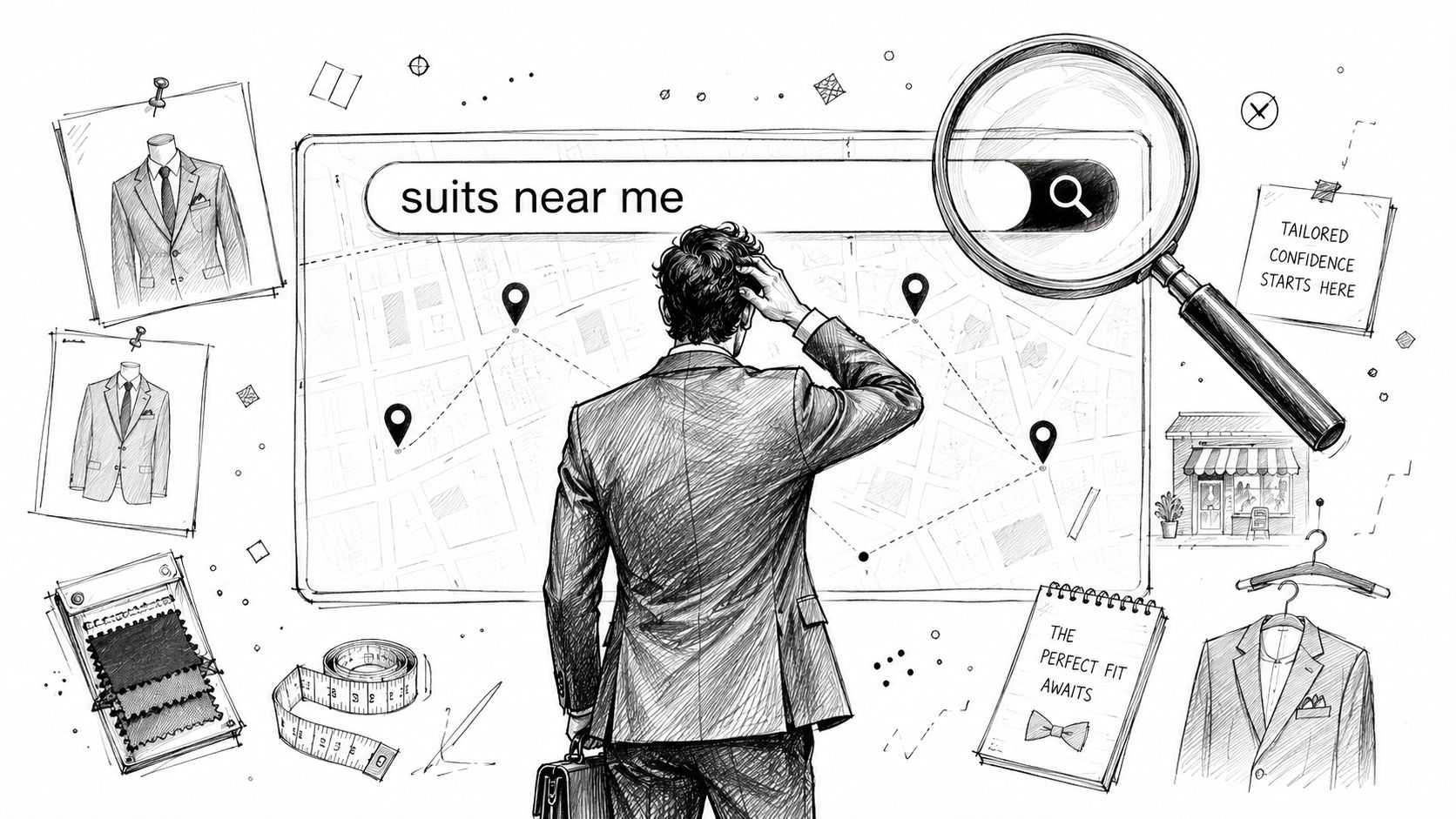
You've likely done it already. Opened a map app, typed suits near me, and found a blur of department stores, wedding chains, menswear shops, and the occasional tailor whose website says everything and nothing at once.
That search can feel practical, but it rarely answers the questions that matter. Will the suit fit your posture and build? Is the service shop-floor retail or proper tailoring? Can someone come to your home or office in Sussex or London, or are you expected to squeeze fittings between meetings and train times?
A good suit isn't just bought. It's selected, shaped, and refined.
Embarking on Your Search for the Perfect Suit
Key Takeaways
- Start by separating retailers from tailors. A convenient address doesn't guarantee real custom work.
- Judge a suit by fit, cloth, and construction. If one of those is weak, the whole garment suffers.
- Ask how the suit is made. Off-the-rack, made-to-measure, and bespoke are not interchangeable.
- Prioritise service that fits your life. Home or office appointments can make the process far smoother.
- Allow proper time. The best result comes from fittings and refinement, not rush promises.
Most men begin the search with location in mind, but location is only the first filter. The better question is which nearby option can produce a suit that flatters your frame, suits the occasion, and feels right when you sit, walk, and move naturally.
That matters more now because the British market has shifted steadily towards personalisation. The UK bespoke and custom-made luxury sector is valued at approximately £5.2 billion, growing at a compound annual rate of 7.4% since 2018, reflecting stronger demand for personalised, high-quality garments over mass-produced alternatives, as noted in this review of Britain's bespoke luxury market.
What a serious client should look for
Three pillars decide whether a suit will earn its place in your wardrobe.
- Fit first: The jacket must balance across the shoulders, collar, and chest. Trousers must hang cleanly from the seat and thigh.
- Fabric next: Cloth determines how the suit drapes, breathes, creases, and ages.
- Construction always: A suit can look neat on a hanger and still feel lifeless once worn if the internal structure is poor.
A smart local search becomes far more useful when you know what you're scanning for. If you're exploring local tailoring options, this guide to tailors near you in Sussex and London can help narrow the field.
Why the search often feels confusing
High street retailers trade on convenience. Specialist tailors trade on process. Many websites blur that distinction.
A polished showroom and a rail of navy suits tell you very little about whether the garment was cut for your body or merely adjusted to it.
That's why a discerning client treats the search result as a starting point, not a decision. The right suit isn't always at the nearest till. Often, it's with the tailor who asks better questions, takes more care, and makes the journey easier by meeting you where you are.
Decoding Your Options Off-the-Rack Made-to-Measure and Bespoke
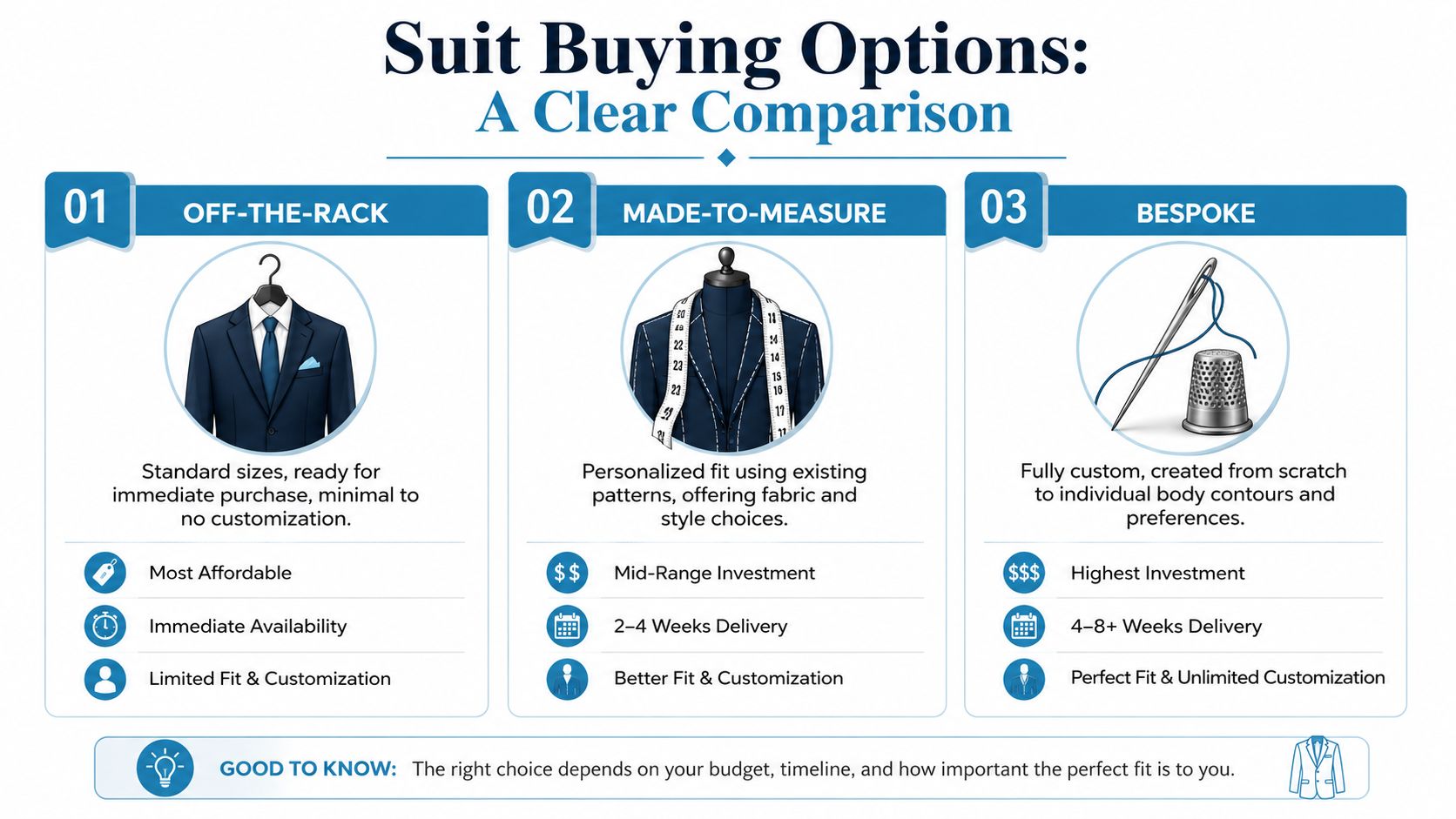
The biggest mistake men make after searching for suits nearby is assuming all tailoring terms mean roughly the same thing. They don't. A suit can be sold as “fitted”, “custom”, or “personalised” and still be very far from bespoke.
That confusion is common. A 2025 British Fashion Council Market Analysis found that 74% of UK male consumers cannot reliably identify if a local suit shop offers bespoke tailoring, while only 29% of online listings explicitly state “fully bespoke”, despite a 22% rise in demand in the South East, according to the cited market analysis reference.
The three routes compared
Off-the-rack is ready to wear. You try standard sizes and, if needed, make small alterations. It's the fastest route, but it depends heavily on your body matching the brand's block.
Made-to-measure starts from an existing pattern. Measurements are taken, options are chosen, and a pre-set template is adjusted to get closer to your shape and preferences.
Bespoke begins with you, not a standard pattern. The cutter drafts a unique pattern for your body and refines it through fittings. That's where posture, asymmetry, shoulder balance, and personal line are properly addressed.
Suit Buying Options At a Glance
| Feature | Off-the-Rack | Made-to-Measure | Bespoke |
|---|---|---|---|
| Pattern | Standard factory size | Existing base pattern adjusted | New pattern cut for the individual |
| Fittings | Usually limited | Usually one or two | Multiple fittings with refinements |
| Personalisation | Minimal | Moderate | Extensive |
| Fit potential | Good if your build is standard | Better for many clients | Best for complex fit and precise preferences |
| Speed | Fastest | Moderate | Slowest, but most exact |
| Best for | Urgent needs, lower involvement | Clients wanting choice with efficiency | Clients prioritising fit, cloth, and craftsmanship |
What works and what doesn't
A straightforward build and a one-off event can sometimes be served well by made-to-measure. It often gives cleaner results than buying off the peg and altering aggressively.
What doesn't work is expecting made-to-measure to solve every fitting issue. If one shoulder sits lower, your stance is forward, or you carry shape unevenly through chest and hips, the limits of a pre-existing pattern start to show.
For a deeper look at the difference, compare made-to-measure and bespoke tailoring before booking your appointment.
Practical rule: If the seller can't explain how the pattern is created, how many fittings are included, and what can actually be changed, treat the service description with caution.
How to Find and Vet a Tailor in Sussex and London
A nearby tailor is useful only if the work is sound and the process fits your life. That means looking beyond map pins and opening hours.
Start with the website. Ignore broad claims for a moment and study the garments themselves. Look at lapels, jacket balance, sleeve pitch, trouser line, and whether the suits appear to sit naturally on real clients rather than models.
What to check before you enquire
- Portfolio quality: You want to see work on different builds, not one repeated house style.
- Clarity of service: The tailor should state whether they offer off-the-rack, made-to-measure, bespoke, or alterations.
- Appointment format: Check whether fittings happen in a studio only, or whether home and office visits are available.
- Client voice: Independent reviews often reveal whether the tailor listens well, keeps time, and resolves issues calmly.
Convenience matters more than many retailers admit. A 2024 UK Tailoring Industry Report found that 68% of men seeking bespoke or made-to-measure suits in regional counties prefer at-home consultations, but only 12% of brick-and-mortar suit retailers currently advertise this service, highlighting a clear gap in flexibility according to this reference on the UK suit retail and store locator landscape.
Why mobile fittings matter
For Sussex clients, the problem is often distance and diary pressure. For London clients, it's rarely distance. It's time. Leaving the office, travelling across the city, waiting for an appointment, and returning again can turn one fitting into half a day.
A tailor who can come to your home or office removes friction from the process. That also changes the conversation. Clients tend to make calmer, better decisions about cloth and styling when they're not standing under bright retail lighting with one eye on the clock.
If you do need to travel into the capital for fittings or cloth viewings, it helps to find out more about train options in advance, especially if you're planning appointments around the working day.
A strong London-focused tailoring service should also explain how and where appointments happen. This page on tailor-made suits in London shows the sort of practical detail worth looking for.
The Consultation and Fitting Process Explained
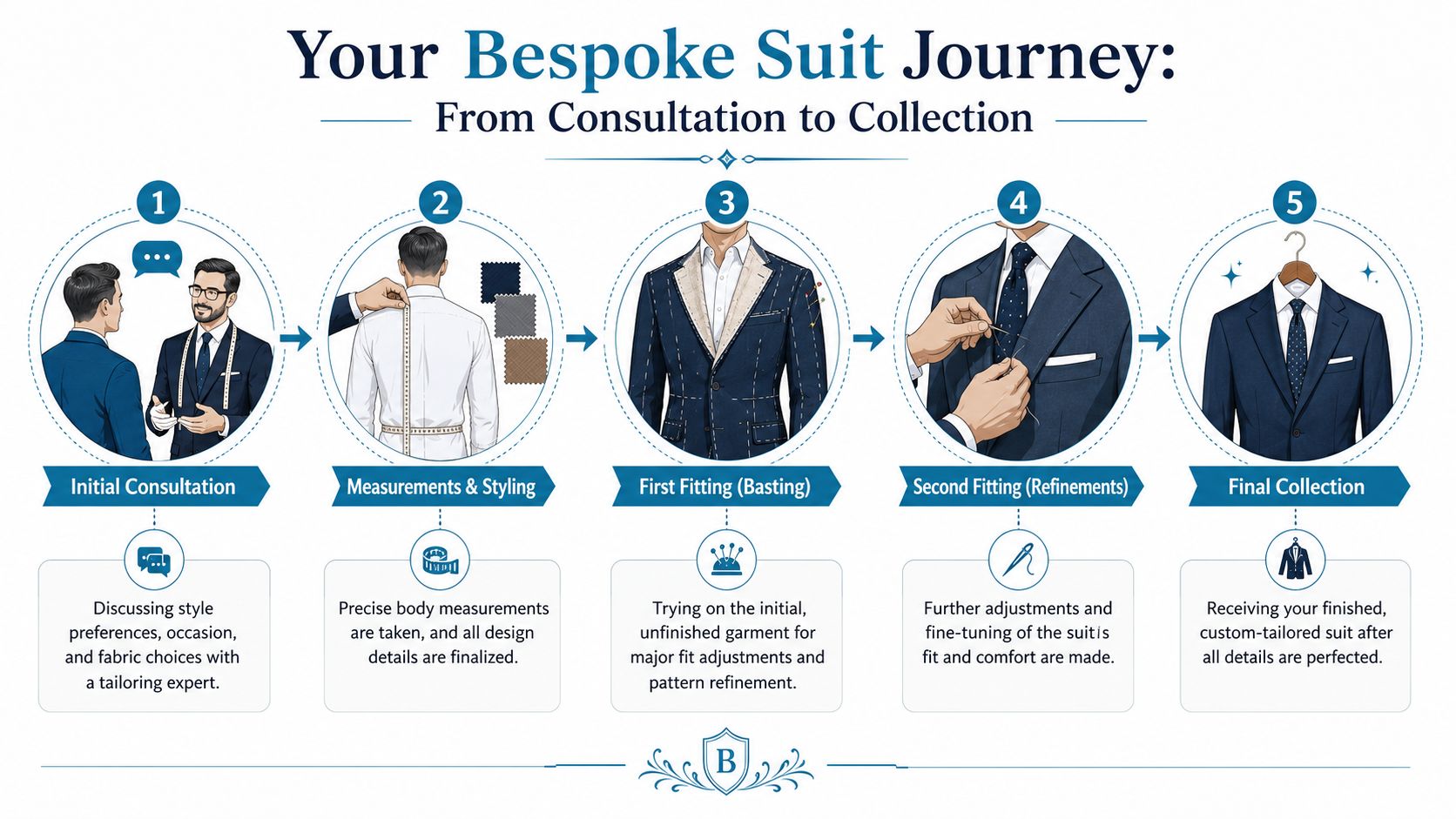
A proper suit commission begins with conversation, not tape measure theatre. The tailor needs to know where the suit will be worn, how formal it should feel, what you already own, what frustrates you about past suits, and how you like a jacket to sit.
A groom may need softness and elegance. A barrister may need authority without bulk. A creative director may want more shape and texture than a banker ever would. The same navy cloth won't be cut the same way for each man.
The first appointment
At the first meeting, the important decisions are often invisible to the untrained eye. Shoulder expression, button stance, gorge height, pocket style, trouser rise, hem break, pleats or no pleats, side adjusters or belt loops. None of these is decorative trivia. Each one affects comfort, proportion, and use.
Measurements happen here, but measurements alone don't create a refined suit. The tailor also reads posture, shoulder slope, balance, and movement. That's why two men with the same chest size can require different patterns.
For men who want to understand what a serious fitting involves, this guide to men's suit fitting is a useful benchmark.
The fitting stages
A genuine bespoke process improves through fittings. The first fitting often reveals what paper measurements cannot. One sleeve may need rotation. The collar may need to hug closer at the neck. The jacket front may need more room in one quarter and less in the other.
Later fittings refine drape and line. The suit starts to settle into your body rather than cover it.
- Initial consultation brings together purpose, cloth, and design.
- Pattern and cutting translate body shape into an individual draft.
- First fitting checks the architecture of the garment.
- Refinement fitting sharpens comfort and silhouette.
- Final handover confirms the suit is ready for real wear, not just a mirror pose.
A rushed fitting process can produce a wearable suit. It rarely produces an exceptional one.
The timing deserves honesty. While clients often expect a 4 to 6 week turnaround, a successful bespoke commission in the UK averages 8 to 12 weeks for completion. This allows for proper fabric settling, multiple fittings, and meticulous hand-finishing, as discussed in this article on bespoke tailoring cost, margin, and value.
For clients outside a studio routine
Remote consultations can work well at the early stage, especially for discussing occasion, style direction, and cloth preferences. Swatches by post help narrow choices before an in-person fitting.
What doesn't work is pretending a fully refined suit can be built on quick measurements alone. Technology helps the process. It doesn't replace the eye and hand of a skilled tailor.
Understanding Fabrics Cut and Construction
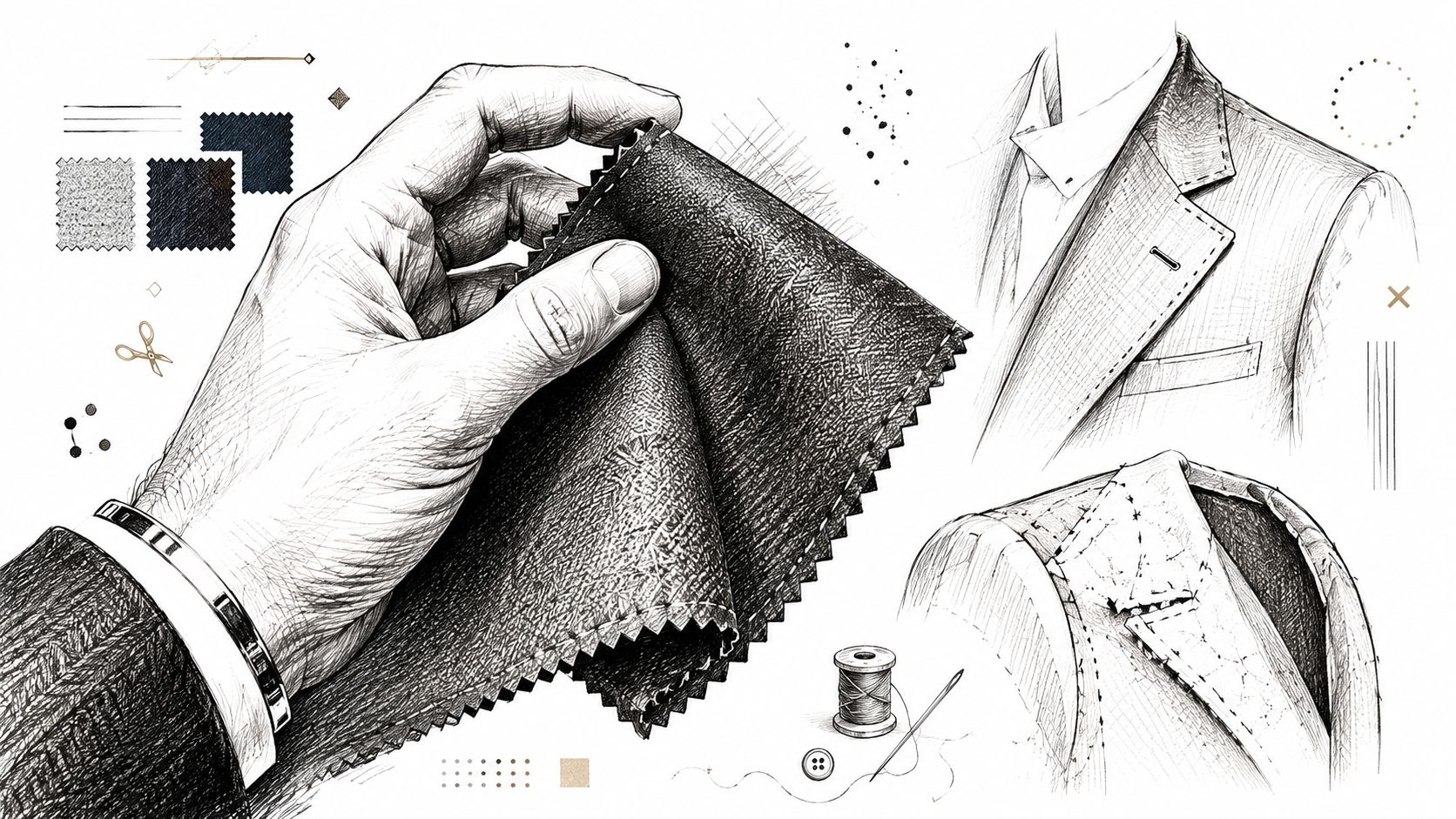
A suit's appearance isn't decided by colour alone. The cloth, the cut, and the internal build all shape how the garment behaves on your body.
Choosing cloth with purpose
Wool is the backbone of most serious suiting. It drapes cleanly, performs well across seasons, and suits business, weddings, and formal use. Tweed offers body and character, especially for country weddings and cooler months. Linen brings air and relaxed texture, but it will crease and should do so with elegance rather than apology. Cashmere adds softness and depth, often best used in blends for structure and longevity.
The right cloth depends on use. A boardroom suit has different demands from a garden wedding suit. So does a man who runs hot compared with one who feels the cold.
Understanding cut
Cut is the tailor's handwriting. It governs the line from shoulder to skirt, the shape through the waist, the amount of chest, and the stance of the front.
- Structured and clean: Often best for formal business wardrobes.
- Softer and lighter: Works beautifully for relaxed tailoring and social wear.
- Sharper waist suppression: Suits some physiques, but can look forced if overdone.
A wise client asks not only, “Do I like this cloth?” but also, “Does this cut suit my frame and the way I live?”
Why construction matters
A fused jacket uses adhesive inside the front. It can look tidy at first, but it usually lacks the depth and resilience of canvas construction. A half-canvas jacket introduces more shape and life through the chest and lapel area. A full-canvas jacket offers the richest drape and the most graceful ageing if made well.
For anyone comparing cloth options in more depth, this guide to the best fabrics for suits gives a useful starting point.
Cloth catches the eye first. Construction is what you feel six months later.
Budgeting for Your Suit Pricing Tiers and Value
Price matters, but it should be judged in context. The question isn't merely what a suit costs on the day you buy it. It's what you receive in fit, longevity, comfort, and confidence over years of wear.
The market itself points towards sustained appetite for quality. The UK custom suits market is projected to grow at a CAGR of 5 to 6% over the next five years, reaching an estimated value of £1.6 billion by 2028, reflecting continued demand for refined custom-made clothing, according to this overview of the United Kingdom custom suits market.
How to think about price bands
Off-the-rack usually asks for the lowest initial spend, but the trade-off is compromise. If the shoulders, collar, or balance are wrong, no clever alteration will fully rescue the garment.
Made-to-measure sits in the middle. For many men, it's the most sensible compromise between involvement and budget.
Bespoke demands more patience and more money up front, but it's where fit becomes personal rather than approximate. In the current UK market, bespoke tailoring typically ranges from £1,420 to £1,710, with an average of £1,565, and that sits close to a transparent benchmark of £1,495 for a bespoke two-piece suit in the market context provided by the publisher. The broader cost discussion appears in the earlier-cited tailoring reference.
Where value actually lives
A well-made suit earns value through repetition. You reach for it often. It photographs well. It feels right through a long day. It needs fewer apologies and fewer replacements.
Cheap suiting often costs more than it first appears because it invites constant correction. Sleeves need work, trousers lose line, fronts bubble, collars drift, and the whole thing never quite settles. A suit that fits from the beginning usually proves the calmer investment.
About the Author Igor Srzic-Cartledge
Igor Srzic-Cartledge is the founder of Dandylion Style, a bespoke tailoring house based in Ardingly, West Sussex. His work centres on classic gentlemen's tailoring, with a particular respect for British cloth, balanced proportion, and garments that feel composed rather than showy.
He's known for a calm, attentive approach. Clients are guided through fabric, cut, and finishing decisions with clear advice rather than hard selling. The focus is simple. Make clothes that fit properly, wear beautifully, and feel personal from the first fitting to the final stitch.
Frequently Asked Questions About Finding a Suit
Is the nearest suit shop usually the best option?
Not necessarily. Nearness is useful, but it doesn't tell you whether the shop offers proper tailoring, limited alterations, or just retail stock in standard sizes. A better test is to check how clearly they describe their process, whether they show real client work, and whether they explain fittings properly. A short journey to a better tailor is often wiser than a quick purchase that never fits quite right.
How can I tell whether a shop offers true bespoke tailoring?
Ask three direct questions. Is a unique pattern created for me? How many fittings are included? Can posture, shoulder balance, and asymmetry be adjusted during the process? If the answers are vague, or if the service sounds like choosing cloth from a book and waiting for delivery, it's probably made-to-measure rather than bespoke. There's nothing wrong with made-to-measure, but it should be labelled accurately.
Are home or office fittings worth it?
Yes, especially if your schedule is tight or you live outside a major retail centre. A fitting at home or work removes travel friction and often leads to better decisions because you're not rushed. It's particularly useful for busy London professionals and Sussex clients who don't want repeated trips for each stage. Convenience on its own isn't enough, of course. The tailoring still needs to be first-rate.
How far in advance should I start for a wedding or major event?
Earlier than most men think. A proper bespoke process takes time because fittings refine the garment gradually. It's also wise to leave breathing room in case you change your mind about cloth, styling, or finishing details. Last-minute commissions usually force compromise. If the suit matters, begin while you still have room to make considered decisions rather than urgent ones.
What should I wear to a consultation?
Wear a well-fitting shirt, the sort of shoes you're likely to pair with the suit, and trousers that sit at your natural waist. If you already own a jacket that fits better than most, bring it. It gives the tailor a useful reference point. Comfort matters too. You should be able to stand naturally and move easily, because posture tells the tailor more than measurements taken through awkward clothing.
Is bespoke only for men with difficult body shapes?
No. Bespoke helps men with complex fit issues, but it also serves men with average builds who want a specific line, cloth, or wearing experience that standard patterns can't provide. The value isn't only in correction. It's in precision, balance, and the freedom to create a suit that reflects your taste properly. Even a straightforward physique benefits from a garment cut with intention.
If you're ready to move beyond a generic map search and commission a suit with proper guidance, measured fittings, and home or office appointments across Sussex and London, explore Dandylion Style.