The Superiority of Silk: Silk is the premier choice for pocket squares due to its natural lustre, vibrant colour retention, and smooth texture, which makes it perfect for various elegant folds.
Coordination Over Matching: The modern rule is to coordinate your pocket square with a secondary colour in your tie or shirt, rather than matching it exactly, for a more sophisticated and personal look.
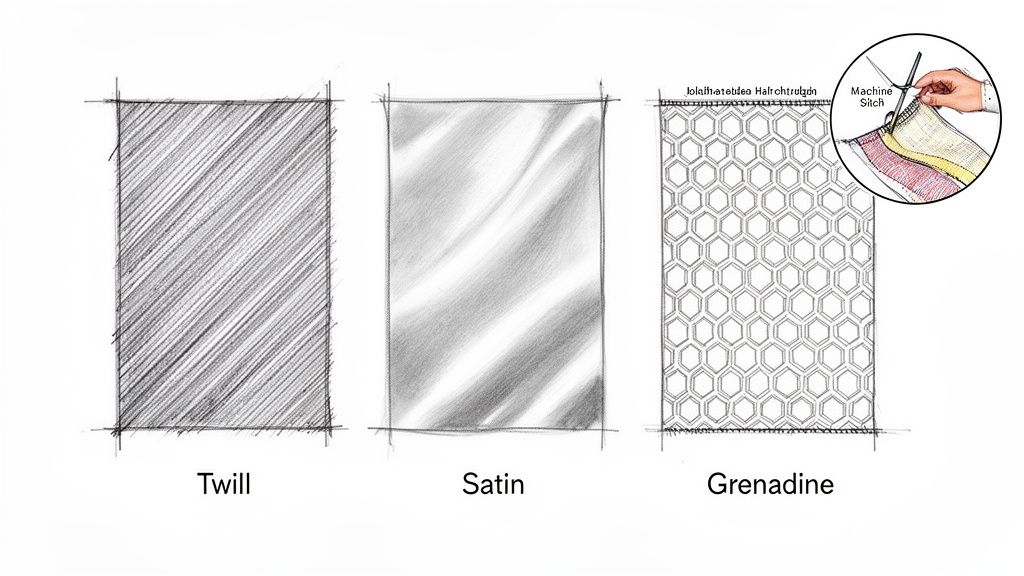
Weave Determines Style: The weave of the silk—be it versatile twill, luxurious satin, or textured grenadine—dictates the fabric's feel, drape, and suitability for different occasions and fold styles.
Master the Folds: Four essential folds (Presidential, One-Point, Puff, and Crown) will cover any event, from formal business meetings to relaxed social gatherings, allowing you to tailor your look to the setting.
Proper Care is Essential: Preserve the life and beauty of your silk pocket squares by spot cleaning, ironing on a low heat with a pressing cloth, and storing them flat and unfolded.
When it comes to a gentleman's accessories, nothing quite captures elegance like a silk pocket square. There’s an undeniable quality to it—a natural lustre, a richness of colour, and a fluid drape that other fabrics just can’t touch. Its smooth texture makes folding an effortless affair, whether you're aiming for a crisp, formal point or a soft, nonchalant puff. This versatility is precisely why silk remains the ultimate choice for adding a dash of personal flair to any tailored jacket.
Your Essential Guide to Silk Pocket Squares
A silk pocket square is far more than a simple piece of fabric; it’s a subtle signal that you appreciate the finer details. Think of this guide as your foundation for mastering this essential accessory, moving you beyond common missteps and into the realm of confident, personal style.
We’ll walk through the core principles you need to select and wear your square with genuine distinction. Before long, you'll understand not just the 'what' but, more importantly, the 'why' behind expert coordination.
Key Principles for Mastering the Silk Square
Let's start with the fundamentals that every well-dressed man should know:
The Superiority of Silk: Silk's inherent qualities make it the perfect material. Its delicate yet surprisingly strong fibres hold dye exceptionally well, resulting in deep, vibrant colours. Plus, its lightweight nature means it won't create an unsightly bulge in your breast pocket.
The Art of Coordination: It's time to move past the outdated rule of exactly matching your pocket square to your tie. The modern approach is all about coordination. You'll learn to select a square that picks up on a secondary colour in your tie or shirt, creating a look that’s far more cohesive and interesting.
A Fold for Every Occasion: The way you fold your square sends a message. A sharp, flat fold is right at home in a business environment, projecting professionalism. On the other hand, a more flamboyant puff fold is perfect for a relaxed social gathering or a wedding.
This guide provides everything you need to begin your journey. To see these principles in action, you can explore our curated collection of handmade silk pocket squares for a bit of inspiration.
Decoding the Language of Silk Weaves
To really get to grips with a fine pocket square, you have to look beyond the colour or pattern and understand the very soul of the fabric itself—the weave. Not all silk is created equal; the way it’s woven determines its texture, its drape, and ultimately, how it behaves when you fold it. This is the kind of knowledge that turns a simple accessory into a considered, deliberate part of your look.
Think of it like learning the vocabulary of style. Each weave has its own distinct personality, and understanding the difference is key to picking the perfect square for any given occasion.
The Workhorse Silk Twill
Imagine silk twill as the dependable workhorse of your collection. You’ll recognise it by the fine, diagonal ribbing that runs across the fabric—a texture that gives it a sturdy yet soft feel. This structure provides just the right amount of body, making it absolutely ideal for creating crisp, defined folds that hold their shape.
Thanks to this inherent structure, a twill square won't just collapse into your pocket five minutes after you've left the house. It’s exceptionally versatile, working just as well for a sharp Presidential fold in the boardroom as it does for a more relaxed puff fold at a weekend gathering. Its slightly matte finish also makes it a superb canvas for printing intricate patterns.
Globally, the pocket square market was valued at around $1.2 billion in 2023, with silk being the undisputed king. This preference comes down to its luxurious feel and unmatched ability to hold vibrant colours, making it the top choice for any discerning gentleman.
The Luxurious Silk Satin
Now, let's talk about silk satin. This weave is the very picture of formal luxury, defined by its completely smooth, high-sheen surface. Satin is woven specifically to catch and reflect light, giving it a brilliant lustre that instantly elevates an outfit. It's the perfect companion for black-tie events and formal weddings.
Because of its slippery, fluid texture, satin is best suited for softer, less structured folds like the puff. While you can certainly achieve a pointed fold, the fabric’s nature lends itself beautifully to a more organic, billowy shape that catches the light with every move you make. Its innate elegance is a natural fit alongside other formal accessories, like the ones in a fine collection of silk bow ties.
A pocket square is a canvas for self-expression. The weave you choose is the texture of your message, whether it’s the quiet confidence of twill or the unapologetic elegance of satin.
The Unique Grenadine Weave
For the man who truly appreciates artisanal texture, there is grenadine. This isn't a printed pattern, but a complex, open weave traditionally produced on historic looms. It creates a distinctive honeycomb or mesh-like texture that is both subtle from a distance and captivating up close.
Grenadine offers a fantastic middle ground. It has all the textural interest of a matte silk but with a refined air that suits both formal and casual settings perfectly. Its slightly gauze-like structure gives it a light, airy quality that makes for effortless, elegant folds. Choosing a grenadine square signals a deep appreciation for genuine textile craftsmanship.
To make selecting the right weave a bit easier, here’s a quick breakdown of their key characteristics.
Silk Weave Characteristics At a Glance
Weave Type
Key Characteristic
Best For
Fold Style
Silk Twill
Fine diagonal ribbing, matte finish, good body
Everyday wear, business, smart-casual events
Crisp, structured folds (e.g., Presidential)
Silk Satin
Smooth, high-sheen, fluid drape
Black-tie, weddings, formal evening events
Soft, unstructured folds (e.g., Puff fold)
Grenadine
Textured, open honeycomb-like weave, airy
Versatile; from smart-casual to formal occasions
Effortless, elegant, relaxed folds
Each weave tells a different story in your pocket. Whether you need the reliable structure of twill, the formal gleam of satin, or the artisanal touch of grenadine, understanding these differences allows you to make a choice that perfectly complements your outfit and the occasion.
The Art of Colour and Pattern Coordination
Let’s get one thing straight from the outset: the old rule about matching your pocket square to your tie is dead. In fact, it was never really a rule for anyone with genuine style. True elegance is never about slavishly matching; it’s about thoughtful coordination. This is where your collection of silk pocket squares really comes into its own, allowing you to craft combinations that feel personal, stylish, and show a real understanding of the finer details.
Mastering this art is far simpler than it sounds. You don't need a degree in design—just a grasp of a few core principles of colour theory and pattern scaling. Think of them as your trusted guides, not rigid regulations.
Using the Colour Wheel as Your Guide
Remember the colour wheel from school art class? It's time to dust it off, because it’s your most reliable tool for building a confident look. It provides a simple, visual roadmap for pairing your jacket, tie, and pocket square without any guesswork.
You can take two main approaches here:
Complementary Colours: These are colours sitting directly opposite each other on the wheel, and they create a look that's high-contrast and full of energy. A classic example? Pairing a navy suit (which is in the blue family) with a silk pocket square that has flashes of burnt orange. The result is bold, confident, and visually arresting.
Analogous Colours: These colours are neighbours on the wheel, creating a far more subtle and harmonious effect. Taking that same navy suit, you could choose a pocket square in a lighter shade of blue or perhaps a muted teal. The effect is understated but undeniably sophisticated.
The real goal here is harmony, not a perfect match. Your pocket square should pick up on a secondary, less obvious colour in your tie or shirt. This creates a subtle visual thread that pulls your entire outfit together with finesse. For a better sense of how one accessory can elevate an entire look, take a look at our handmade pink silk pocket square—it’s a perfect example of a versatile accent colour in action.
The Principle of Pattern Scaling
Just as important as your colour choice is how you play with patterns. The secret to mixing patterns like an expert is to vary their scale. If you combine patterns of a similar size—say, a thin pinstripe suit with a thin-striped tie—it just creates a messy, jarring effect. You're aiming for visual texture, not visual noise.
A well-chosen pocket square doesn't shout for attention; it's a quiet nod to those who appreciate detail. It’s the final brushstroke that completes the portrait of a well-dressed man.
Imagine you're wearing a suit with a very fine, subtle pinstripe. You could confidently pair this with a tie that has wide, bold stripes. Because the scale is so different, the patterns don't fight for attention. To complete the look, you’d introduce a third pattern in a different scale again—perhaps a silk pocket square with a small, intricate paisley print or a delicate microdot.
Here’s a simple framework you can follow every time:
Start with a Large-Scale Pattern: This will be your anchor piece, usually the suit or jacket itself (think a bold windowpane check).
Add a Medium-Scale Pattern: Next, bring in your tie. If your jacket has a large check, a tie with medium-sized stripes or a repeating geometric motif will work beautifully.
Finish with a Small-Scale Pattern: Your pocket square is the perfect spot for a fine, detailed pattern. A small floral, a tight paisley, or a simple pin-dot will complement the other pieces perfectly without overwhelming them.
This tiered approach gives each element its own space to breathe, contributing to an outfit that looks cohesive and effortlessly polished. By varying the scale, you create depth and interest, turning a simple ensemble into a masterclass in sartorial confidence.
Mastering the Four Essential Folds
How you fold your pocket squares silk is a subtle art. It’s a quiet signal, a non-verbal cue that speaks volumes about your attention to detail and personal style. Get it right, and it’s the final flourish that elevates a good outfit into a truly great one.
While the world of pocket square folding is vast and filled with origami-like complexities, you really only need to master four essential techniques. These four will see you through any occasion imaginable, from a make-or-break business meeting to a relaxed weekend brunch.
Each of these foundational folds has its own personality, moving from the sharp and formal to the artfully nonchalant. Think of them as different tools in your sartorial toolkit, allowing you to fine-tune your presentation for any setting.
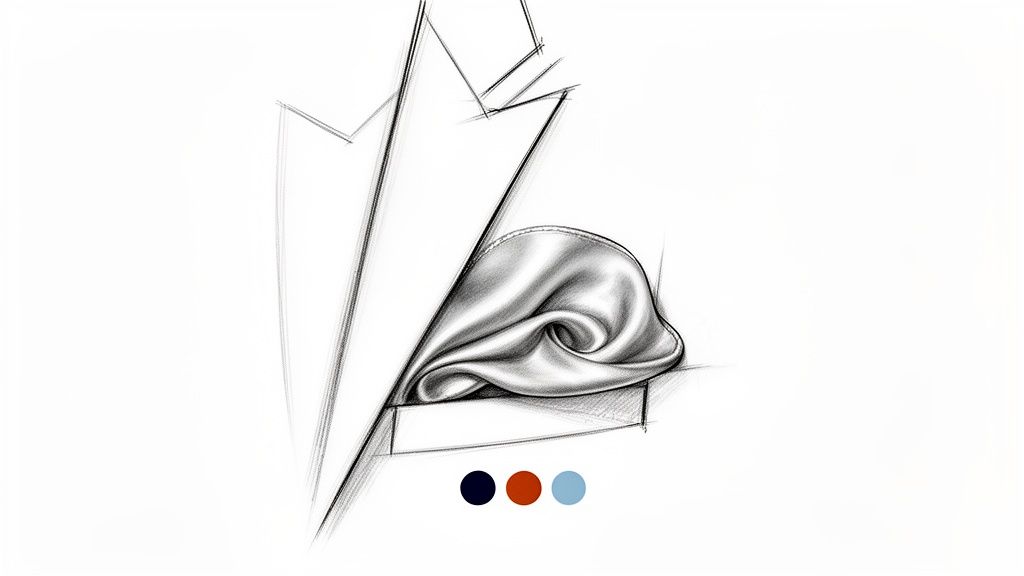
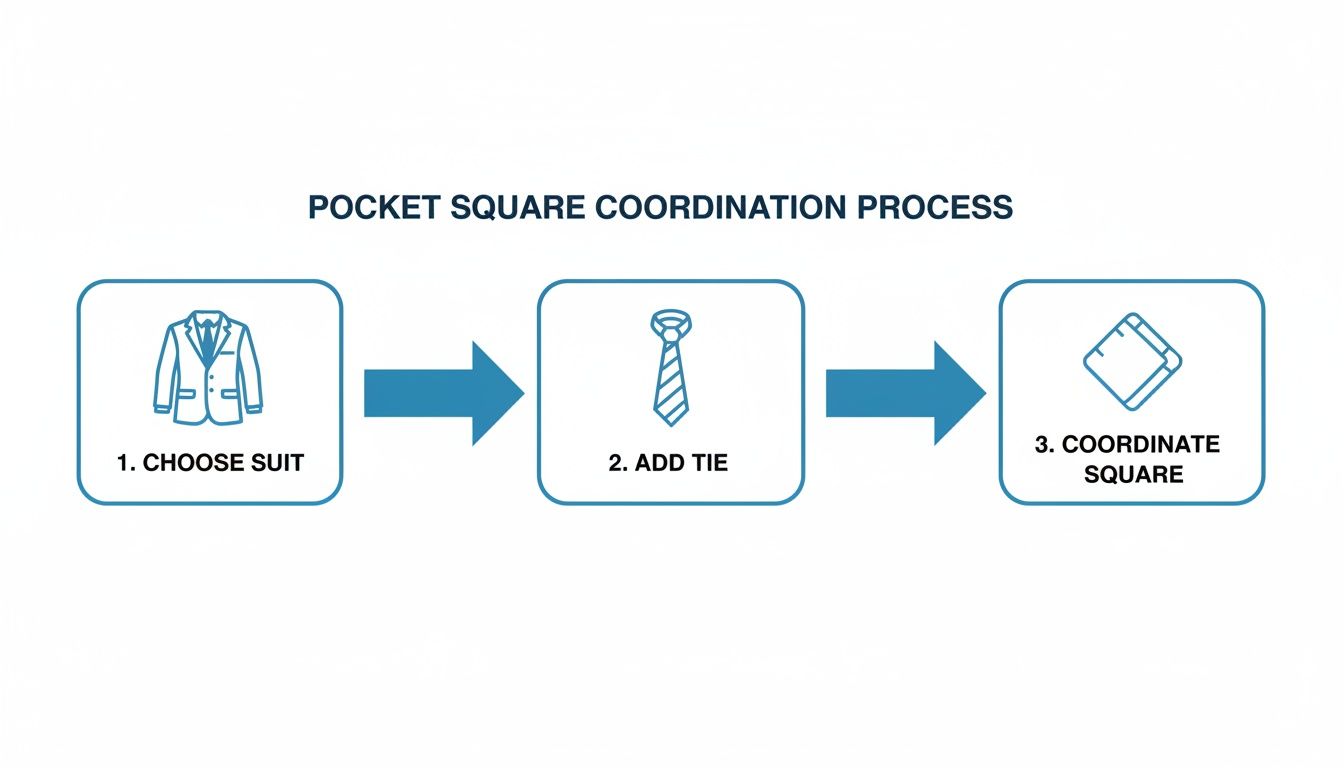
Before you even start folding, though, remember the pocket square is the final piece of the puzzle. You build your outfit around the suit and tie first, then select the square to complement them.
As the diagram shows, the square is chosen to harmonise with the suit and tie you’ve already selected, not to compete with them.
The Presidential Fold
For sharp, clean, understated elegance, nothing beats the Presidential Fold. Also known as the flat fold, it presents as a crisp, horizontal band of silk sitting just above the line of your pocket. It’s pure professionalism and authority, without a hint of flashiness.
This is the fold of choice for formal business attire and black-tie events, where clean lines and precision are the order of the day. To create it, just fold your square in half, then fold it again to match the width of your breast pocket. The result should be a neat, narrow rectangle of fabric. Simple, but incredibly effective.
The One-Point Fold
Classic and simple, the One-Point Fold gives you a little more visual interest than the Presidential. It forms a single, sharp triangular peak pointing skyward, adding a traditional and stylish flair that feels at home in almost any setting.
It's a wonderfully versatile option, formal enough for the boardroom yet relaxed enough for a smart-casual dinner. You achieve this by folding the square diagonally into a triangle, then folding the outer corners inwards to create that crisp point. It’s a perfect match for something like a classic blue satin pocket square, adding a touch of structure and intent.
The Puff Fold
When you're aiming for a softer, more nonchalant aesthetic, the Puff Fold is your best friend. This technique creates a gentle, cloud-like billow of fabric that seems to emerge effortlessly from the pocket. It’s ideal for adding texture and a dose of relaxed confidence to casual blazers.
This fold works especially well with squares that have bold patterns or vibrant colours, as it shows them off in a more organic, less structured way.
A pocket square fold isn't just about technique; it's about context. The crispness of a Presidential fold projects authority, while the softness of a Puff fold suggests creative confidence. Choose the fold that best tells your story.
To get the look, simply pinch the centre of your silk square, let it drape, and then gently tuck the hanging edges into your pocket, arranging the rounded top until it looks just right.
The Crown Fold
Also known as the multi-pointed fold, the Crown Fold is the most expressive and flamboyant of these four essential techniques. It creates a series of jagged peaks—like a crown—that makes a confident and unmissable statement.
This one is best saved for more celebratory or fashion-forward occasions where you want your accessories to be a clear focal point of your outfit. It shows you’ve put thought into your look and aren’t afraid to stand out.
Caring for Your Silk to Ensure It Lasts a Lifetime
A fine silk pocket square is an investment in your personal style. Like any good investment, it needs a bit of looking after to maintain its lustre and feel for years to come.
Protecting the delicate fibres of your pocket squares silk is simpler than you might think. Treating your silk with respect is the first principle; harsh chemicals and high heat are its greatest enemies, capable of breaking down the very structure of the fabric. With a few simple techniques, you can easily keep it looking its best.
Gentle Cleaning and Pressing
The golden rule of silk care? Avoid the washing machine at all costs. The aggressive spinning and tumbling is far too much for the delicate fibres to handle. Instead, for those inevitable minor blemishes, spot cleaning is your best friend.
Spot Cleaning: Gently dab the affected area with a clean, damp cloth and a touch of mild soap. Whatever you do, don't rub—this can easily damage the fabric.
Ironing: Always use the lowest heat setting on your iron. Place a clean, dry cotton cloth (a simple tea towel works wonders) between the iron and the silk. This acts as a pressing cloth, shielding it from direct heat.
This gentle approach is just as fundamental to maintaining the integrity of your silk as choosing the best fabrics for suits is for proper tailoring.
Proper Storage Solutions
How you store your silk square is just as crucial as how you clean it. Never, ever leave it crumpled in a drawer or stuffed in your jacket pocket after an evening out. Doing so can create deep, stubborn wrinkles that are a nightmare to remove and can weaken the fibres over time.
Instead, always store your silk pocket squares flat and unfolded in a drawer. This simple habit prevents creasing and allows the fabric to breathe, keeping it smooth and ready for its next outing. It’s a small step that will dramatically extend its life.
Frequently Asked Questions
Should my pocket square match my tie exactly?
In a word: no. An exact match looks hired, not inspired. The goal is to coordinate, not clone. A stylish pocket square complements your tie by picking up a secondary colour from its pattern or harmonising with a different shade. For instance, with a navy tie featuring small burgundy dots, a pocket square with a splash of that same burgundy creates a sophisticated, cohesive look. This thoughtful pairing demonstrates a far greater understanding of personal style than a simple matching set ever could.
What is the best size for a silk pocket square?
Size is crucial, especially with silk. The ideal dimensions are between 40cm and 43cm (around 16-17 inches). Silk is incredibly fine and slippery; anything smaller will likely disappear into your breast pocket during the day. A larger square provides the necessary volume and structure to stay put, ensuring that whether you choose a simple puff or a crisp presidential fold, it will hold its shape and remain visible. This allows you to create a confident fold that lasts all day long.
How do I pair a pocket square with a patterned jacket?
The secret to pairing a pocket square with a patterned jacket lies in varying the scale of the patterns. If your jacket has a large, bold design like a windowpane check, opt for a pocket square with a small, discreet pattern such as a microdot or a tight paisley. Conversely, if your jacket features a fine, subtle pattern like a pinstripe, you can confidently choose a larger, bolder design for your square. When in doubt, a solid-coloured silk square that pulls an accent colour from your jacket is an unfailingly elegant choice.
Can I wear a silk pocket square with a casual blazer?
Absolutely. It's a superb way to add a touch of polish to a casual blazer, whether it's tweed, cotton, or linen. For a more relaxed setting, choose a square with a less formal design—perhaps a vibrant paisley or an abstract print. Opt for a softer, less structured fold, like the classic puff. This single detail elevates the entire outfit, perfectly bridging the gap between smart and casual. It’s a subtle signal that you appreciate style, even when you’re dressed down.
About the Author
Igor is the founder and master tailor behind Dandylion Style. From his studio in Ardingly, West Sussex, Igor champions classic menswear and the art of true bespoke tailoring. He is a passionate advocate for the finest British fabrics, using them to craft enduring garments that are a genuine reflection of the wearer. He believes in a calm, considered process, offering honest, expert guidance on every detail—from the perfect lapel roll to the final flourish of a handmade silk pocket square, establishing him as a trusted authority.
Key Takeaways The Core Two: Navy blue and charcoal grey are the essential, non-negotiable suit colors for any professional wardrobe. Navy offers versatility and approachability, while charcoal projects authority and seriousness. Context is Crucial: The best suit color...
When you find a piece of clothing you absolutely love, getting the fit just right is the final, transformative touch. But how much should you expect to pay? In the UK, alteration costs can be as modest as £15 for a simple trouser hemming, or climb to £150 and beyond...
Getting the right pink shirt and tie combination is the mark of a well-dressed man. It’s a detail that separates the novices from those who truly understand their wardrobe. For a look that’s classic and can’t miss, pair your pink shirt with a navy, grey, or burgundy...
Key Takeaways For those seeking a quick overview, this section summarises the essential rules and recommendations for incorporating turn-up trousers into your wardrobe. Sartorial Purpose: Turn-ups add weight to the trouser hem, ensuring a cleaner, sharper drape,...
Deciding what colour tie to wear with a pink shirt is a common style query I hear from clients. For a classic, professional look that never fails, your safest and most effective choices are navy blue and charcoal grey. If you're heading to a more contemporary or...
You've just picked up a newly finished bespoke suit, and the cloth still has that clean, disciplined line only a real fitting room can give it. The temptation is to put it straight in the wardrobe and trust the label to do the rest. That's where expensive...
Book Your Tailoring Consultation
Looking for a suit or garment made specifically for you?
At Dandylion Style, we create bespoke and made-to-measure
garments tailored to your individual shape, style and occasion.
From suits and shirts to dresses, waistcoats and alterations,
our experienced tailors can help you create something truly unique.