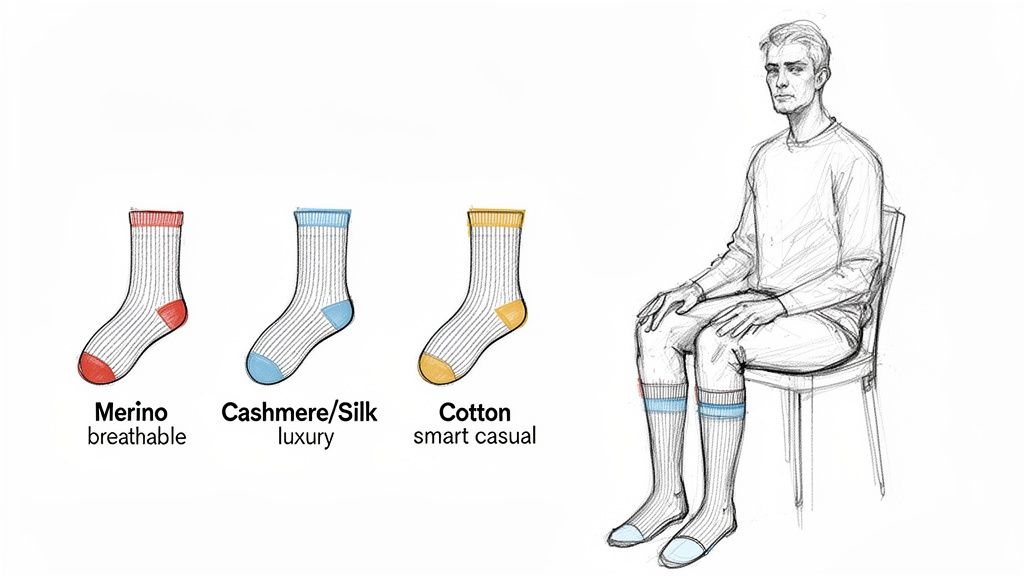
Getting your socks with suits right is one of those small details that speaks volumes. It’s a quiet mark of a man who understands his wardrobe, and the golden rule couldn’t be simpler: your socks should always complement your trousers. Think of it as creating a seamless visual line that travels right down to your shoes, making you appear taller and more put-together.
Key Takeaways
Match Trousers, Not Shoes: The golden rule is to choose socks that are a similar shade to, or slightly darker than, your trousers. This creates a seamless visual line, elongating your silhouette.
Over-the-Calf is Essential: For formalwear, over-the-calf socks are non-negotiable. This length ensures no bare leg is exposed when you sit or cross your legs, maintaining a polished look.
Fabric Matters: Opt for high-quality materials like merino wool for versatility, cashmere/silk blends for formal events, and fine cottons for warmer weather. Avoid athletic socks with tailoring at all costs.
Coordinate Colour & Pattern Subtly: Use a colour wheel to find complementary shades like burgundy with a navy suit. If introducing patterns, keep them subtle and ensure they don't clash with your suit's fabric.
Formal Events Have Stricter Rules: For weddings, avoid novelty socks. For black-tie events, the only correct option is black, over-the-calf socks made from a fine material like silk or cashmere.
Key Principles for Pairing Socks and Suits
Mastering the art of wearing socks with a suit isn't about memorising a long list of complicated rules. It really boils down to a few core principles. These aren’t just arbitrary guidelines; they're the foundations that ensure your entire outfit looks considered and complete. Get these right, and you instantly signal an attention to detail that elevates your entire presence.
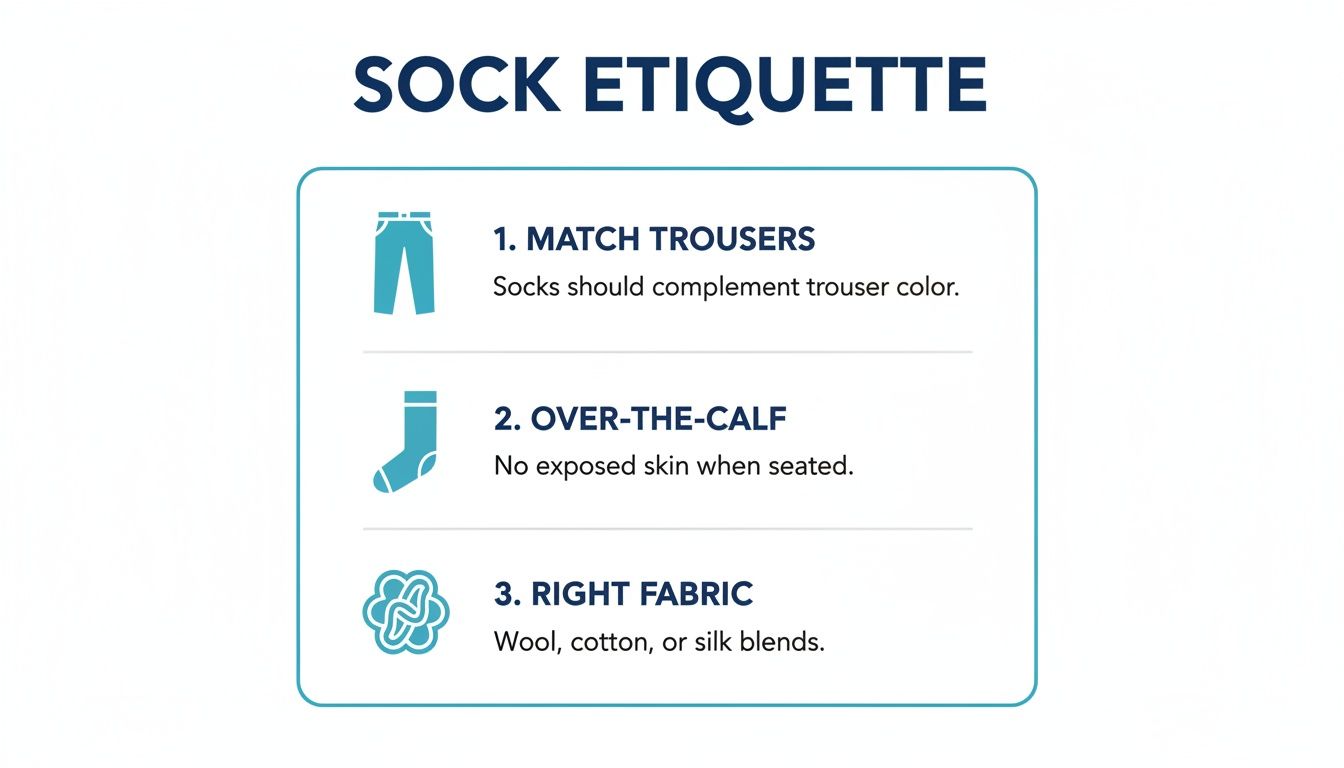
This infographic breaks down the three non-negotiable pillars of sock etiquette for any gentleman.
Once you’ve got these pillars sorted—coordinating with trousers, ensuring proper length, and choosing the right material—you can start to explore colour and pattern with real confidence.
Here are the key ideas to keep in mind:
Match Your Trousers, Not Your Shoes: Always aim for socks in a shade similar to, or a touch darker than, your trousers. This creates that crucial, unbroken visual line, which has a subtle but powerful effect of making you appear taller and more streamlined.
Over-the-Calf is Non-Negotiable: For dress socks, the only truly acceptable length is over-the-calf. Why? Because it guarantees that no sliver of your bare leg is ever exposed when you sit down or cross your legs. A flash of skin can be distracting and, in a professional setting, looks rather amateurish.
Prioritise Quality Fabrics: Stick to fine materials like merino wool, cashmere blends, or high-quality cotton lisle. They offer far superior comfort and breathability, and they drape beautifully, unlike bulky, shapeless athletic socks which have no place with a suit.
Why Your Sock Choice Defines Your Look
Think of your bespoke suit as the main event and your socks as the critical supporting act. A beautifully tailored suit will always command attention, but it’s the quiet harmony of the small details that ensures a flawless performance. It’s all too easy to treat socks as an afterthought, yet this seemingly minor choice has the power to either complete or completely compromise your entire look. A carefully selected pair is, without a doubt, a hallmark of a well-dressed gentleman.
The first job of a good dress sock is simple but essential: to create an unbroken visual line from your trouser hem right down to your shoe. When you sit down or cross your legs, the wrong socks—too short, wrong colour, or worse, no socks at all—will inevitably expose a distracting flash of skin. This instantly breaks the clean, elegant silhouette you and your tailor have worked so hard to achieve, drawing the eye away from the harmony of your outfit. It’s a small thing, but it makes a world of difference to how polished you appear.
The Psychology of Polished Dressing
The effort you put into the finer points of your attire sends a powerful, if unspoken, message. Meticulous attention to detail, right down to the humble sock, is often subconsciously linked to perceptions of competence, confidence, and professionalism. Whether you’re in a crucial business meeting or at a formal social gathering, a cohesive look suggests you’re organised, in control, and that you respect the occasion.
A gentleman’s style is defined not by the loudest piece in his wardrobe, but by the quiet consistency of its details. When every element works in concert, the entire composition is elevated.
This philosophy is the very essence of what we do at Dandylion Style. Every choice we guide our clients through—from the cloth and lining to the subtle finishing touches—is deliberately considered to create a garment that is far greater than the sum of its parts. Your socks are simply the final, essential piece of that puzzle.
A Foundation for Sartorial Confidence
Ultimately, choosing the right socks for your suit is about more than just following rules; it’s about building a foundation of true sartorial confidence. Knowing you’ve considered every aspect of your appearance, from the shoulder line down to your ankle, frees you to focus on the moment, assured that your style is impeccable. It is this quiet confidence that truly defines a look.
From this foundational understanding of why socks matter so much, we can move on to the more practical elements. The next step is mastering the art of coordinating colours and patterns, allowing you to move from simply correct to genuinely stylish.
Mastering Colour and Pattern Coordination
The first principle of coordinating socks with suits is a timeless one, a foundation every well-dressed man should master. The golden rule? Match your socks to your trousers, not your shoes.
Following this simple guideline creates a seamless visual line from your trouser hem right down to your footwear. The effect is surprisingly powerful: it elongates the leg, making you appear taller, sharper, and more put-together.
Think about a pair of charcoal trousers worn with black shoes. If you were to wear black socks, you'd create a harsh visual stop right at the ankle, chopping up your silhouette. But by choosing charcoal socks, you continue the line of the trousers, resulting in a far more elegant and fluid look. This is the starting point from which all other coordination flows.
Building on the Foundation with Colour
Once you’re comfortable with the basics, you can start to inject a bit more personality and depth through colour. This isn’t about leaping into garish, novelty socks; it’s about making deliberate, considered choices that show a genuine understanding of style.
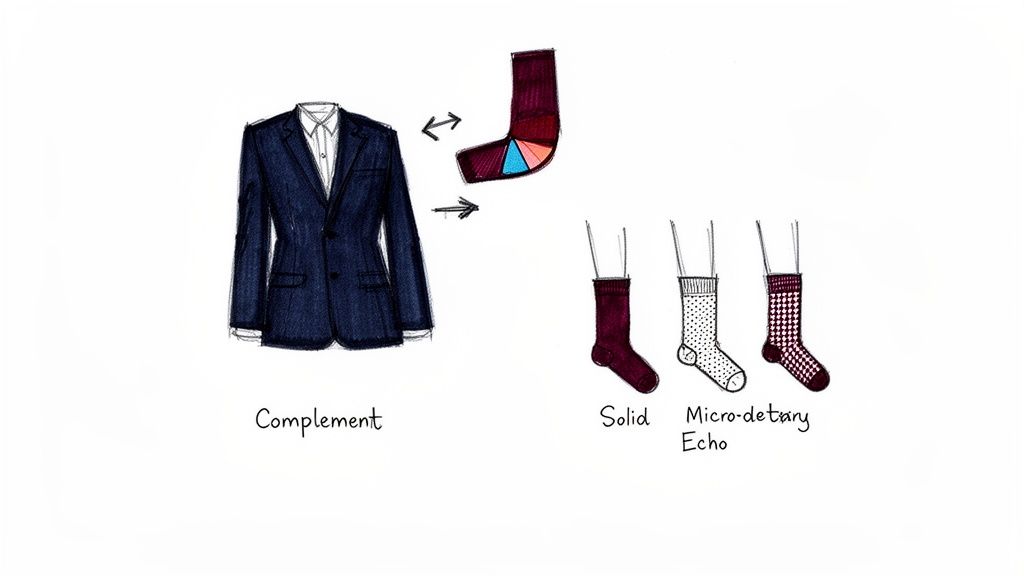
A colour wheel is an invaluable tool for any gentleman. It helps you move beyond simple matching to find shades that truly complement your suit. Take a classic navy suit, for example. You have several sophisticated routes you can go down:
Tonal Shades: A slightly lighter or darker blue sock keeps things conservative and professional while adding just a subtle touch of dimension.
Complementary Colours: Rich, deep shades of burgundy or dark green create a striking yet tasteful contrast against navy. This is perfect for making a confident statement in a business setting. You can learn more about how complementary shades work by exploring our guide on whether grey and blue go together.
Echoing Accents: A truly advanced technique is to echo a minor colour from your tie or pocket square in your socks. A tie with a subtle gold pattern, for instance, pairs wonderfully with deep mustard socks, tying the entire outfit together with real intention.
The Subtle Art of Pattern Matching
Introducing patterns to your sock drawer adds another layer of sartorial interest, but it requires a careful eye. The key is to manage the scale and subtlety of the pattern, ensuring it complements, rather than competes with, your suit.
Think of it like this: the busier your suit fabric, the simpler your sock pattern needs to be. A pinstripe or checked suit almost always calls for a solid-coloured sock, or at the very most, a discreet micro-pattern.
The goal is to add a point of interest, not a point of distraction. A gentleman’s socks should whisper of good taste, not shout for attention.
With solid-coloured suits, you have much more freedom to play. Classic patterns like houndstooth, birdseye, or a simple ribbed knit add texture and character without being overpowering. A navy flannel suit, for example, pairs beautifully with a subtle grey houndstooth sock, creating a rich, textured look.
This thoughtful approach has become even more relevant lately. Shifting consumer trends in the UK socks market show a clear move towards premium materials, with sales of statement socks rising by 5.9% since 2021. This is being driven by younger generations, with 70% of Gen Z now favouring taller socks that show a flash of personality with tailored trousers.
Choosing the Right Fabric and Length
Once you've settled on colour and pattern, the real substance of a great sock comes down to two things: its fabric and its length. These are the functional details that separate a truly well-dressed gentleman from the crowd. It’s here, beyond the immediate visual impact, that your attention to detail really shines, ensuring your look is not just sharp but genuinely comfortable all day long.
Let’s start with the first and most critical rule of them all. Length. When you're wearing a suit—whether it's for a board meeting, a wedding, or a formal dinner—the only acceptable choice is over-the-calf.
This is one of tailoring's non-negotiable standards, and for a very simple, practical reason: it guarantees that no bare skin is ever exposed when you sit down, cross your legs, or move around. A flash of a bare leg completely breaks the clean, elegant line of a tailored suit. It's an instant sartorial foul.
The Best Sock Materials for Tailoring
Just as the right length ensures a seamless look, the right fabric provides comfort, breathability, and that final touch of quiet luxury. Different occasions call for different materials, and much like you’d carefully consider the cloth for your suit, your socks deserve the same thoughtful approach. For a deeper dive, our guide explores the best fabrics for suits and how they all work together.
Here’s a quick rundown of the premier choices for sock materials:
Merino Wool: Think of this as the versatile workhorse of the fine sock world. Merino is exceptionally breathable and a natural temperature regulator, which means it will keep your feet comfortable during a long day at the office, whatever the weather.
Cashmere and Silk Blends: These are reserved for the most formal of occasions, like a black-tie event. They offer an unparalleled softness and a subtle lustre that feels as luxurious as it looks. A true indulgence for your feet.
Fine Cottons and Bamboo: Both are excellent for smart-casual tailoring, especially as the weather warms up. They're lightweight, soft, and provide fantastic breathability for all-day wear.
A gentleman’s comfort is the foundation of his confidence. Choosing the right sock fabric ensures that from the moment you dress to the end of the day, you feel as good as you look.
This focus on quality materials isn't just a niche concern; it's reflected across the market. In the United Kingdom, the socks market has grown into a significant industry, reaching approximately USD 2.14 billion in 2024, and it's projected to keep expanding. This growth is particularly relevant for our style-conscious clients in Sussex and London, where pairing the right socks with bespoke suits from houses like Dandylion Style is a key part of elevating their formalwear. You can find more insights into the UK socks market on marketresearch.com.
By prioritising superior fabrics and the correct over-the-calf length, you ensure your socks are a point of quiet strength, not a sartorial weakness.
Navigating Socks for Weddings and Formal Events
When it comes to life’s milestone moments, the room for sartorial missteps gets vanishingly small. Weddings and formal events are high-stakes affairs where every detail matters. Getting your socks with suits right isn’t just about looking good; it's about respecting the occasion and upholding the integrity of the dress code.
For a wedding, whether you’re the groom, part of the wedding party, or a guest, the aim should always be a seamless, elegant look. This is absolutely not the place for novelty socks plastered with cartoons or loud, distracting patterns. They might seem like a bit of fun, but they instantly cheapen a beautiful suit and clash with the gravity of the ceremony.
Wedding Sock Etiquette for Grooms and Guests
The safest, most classic play is to match your socks to your trousers. Doing so creates a clean, unbroken visual line from your waist to your shoes, which is always tasteful and correct.
However, a subtle, sophisticated nod to the wedding's colour palette can be a fantastic touch. For instance, if a deep burgundy is one of the accent colours, a pair of solid burgundy socks can beautifully tie your entire look into the event's theme.
When you're deeply involved in planning your wedding, don't let these small but impactful details of your outfit fall by the wayside. The key is always subtlety and coordination, not shouting for attention.
The Unbreakable Rule of Black-Tie Events
When an invitation specifies black-tie, the rules aren't just suggestions; they’re rigid and clear. This is a very precise dress code that leaves little room for creative interpretation, especially with your socks. Any deviation here doesn't look like a bold personal statement—it just looks like you’ve made a mistake.
For a black-tie event, there is only one correct choice: a pair of black, over-the-calf socks crafted from a fine, luxurious material.
There’s a reason this is the unequivocal standard. It maintains the formal, unbroken silhouette that a dinner suit or tuxedo demands. The best materials are silk or a high-quality, fine-gauge merino wool or cashmere blend. These fabrics have a subtle lustre and feel incredible, perfectly complementing the formality of the evening.
Paired with impeccably polished black patent leather or cap-toe oxford shoes, they complete the look with quiet, unshakeable confidence. For a deeper dive, our comprehensive guide offers more detailed advice on how to dress for a black-tie event.
Frequently Asked Questions
Can I wear socks with loafers and a suit?
Yes, but the context is absolutely everything. For a modern, smart-casual look with a summer suit, using no-show socks is a sharp way to maintain a clean ankle line. However, for traditional business meetings or formal events, loafers must be paired with over-the-calf socks that complement your trousers. This preserves the unbroken visual line that is a cornerstone of classic tailoring. The rule is simple: match the formality of your socks to the gravity of the occasion and the environment.
What is the rule for white socks with a suit?
The rule is simple and non-negotiable: never wear white athletic socks with a suit. These socks are designed for sport; their thick, ribbed cotton construction creates a jarring visual clash against the refined fabrics and elegant lines of a suit. It instantly signals a misunderstanding of dress codes and can undermine an otherwise well-considered outfit. For any professional or formal setting, always reach for proper dress socks in shades that coordinate with your trousers to maintain a polished, sophisticated appearance.
Should my socks match my tie or pocket square?
This is an advanced technique that shows real sartorial confidence when done correctly. The key is to avoid a perfect, identical match, which can look contrived. Instead, aim to create a subtle echo. Pick out a secondary accent colour from your tie or pocket square and reflect that in your socks. For example, if your tie has a small burgundy motif, solid burgundy socks create a sophisticated visual thread that ties the whole look together. It’s a considered touch that shows a keen eye.
How do I choose socks for a tweed suit?
A tweed suit invites you to play with texture and complementary colours. Given its rustic heritage, tweed pairs beautifully with socks in rich, earthy tones like forest green, deep burgundy, mustard, or classic dark brown. You can enhance this by choosing a sock with a corresponding texture, such as a ribbed knit in merino wool, which echoes the robust nature of the tweed. A subtle, classic pattern like a birdseye or muted check can also work wonderfully, provided it harmonises with the tweed's pattern.
About The Author
Igor is the founder and master tailor behind Dandylion Style, bringing a lifetime of passion for classic menswear and the finest British fabrics to every piece he creates. From his studio nestled in the West Sussex countryside of Ardingly, he has cultivated a reputation for crafting one-of-a-kind garments that speak to quiet refinement and enduring quality.
He believes that true style is a deeply personal journey. His considered, thoughtful process guides each client through every detail, from selecting the perfect tweed or cashmere to achieving the ideal cut and finish. To learn more about his philosophy, you can read about Igor's journey as a master tailor on our site.
Igor’s expertise ensures every bespoke suit is more than just clothing; it’s a comfortable, personal expression of the wearer, right down to the final details like pairing the perfect socks with suits.
Key Takeaways The Core Two: Navy blue and charcoal grey are the essential, non-negotiable suit colors for any professional wardrobe. Navy offers versatility and approachability, while charcoal projects authority and seriousness. Context is Crucial: The best suit color...
When you find a piece of clothing you absolutely love, getting the fit just right is the final, transformative touch. But how much should you expect to pay? In the UK, alteration costs can be as modest as £15 for a simple trouser hemming, or climb to £150 and beyond...
Getting the right pink shirt and tie combination is the mark of a well-dressed man. It’s a detail that separates the novices from those who truly understand their wardrobe. For a look that’s classic and can’t miss, pair your pink shirt with a navy, grey, or burgundy...
Key Takeaways For those seeking a quick overview, this section summarises the essential rules and recommendations for incorporating turn-up trousers into your wardrobe. Sartorial Purpose: Turn-ups add weight to the trouser hem, ensuring a cleaner, sharper drape,...
Deciding what colour tie to wear with a pink shirt is a common style query I hear from clients. For a classic, professional look that never fails, your safest and most effective choices are navy blue and charcoal grey. If you're heading to a more contemporary or...
You've just picked up a newly finished bespoke suit, and the cloth still has that clean, disciplined line only a real fitting room can give it. The temptation is to put it straight in the wardrobe and trust the label to do the rest. That's where expensive...
Book Your Tailoring Consultation
Looking for a suit or garment made specifically for you?
At Dandylion Style, we create bespoke and made-to-measure
garments tailored to your individual shape, style and occasion.
From suits and shirts to dresses, waistcoats and alterations,
our experienced tailors can help you create something truly unique.