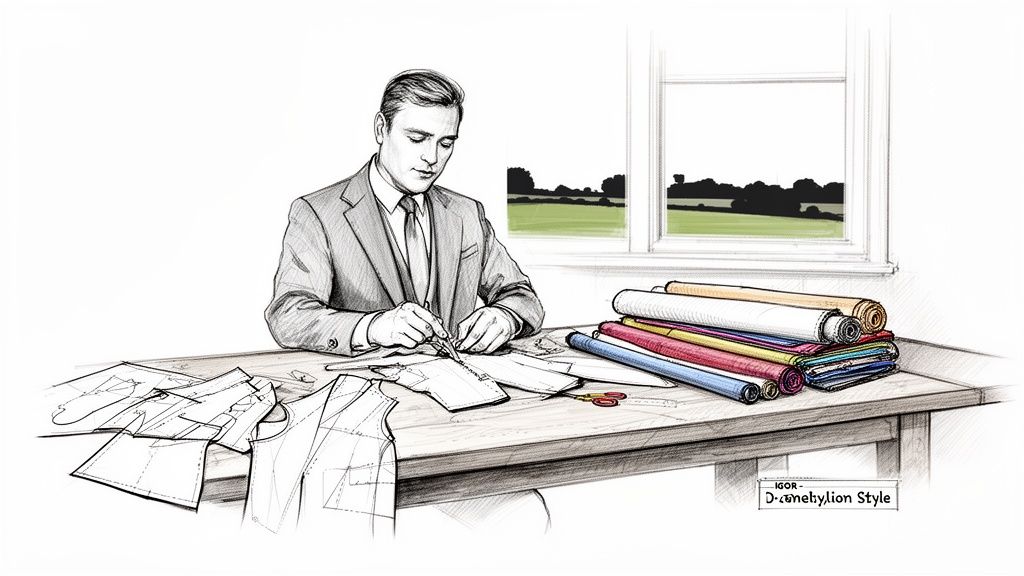
A bespoke tailored suit is a world away from anything you can buy off a rail. It's a garment born from scratch, crafted for one person and one person only, beginning with a unique paper pattern that is yours alone. Unlike any other option, it promises a flawless fit by embracing every subtle detail of your posture and build. The result is complete personalisation and a suit built not just for a season, but for a lifetime.
Key Takeaways
Unique Pattern: A true bespoke suit is defined by a unique paper pattern created from scratch for each client, unlike made-to-measure which alters an existing template.
The Journey: The process is a collaborative journey with your tailor, typically spanning 8-12 weeks and involving multiple fittings to sculpt the garment to your body.
Fabric is Key: The choice of fabric—from worsted wool to tweed or linen—dictates the suit's character, performance, and feel, making it a crucial part of the personalisation process.
A Worthwhile Investment: The cost reflects master craftsmanship, hours of hand labour, and premium materials, resulting in a durable, perfectly fitting garment that outlasts off-the-rack options.
Your Guide to the Perfect Fit
Starting the journey of commissioning a bespoke suit is a real investment in yourself. It's about so much more than just the clothes; it's a collaborative art form between you and your tailor, culminating in a piece that feels like a true extension of your physique and personality.
This guide is here to pull back the curtain on the entire experience, walking you through everything from the first conversation to the final fitting. We’ll explore the deep-rooted craftsmanship that makes bespoke tailoring a completely different beast from made-to-measure or off-the-rack suits, giving you a proper appreciation for its timeless value.
Understanding the Foundation
At the heart of any truly great suit is the fit, and that all starts with precise measurements. While your tailor will, of course, handle this meticulously during your consultation, getting a sense of the fundamentals can be incredibly insightful. For anyone curious about the nitty-gritty, our guide on how to measure yourself for a suit offers a peek into what a tailor is looking for. This knowledge really helps you appreciate the sheer level of detail involved.
A genuinely bespoke garment, however, goes far beyond a simple tape measure. It accounts for all the individual nuances that ready-made suits simply can't:
The natural slope and set of your shoulders.
The way you stand and hold yourself—your posture.
The unique curve and arch of your back.
It’s these subtle, personal details that ensure the suit drapes perfectly across your body and moves with you, not against you. This harmony delivers a level of comfort and a sharp silhouette that is simply second to none.
A well-made suit is not just an article of clothing; it's a second skin. The bespoke process ensures this skin is crafted with precision, reflecting both your physical form and personal style in a way no other garment can.
What you're left with is a suit with real character, one that's built to last for decades. It becomes a reliable cornerstone of your wardrobe, ready for any of life's most important moments.
What Defines a Truly Bespoke Suit
So, what really separates a bespoke suit from everything else? It all boils down to one absolutely crucial element: the creation of a unique paper pattern. This pattern is drawn up from scratch, just for you, becoming the architectural blueprint for your suit. This is the single biggest difference that places bespoke tailoring in a class of its own.
Think of it like building a house. An architect designs a custom home from the ground up, considering the specific piece of land and the owner's lifestyle. In contrast, a builder who just modifies an existing floor plan is doing something closer to made-to-measure. A true bespoke tailor looks at more than just your chest or waist size; they study your posture, the slope of your shoulders, and even the way you stand and walk to craft a suit that feels less like clothing and more like a second skin.
The Art of the Individual Pattern
The real magic of tailoring happens when the artisan translates over thirty detailed measurements into a flat, two-dimensional paper pattern. This is the foundation that will eventually become a three-dimensional garment, perfectly sculpted to your body. In the world of genuine bespoke, this step is non-negotiable. It guarantees that every line and seam is balanced to your individual proportions, not just tweaked from a standard-sized template.
This painstaking process is what separates true craftsmanship from mass production. The outcome is a suit that moves as you do, giving you a level of comfort and elegance that simply can't be replicated. It’s a testament to a craft that has been perfected over generations.
"A bespoke suit is not just a purchase; it's a commission. It’s a collaboration between client and craftsman to create an item of sartorial art that is completely and utterly unique to the wearer."
Heritage and Craftsmanship in Every Stitch
Understanding what makes a bespoke suit special means appreciating a philosophy built on classic, timeless, and elegantly tailored aesthetics. It's not just about what you're wearing; it’s about participating in a legacy of artisanal skill. Details you might not notice at first, like working sleeve buttons (known as surgeon’s cuffs) and lapels that have been meticulously stitched by hand, are the quiet hallmarks that distinguish your suit as a piece of exceptional quality.
This dedication to craft is a proud cornerstone of the UK’s fashion industry, which contributes a staggering £62 billion to the GDP and supports 1.3 million jobs. While many areas of clothing manufacturing have dwindled, the demand for bespoke tailoring and high-quality alterations has remained strong, showing just how much people still value this level of quality.
At its heart, the process is built on the relationship between you and your tailor. Through a series of conversations and fittings, a real understanding is formed, leading to a garment that doesn't just fit your body, but also your personality and lifestyle. This collaborative journey is what makes the final suit so personal and so much more than the sum of its parts. To dive deeper, you can explore our detailed guide on what makes a full bespoke suit so unique.
The Bespoke Suit Journey From Start to Finish
Commissioning a bespoke suit is less a transaction and more a partnership—a creative collaboration between you and your tailor. It's a journey that turns a bolt of cloth into a garment that is utterly and completely yours, sculpted not just for your body, but on it. This isn't an off-the-rack experience measured in minutes; it's a deliberate process measured in weeks, ensuring every single detail is given the time and attention it truly deserves.
From our first handshake to you walking away with your finished suit, the entire process typically spans between eight to twelve weeks. This isn't just waiting time. This timeline is essential for the meticulous craftsmanship, the sourcing of world-class fabrics, and the series of fittings that are the very heart of the bespoke method.
Step 1: The Initial Consultation and Design
It all begins with a conversation. We’ll sit down together, perhaps over a coffee, and simply talk about what you need. Is this suit for your wedding? A pivotal business meeting? Or maybe a black-tie event on the horizon? Understanding the context is everything; it informs every choice we make, from the weight of the fabric to the very structure of the jacket.
This is also where we get to know your personal style. We'll discuss the finer points—lapel widths, pocket styles, button choices, the sort of break you like on your trousers. Think of it as laying the blueprint for a suit that fits not just your measurements, but your personality and your life.
Step 2: Fabric Selection and Measurements
With a clear vision established, we move on to one of the most enjoyable parts of the process: choosing your fabric. You'll get to handle and feel a curated selection of exceptional British cloths, from rugged tweeds and sumptuous cashmeres to lightweight linens and classic worsted wools. I'll be on hand to guide you, explaining how each fabric drapes, feels, and performs, helping you find the one that’s just right.
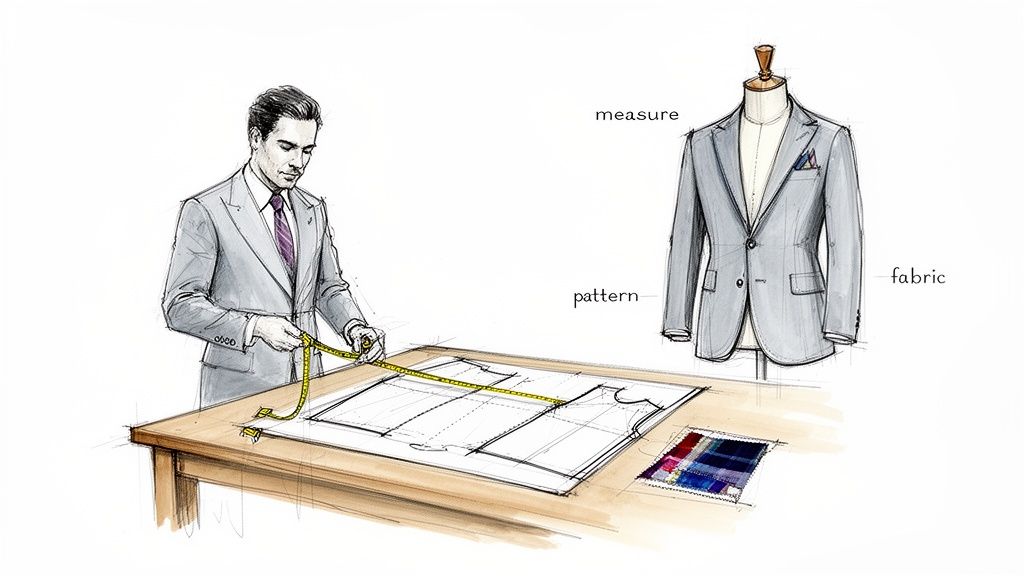
Once the cloth is chosen, we take an exhaustive set of measurements—often more than thirty. This goes far beyond a simple chest and waist measurement. We capture the subtle nuances of your physique: the slope of your shoulders, your posture, the unique arch of your back. These precise figures are the very foundation upon which we'll draft your personal paper pattern, the true architectural plan for your suit.
Step 3: The Fittings—From Basted to Final
The fitting stage is where the magic really happens, where your suit comes to life on your body. It’s a multi-step process designed for progressive refinement.
The Basted Fitting: Your suit is loosely pieced together with temporary white basting stitches. It's essentially a 'skeleton' of the final garment. This first fitting is crucial for us to assess the primary balance, the drape, and the overall proportions on your body. We make the big adjustments here—things like the jacket's length, the shoulder width, and how the trousers fall.
The Forward Fitting: After making those initial changes, the suit is constructed more fully. Now we can hone in on the finer details, like the roll of the lapel, the placement of the collar, and the pitch of the sleeves. This is where we perfect the silhouette, making sure the garment moves with you gracefully and without restriction.
The Final Fitting: By this stage, the suit is almost complete, with most of the permanent stitching in place. This is our last chance to make any minor tweaks, ensuring buttonholes are perfectly aligned and every seam is flawless. Once you are completely happy, the suit receives its final press and is ready for you to take home.
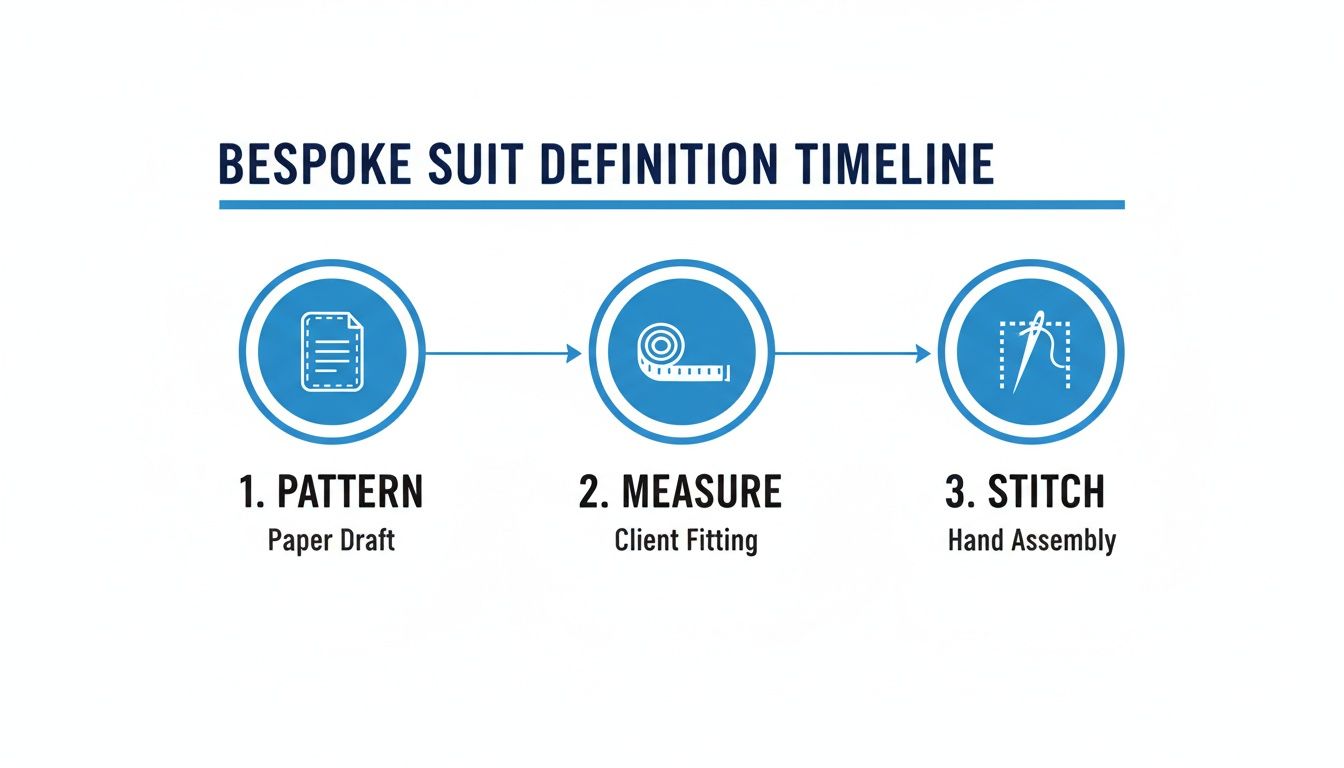
The infographic below neatly illustrates these core stages, showing the transformation from a concept to a tangible, wearable piece of art.
This visual shows how each step—patterning, measuring, and stitching—is an essential and distinct phase in creating a true bespoke tailored suit.
"A bespoke suit is not made for you; it is made on you. The series of fittings are where the tailor sculpts the fabric directly to your form, turning cloth into a second skin."
This iterative process means nothing is left to chance. Every fitting is an opportunity to refine and perfect, guaranteeing the end result isn’t just a suit that fits, but a suit that feels like it belongs to you. It's a journey of collaboration and craftsmanship that results in a garment you'll wear with pride for many years to come.
Choosing Your Fabric and Construction Details
Once we've taken the blueprint of your measurements, we move on to what I think is the most expressive part of creating a bespoke suit: choosing the materials and deciding on the construction. This is where your personality truly gets woven into the garment. It's the point where you stop being a customer and become a collaborator.
The fabric is the very soul of the suit. It dictates how it hangs, how it feels against your skin, and the character it projects. A rugged tweed, for example, is perfect for country life, giving you warmth and durability. On the other hand, a lightweight linen breathes beautifully, making it the obvious choice for a summer wedding or a trip somewhere warm. The weight and weave of the cloth have a massive impact on how the suit performs and feels for its entire life.
Understanding Fabric Choices
Picking the right material is a sensory experience. You really need to feel the texture in your hands and see how it catches the light. Each one brings something different to the table.
Worsted Wool: This is the cornerstone of classic tailoring. Known for its strength, smooth finish, and incredible drape, it’s a versatile workhorse for everything from daily business suits to formal wear.
Tweed: A durable, hearty woollen fabric with that distinctive, slightly rough texture. It’s got Scottish roots, provides fantastic warmth, and is perfectly suited for jackets and country suits that need to stand up to the elements.
Linen: A lightweight, airy fabric made from the flax plant. It's incredibly breathable and has a relaxed, slightly rumpled charm that's perfect for less formal occasions in warm weather.
Mohair and Cashmere: These are the luxury players. They add a beautiful lustre and softness to the cloth. Mohair is crisp and resilient, while cashmere offers that famous, unparalleled softness and warmth without feeling heavy.
Your choice of fabric is more than just a matter of taste; it’s a statement of intent. It also positions you within a thriving market for quality garments. The European custom suits market is booming, with the UK commanding a significant 15.60% share. This sector grew from €1,249.67 million to €1,563.22 million in just four years, proving that discerning clients are continuing to invest in true quality. For a deeper dive into materials, have a look at our guide to the best fabrics for suits and what makes each one special.
The Inner Workings: Construction Details
Beyond the fabric you see, the internal construction of your jacket is what gives it shape and longevity. This is where true craftsmanship is often hidden from view, but it’s absolutely critical to how the suit feels and wears over time.
The most important decision here is the canvassing. The canvas is a layer of material, usually a blend of horsehair and wool, that sits between the outer suit fabric and the inner lining. It’s what helps the jacket mould to your body, creating a far superior fit.
A full canvas is the gold standard of bespoke tailoring. It runs from the shoulder right down to the bottom of the jacket, allowing the garment to drape naturally and move with you, improving with every single wear.
Your main options are:
Full Canvas: This is the hallmark of a high-quality bespoke suit. The canvas runs the entire length of the jacket front, providing structure and allowing the suit to mould to your body perfectly over the years. It truly becomes a second skin.
Half Canvas: This is a fantastic middle ground. The canvas extends from the shoulder down to the chest, offering great shape in the most crucial areas while being a slightly less labour-intensive option.
Other details, like your choice of lining—perhaps a bold silk print that only you know is there—and the type of buttons, from classic horn to mother-of-pearl, add further layers of personalisation. These small but significant choices are what make a bespoke suit truly your own. It becomes a garment crafted not just for your measurements, but for your individual style.
Understanding the Investment in a Bespoke Suit
Let's talk about the price. A bespoke suit is a significant investment, there's no two ways about it. But it's important to understand that the cost isn't just an arbitrary number; it’s a direct reflection of immense skill, hundreds of hours of work, and the very best materials coming together to create something that is exclusively yours.
When you commission a bespoke suit, you're not just buying a piece of clothing. You’re investing in a master tailor’s years of expertise, the countless hours of painstaking hand-stitching, the premium quality of fine British fabrics, and the multiple fitting sessions that are absolutely essential to achieving a perfect result.
Deconstructing the Cost
The final price of a bespoke tailored suit is built on a few key pillars. Every single component adds to the garment's quality, fit, and longevity, setting it worlds apart from anything you could buy off a hanger.
Master Craftsmanship: We're talking about dozens of hours dedicated purely to your suit. Drafting your unique paper pattern, cutting the cloth by hand, and meticulously hand-stitching the garment together. This skilled labour is the heart of the suit, and the largest part of the cost.
Premium Fabrics: We source exceptional materials from some of Britain’s most renowned mills. The quality of the wool, tweed, or cashmere has a profound impact on the suit's drape, its comfort, and how well it will stand the test of time.
The Fitting Process: Unlike made-to-measure, the bespoke journey involves multiple fittings—basted, forward, and final. This is where we sculpt the suit directly onto your body. It's an iterative, collaborative process that's vital for achieving perfection.
Investing in a bespoke suit is like commissioning a piece of art. The value lies not just in the finished product, but in the collaborative process, the artisan's skill, and the knowledge that it was created without compromise, just for you.
A Tangible Benchmark for Your Investment
To give you a clear and concrete starting point, our bespoke two-piece suits begin at £1,495. This figure is the entry point into the world of true bespoke tailoring, offering a benchmark against which you can measure the remarkable value you receive. For a more detailed breakdown, feel free to explore our full guide on how much a bespoke suit costs.
It helps to think of this not as an expense, but as a long-term investment in your personal style and confidence.
The demand for this level of quality is clear. In the UK, the bespoke tailoring sector is a vibrant part of a menswear market that generated a staggering £27.5 billion in revenue. This huge figure shows exactly why artisans like Dandylion Style are perfectly positioned to serve discerning clients who are looking for one-of-a-kind suits made from the finest British fabrics. You can read more about the UK's thriving menswear market on grandviewresearch.com.
Ultimately, a single bespoke suit will outlast and outperform several off-the-rack alternatives, giving you far superior value and timeless style for years to come.
Meet Igor the Tailor Behind Dandylion Style
Behind every truly exceptional suit, you’ll find a master tailor—an artisan whose passion is stitched into every seam. At Dandylion Style, that artisan is Igor, our founder and the creative force who translates each client's vision into a wearable reality.
His philosophy is rooted in the time-honoured traditions of classic gentlemen's tailoring. For Igor, everything begins and ends with you, the client. The absolute cornerstone of his work is creating a unique paper pattern for every individual, a non-negotiable step that guarantees a flawless, comfortable fit. This is pure bespoke, ensuring your garment is genuinely one-of-a-kind.
A Personal Approach to Timeless Style
Working from his serene studio in Ardingly, West Sussex, Igor offers a service that is both personal and deeply attentive. The experience is relaxed, yet utterly refined. He’ll be your guide, navigating the world of fine British fabrics and intricate design details to create a finished suit that is a true reflection of your personality.
Igor’s work is defined by its quiet elegance and an enduring style that transcends fleeting trends. He creates garments that are not just worn, but cherished for years to come. To get a better sense of the man behind the brand, you can read more about Igor here and discover his sartorial philosophy for yourself.
Frequently Asked Questions About Bespoke Suits
How long does the bespoke process take?
The journey of creating a true bespoke tailored suit is a meticulous craft that shouldn’t be rushed. From your initial consultation to the final fitting, the entire process typically spans between eight to twelve weeks. This timeframe allows for the careful drafting of your unique pattern, sourcing the finest materials, and conducting the multiple fittings necessary to sculpt the garment perfectly to your body. This patient, detailed approach is essential to achieving the unparalleled fit and quality that defines bespoke tailoring.
What is the real difference between bespoke and made-to-measure?
The key distinction lies in the pattern. A bespoke suit begins with a blank sheet of paper, where a pattern is drawn from scratch based on your unique measurements and posture. This captures nuances like shoulder slope and stance. In contrast, a made-to-measure suit starts with a pre-existing standard pattern, or ‘block,’ which is then simply adjusted to fit your basic measurements. While better than off-the-rack, it cannot achieve the same level of personalised fit as a garment built entirely around you.
How should I care for my bespoke suit?
To preserve your investment, hang your suit on a wide, wooden hanger to support the shoulders and maintain its shape. Allow the garment to rest for at least a day between wears, letting the natural fibres breathe. Avoid frequent dry cleaning; instead, opt for professional sponging and pressing when necessary, as the chemicals can be harsh. For minor wrinkles, a gentle steaming at home is a much better alternative. This simple care routine will ensure your suit lasts for many years.
Can a bespoke suit be altered in the future?
Absolutely. A key feature of a quality bespoke suit is the inclusion of generous inlay allowances—extra fabric left within the seams. This is a deliberate design choice that ensures the garment can adapt with you over time. Should your body shape change, a skilled tailor can easily let out the waist, chest, or seat to maintain a perfect fit. This built-in longevity makes a bespoke suit a truly sustainable and wise long-term investment in your personal style.
Ready to experience the art of true bespoke tailoring for yourself? At Dandylion Style, Igor is ready to guide you through a calm, considered process to create a garment that is uniquely yours. Book your consultation today and start your journey towards a perfect fit.
Key Takeaways The Core Two: Navy blue and charcoal grey are the essential, non-negotiable suit colors for any professional wardrobe. Navy offers versatility and approachability, while charcoal projects authority and seriousness. Context is Crucial: The best suit color...
When you find a piece of clothing you absolutely love, getting the fit just right is the final, transformative touch. But how much should you expect to pay? In the UK, alteration costs can be as modest as £15 for a simple trouser hemming, or climb to £150 and beyond...
Getting the right pink shirt and tie combination is the mark of a well-dressed man. It’s a detail that separates the novices from those who truly understand their wardrobe. For a look that’s classic and can’t miss, pair your pink shirt with a navy, grey, or burgundy...
Key Takeaways For those seeking a quick overview, this section summarises the essential rules and recommendations for incorporating turn-up trousers into your wardrobe. Sartorial Purpose: Turn-ups add weight to the trouser hem, ensuring a cleaner, sharper drape,...
Deciding what colour tie to wear with a pink shirt is a common style query I hear from clients. For a classic, professional look that never fails, your safest and most effective choices are navy blue and charcoal grey. If you're heading to a more contemporary or...
You've just picked up a newly finished bespoke suit, and the cloth still has that clean, disciplined line only a real fitting room can give it. The temptation is to put it straight in the wardrobe and trust the label to do the rest. That's where expensive...
Book Your Tailoring Consultation
Looking for a suit or garment made specifically for you?
At Dandylion Style, we create bespoke and made-to-measure
garments tailored to your individual shape, style and occasion.
From suits and shirts to dresses, waistcoats and alterations,
our experienced tailors can help you create something truly unique.