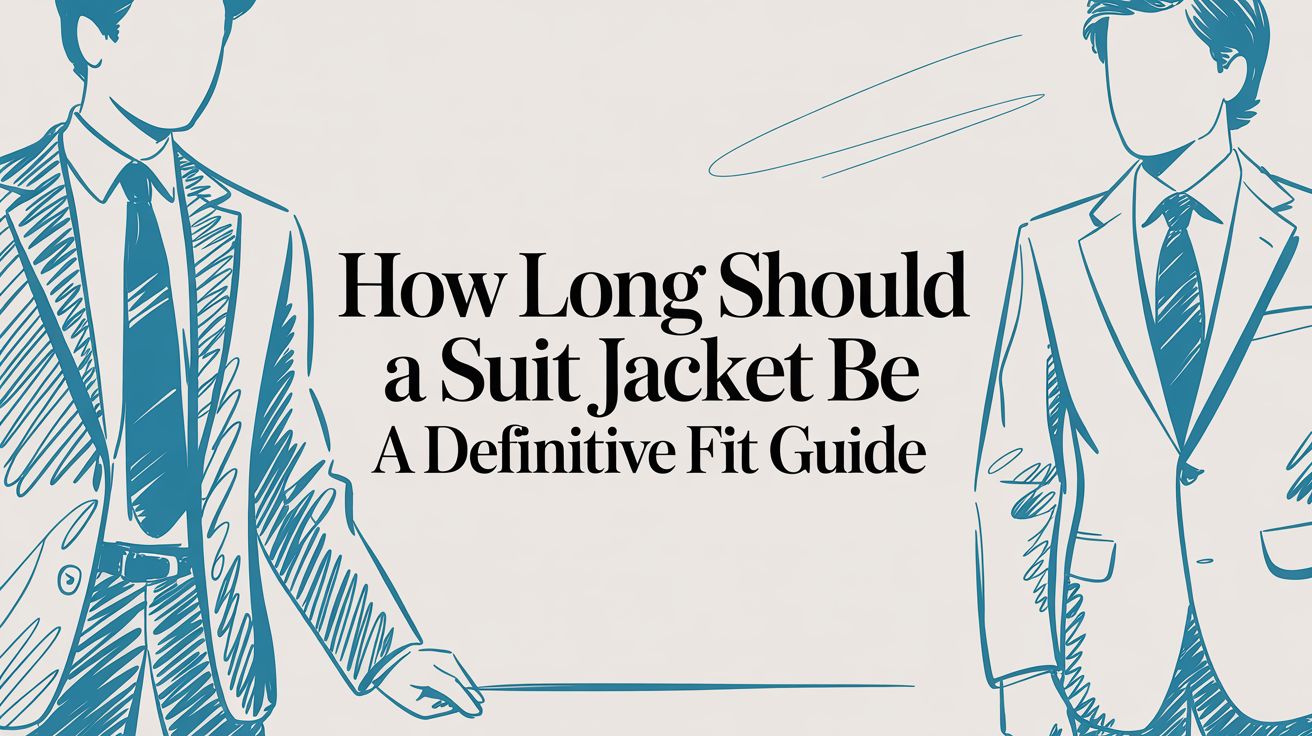
For a classic fit, your suit jacket should end somewhere around the knuckle of your thumb, assuming your arms are hanging relaxed at your sides. But the golden rule—the one that really matters—is that the hem must fully cover the seat of your trousers. Get this detail right, and you create a beautifully balanced 50/50 visual split between your upper and lower body. It’s absolutely fundamental to a sharp, well-proportioned silhouette.
Key Takeaways
- Seat Coverage is King: The most important rule for a classic fit is that the jacket hem must fully cover the seat of your trousers. This creates a balanced, proportionate silhouette from all angles.
- Use the Thumb Rule: As a reliable guideline, the jacket hem should align with your thumb knuckle when your arms are relaxed at your sides. This is a great starting point for assessing off-the-rack suits.
- Aim for a 50/50 Balance: A well-fitting jacket should visually divide your body in half, creating a harmonious line from the collar to the hem and from the hem to the floor.
- Adapt to Your Body Type: Taller men may benefit from a slightly longer jacket, while shorter men can create the illusion of height with a slightly shorter hemline.
- Length Cannot Be Altered: Unlike other parts of a suit, the jacket's length is one of the few elements that cannot be easily fixed by a tailor. It’s crucial to get it right from the start.
The Rules of Perfect Suit Jacket Length
Before we get into the finer points and bespoke nuances, let's lay down the foundational principles for getting the jacket length spot on. Think of these as your toolkit for instantly sizing up an off-the-rack jacket or starting a conversation with your tailor from a place of confidence.
Nailing these fundamentals is the first step. It’s what makes a suit look intentional, considered, and perfectly proportioned to you. We'll be covering three classic methods for checking the length:
- The Thumb Knuckle Rule: A traditional guideline that has stood the test of time.
- The Fingertip Method: A simple alternative for getting a quick visual check.
- The Seat Coverage Check: The most important visual anchor for creating that essential balance.
Understanding these basics is everything, as the jacket is the true centrepiece of your entire suit. For a closer look at how all the different elements of a suit work in harmony, our guide on the parts of the suit is the perfect next step.
Mastering the Three Pillars of Jacket Measurement
Moving past a quick glance in the mirror, truly mastering your jacket’s length means understanding the three core ways to measure it. While the old-school ‘cupped fingers’ method is a well-known starting point, most modern tailors lean on more precise techniques to nail down exactly how long a suit jacket should be.
The most reliable visual cue? Making sure the jacket’s hem completely covers the seat of your trousers. This single checkpoint is fundamental to creating a balanced, proportionate silhouette from every angle.
For a more contemporary rule of thumb, many guidelines suggest the jacket hem should land right at your thumb knuckle when your arms are relaxed at your sides. This is a critical detail because, unlike almost any other element of a suit, the jacket's length cannot be altered once it's made. To dig deeper into these measurement points, you can explore our full suit measuring chart.
Here’s a quick overview of these methods.
Jacket Length Measurement Methods at a Glance
This table breaks down the three primary methods for assessing suit jacket length, explaining how to use each one and what to keep in mind.
| Method | How to Measure | Best For | Consideration |
|---|---|---|---|
| The Thumb Rule | With your arms relaxed at your sides, the hem of the jacket should align with the knuckle of your thumb. | A quick, modern check for off-the-rack suits and a good general guideline. | Can be influenced by arm length, so it’s not always foolproof for every body type. |
| Seat Coverage | The bottom hem of the jacket should fall low enough to completely cover the seat of your trousers. | The most universally accepted rule for a classic, proportionate fit. Essential for formal and business suits. | Ensures a clean line from behind, preventing the jacket from looking short or chopped-off. |
| Body Balance | The jacket should visually bisect your body, creating roughly equal proportions from the collar to the hem and from the hem to the floor. | Achieving a harmonious and balanced silhouette, especially important in bespoke tailoring. | This is more of an artistic judgement than a hard rule, taking your entire frame into account. |
By using these three pillars together, you move from simple rules to a more holistic understanding of fit.
This infographic neatly sums up the visual rules that lead to a perfect suit jacket length.

By bringing together the thumb rule, seat coverage, and a sense of overall body balance, you can achieve a fit that doesn’t just follow the rules, but looks and feels instinctively right.
Adapting Jacket Length to Your Body Type
While the classic rules give you a superb foundation, the real art of an exceptional suit is how it works with your unique physique. This is where knowing how to adapt jacket length for different body types turns a good fit into a truly great one. The goal, always, is to sculpt the most flattering and balanced silhouette imaginable.
For taller gentlemen, a jacket that’s a fraction longer can work wonders. It helps to ground your frame and prevents that ‘all legs’ look. On the other hand, for shorter men, a marginally shorter hemline is a game-changer. It cleverly creates the illusion of height by elongating the leg line. Men with broader midsections or athletic builds can also use the hemline to their advantage, carving out a powerful, streamlined look.
Of course, the jacket's style itself plays a role. A single-breasted vs double-breasted suit can also influence how the length interacts with your frame, but we’ll get into that.

Matching Jacket Length to Style and Occasion
The “perfect” jacket length isn’t one single, unmovable measurement. Far from it. In reality, it’s a fluid idea that shifts depending on the garment’s specific style, where it comes from, and where you plan to wear it.
Think of it like this: a classic British business suit, with its roots in military and equestrian tailoring, traditionally features a longer, more structured jacket. This cut creates a conservative, commanding silhouette. On the other hand, much of modern Italian tailoring favours a shorter, more fashion-forward hemline. This gives the wearer a sharper, trimmer look that feels distinctly contemporary.
This same logic applies to occasion. A formal black-tie dinner suit, for example, demands classic proportions to maintain its timeless elegance. But a casual tweed sports coat? That allows for far more relaxed rules. You can explore more about these distinctions in our guide to the blazer vs suit jacket. Understanding these nuances is the key to building a wardrobe that isn't just well-fitting, but contextually spot on.
Common Jacket Fit Mistakes and How to Avoid Them
Getting that impeccable fit often just means sidestepping a few very common mistakes. Knowing what to look for is the difference between looking sharp and looking, well, a bit dated.
A jacket that hangs too long is one of the most frequent culprits. It has the unfortunate effect of visually shortening your legs, throwing your entire silhouette out of balance and giving off an old-fashioned vibe. It’s an instant way to look shorter and stouter than you are.

On the flip side, a jacket that’s too short looks just as ill-fitting. It disrupts your body’s proportions and leaves the seat of your trousers improperly exposed—a look that screams "I've outgrown my suit."
Here’s the critical part: jacket length is one of the very few things a tailor can’t easily fix. You can't just add fabric to lengthen it, and attempting to shorten it too much throws off the balance of the pockets and button placement, ruining the jacket's proportions entirely. You have to get the length right from the start.
This is precisely where expert guidance becomes invaluable, a topic we touch on in our overview of men's suit alterations near me, which breaks down exactly what a skilled tailor can and cannot adjust.
Frequently Asked Questions
Can a tailor shorten my suit jacket?
A tailor can shorten a suit jacket, but only by a very small amount—typically no more than an inch. Any more than that will disrupt the jacket’s balance, as the pockets and button stance will appear too close to the hem. Lengthening a jacket is almost always impossible due to the lack of spare fabric. For this reason, it is far better to buy a jacket that is the correct length from the outset rather than relying on alterations for significant changes.
Should a double-breasted jacket be longer?
Yes, double-breasted jackets are traditionally cut slightly longer than their single-breasted counterparts. This extra length helps accommodate the overlapping fabric and additional buttons, maintaining a balanced and elegant silhouette. The hem should still cover the seat completely, but the overall effect is more substantial and formal. A shorter, modern cut on a double-breasted jacket can look unbalanced and less sophisticated, so it’s best to stick to classic proportions that honour the style’s formal heritage and structure.
How do I know if my suit jacket is too short?
The most obvious sign of a jacket that is too short is that it fails to fully cover the seat of your trousers, leaving a visible horizontal line that cuts your body in half unflatteringly. This disrupts the visual flow from your torso to your legs, often making you look disproportionate. Another clue is if the hem sits significantly higher than your thumb knuckles when your arms are relaxed. A jacket that's too short can make you look as if you've outgrown it.
Does jacket length change for casual vs. formal suits?
Yes, jacket length can vary with formality. Formal suits, such as those for business or black-tie events, adhere to classic rules: the hem should cover the seat and bisect your body. This creates a timeless and authoritative look. For more casual jackets, like sports coats or blazers, the rules are more relaxed. It's common for them to be cut slightly shorter for a more modern, laid-back feel. However, even with casual styles, the jacket should never be so short that it uncovers your seat.
About the Author
Igor is the founder and master tailor behind Dandylion Style, with over 20 years of experience crafting bespoke and made-to-measure suits for discerning gentlemen. Based in Ardingly, West Sussex, he combines time-honoured British techniques with an intuitive eye for modern style, helping men feel completely at ease in garments that fit beautifully. With decades spent honing his craft in respected tailoring houses, Igor offers trusted, honest advice to help you build a wardrobe with confidence and elegance.