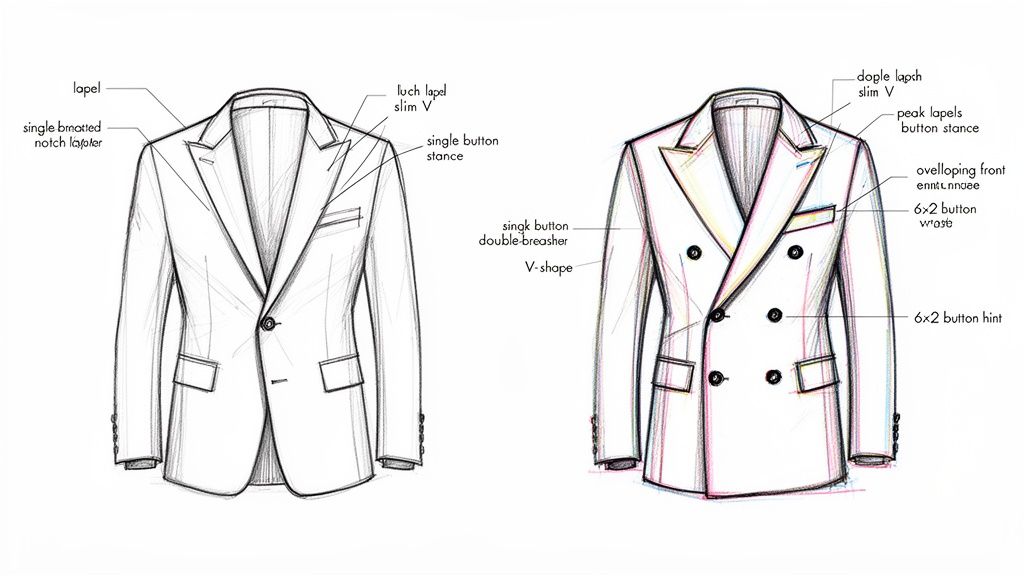
At its heart, the choice between these two styles boils down to one simple question: versatility or formality? The single-breasted suit is the quintessential modern workhorse, offering clean, simple lines that adapt to almost any situation, from daily business to a casual weekend event. In stark contrast, the double-breasted suit is a statement. It presents a bolder, more structured silhouette with its overlapping front panels and commanding presence, making it a powerful piece reserved for making an impression.
Key Takeaways
Versatility vs. Formality: Single-breasted suits are the versatile workhorse of menswear, ideal for daily wear and a wide range of occasions. Double-breasted suits are inherently more formal and designed to make a bold, authoritative statement.
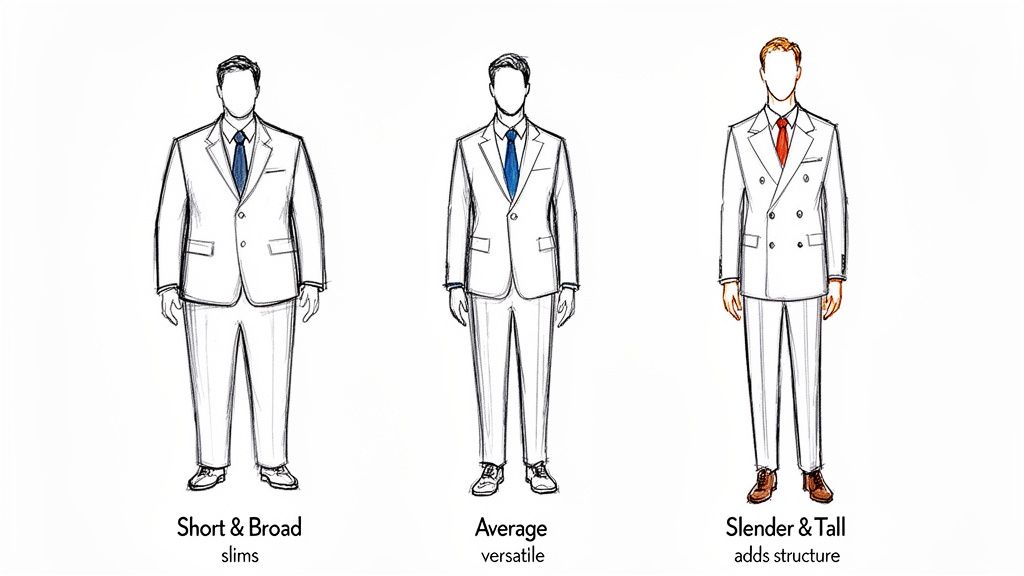
Body Type Flattery: The clean, vertical lines of a single-breasted jacket are universally flattering, especially for shorter or broader builds. The structure of a double-breasted jacket adds width, making it an excellent choice for taller, slender frames.
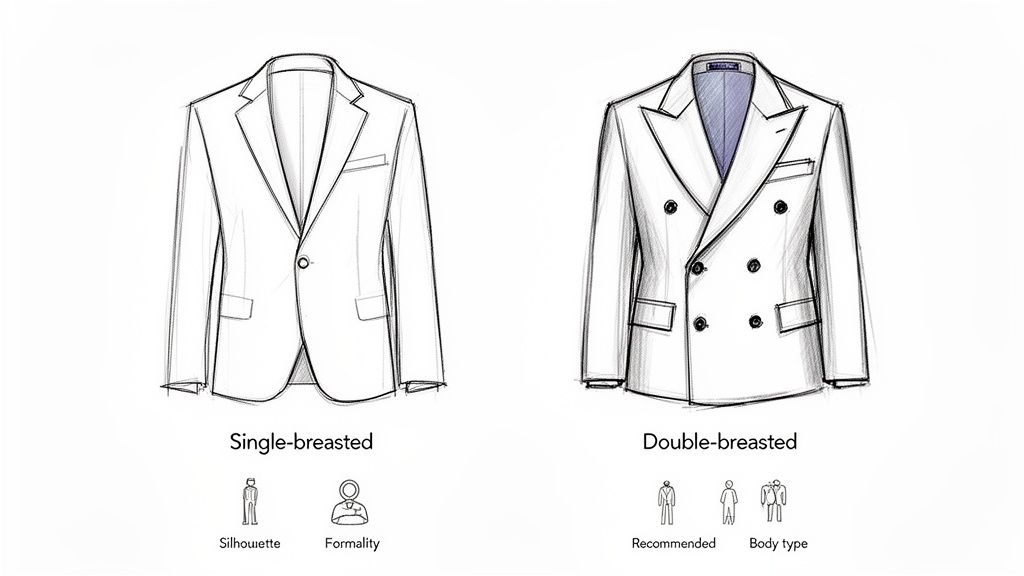
Anatomical Differences: The core distinction lies in construction. Single-breasted suits typically have notch lapels and a single row of buttons, while double-breasted suits feature peak lapels and two parallel button columns, creating a wider V-shape.
Styling Context: Single-breasted suits can be easily dressed up for business or down for smart-casual events. Double-breasted suits demand more formal pairings and are best kept buttoned to maintain their powerful silhouette.
Deciding Between Single Breasted and Double Breasted Suits
Choosing your suit’s construction is a decision rooted in the occasion, your personal style, and the silhouette you want to create. The single-breasted jacket, with its classic single column of buttons, is the undisputed cornerstone of modern menswear. It moves seamlessly from the boardroom to a relaxed garden party.
Its straightforward design has a naturally slimming effect, which makes it a universally flattering option for nearly any body type. It’s the reliable default for a reason.
The double-breasted jacket, on the other hand, evokes a sense of sartorial heritage and authority. With its two parallel columns of buttons and wider, overlapping fabric, it carves out a powerful V-shape across the torso. This style has always leaned more formal, making it an excellent choice for significant events where cutting a memorable figure is the goal. Taking a moment to explore different style of suits can help clarify which silhouette best fits your wardrobe and life.
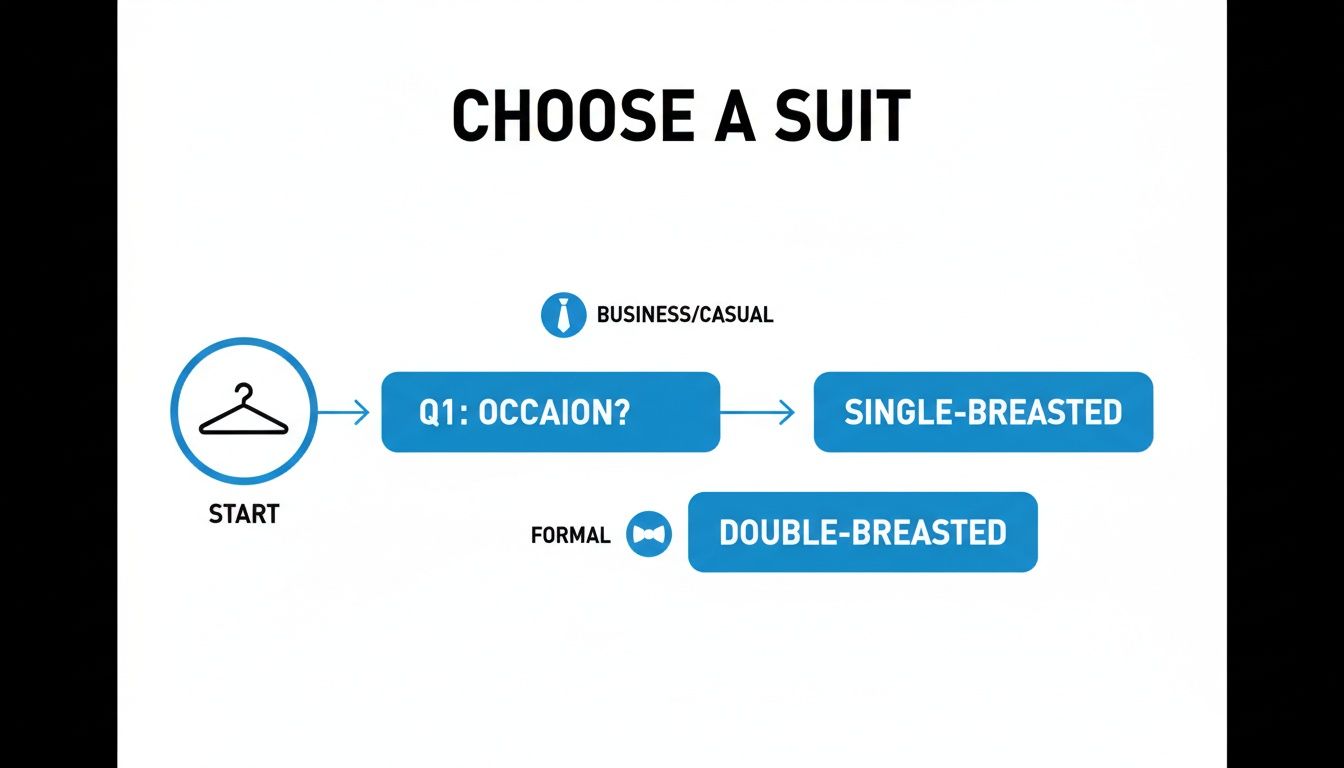
This decision tree infographic can help visualise the choice, guiding you based on the event's formality and the impression you want to make.
Ultimately, while the single-breasted suit is a safe and stylish default for almost any scenario, the double-breasted is often the superior choice when you need to elevate your formal attire and make a deliberate statement.
At a Glance Single Breasted vs Double Breasted Suits
To simplify things, here's a quick reference table that breaks down the core characteristics and ideal situations for each style. It's a handy guide for making that initial decision.
Characteristic
Single Breasted Suit
Double Breasted Suit
Formality Level
Versatile (Business to Casual)
More Formal (Statement Occasions)
Best For
Daily wear, interviews, weddings
Formal events, power dressing
Body Type Fit
Universally flattering, slimming
Best on taller or slender frames
Button Stance
Single vertical row (1–3 buttons)
Two parallel rows (4–8 buttons)
Overall Vibe
Modern, understated, classic
Authoritative, traditional, bold
This table should give you a clear, immediate sense of where each suit style sits. The single-breasted is your reliable all-rounder, while the double-breasted is the specialist you call upon for maximum impact.
The Heritage Behind Each Suit Silhouette
Every suit tells a story. When you choose between a single-breasted and a double-breasted jacket, you're not just picking a style; you're tapping into a rich sartorial history that defines how each one feels and functions today. Understanding where these two distinct silhouettes came from reveals exactly why one feels so modern and versatile, while the other projects an air of authority and old-school formality.
The single-breasted suit we know and love today found its footing in the less formal lounge suits of the Victorian era. It was first conceived as a relaxed alternative to the stiff, formal frock coats that were the absolute standard for gentlemen's daywear. Its streamlined and practical design made it the perfect garment for a man at his leisure, away from the rigid demands of court or high society.
It wasn’t until after World War I, however, that the single-breasted suit truly came into its own. Society was changing, and the move towards less rigid social structures and more active lifestyles called for simpler, more functional clothing. With its minimal fabric and clean lines, the single-breasted jacket was the perfect answer, cementing its place as the go-to choice for both business and daily life.
The Evolution of the Modern Staple
Today, the single-breasted suit's dominance is undeniable. In the UK men's suit market, it commands an estimated 75-80% market share—a powerful testament to its timeless versatility for professionals and grooms alike. This modern preference is a direct result of its historical journey from a casual alternative to an adaptable, indispensable staple. You can explore more on the UK apparel market from Statista's market analysis.
The Aristocratic Roots of the Double-Breasted Cut
The double-breasted suit, by contrast, has a much more formal and martial story. Its design is a direct descendant of naval reefer jackets and military uniforms, where the wide, overlapping front panels offered sailors extra protection and warmth against the elements. This military DNA immediately gave the style a sense of discipline and authority.
By the early 20th century, tastemakers like the Duke of Windsor had popularised the double-breasted suit, transforming it into a powerful symbol of aristocratic elegance and swagger. It was never intended for casual wear; its entire purpose was to make an entrance and project confidence.
The double-breasted suit commands presence. Its structure, with wide peak lapels and a buttoned-up stance, is designed to broaden the shoulders and trim the waist, creating a powerful and undeniably formal silhouette.
This powerful aesthetic saw a huge resurgence during the power-dressing era of the 1980s, becoming the unofficial uniform for financiers and executives in the City of London and on Wall Street. It was the obvious choice for anyone looking to project ambition and success.
Even now, a double-breasted dinner jacket remains a pinnacle of sophisticated evening wear, drawing directly on this rich heritage of high-impact, formal tailoring. Ultimately, the history of each suit directly informs its modern use—one was built for versatility, the other for making a lasting impression.
Deconstructing the Anatomy of Each Suit
To really get to the heart of the single-breasted vs. double-breasted debate, you have to look beyond a simple button count. The core architecture of each jacket—its lapels, the stance of its buttons, and the V-shape it cuts across the chest—is what truly defines its character. These aren't just minor details; they dictate the suit's formality, its visual punch, and how it shapes your entire silhouette.
Getting a handle on these elements is absolutely vital, especially if you're thinking about a bespoke commission. When you can dissect the anatomy of each style, you gain the language needed to tell your tailor precisely what you want. This deeper understanding ensures the finished suit is a genuine reflection of your personal style, not just a garment off a pattern book.
The Lapel: A Suit's Defining Feature
If there’s one feature that sends the clearest signal, it’s the lapel. It frames your torso and face, and its shape instantly communicates the suit's intended purpose. The two main styles you'll encounter, notch and peak, are not interchangeable; they are fundamentally tied to the suit's construction.
Notch Lapel: This is the most common style you'll see, defined by the triangular 'notch' where the lapel and collar meet. It’s the undisputed standard for single-breasted suits and is loved for its sheer versatility, looking just as good on a sharp business suit as it does on a relaxed blazer.
Peak Lapel: More formal and far more dramatic, the peak lapel sweeps upwards towards your shoulder. This powerful V-shaped line has a fantastic effect, making the shoulders appear broader while visually slimming the waist. It's the default for double-breasted jackets and is often brought in for more formal single-breasted suits, like dinner jackets.
In most cases, the choice is clear. Notch lapels are the hallmark of versatile, everyday single-breasted suits. Peak lapels, on the other hand, are absolutely essential to the commanding structure of a double-breasted jacket. For a complete rundown of every component, you can explore our detailed guide on the parts of a suit.
V-Shape and Gorge: The Silhouette's Core
The V-shape created by the jacket's closure is central to its entire look. A single-breasted jacket generally forms a moderate V, which can be deepened or shortened depending on where the buttons are placed. A one-button jacket, for instance, creates a deep, plunging V often seen in evening wear or more fashion-forward designs. The classic two-button offers the most balanced and timeless V-shape.
The double-breasted jacket is a different beast entirely. Its overlapping fabric creates a much wider, more pronounced V naturally. This architectural feature is the key to its commanding presence, drawing the eye up and out to create an illusion of greater height and shoulder width.
A key bit of tailoring knowledge is that the 'gorge'—the seam where the collar and lapel join—massively influences the suit's character. A higher gorge creates a longer, cleaner lapel line, giving the suit a more contemporary and statuesque feel. It’s a subtle detail that master tailors use to enhance a client's physique.
Button Stance and Configuration
The final piece of this anatomical puzzle is the button stance—the specific arrangement of the buttons. This defines where the jacket fastens and dictates its overall balance, with certain configurations being traditional to each style.
A single-breasted suit is beautifully straightforward, featuring one vertical row of one, two, or sometimes three buttons. The two-button is the modern standard, offering a silhouette that flatters most body types and stands the test of time.
The double-breasted suit, however, offers more complexity. Its button layout is described using a "number-on-number" format, like the classic 6×2.
6×2 Configuration: This is the most traditional and popular style. It has six buttons arranged in two columns, but only the middle two are functional for fastening. This setup creates that quintessentially balanced, symmetrical look people associate with the double-breasted jacket.
4×2 Configuration: A slightly more modern and less formal take, with four buttons in total, two of which fasten.
6×1 Configuration: A high-fastening, more rakish option where only the bottom button is used. This creates a very long, dramatic lapel line that really makes a statement.
This underlying structure is what gives the double-breasted suit its formal, almost military-inspired bearing, while the single-breasted maintains its clean, adaptable simplicity.
Selecting the Best Suit for Your Body Type
When you're choosing between a single-breasted or double-breasted suit, the goal isn't to hide your physique—it's to enhance it. The right cut creates balance and proportion, making you look and feel your absolute best. While an off-the-rack suit is a starting point, bespoke tailoring is where the real magic happens, allowing a master tailor to sculpt the garment to your unique form.
The secret is understanding how the lines and structure of each jacket style work with different body shapes. A single-breasted suit creates a clean, vertical line that naturally elongates the torso. In contrast, a double-breasted suit adds horizontal breadth and structure, which can be just as flattering when deployed correctly.
Single-Breasted Suits for Shorter or Broader Builds
For gentlemen with a broader frame or a shorter stature, the single-breasted suit is often the most flattering place to begin. Its very design draws the eye up and down, which has a powerful slimming and heightening effect. It's a classic for a reason.
The less-is-more construction, with its single row of buttons and narrow overlap of fabric, minimises any bulk around the midsection. A two-button jacket is particularly effective, as its deep V-shape is perfectly proportioned to create a longer, leaner silhouette without feeling restrictive. In a bespoke fitting, we can even adjust the button stance—moving it slightly higher or lower—to further enhance this illusion of height.
Double-Breasted Suits for Taller or Slender Frames
On the other hand, a double-breasted suit is an excellent choice for taller, more slender gentlemen. The additional fabric and the strong horizontal line created by the button configuration add perceived width and structure across the chest and shoulders, building up the frame.
This style's peak lapels work wonders, sweeping upwards and outwards to visually broaden the shoulders and create a more athletic V-taper. A classic 6×2 button stance is ideal for this, providing a balanced and authoritative frame. The fit is absolutely crucial here; it must be tailored to sit close to the body to avoid a boxy, overwhelming look. Understanding the nuances between a slim vs tailored fit is essential, as a properly tailored cut will provide shape without being constrictive.
A well-cut double-breasted jacket should feel like a suit of armour. The overlapping front panels and structured shoulders give the wearer an immediate sense of presence and confidence, powerfully shaping the silhouette.
This powerful aesthetic is part of why it holds such a premium position in the market. Double-breasted suits make up just 15-20% of the UK suits market but often command 25-30% higher prices in bespoke tailoring, reflecting their sophisticated appeal. In fact, their authoritative six-button stance is favoured by 52% of black-tie wedding clients in London and Sussex, according to our own market analysis. You can explore more on these UK apparel market trends from Statista.
The Power of Bespoke Tailoring for Every Body Type
It's a common misconception that certain body types are restricted to one style. Nothing could be further from the truth. A skilled tailor can adapt either suit to flatter any physique, turning conventional wisdom on its head.
For a broader man who wants the authority of a double-breasted suit, a tailor can use a lower button stance and a longer lapel line to create a more vertical feel, mitigating the widening effect.
Similarly, for a shorter gentleman, a single-breasted jacket can be cut with a higher gorge and button stance to lengthen the legs. Bespoke tailoring transcends general rules. We focus on creating a garment that is perfectly balanced for you, the individual, turning potential challenges into stylistic strengths.
How to Style Your Suit for Any Occasion
Knowing how to style a suit is really about understanding context. Whether you reach for a single-breasted or double-breasted jacket hinges entirely on the occasion, but it's the details—the shirt, the tie, the shoes—that pull the whole look together and make it truly memorable. Each style gives you a different canvas to work with.
Think of the single-breasted suit as your reliable workhorse. It’s incredibly versatile, easily dressed up for a formal business meeting or pared down for a smart-casual event. The double-breasted suit, on the other hand, brings an inherent formality and a touch of swagger. Styling it well is an exercise in honouring its commanding presence while making sure it feels right for the setting.
Styling for Business Formal
In a traditional business environment, the single-breasted suit in navy or charcoal grey wool is the undisputed champion. It projects professionalism and reliability without ever feeling flashy.
Shirt: Keep it classic with a crisp, white or light blue poplin shirt. A spread or semi-spread collar is the perfect partner.
Tie: A silk tie in a conservative pattern, like a subtle stripe or a small geometric print, is just the ticket. Make sure its width complements your jacket’s lapels.
Footwear: Classic black or dark brown leather Oxfords are non-negotiable for this level of formality. They ground the entire look.
A double-breasted suit makes a much bolder statement in the office. If you choose this path, stick to a dark, solid colour and ensure the fit is absolutely impeccable. You want a sharp, authoritative silhouette, not a bulky one.
Dressing for a Wedding
Weddings offer a bit more creative freedom, with the dress code setting the tone. A single-breasted suit is wonderfully adaptable for wedding guests and even the groom.
For a summer or destination wedding, a single-breasted suit in a lighter fabric like linen or a fine worsted wool in beige, light grey, or pastel blue is perfect. It looks fantastic styled with an open-collared shirt for a relaxed yet elegant feel.
A double-breasted suit is an excellent choice for a more formal, urban wedding. A navy or mid-grey 6×2 configuration exudes a timeless, almost cinematic elegance.
For the groom, a single-breasted three-piece suit offers a classic look that can be distinguished with a statement waistcoat in a fine tweed or silk. This allows the groom to remove his jacket during the reception while still looking polished and formal.
Mastering Smart Casual
The smart casual dress code is where the versatility of both suit styles can really shine, inviting more contemporary pairings that break away from tradition.
A single-breasted jacket, particularly one with softer construction or patch pockets, excels here. It’s easily worn as a separate blazer with tailored chinos or smart wool trousers.
The double-breasted jacket can also be dressed down for a sophisticated, modern look. One of the most stylish contemporary moves is to pair a double-breasted suit with a fine-gauge roll-neck jumper in a complementary colour like navy or cream. This creates a sleek, continental look that’s both comfortable and incredibly chic—perfect for a creative meeting or an elegant evening out.
As you master styling your suits, you might also find the world of professional fashion product photography interesting, as it plays a key role in how these garments are presented to the world.
Cohesive Outfit Pairings
To help you pull it all together, the table below offers some quick-reference pairings for common scenarios, ensuring every element works in perfect harmony.
Occasion
Suit Style
Shirt Pairing
Footwear Choice
Boardroom Meeting
Single-Breasted Navy Wool
Crisp White Poplin Shirt
Black Leather Oxfords
Summer Wedding
Single-Breasted Linen Suit
Open-Collar White Shirt
Brown Suede Loafers
Creative Event
Double-Breasted Flannel
Fine-Gauge Roll-Neck Jumper
Polished Chelsea Boots
Beginning Your Bespoke Journey
Choosing between a single-breasted and a double-breasted suit is more than just ticking a box; it’s the first real step you take in commissioning a piece that truly speaks to who you are. Now that you’ve explored their very different histories, understood the nuances of their construction, and seen how they can be styled, the path forward should feel much clearer. At the end of the day, the best suit is the one that works in harmony with your build, the occasion, and your personal taste.
This is where the real art of bespoke tailoring comes into its own. While general advice can give you a solid foundation, nothing compares to a personal consultation with a master tailor. It’s a process that transforms abstract ideas into something tangible and perfectly fitted to you. This is a collaboration, a conversation where your personal preferences meet decades of hands-on expertise.
The Consultation: The Heart of Bespoke
The initial consultation is just that—a conversation, not a hard sell. It’s our chance to talk about your lifestyle, what you want your suit to say about you, and most importantly, how you want to feel when you wear it. We’ll take every factor we've discussed—from the way a single-breasted jacket can create a slimming vertical line to the sheer presence of a double-breasted—and apply it directly to your frame.
A bespoke suit is not merely constructed; it is sculpted. The tailor's role is to interpret your vision and use their skill to create a silhouette that is perfectly balanced, comfortable, and uniquely yours.
This dialogue is where we fine-tune the details. We might discover that for your body type, a single-breasted jacket with a slightly higher button stance will subtly add a sense of height. Or perhaps a modern 4×2 double-breasted configuration is the perfect way to get that structured silhouette you're after, without looking too buttoned-up or formal. As you begin this process, it’s insightful to consider the craftsmanship and essential tailoring tools like professional tailor scissors that bring a suit to life.
From Vision to Reality
Ultimately, the goal isn't to follow a rigid set of rules, but to understand them well enough to bend them to your will. Whether you find yourself leaning towards the timeless versatility of a single-breasted suit or the commanding elegance of its double-breasted cousin, the journey itself should feel just as rewarding as the finished garment.
The bespoke process cuts through the confusion, ensuring the suit you commission is not just another purchase, but a genuine investment in your personal expression and in quality that will last a lifetime. To get a better sense of what the experience involves, you can read our guide on crafting your bespoke suit journey. We invite you to book a consultation with us and begin creating a piece that is impeccably tailored not just to your body, but to your life.
Frequently Asked Questions
Which suit style is better for a wedding guest?
For most weddings, a single-breasted suit is the safest and most versatile choice for a guest. Its classic silhouette adapts well to various dress codes, from a relaxed garden ceremony to a more formal evening event. You can easily adjust its formality with your choice of fabric, colour, and accessories. A double-breasted suit can be an excellent option for a very formal or black-tie optional wedding, but it risks appearing overly assertive if the occasion is more understated.
Can you tailor a single-breasted suit to look like a double-breasted one?
No, this is not a feasible alteration. The fundamental construction of single-breasted and double-breasted jackets is entirely different. A double-breasted jacket requires a significant amount of extra fabric in the front panels to create the signature overlap for the two columns of buttons. A single-breasted jacket simply doesn't have this material. Attempting such a conversion would require recutting the entire front of the jacket, which is impractical and would compromise the garment’s structure and balance entirely.
Is a double-breasted suit considered old-fashioned?
While it has deep historical roots, the double-breasted suit is not old-fashioned when styled correctly. Modern iterations feature a slimmer, more tailored fit than the boxy cuts of the 1980s. When paired with contemporary elements like a fine-gauge knit instead of a shirt and tie, it looks incredibly sharp and sophisticated. Its resurgence among style connoisseurs proves its timeless appeal. The key is a perfect fit and a confident attitude; this ensures the look is classic and authoritative, not dated.
Should a double-breasted jacket always be buttoned?
Generally, yes. The double-breasted jacket is meticulously designed to be worn buttoned to maintain its structured silhouette and allow the fabric to drape correctly. The overlapping material can look untidy and disrupt the clean lines when left undone. The inner anchor button, or 'jigger', is essential for ensuring the jacket sits perfectly on your torso. While some in fashion might wear it open for a relaxed look, keeping it fastened is the established rule for classic and formal settings.
Which style is more versatile for a first bespoke suit?
For a first bespoke commission, the single-breasted style is undoubtedly the more versatile and practical choice. A simple two-button, notch-lapel suit in a foundational navy or grey wool is a true workhorse, appropriate for almost any setting – from business meetings to weddings. Crucially, its jacket can be worn separately as a blazer with chinos or flannel trousers, massively increasing its value and utility. While a double-breasted suit has undeniable elegance, its formality makes it less adaptable.
About the Author
Igor Srzic-Cartledge is the founder and master tailor behind Dandylion Style, a luxury bespoke tailoring house in Ardingly, West Sussex. With a profound passion for classic British menswear and an eye for the world's finest fabrics, Igor has dedicated his craft to creating one-of-a-kind garments. His expertise lies in translating a client's personality into a suit that fits not just their body, but their life. Igor offers honest, expert guidance, ensuring every commission is a personal and enduring part of a gentleman's wardrobe.
The journey to your perfect suit starts with a conversation. At Dandylion Style, we translate your vision into an impeccably tailored reality. Book your personal consultation today.
Key Takeaways The Core Two: Navy blue and charcoal grey are the essential, non-negotiable suit colors for any professional wardrobe. Navy offers versatility and approachability, while charcoal projects authority and seriousness. Context is Crucial: The best suit color...
When you find a piece of clothing you absolutely love, getting the fit just right is the final, transformative touch. But how much should you expect to pay? In the UK, alteration costs can be as modest as £15 for a simple trouser hemming, or climb to £150 and beyond...
Getting the right pink shirt and tie combination is the mark of a well-dressed man. It’s a detail that separates the novices from those who truly understand their wardrobe. For a look that’s classic and can’t miss, pair your pink shirt with a navy, grey, or burgundy...
Key Takeaways For those seeking a quick overview, this section summarises the essential rules and recommendations for incorporating turn-up trousers into your wardrobe. Sartorial Purpose: Turn-ups add weight to the trouser hem, ensuring a cleaner, sharper drape,...
Deciding what colour tie to wear with a pink shirt is a common style query I hear from clients. For a classic, professional look that never fails, your safest and most effective choices are navy blue and charcoal grey. If you're heading to a more contemporary or...
You've just picked up a newly finished bespoke suit, and the cloth still has that clean, disciplined line only a real fitting room can give it. The temptation is to put it straight in the wardrobe and trust the label to do the rest. That's where expensive...
Book Your Tailoring Consultation
Looking for a suit or garment made specifically for you?
At Dandylion Style, we create bespoke and made-to-measure
garments tailored to your individual shape, style and occasion.
From suits and shirts to dresses, waistcoats and alterations,
our experienced tailors can help you create something truly unique.