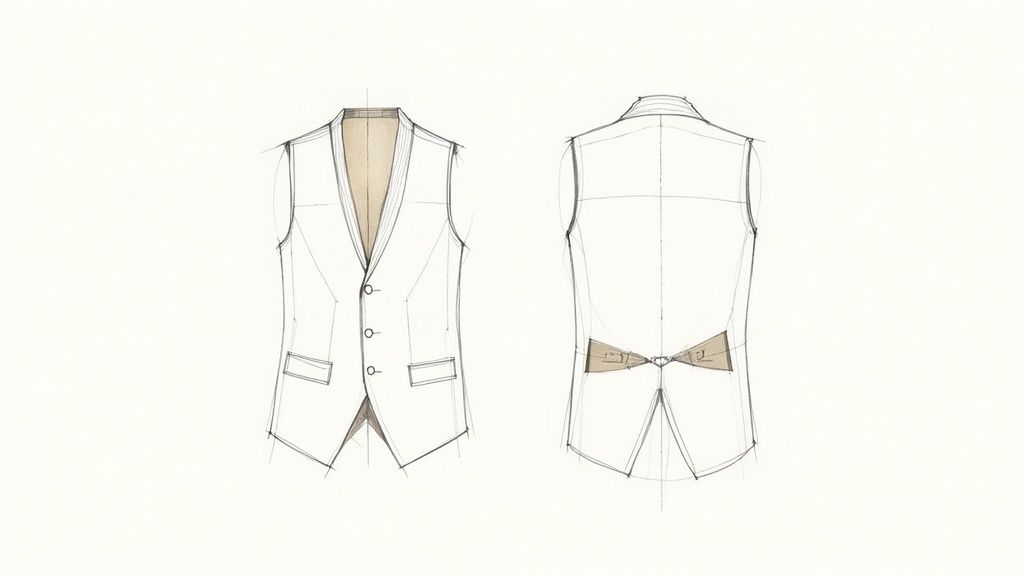
A gentleman’s suit is built from three core components: the jacket, the trousers, and often, a waistcoat. Together, these pieces form the quintessential silhouette. Getting to grips with these fundamental parts of a suit is the first real step into the world of fine tailoring. It allows you to not only appreciate the artistry involved but also to start making choices that truly define your personal style.
Key Takeaways
The Three Core Components: A classic suit is composed of a jacket, trousers, and sometimes a waistcoat, each with specific parts that define its style and formality.
Jacket Anatomy is Key: The jacket’s lapels (notch, peak, shawl), pockets, and internal canvas construction (fused, half, or full) are the most critical elements determining its quality and appearance.
Trousers Anchor the Look: Details like a flat-front or pleated design, side adjusters versus belt loops, and the trouser break (the fold of fabric over the shoe) are crucial for a polished silhouette.
Construction Defines Quality: The difference between ready-to-wear, made-to-measure, and bespoke suits lies in the construction, with a full-canvas interior being the hallmark of superior craftsmanship and longevity.
The Foundations of a Gentleman’s Wardrobe
To properly appreciate a beautifully made suit, you first need to understand its architecture. Don’t think of it as a single garment, but as a meticulously constructed ensemble where every single piece plays a crucial role. This guide will deconstruct each element, serving as a complete glossary for the discerning man.
By exploring every component in detail—from the cut of a jacket’s lapels to the break of a trouser’s cuff—you’ll gain the knowledge to:
Spot quality construction and superior fabrics at a glance.
Speak the same language as your tailor.
Choose the perfect styles for any occasion, from the boardroom to a wedding.
Build a wardrobe that is both versatile and timeless.
This foundational knowledge is absolutely essential before we dive into the finer points, ensuring every decision you make is an informed one.
Deconstructing the Anatomy of a Suit Jacket
The suit jacket is, without question, the centrepiece of any tailored outfit. It’s where craftsmanship and style truly meet, dictating the silhouette, setting the level of formality, and defining the overall impression you make.
Understanding its various parts isn’t just for tailors; it’s essential for anyone looking to invest in a quality garment and communicate their preferences clearly. From the lapels that frame your face to the vents that allow for movement, every single detail serves a purpose, both aesthetic and practical.
The jacket’s importance is also clear in market trends. In the UK, the suit market is a huge part of men’s apparel, projected to hit US$915.23 million by 2025. Tellingly, topwear—which includes suit jackets—accounted for a massive 58.06% revenue share in 2024, confirming its dominance. You can explore more insights into the UK menswear market on Statista.com.
In this deep dive, we’ll explore the external features you can see and the internal construction that defines a jacket’s quality and lifespan. Once you get a handle on these components, you’ll be much better equipped to spot the difference between a simple blazer and a true suit jacket, a topic we cover in our detailed comparison of a blazer vs a suit jacket.
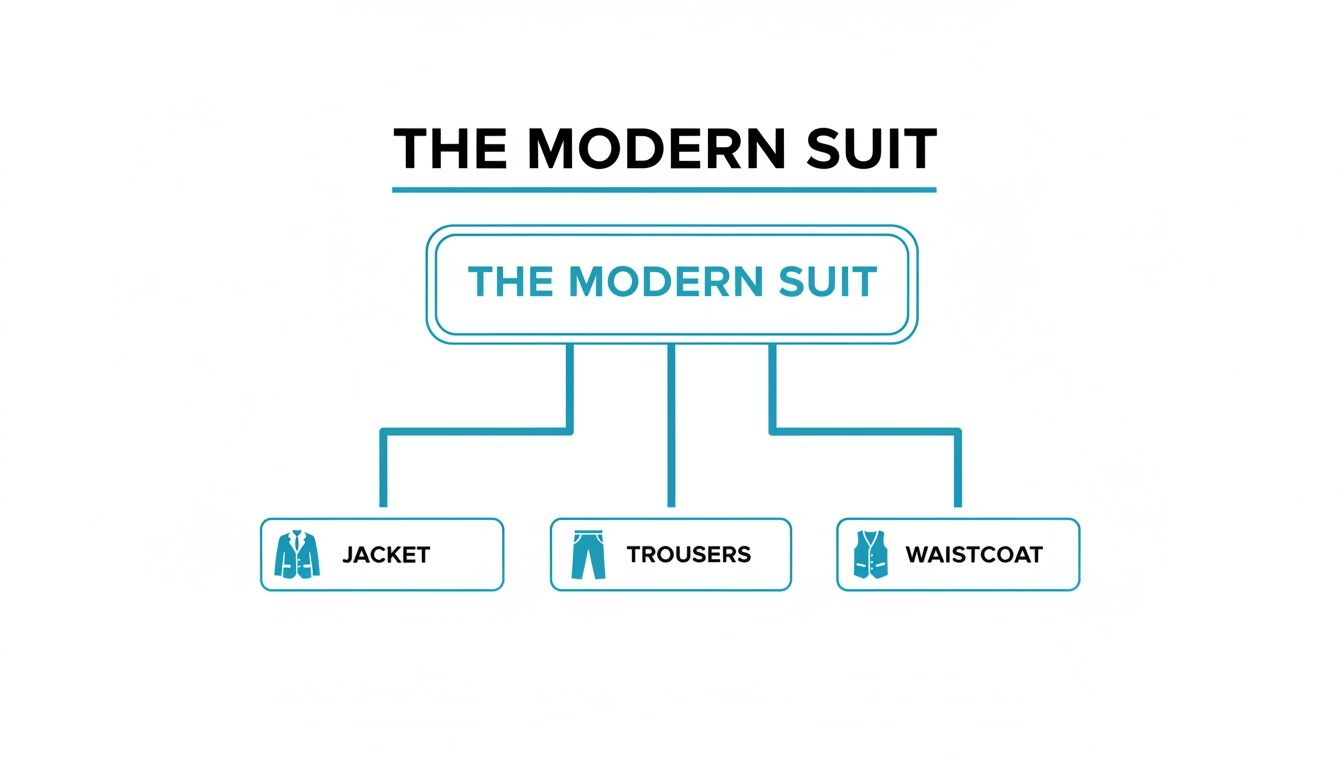
This diagram breaks down the core elements of a modern suit, highlighting how the jacket, trousers, and waistcoat form a cohesive whole.
As you can see, the jacket is the foundation. It’s the piece from which the rest of the suit’s style and structure flows.
External Features The Visible Elements of Style
The external parts of a suit jacket are what create its immediate visual identity. These are the primary tools a tailor uses to craft a garment that complements your physique and is appropriate for the occasion.
First and foremost are the lapels, the folded flaps of cloth on the front of a jacket. They are perhaps the most defining feature, and their style can instantly signal how formal—or informal—a jacket is.
Connected to this is the gorge, which is simply the seam where the collar meets the lapel. A higher gorge can create the illusion of height and is a hallmark of more contemporary tailoring, while a lower gorge is traditionally found on classic, more conservative suits.
Suit Jacket Lapel Styles And Formality
The choice of lapel is one of the most important decisions you’ll make when commissioning or buying a suit, as it has a huge influence on the jacket’s character. There are three primary styles to know, each with its own distinct personality and purpose.
Lapel Style
Description
Best For
Notch Lapel
Features a triangular “notch” where the lapel meets the collar. This is the most common and versatile style you’ll see.
Business suits, blazers, sports coats, and general everyday wear. It’s the standard for a reason.
Peak Lapel
Points upwards sharply towards the shoulder, creating a strong, formal line that broadens the chest.
Double-breasted jackets, dinner jackets (tuxedos), and formal, statement-making tailoring.
Shawl Lapel
A smooth, rounded lapel with no notch or peak at all. It is reserved almost exclusively for evening wear.
Tuxedos, smoking jackets, and any black-tie event where elegance is paramount.
Getting these distinctions right helps you align your suit with the event’s dress code, ensuring you always look the part.
Pockets Buttons And Vents
Beyond the lapels, several other external features contribute to the jacket’s function and form. Pockets, for instance, vary significantly in style and formality.
Jetted Pockets: The most formal option, appearing as a clean, narrow slit in the fabric with no flap. You’ll find these on dinner jackets.
Flap Pockets: The standard for most business suits. These feature a flap covering the pocket opening, striking a perfect balance between practicality and elegance.
Patch Pockets: Stitched directly onto the outside of the jacket, these are the most casual style, perfectly suited for sports coats and informal blazers.
The button stance—the number and placement of buttons—is another critical element. A two-button jacket is the timeless standard, versatile and flattering. A one-button style offers a sleeker, more modern aesthetic, often seen in evening wear. Double-breasted jackets, of course, have a much more commanding presence, defined by their overlapping fronts and multiple buttons.
A key rule of thumb for single-breasted jackets is “sometimes, always, never.” For a three-button jacket, you sometimes fasten the top, always fasten the middle, and never fasten the bottom. For a two-button, it’s simply always the top and never the bottom.
Finally, vents are the slits at the back of the jacket that allow you to move freely. A centre vent is a single slit, common in American tailoring. Side vents, with two slits, are a British tradition that offers a more flattering drape, allowing the back of the jacket to remain smooth when you sit or put your hands in your trouser pockets. A ventless jacket offers the cleanest silhouette but can feel more restrictive.
Internal Construction The Unseen Hallmarks of Quality
What’s going on inside a suit jacket is just as important as what you see on the outside. The internal construction is the real mark of a garment’s quality, durability, and how well it will mould to your body over time.
The most crucial internal component is the canvas. This is a layer of material, traditionally woven from horsehair and wool, that sits between the outer fabric and the lining. Its job is to give the jacket its shape, structure, and life.
There are three main ways a jacket can be constructed:
Fused: A fusible interlining is glued to the fabric. It’s the cheapest method, but it results in a stiffer jacket that doesn’t drape as naturally and can be prone to bubbling after a few trips to the dry cleaner.
Half-Canvas: A canvas piece runs through the chest and lapels, providing structure where it’s needed most while keeping costs down. The lower part of the jacket is fused. This is a great middle ground.
Full-Canvas: The canvas extends all the way from the shoulders down to the hem. This is the gold standard of tailoring, allowing the jacket to drape beautifully and conform to your body’s shape as you wear it. It is, by far, the most durable and comfortable construction.
The lining, typically made from smooth materials like silk, cupro, or viscose, makes the jacket easy to slip on and off. A full lining adds a bit of weight and structure, while a half-lined or unlined jacket is lighter and more breathable—perfect for warmer climates. With bespoke tailoring, you also get the chance to choose a unique lining, adding a touch of personal flair that only you (and those you choose to show) will see.
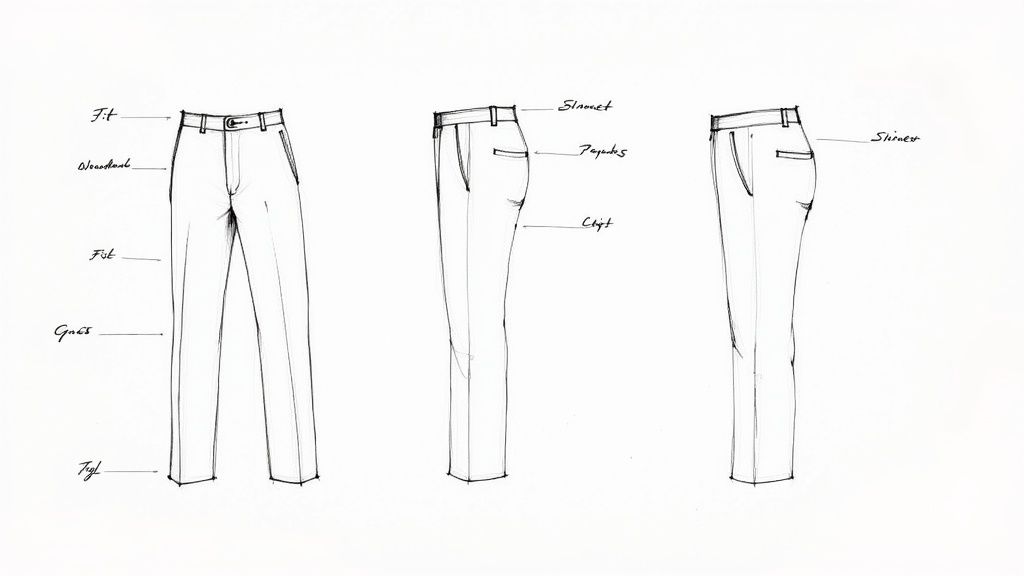
Understanding Suit Trousers from Waist to Hem
While the jacket might steal the limelight, the trousers are the unsung heroes of a great suit. They anchor the entire look, and getting the fit and details right is non-negotiable for a truly polished silhouette. From how they sit on your waist to the way they fall over your shoes, every single element matters.
A well-cut pair of trousers is about more than just comfort; it creates a clean, unbroken line from your waist down to your shoes, making you look taller and sharper. If you want to dive deeper into the nuances of a perfect fit, our detailed guide on how suit trousers should fit is the perfect companion to this anatomical breakdown.
The Waistband and Front Construction
Everything starts at the top. The waistband is the foundation, dictating how the trousers sit and feel throughout the day. In bespoke tailoring, we cut trousers to sit on the natural waist—not the hips. This is a classic technique that has a powerful effect, elongating the leg line and allowing the fabric to drape beautifully.
You’ve got two main options for keeping them up, and each has a very different feel:
Belt Loops: The default for most off-the-rack trousers, offering the practicality of a belt. The trade-off? A belt can sometimes interrupt the clean, seamless line of a well-made suit.
Side Adjusters: These are the hallmark of bespoke trousers. Small buckles or button tabs are built into the waistband, allowing for fine-tuning without the need for a belt. The result is a much cleaner, more streamlined silhouette.
Just below the waistband, you’ll find another key style choice. Flat-front trousers offer a smooth, plain finish for a modern and slimming look. In contrast, pleated trousers have folds of fabric sewn in below the waistband. These pleats—either single or double—give you a bit more room around the hips and thighs, adding comfort and a touch of classic character.
Pockets, Fly, and the Trouser Leg
Moving down, we get to the functional elements. The fly is the opening at the front, almost always fastened with a zip. On higher-end bespoke garments, you might find a traditional button-fly. We always insist on high-quality zips, because nothing is worse than a fastener that fails.
Trouser pockets also come in different styles, each contributing to the overall aesthetic.
Front Pockets: You’ll typically see either slanted pockets, which follow the side seam for easy access, or vertical seam pockets, which are more discreet and cleaner.
Rear Pockets: For suit trousers, the standard is the jetted pocket—a simple, elegant slit in the fabric. We usually add a button to keep it flush against the body and prevent it from gaping open.
The leg itself is where the tailor’s skill really shows. A sharp crease is pressed down the front and back of each leg, and it’s an essential detail that adds structure and formality. The overall cut can be anything from a contemporary slim taper to a more traditional straight leg, all down to your personal preference and what flatters your build.
In the workshop, we are obsessed with the “drape” of the trouser leg—the way the cloth falls cleanly from the thigh all the way down to the shoe. The aim is always a smooth, unbroken line with no pulling, twisting, or bunching.
The Hem and Trouser Break
Finally, we arrive at the point where the trousers meet the shoes. The hem can be finished in a couple of ways: a plain hem, which is the clean, versatile standard, or with turn-ups (cuffs in American English). Turn-ups add a little weight to the bottom of the trouser leg, which helps the fabric hang better. They’re considered a touch less formal and work wonderfully with pleated trousers or heavier cloths like tweed.
The trouser break is that subtle fold of fabric that forms where the front of your trouser leg rests on your shoe. How much break you have is a real point of personal style. You can go for no break at all for a very sharp, modern look, or a full break for a more traditional, classic appearance. Nailing the break is one of those final, tiny details that makes all the difference to the suit’s overall silhouette.
Mastering the Waistcoat for a Three-Piece Suit
The waistcoat, or vest as it’s often called, is the single garment that elevates a standard two-piece into a truly distinguished three-piece suit. It’s what adds that extra layer of depth and formality, pulling the whole look together into a more structured, complete silhouette. A well-fitting waistcoat is far more than just an accessory; it’s a hallmark of high-level tailoring that signals a genuine appreciation for detail.
Its main job is to create a clean, unbroken line from your chest down to your waist. This ensures you look sharp and put-together, even with your jacket unbuttoned, as it elegantly bridges the gap between the jacket and trousers, eliminating any disruptive flash of shirt fabric.
Design and Button Configuration
Much like a suit jacket, waistcoats are available in both single-breasted and double-breasted styles. The single-breasted is the most common choice you’ll see, usually designed with five or six buttons. It has a distinctive pointed bottom that creates a classic ‘V’ shape, perfectly framing the shirt and tie.
An old sartorial rule dictates that the bottom button of a single-breasted waistcoat should always be left undone. This tradition is said to trace back to King Edward VII, who apparently left his unfastened for comfort, inadvertently setting a trend that has stuck around to this day.
Double-breasted waistcoats offer a more formal and commanding presence. They feature overlapping front panels with two parallel columns of buttons, which creates a strong horizontal line across the chest. This style has a more substantial look, adding a touch of old-world panache to any outfit.
Key Construction Elements
The fit of a waistcoat is everything, and several key parts ensure it sits just right. The ‘V’ opening at the top is crucial; its depth and width need to be perfectly balanced to complement the jacket’s lapels and the knot of your tie.
A waistcoat’s length is also non-negotiable. It must be long enough to completely cover the waistband of your trousers, leaving absolutely no shirt visible in between. This creates that seamless transition that is so central to the polished look of a three-piece suit.
Turn it around, and you’ll find the back is typically made from a smooth, silky lining material. This isn’t just for looks; it reduces friction and allows your jacket to glide over it without catching. A vital feature you’ll find on the back is a rear cinch or adjuster. This small belt-and-buckle system allows you to fine-tune the fit around your waist, ensuring the waistcoat lies flat against your torso without any pulling or bunching. It’s this final little adjustment that really achieves that truly tailored finish.
Integrating the Essential Dress Shirt
While it isn’t physically part of the jacket or trousers, the dress shirt is one of the most vital components of any suit. Think of it as the canvas for your tie and the backdrop that makes your suit fabric truly stand out. Picking the right shirt is about more than just colour; every detail has to work in concert with your tailoring to create that polished, unified look we’re all after.
Getting the interplay right between a shirt’s collar, cuffs, and placket and your suit is absolutely crucial for a genuinely impeccable appearance. A mismatched collar can throw off the balance of your jacket’s lapels, and the wrong cuff style can completely disrupt the clean line running from your shoulder to your wrist. Every single detail matters.
Harmonising Collars with Jacket Lapels
The shirt collar is arguably the most important feature, as it frames your face and sets the tone for the entire outfit. The goal here is to create a pleasing visual harmony with the jacket’s lapels. A narrow lapel, for example, looks its best with a smaller, more modest collar. On the other hand, a wide lapel demands a collar with a more generous spread to match its proportions.
There are several key styles you’ll want to get to know:
Point Collar: This is the most traditional style you’ll find, with collar points that sit quite close together. It’s a versatile choice that works perfectly with a classic notch lapel, making it a reliable option for most business settings.
Spread Collar: As the name suggests, this style has wider-set points, creating a broader opening that’s ideal for showing off a more substantial tie knot, like a Half- or Full-Windsor. It pairs beautifully with both notch and peak lapels.
Cutaway Collar: This is an even more dramatic version of the spread, where the points are angled back quite sharply. It’s a bold, contemporary choice that really needs a wide lapel to maintain that visual balance.
A quick tip from the fitting room: the tips of your shirt collar should always be tucked neatly under the jacket lapels. If you can see the points floating above the lapel, it’s a dead giveaway that the collar’s spread is too wide for that particular jacket.
Mastering this harmony is a subtle art. For anyone chasing that perfect match, exploring bespoke options is the way to go. Our guide to perfectly fitted shirts dives deeper into achieving this balance.
Choosing the Right Cuffs and Placket
The cuffs are another critical point of contact between your shirt and suit. The most common style is the barrel cuff, which fastens with one or two buttons. It’s practical, straightforward, and universally accepted for everyday business wear.
For more formal occasions, however, the French cuff is the superior choice. This is a double-length cuff that’s folded back on itself and secured with cufflinks, which adds a touch of elegance and offers a fantastic opportunity for personal expression. A well-tailored jacket sleeve should always be short enough to show about half an inch of shirt cuff.
And to perfectly round out your ensemble, especially when you’re wearing French cuffs, you might consider adding a timepiece. A good place to start is understanding the classic dress watch.
Finally, we have the placket—that vertical strip of fabric where the buttonholes live. This detail also influences a shirt’s formality. A standard placket has a visible stitched edge, making it a common choice for business shirts. For a cleaner, more formal look, a French placket has no visible stitching at all, creating a seamless appearance that’s perfect for black-tie events.
Analysing Suit Fabrics and Construction Quality
Beyond the individual bells and whistles, the true soul of a suit lies in its cloth and construction. The fabric dictates how it feels, how it hangs, and what season it’s best for, while the inner workings determine how long it’ll last and how well it moulds to your body. Getting your head around these elements is the key to making a savvy investment.
Choosing the cloth is your first major decision. Timeless fabrics like wool, cotton, and linen each have their own personality. Wool is really the backbone of classic tailoring; it’s breathable, resists wrinkles, and has a fantastic drape that makes it a year-round workhorse. Cotton offers a crisper, more casual feel, perfect for summer suits, while linen is the undisputed champion of hot weather for its light, airy quality—even if it does crease at the mere thought of being worn. You can get into the finer points with our complete guide to the best fabrics for suits.
The UK’s garment manufacturing sector is a massive part of this picture, supporting some 234,000 businesses and on track to generate £117.7 billion by 2025. This deep-rooted supply chain gives tailors access to everything from fine British wools to hard-wearing synthetics, which is absolutely vital for producing quality garments. You can find more industry insights over at ibisworld.com.
The Spectrum of Suit Construction
How a suit is put together is just as crucial as the fabric it’s made from. There are three main methods, and each one represents a different tier of quality, price, and pure craftsmanship.
Ready-to-Wear (RTW): These are the suits you find hanging on a rail, mass-produced in standard sizes. They’re convenient, for sure, but often need a lot of altering for a decent fit and are typically made using a cheaper fused construction.
Made-to-Measure (MTM): This is a brilliant middle ground. A tailor takes your specific measurements and adjusts a standard, pre-existing pattern to fit you. It offers a far better fit than RTW and gives you some customisation options, neatly bridging the gap between off-the-rack and the full bespoke experience.
Bespoke: This is the absolute pinnacle of the craft. A unique pattern is drafted from scratch, just for you. The customisation options are limitless, and the fit is perfect. A bespoke suit almost always features the superior full-canvas construction.
The Importance of Canvas
The canvas is the unseen heart of a high-quality jacket. It’s the internal layer that gives the garment its shape and structure, and how it’s applied is what separates an exceptional suit from a mediocre one.
Think of the canvas as a floating inner layer. It allows the suit to drape naturally and gently conform to your body over time. It is the single biggest indicator of a suit’s longevity and craftsmanship.
There are three ways it can be done:
Fused: A stiff interlining is literally glued to the fabric. It’s the cheapest and quickest method, but it results in a rigid garment that can start to bubble and peel with age and after a few trips to the dry cleaner.
Half-Canvas: Here, a layer of canvas is stitched through the chest and lapels—the most important areas for structure—while the lower part of the jacket is fused. This gives you the shape and drape where it matters most, but keeps the cost more accessible.
Full-Canvas: This is the gold standard. A full layer of canvas runs from the shoulders right down to the hem. It allows the jacket to mould to your body like a second skin, offering unparalleled comfort, a beautiful drape, and incredible durability. This is the hallmark of true bespoke tailoring.
Frequently Asked Questions About Suit Parts
What is the difference between a notch lapel and a peak lapel?
The main difference is formality and visual impact. A notch lapel, with its triangular ‘notch’, is the most common and versatile style, perfect for everyday business suits and blazers. It’s a safe, classic choice. A peak lapel points upwards towards the shoulder, creating a stronger, more formal V-shape that broadens the chest. This makes it the preferred choice for double-breasted jackets, dinner jackets, and any occasion where you want to make a more powerful sartorial statement.
Should my suit trousers have pleats or a flat front?
This choice depends on both aesthetics and your body type. Flat-front trousers provide a clean, modern, and slimming silhouette, making them a very popular contemporary option. Pleats, which are small folds of fabric at the waistband, add extra room and comfort around the hips and thighs. They create a more traditional look and allow for greater freedom of movement, often suiting men with larger builds or those who simply prefer a classic, comfortable fit for their suit trousers.
What are the vents on a suit jacket for?
Vents are the vertical slits at the back of a suit jacket, designed primarily to improve comfort and freedom of movement. A single centre vent is a classic American style, while double side vents are a British tradition that many prefer as they allow the jacket to drape cleanly over the hips when seated or reaching into pockets. This prevents the fabric from bunching up. A jacket with no vents offers the sleekest silhouette but can feel more restrictive during movement.
What is the gorge on a suit jacket?
The gorge is a specific sartorial term for the seam where the jacket’s collar meets its lapel. While it’s a subtle detail, its placement is significant. A higher gorge, positioned closer to the shoulder, is a hallmark of modern Italian tailoring and can help create an illusion of height and a sleeker silhouette. A lower gorge is more traditional and often found on classic British or American suits. It’s one of those small parts of a suit that master tailors use to subtly shape perception.
Why should the bottom button of a waistcoat be left undone?
Leaving the bottom button of a single-breasted waistcoat unfastened is a long-standing sartorial tradition. The practice is often attributed to King Edward VII, who supposedly left his unbuttoned for comfort due to his size, inadvertently setting a trend. Beyond tradition, it serves a practical purpose: it prevents the waistcoat from pulling and bunching around the hips when you sit down, allowing it to drape more naturally and maintain a cleaner line. It is a sign of sartorial know-how.
About the Author
Igor is the founder and head tailor at Dandylion Style. With years of experience in the world of gentlemen’s bespoke tailoring, he established Dandylion Style to champion the principles of timeless elegance, superior craftsmanship, and personalised service. Igor believes that a well-made suit is more than just clothing; it’s a form of self-expression. He is passionate about educating men on the finer points of sartorial arts, helping them build confidence and develop a personal style that truly reflects who they are.
Igor is the founder of Dandylion Style, a tailoring house built on the simple, deeply held belief that a suit should be like a second skin—a true extension of a gentleman’s personality. For Igor, tailoring isn't just about cutting cloth; it's an art form dedicated to creating unique, perfectly fitted attire for the discerning man. His passion is rooted in classic sartorial traditions, yet he maintains a keen eye for contemporary style, ensuring his creations are both timeless and relevant. This approach has cemented his reputation for genuine craftsmanship and a truly personal service.
Key Takeaways The Core Two: Navy blue and charcoal grey are the essential, non-negotiable suit colors for any professional wardrobe. Navy offers versatility and approachability, while charcoal projects authority and seriousness. Context is Crucial: The best suit color...
When you find a piece of clothing you absolutely love, getting the fit just right is the final, transformative touch. But how much should you expect to pay? In the UK, alteration costs can be as modest as £15 for a simple trouser hemming, or climb to £150 and beyond...
Getting the right pink shirt and tie combination is the mark of a well-dressed man. It’s a detail that separates the novices from those who truly understand their wardrobe. For a look that’s classic and can’t miss, pair your pink shirt with a navy, grey, or burgundy...
Key Takeaways For those seeking a quick overview, this section summarises the essential rules and recommendations for incorporating turn-up trousers into your wardrobe. Sartorial Purpose: Turn-ups add weight to the trouser hem, ensuring a cleaner, sharper drape,...
Deciding what colour tie to wear with a pink shirt is a common style query I hear from clients. For a classic, professional look that never fails, your safest and most effective choices are navy blue and charcoal grey. If you're heading to a more contemporary or...
You've just picked up a newly finished bespoke suit, and the cloth still has that clean, disciplined line only a real fitting room can give it. The temptation is to put it straight in the wardrobe and trust the label to do the rest. That's where expensive...
Book Your Tailoring Consultation
Looking for a suit or garment made specifically for you?
At Dandylion Style, we create bespoke and made-to-measure
garments tailored to your individual shape, style and occasion.
From suits and shirts to dresses, waistcoats and alterations,
our experienced tailors can help you create something truly unique.