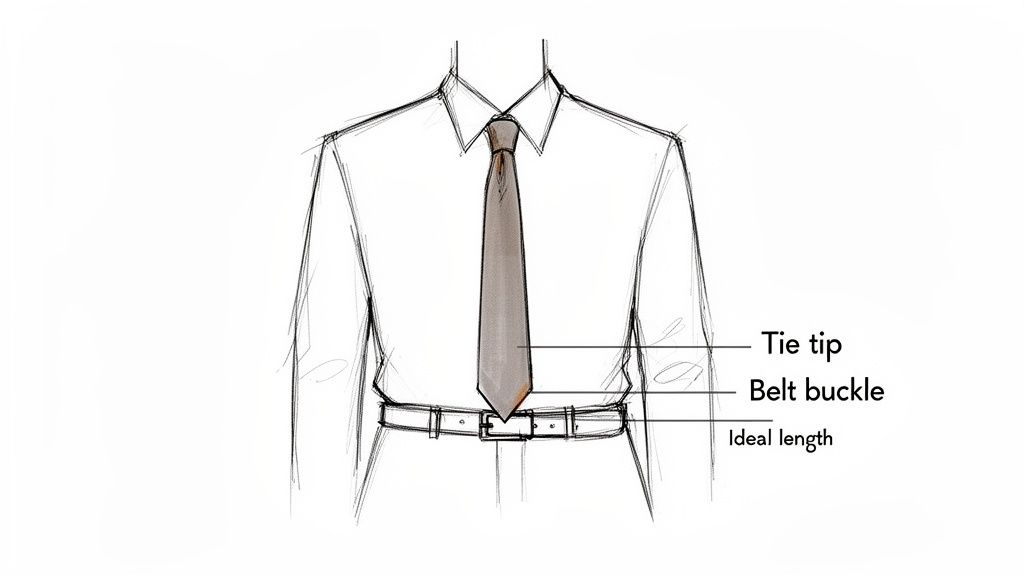
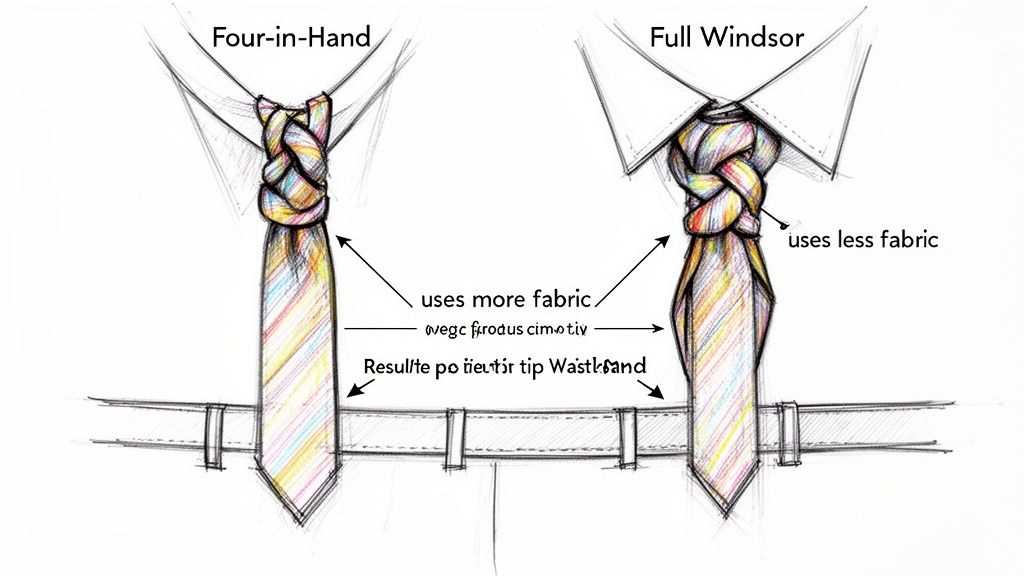
When it comes to the length of your tie, the golden rule is beautifully simple: the tip should just graze the top of your waistband or belt buckle. Get this small detail right, and you create a clean, balanced silhouette that has a surprisingly big impact on your whole look.
Key Takeaways
The Golden Rule: The tip of your tie should just touch the top of your belt buckle or trouser waistband. This creates a clean, balanced vertical line.
Context is Key: Adjust the length when wearing high-waisted trousers (shorter) or a waistcoat (the tie must end behind the waistcoat).
Your Knot Matters: A larger knot like a Full Windsor uses more fabric, shortening the tie's final length. A smaller Four-in-Hand knot preserves length, making it ideal for taller men.
Body Proportions: Standard ties (57-59 inches) suit most men, but taller gentlemen may need extra-long versions to achieve the correct length without compromising on the knot.
Your Quick Guide to Perfect Tie Length
Mastering the length of your tie is one of those fundamental skills in a gentleman's wardrobe. Think of it as the central pillar that holds your entire outfit together. It's the sartorial equivalent of perfect posture; it signals confidence and an eye for the details that matter. This guide is your new reference for getting it spot-on every time.
Key Factors for Ideal Tie Placement
While the "tip to the buckle" rule is a solid place to start, a few other things come into play. Understanding these variables lets you fine-tune the final placement for a flawless finish, whatever you’re wearing.
Your Height and Torso: Most men are well-served by a standard tie (around 57-59 inches), but if you're a taller gentleman, you'll likely need an extra-long version to nail the proportions.
Trouser Rise: Pay close attention to where your waistband sits. High-waisted trousers, for example, have a higher landing point, which means your tie will need to be tied a bit shorter to maintain that perfect balance.
The Knot You Choose: Different knots use up different amounts of fabric. A bulky Full Windsor will eat up more of the tie's length than a slim and simple Four-in-Hand, so you'll need to adjust how you tie it accordingly.
To help you visualise this, here's a quick summary of how different factors can influence the ideal placement of your tie tip.
Quick Reference for Ideal Tie Placement
Factor
Traditional Guideline
Modern Best Practice
Standard Trousers
Tip lands directly on the belt buckle.
Tip should just touch or slightly cover the top of the buckle.
High-Waisted Trousers
Tip meets the waistband.
Aim for the tip to sit just above the natural waistline.
No Belt
Tip aligns with the top of the trouser waistband.
Tip should end at the centre of the waistband button.
Casual/Knit Ties
Same rule applies: tip to the buckle.
Can be worn a fraction shorter for a relaxed feel.
Ultimately, a well-proportioned tie creates a strong, unbroken vertical line. This has the fantastic effect of elongating your frame and lending you a more polished, commanding presence.
It’s a subtle art, but getting the length right is one of those details that truly separates the well-dressed from the exceptionally stylish.
Why the Unspoken Tie Length Rule Matters
Think of your tie as the central pillar of your entire outfit. Like a column in a grand building, its length and placement are crucial to the overall harmony of the structure. It’s far more than just a decorative piece of fabric; the length of the tie is what provides visual balance, guiding the eye and creating a sense of deliberate polish. There's a powerful reason this unspoken rule exists: it's all about proportion.
When a tie hangs too short, floating awkwardly above your waistband, it visually chops your torso in half. This creates a jarring horizontal line that completely disrupts the flow of your suit, making you look shorter and the whole outfit feel ill-considered, even a bit juvenile. It screams of accidental oversight, undermining the very confidence a well-fitted suit is meant to project.
On the other hand, a tie that dangles too far below the belt buckle is just as bad. It unnaturally elongates the torso, throwing your body's proportions completely off-kilter and making your legs seem shorter by comparison. The look is sloppy and careless, instantly detracting from the crisp, clean lines of a tailored jacket and trousers. Your entire silhouette is compromised by this one, simple mistake.
Creating a Seamless Vertical Line
The real goal here is to create a seamless vertical line that runs from your collar right down to your waist. When the tip of your tie just brushes the top of your belt buckle, it achieves this perfectly. This continuous line has a subtle but powerful effect: it elongates your frame, making you appear taller, slimmer, and more put-together.
This is a principle any master tailor understands instinctively. Every single element of a bespoke suit, from the width of the lapels to the break of the trousers, is designed to work in harmony. The length of the tie is a vital part of that equation—a finishing detail that either reinforces the whole tailored look or completely unravels it.
Achieving the correct length demonstrates an appreciation for sartorial detail. It’s a quiet signal that you understand not just what to wear, but how to wear it, ensuring every component of your ensemble presents you at your absolute best.
Getting this right isn't about being a stickler for old-fashioned rules; it’s about using a time-tested principle of visual aesthetics to your advantage. It ensures your look is intentional, cohesive, and ultimately, far more powerful.
Adjusting Tie Length for Your Height and Build
Off-the-rack ties are made with the ‘average’ man in mind, but let’s be honest—true style is anything but average. It’s personal. A standard tie simply won’t suit every physique, which is why learning how to adapt the length to your own height and build is such a vital sartorial skill. It’s about making your clothes work for you, not the other way around.
The first step to getting the fit right is to properly acknowledge your own frame. For taller gentlemen, especially those over 6'2", a standard tie can often feel comically short, failing to reach the waistband and throwing off the entire visual line of your torso. In this case, extra-long ties become a necessity, not just a preference.
For men of a shorter stature, the challenge is the complete opposite but just as crucial to get right. A standard-length tie can easily hang far too low, creating a sloppy, ill-considered look. The secret here lies in the knot; a more substantial knot like the Full Windsor uses up more of the tie’s fabric, effectively shortening the final length for a precise, perfectly balanced finish.
Proportions for the Broader Gentleman
If you have a broader chest or a more robust build, you need to consider the tie’s width and length in tandem. A tie that’s too narrow will simply get lost on a wider frame, while one that’s too short creates an unflattering, disproportionate look. The aim is to find a tie that maintains a powerful, proportional line that complements your physique.
After decades of market research, contemporary British tie makers have settled on remarkably consistent standards. The typical modern tie measures somewhere between 56–59 inches untied, a length that suits most men up to about 6 feet 3 inches. However, any quality retailer will also stock extra-long options, usually around 63 inches, designed for taller gentlemen or those who need a bit more length to accommodate a broader frame.
A well-chosen tie should feel like a natural extension of your outfit. For a truly seamless look, the length and width must be in perfect harmony with your body’s unique proportions.
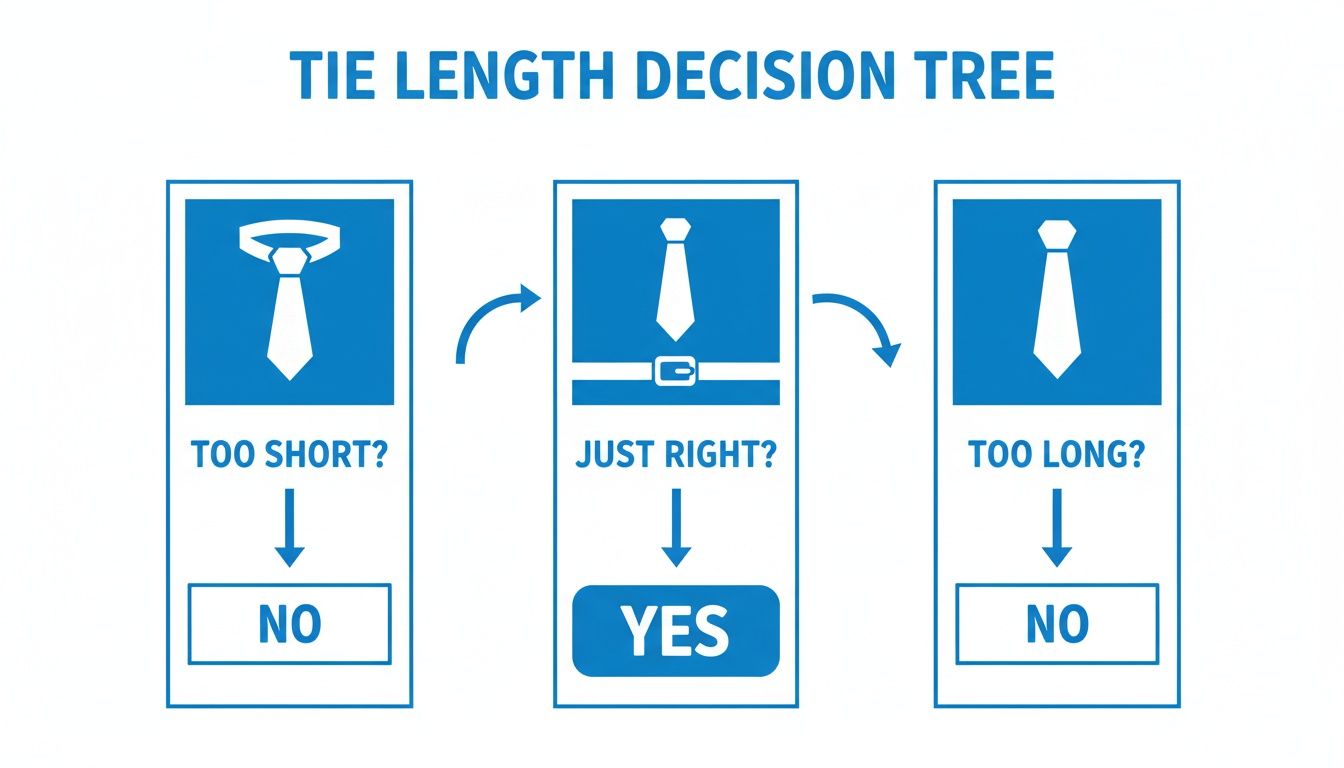
This visual guide helps simplify the process of checking your tie length at a glance.
As the infographic makes clear, the "just right" length—where the tip just grazes the waistband—is what creates the most balanced and visually appealing silhouette.
Beyond the Tie: Your Complete Silhouette
Ultimately, achieving a perfectly tailored look is about ensuring every element of your outfit works in concert. Your tie length is a critical detail, but it’s just one part of a larger picture that includes your entire ensemble. You can find more details in our guide on how to measure yourself for a suit.
Achieving that ideal look isn't solely about your tie; the perfect fit extends to every garment you wear. For instance, to ensure a polished appearance from head to toe, you might also find it helpful to learn how to hem pants for a perfect fit. When every component is correctly proportioned, your personal style is elevated from simply well-dressed to truly impeccable.
How Your Knot Choice Controls the Final Length
Think of the knot you choose as the secret weapon in your sartorial arsenal. It gives you the power to subtly adjust the final length of the tie on the fly, a small detail that makes a world of difference. Different knots consume different amounts of fabric, and mastering this simple fact can dramatically alter where the tip of your tie eventually lands.
A necktie's length isn't fixed in stone; its functional length is decided by how much of that fabric you dedicate to the knot itself. It's a bit like adjusting a rope: a simple, small knot leaves you with plenty of slack, while a large, complex one shortens its overall reach. This principle is absolutely key to making a single tie work for various shirt collars and body types.
Comparing Popular Knots and Fabric Usage
Learning which knots are "thirsty" for fabric and which are more economical is a practical skill every well-dressed man should have. For a shorter gentleman, a larger knot can be a godsend for shortening a standard tie. For a taller chap, a smaller knot helps preserve every precious centimetre of length.
The Four-in-Hand Knot: This is the quintessential lean knot. It's wonderfully simple, slightly asymmetrical, and uses the least amount of fabric. For taller gentlemen, it's often the default choice as it maximises the tie's length, helping it reach the belt buckle without a struggle.
The Half-Windsor Knot: A clear step up in size and symmetry, the Half-Windsor is a versatile, medium-sized knot that sits perfectly in the middle. It takes up more fabric than the Four-in-Hand, making it a brilliant all-rounder for men of average height using a standard-length tie.
The Full Windsor Knot: This is the most substantial and symmetrical of the classic knots. It requires significantly more fabric to pull off, which makes it an excellent tool for shorter men who need to use up more of a standard tie’s length to nail that perfect placement.
Your choice of knot is a practical adjustment, not just a stylistic one. It’s an active decision that directly influences proportion and balance, allowing you to fine-tune your appearance with precision.
This level of control means you can adapt the same tie to different situations. A wider spread collar, for instance, often looks best with a more substantial knot like a Windsor to fill the space. A narrow point collar, on the other hand, pairs elegantly with a slender Four-in-Hand. Knowing how each knot impacts the final length of the tie is a core component of dressing with real intention.
And while the necktie is a classic choice, don't forget that exploring other forms of neckwear can also broaden your stylistic range. For more formal occasions, you might find our guide to handmade silk bow ties particularly useful.
Dressing for the Occasion: Business, Weddings, and Formal Events
Great style isn’t just about memorising rules; it’s about understanding the context and knowing precisely how to adapt. The perfect length for your tie is one of those details that can shift depending on the dress code, and mastering these nuances is a sure sign of a man who knows his clothes. Every occasion has its own subtle expectations.
Mastering the specifics of your outfit is essential, especially when dressing for business functions or formal celebrations. For instance, knowing what to wear for headshots can make a huge difference to your professional image, and details like getting the tie length just right are a massive part of that.
The Unwavering Business Standard
In the professional world, there’s simply no room for debate: the tip of your tie must hit the very top of your belt buckle. This isn't a casual guideline; it’s a non-negotiable part of projecting competence, precision, and a certain quiet authority.
A tie that’s too short looks clumsy, and one that’s too long just looks sloppy. Either way, it undermines the sharp, pulled-together image you want to present. Think of it as the final, confident full stop on your outfit—it shows you care about the details, and that’s a powerful message to send.
Adjusting for Weddings and Waistcoats
Weddings and other events that call for a three-piece suit bring a new player into the game: the waistcoat. The moment you put one on, all the old rules about tie length change.
With a waistcoat, your tie must always end neatly behind it, stopping well above your trouser waistband. The waistcoat creates a new, higher visual endpoint, and the tie has to respect that new boundary.
Letting the tip of the tie poke out from underneath the bottom of your waistcoat is a rookie error. It looks messy and completely disrupts the clean, formal lines you’re trying to create. The goal is a seamless, contained look where every piece works together in perfect harmony.
Navigating Formal and Black-Tie Events
For a proper black-tie affair, the classic choice will always be a bow tie. But if you decide to wear a necktie with your dinner jacket, you must uphold the elegance and tradition of formalwear. We cover this in more detail in our guide on how to dress for a black-tie event.
While the standard rule of the tip touching the waistband still applies, the details become even more critical. The fabric—usually a rich silk or satin—and a neater, more symmetrical knot like the Half-Windsor are essential for maintaining the elevated tone of the evening.
The Bespoke Solution to Perfect Tie Length
When an off-the-rack tie just won't cut it, a bespoke creation is the ultimate solution. For gentlemen who find standard lengths consistently too short or frustratingly long, or for those who simply appreciate the finest craftsmanship, a handmade tie offers a level of precision that mass-produced accessories could never hope to match. It’s the definitive way to achieve the perfect length of the tie.
This approach moves far beyond mere guesswork. It’s a personal consultation, a proper conversation to determine the exact dimensions needed for your unique physique, your preferred shirt collar styles, and even the specific knots you favour.
A Consultation for Unmatched Precision
A true bespoke experience begins with a detailed discussion. At Dandylion Style, Igor will consider several key factors to craft a tie that is perfectly proportioned just for you:
Your Height and Torso Length: The tie’s overall length is cut specifically for you, ensuring the tip lands perfectly at your waistband every single time. No more second-guessing.
Your Preferred Knot: Whether you’re a fan of a lean Four-in-Hand or a more substantial Full Windsor, the tie is made with just the right amount of length and blade width to accommodate it flawlessly.
Your Shirt Collars: The tie’s width is carefully matched to your typical collar style. This ensures a beautiful visual harmony between your shirt and your neckwear, creating a seamless look.
A bespoke tie isn't merely an accessory; it's a piece of personal engineering designed to complete your silhouette with absolute accuracy. This level of detail is a hallmark of true craftsmanship.
The result is a tie that's handmade from exquisite British fabrics, perhaps a pure silk or a fine wool, constructed to your exact specifications. It guarantees that the final detail of your outfit is not just an afterthought, but a deliberate and perfectly executed finishing touch.
Choosing a custom-made tie is one of the many advantages of working directly with a tailor. You can learn more about this meticulous process in our guide that explains what is bespoke tailoring.
Frequently Asked Questions About Tie Length
Should a tie be shorter when wearing a waistcoat?
Yes, absolutely. When wearing a waistcoat, the tie's tip should end comfortably behind it, well above the waistband of your trousers. The waistcoat creates a new, higher visual endpoint for your torso. Allowing the tie to peek out from beneath the waistcoat's bottom points looks untidy and completely disrupts the clean, sharp lines of a three-piece suit. The goal is a seamless, contained appearance where every element is in perfect harmony, with the tie neatly tucked away from sight.
Does the rule change for skinny ties?
No, the rule holds firm regardless of the tie's width. A skinny tie’s tip should also land right at your belt buckle or waistband. While its narrow profile offers a more modern aesthetic that pairs best with slim lapels, the core principle of vertical proportion remains exactly the same. A skinny tie that is either too short or too long creates the same visual imbalance as a standard one, so always aim for that perfect placement to maintain a sharp, deliberate silhouette.
How does trouser rise affect tie length?
Trouser rise is a critical and often overlooked factor. The "tip to the waistband" rule generally assumes you're wearing modern, lower-rise trousers. If you prefer high-waisted trousers that sit at your natural waist, your tie must be tied shorter to meet that higher line. This is why you will often see shorter ties in vintage-inspired or classic tailoring. A skilled tailor always considers the entire silhouette, ensuring the length of the tie is in perfect harmony with your choice of trousers.
What is the standard length of a men's tie?
A standard men's tie typically measures between 57 and 59 inches (about 145-150 cm). This length is designed to accommodate most men of average height and build, allowing them to tie a common knot like a Half-Windsor and have the tip land correctly at the belt buckle. For gentlemen taller than 6'2", an extra-long tie, usually around 63 inches (160 cm), is often necessary to achieve the correct proportions without having to resort to an overly small knot.
How do I fix a tie that is too long?
If your tie is too long, the easiest solution is to use a larger knot. A Full Windsor or even a Pratt knot will use up more of the tie's fabric, effectively shortening the final length. Another option is to tuck the narrow end (the tail) into your shirt between two buttons. For a more permanent fix with a beloved tie, a professional tailor or seamstress can skillfully shorten it from the narrow end, preserving the shape of the main blade.
And of course, once you've perfected the length, remember that colour coordination is just as vital. You can learn more by reading our guide on the best tie colours for a blue shirt.
About the Author: Igor Srzic-Cartledge of Dandylion Style
Igor is the founder and master tailor behind Dandylion Style, a luxury bespoke tailoring house nestled in Ardingly, West Sussex. With a profound passion for fine British fabrics and the art of precision cutting, Igor specialises in creating truly one-of-a-kind garments, each shaped perfectly to the client. From bespoke suits for weddings and business to casual tailoring and handmade accessories, his work is defined by quiet refinement and an unwavering commitment to quality. Igor’s honest, expert guidance ensures every client receives a garment that is both deeply personal and truly enduring.
Key Takeaways The Core Two: Navy blue and charcoal grey are the essential, non-negotiable suit colors for any professional wardrobe. Navy offers versatility and approachability, while charcoal projects authority and seriousness. Context is Crucial: The best suit color...
When you find a piece of clothing you absolutely love, getting the fit just right is the final, transformative touch. But how much should you expect to pay? In the UK, alteration costs can be as modest as £15 for a simple trouser hemming, or climb to £150 and beyond...
Getting the right pink shirt and tie combination is the mark of a well-dressed man. It’s a detail that separates the novices from those who truly understand their wardrobe. For a look that’s classic and can’t miss, pair your pink shirt with a navy, grey, or burgundy...
Key Takeaways For those seeking a quick overview, this section summarises the essential rules and recommendations for incorporating turn-up trousers into your wardrobe. Sartorial Purpose: Turn-ups add weight to the trouser hem, ensuring a cleaner, sharper drape,...
Deciding what colour tie to wear with a pink shirt is a common style query I hear from clients. For a classic, professional look that never fails, your safest and most effective choices are navy blue and charcoal grey. If you're heading to a more contemporary or...
You've just picked up a newly finished bespoke suit, and the cloth still has that clean, disciplined line only a real fitting room can give it. The temptation is to put it straight in the wardrobe and trust the label to do the rest. That's where expensive...
Book Your Tailoring Consultation
Looking for a suit or garment made specifically for you?
At Dandylion Style, we create bespoke and made-to-measure
garments tailored to your individual shape, style and occasion.
From suits and shirts to dresses, waistcoats and alterations,
our experienced tailors can help you create something truly unique.