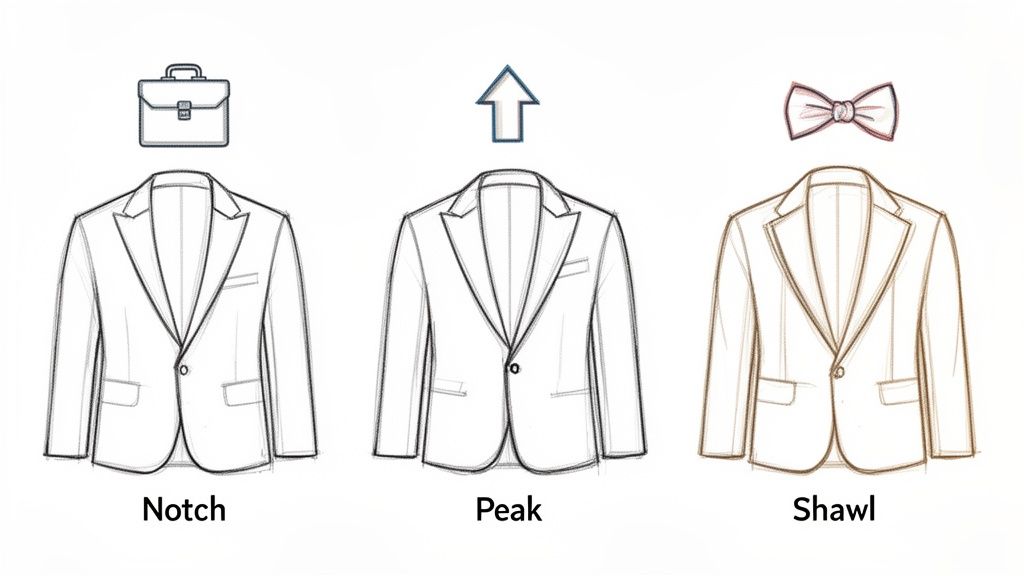
A jacket’s lapels are far more than just folded bits of cloth. They’re the single most important detail that frames your torso, sets the tone for the entire garment, and speaks volumes about the occasion. You have three foundational styles to choose from: the workhorse notch lapel for business and everyday wear, the powerful peak lapel for more formal moments, and the elegant shawl lapel, reserved almost exclusively for black-tie.
Getting to grips with these is the first step towards commissioning a jacket that’s truly, distinctively yours.
Key Takeaways
Three Core Styles: The most common lapel is the versatile notch lapel, suitable for business and casual wear. The peak lapel is more formal, ideal for weddings and statement suits, while the elegant shawl lapel is reserved for tuxedos and black-tie events.
Proportion is Paramount: Lapel width should be in proportion to your body type. A skilled tailor balances the width with your shoulder and chest measurements to create a flattering, timeless silhouette.
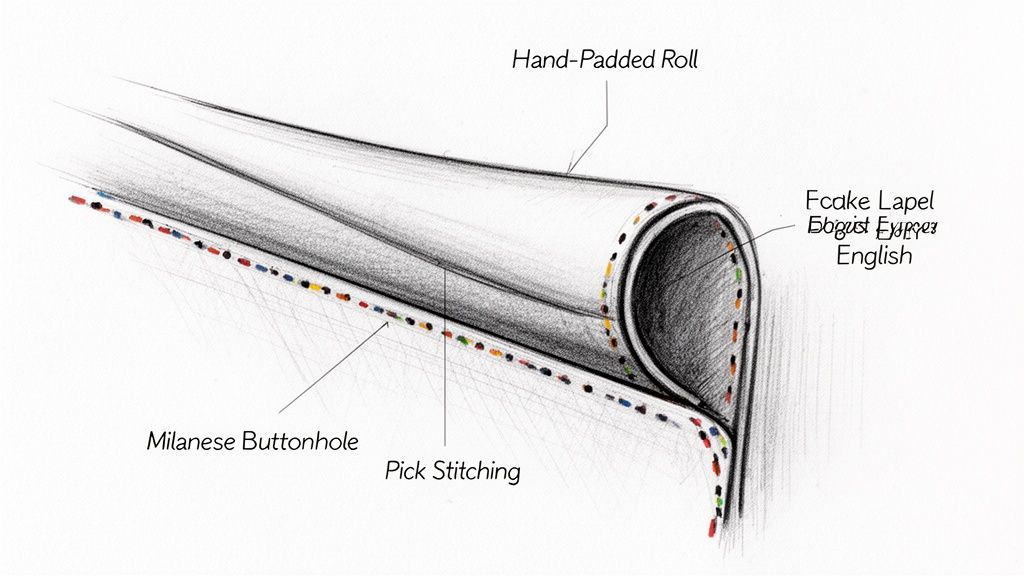
Craftsmanship Matters: The hallmark of a bespoke jacket is the lapel roll—a gentle, three-dimensional curve created by hand-padding a full canvas. This detail, along with functional buttonholes and pick stitching, signals superior quality.
Your Guide to Mastering Jacket Lapels
Think of a jacket’s lapels as its signature—the flourish that communicates your intent, personal style, and respect for the occasion. This guide will walk you through the core principles that separate an ordinary jacket from an exceptional one, giving you the confidence to make the right choices for your next commission.
Here’s what we’ll cover:
The Three Foundational Styles: We’ll break down the notch, peak, and shawl lapels and, most importantly, explain where each one shines.
Proportion is Key: Discover how a skilled tailor uses lapel width to complement your unique body shape, creating a timeless look that transcends fleeting trends.
The Bespoke Difference: We’ll introduce you to the subtle details, like the gentle lapel roll, that signal superior craftsmanship and set a bespoke creation leagues apart.
With this foundation, you’ll not only appreciate the artistry involved but also be able to articulate your own vision with clarity and confidence.
Deconstructing the Anatomy of a Lapel
To truly get a feel for the artistry that goes into a jacket's lapels, you first need to understand what makes them tick. Like a piece of fine architecture, a lapel isn't just one piece of fabric; it’s a careful assembly of different parts all working in concert. Learning this language is the first step towards having a much deeper, more productive conversation with your tailor.
Think of the lapel as more than just a folded flap of cloth. It's the aesthetic and structural frame for your entire torso. Every single component, from the gentle curve of its roll down to the precise point where it meets the collar, plays a vital role in the jacket's overall character and how it drapes. Understanding these parts allows you to see a jacket not just as an item of clothing, but as a thoughtfully constructed object.
The Key Components of a Lapel
There are two elements, above all others, that define a lapel’s shape: the gorge and the lapel roll. These are the details that separate a lifeless, mass-produced jacket from a dynamic, bespoke creation that feels alive.
The gorge is simply the seam where the bottom of the collar meets the top of the lapel. The height of this seam has a surprisingly powerful effect on your silhouette. A higher gorge tends to create an illusion of height, giving the jacket a more contemporary feel. A lower gorge, on the other hand, often harks back to a more traditional, classic aesthetic.
Next, you have the lapel roll, which is perhaps the most telling sign of true craftsmanship. This isn't a sharp, ironed-in crease but a gentle, three-dimensional curve that allows the lapel to fall away gracefully from the collar and rest softly on the chest. A beautiful roll is something that can only be achieved with a full-canvas construction, where the inner layers are meticulously hand-padded to create that elegant, flowing shape.
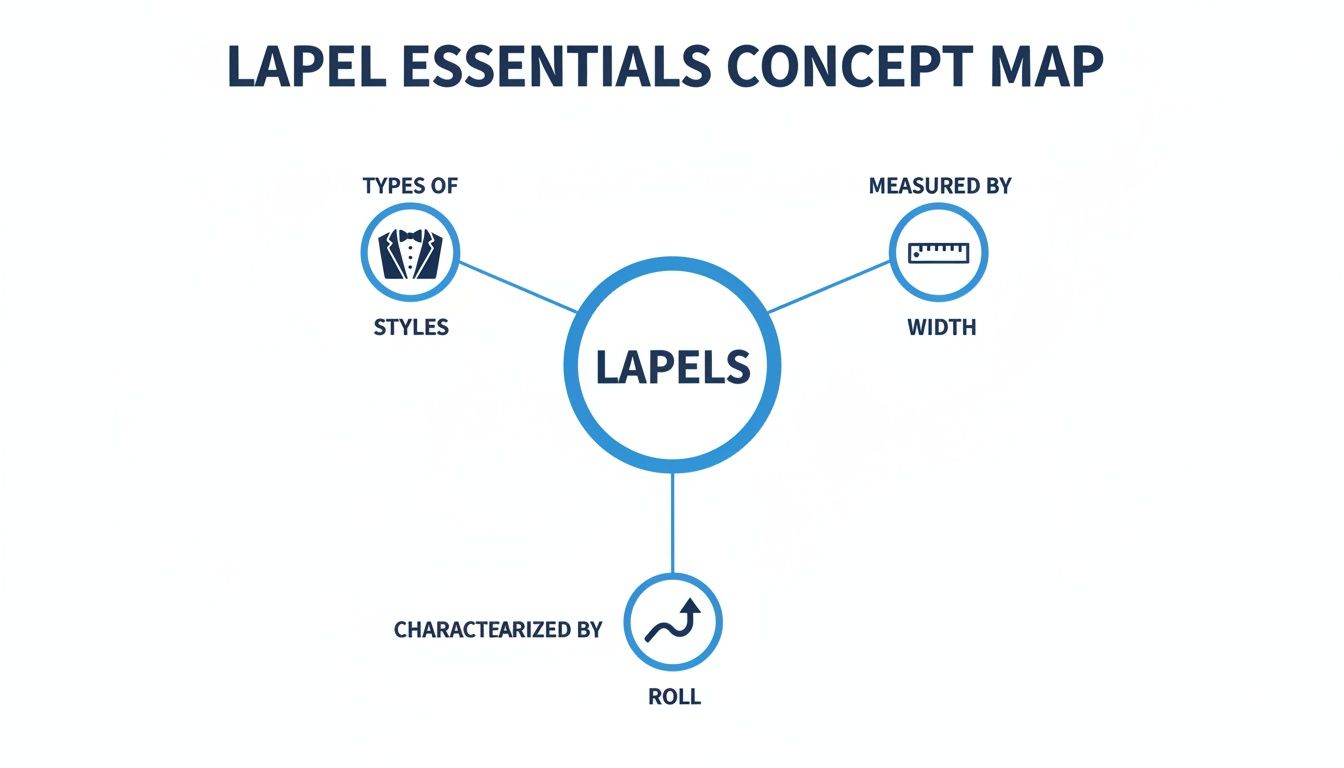
This visual guide breaks down how styles, width, and roll are the three core pillars of great lapel design.
As the infographic shows, a lapel's character is a careful balance of these three interconnected elements.
Finishing Touches That Define Quality
Beyond the main structure, it's the smaller details that contribute so much to the lapel’s finish and function. These are often the quiet signatures of a meticulously made garment.
A lapel buttonhole, for instance, should always be functional on a bespoke jacket. It was historically used to fasten the jacket at the neck for a bit of extra warmth, but today it serves as the perfect spot for a boutonnière. The quality of the stitching here—especially in a hand-sewn Milanese buttonhole—speaks volumes about the skill involved. For a deeper dive into all the components that make up a suit, you might find our guide on the parts of a suit useful.
A beautifully executed lapel roll is the soul of a jacket. It’s not just folded fabric; it's a soft, living curve that shows the garment has been shaped by hand, not just pressed by a machine.
Finally, pick stitching refers to those small, subtle stitches running along the lapel's edge. While machines often try to mimic this look, true hand-pick stitching is a hallmark of artisanal care. It adds a touch of texture and reinforces the lapel’s edge with an understated flourish. It’s these anatomical details, all working together, that ultimately form the unique personality of your jacket.
Choosing Your Style: Notch, Peak, or Shawl
The lapel you choose is probably the single biggest statement your jacket can make. It’s a detail that sets the formality, frames your torso, and telegraphs your understanding of the unwritten rules of style. While all three main types—notch, peak, and shawl—are superb in the right context, knowing which one to pick for the occasion and your personal taste is a crucial step in commissioning a suit that truly works for you.
Each style has its own distinct personality. The notch is the reliable workhorse, the peak is the confident power player, and the shawl is pure, unadulterated elegance. Understanding their unique characters is the key to building a wardrobe where every jacket serves its purpose perfectly.
The Notch Lapel: The Versatile Standard
The notch lapel is, without a doubt, the most common style you’ll see on a gentleman's jacket, and for good reason. It’s defined by the very distinct, V-shaped 'notch' cut into the fabric right where the lapel meets the collar. Think of it as the Oxford shoe of the lapel world—it’s classic, dependable, and appropriate for an incredibly wide range of settings.
This inherent versatility makes it the go-to choice for most business suits, sports coats, and casual blazers. The notch lapel projects a quiet confidence without shouting for attention, making it ideal for the boardroom, a job interview, or a smart-casual weekend gathering. It really is the foundation of any well-rounded tailored wardrobe.
The notch lapel is the cornerstone of daily tailoring. Its strength lies in its understatement, providing a clean and timeless frame that works with nearly any physique or occasion.
But its ubiquity is also its one limitation. For those moments that call for a higher degree of formality or a more pronounced statement, the notch can sometimes feel a little too safe. A bit ordinary. This is where its more assertive cousin, the peak lapel, really comes into its own.
The Peak Lapel: The Commanding Choice
The peak lapel is instantly recognisable. You can’t miss its sharp edges that point dramatically upwards towards the shoulder, creating a strong, dynamic line. This style is inherently more formal and theatrical than the notch, tracing its heritage back to formal evening tailcoats. Today, it remains a powerful choice that conveys authority and a certain sartorial flair.
That upward sweep has a wonderfully flattering effect, drawing the eye outwards and upwards, which helps to broaden the shoulders and create the illusion of height. It is the absolute standard for double-breasted jackets, but it also makes a bold statement on a single-breasted suit, elevating it from standard business wear to something more fitting for a celebration or a major event. To really get to grips with this style, we explore it further in our guide to the peak lapel suit.
Because of its formal heritage, the peak lapel is an excellent choice for:
Wedding Suits: It adds a celebratory feel that’s perfect for a groom or a distinguished guest.
Formal Business Attire: In high-stakes environments, it projects confidence and power like nothing else.
Black-Tie Events: While the shawl lapel is the other classic, a tuxedo with peak lapels is a sharp and equally correct alternative.
Choosing a peak lapel is a deliberate decision to stand out. It signals that you appreciate the finer points of tailoring and aren’t afraid to make a confident statement.
The Shawl Lapel: The Epitome of Elegance
Finally, we arrive at the shawl lapel. Unlike its angular counterparts, the shawl lapel features a smooth, continuous, rounded edge. It flows seamlessly from the collar, around the neck, and down the front of the jacket. No notches, no peaks—just one unbroken line of pure elegance.
This style is reserved almost exclusively for black-tie and formal eveningwear, most notably on dinner jackets and smoking jackets. Its soft, clean curve offers a sophisticated contrast to the crisp lines of a dress shirt and bow tie. The face of the shawl lapel is also typically finished in a contrasting fabric like silk, satin, or grosgrain, adding a luxurious texture and a subtle sheen.
Its purpose is singular: to convey refined formality in evening settings. You would never wear a shawl lapel to the office. It belongs at galas, formal weddings, and any occasion where the dress code is explicitly black-tie. It is the pinnacle of formal elegance, offering a look that is both timeless and effortlessly graceful.
Here's a quick guide to help you match the lapel to the moment. Think of this as your sartorial cheat sheet for getting it right every time.
Lapel Style Occasion Guide
Lapel Style
Best For Occasions
Commonly Found On
Formality Level
Notch
Business, Smart-Casual, Daily Wear, Less Formal Weddings
Black-Tie Galas, Formal Evening Events, Red Carpet
Dinner Jackets (Tuxedos), Smoking Jackets
Strictly Formal / Evening
While these are the general rules, remember that in bespoke tailoring, the final decision is always yours. Understanding the language of lapels allows you to make an informed choice that perfectly aligns with the garment's purpose and your own personal style.
How Lapel Width Shapes Your Silhouette
Beyond the simple choice of notch, peak, or shawl, the width of your lapels is one of the most powerful tools in a tailor’s arsenal. This isn't about chasing fleeting trends; it’s a fundamental principle of proportion. A well-chosen lapel width works in harmony with your physique, creating a balanced and flattering silhouette that feels both timeless and personal.
This is where the art of bespoke tailoring really comes into its own. While an off-the-rack jacket offers a generic, one-size-fits-all solution, a skilled tailor like Igor here at Dandylion Style takes the time to analyse your individual frame—your shoulder breadth, your chest measurement, even your height—to recommend a width that enhances your best features. It’s a completely personal approach that ensures your jacket is a true extension of you, not just another garment on a hanger.
Finding Your Proportional Sweet Spot
The golden rule of lapel width is, quite simply, balance. A good lapel should lead the eye gracefully across your upper body, carving out a V-shape that complements your torso without either overwhelming it or looking lost. The goal is to strike a visual equilibrium that just feels right.
For years, a classic starting point was to match the lapel width to the widest point of your tie, which typically lands somewhere between 3 to 3.5 inches (around 7.5 to 9 cm) for a man of average build. Think of this as a guideline, though, not a rigid rule. The real artistry is in adapting that starting point to your specific body type, making sure the final result is perfectly in tune with your proportions.
A jacket's lapel should be a conversation, not a command. Its width should speak to the proportions of the wearer, creating a subtle harmony between fabric and frame that off-the-rack can never replicate.
This dialogue between the garment and the man wearing it is central to the bespoke experience. We move beyond generic numbers to create something that feels utterly unique.
Tailoring Lapels to Your Body Type
So, how does this principle of balance work in practice? A bespoke tailor uses lapel width to create specific optical effects, subtly sculpting and refining your silhouette. It’s a quiet art, but one with a massive impact on how the finished jacket looks and feels.
Here’s a look at how we adjust lapel width for different body frames:
For the Slimmer Gentleman: A slightly wider lapel (around 3.5 inches or more) can work wonders. That extra width creates the illusion of a broader chest and shoulders, adding a bit of substance and presence to a slender frame. Go too skinny with the lapel, and you risk making a slim man look even narrower.
For the Broader Gentleman: Here, moderation is key. An excessively wide lapel will only add unnecessary bulk to a larger frame, while a skinny lapel can look comically small and out of proportion. We aim for a balanced width that maintains a strong, masculine line without any exaggeration.
For the Shorter Gentleman: We can create an illusion of height by using a slightly slimmer lapel with a higher gorge (where the lapel meets the collar). This has the clever effect of drawing the eye upward, elongating the torso to create a longer, more flattering vertical line.
For the Taller Gentleman: A taller man can comfortably carry a slightly wider lapel. It helps to balance out a longer torso and broader shoulders, ensuring the lapels feel substantial and perfectly proportional to his height.
This kind of detailed consideration is especially vital for garments like double-breasted jackets, where the interplay of proportions is far more complex. You can dive deeper into that in our guide comparing single-breasted vs double-breasted suits, where lapel choice plays a starring role.
Ultimately, the perfect lapel width isn't something you can find on a chart. It’s a carefully considered decision made between you and your tailor—a collaboration designed to produce a jacket that is in perfect harmony with your body. This ensures the lapels of a jacket don’t just look correct, they feel intrinsically right.
The Hallmarks of Bespoke Lapel Craftsmanship
What truly sets an exceptional, bespoke jacket apart from a standard, off-the-rack garment? The answer is rarely found in grand gestures. Instead, it’s woven into a series of subtle, handcrafted details that are felt as much as they are seen. These hallmarks of craftsmanship are central to our philosophy, representing a deep commitment to artisanal quality over mass-produced uniformity.
These fine points are where the soul of the jacket resides. While an ordinary lapel might lie flat and lifeless, a bespoke lapel has a dynamic, three-dimensional quality that breathes life into the entire garment. It’s a testament to the patient, skilled work of a tailor’s hands, transforming simple cloth into something with structure, grace, and personality.
The Art of the Hand-Padded Lapel Roll
One of the most telling signs of a superior jacket is the lapel roll. Look closely at the way the lapel curves from the top button towards the collar. A truly great jacket won't have a sharp crease pressed in by a machine; it will have a gentle, elegant curve that falls away from the chest. This is the roll, a rich, convex shape built from within using hundreds of careful hand stitches that attach the canvas interlining to the cloth.
This process, known as hand-padding, creates a natural tension that encourages the lapel to sit proudly, giving it depth and character. In contrast, mass-produced jackets often use a fusible interlining that is essentially glued to the fabric. The result is a lapel that looks flat, stiff, and two-dimensional, lacking the organic curve that defines high-quality tailoring.
The lapel roll is the gentle heartbeat of a bespoke jacket. It’s a subtle but constant reminder that the garment was shaped by a human hand, not just cut and fused by a machine.
This meticulous construction does more than just look beautiful. It ensures the jacket drapes correctly over your body and maintains its intended shape for years, long after a fused lapel would have started to bubble or lose its form. Our guide to crafting bespoke suits explores how this foundational quality is built into every garment we create.
Signatures of Elite Tailoring
Beyond the structural beauty of the lapel roll, other exquisite details serve as quiet signatures of artisanal care. These are the elements that a discerning eye will instantly recognise as marks of true craftsmanship, setting your jacket apart.
The Milanese Buttonhole: Far more than a simple slit in the cloth, the Milanese buttonhole is a small work of art. It requires immense skill, using a special gimp thread to build up a raised, lustrous buttonhole that is both incredibly durable and visually stunning. Its precise, hand-sewn finish is an unmistakable mark of elite, continental tailoring.
Pick Stitching: These are the small, subtle stitches that run along the edge of the lapels. While often imitated by machines, authentic hand-pick stitching has a unique, slightly imperfect charm that adds texture and a bespoke feel. It keeps the lapel’s edges crisp and clean, demonstrating a commitment to finishing every detail perfectly.
These flourishes aren't new; they echo a long tradition in menswear. The 1920s, for instance, were a golden age for lapel design. British style evolved from the slim, military-influenced cuts post-World War I to more opulent, padded styles that screamed prosperity. In the UK, particularly among London's aristocracy and the country gentlemen of West Sussex, jacket lapels widened to 4 inches by 1925—a significant jump from the 2.5-inch averages of 1918. Paired with boxy silhouettes, it created a drape that was altogether sportier and more confident.
Frequently Asked Questions About Jacket Lapels
What is the ideal width for my jacket lapels?
The right lapel width isn't about chasing trends; it's all about proportion. A good rule of thumb is to have your lapel’s width echo the width of your favourite tie, but the most important factor is your own physique. A slimmer gentleman often looks best with lapels around 2.5–3 inches, while men with broader shoulders can easily carry a wider lapel of 3.5–4 inches. A bespoke tailor will look at your chest and shoulder measurements to recommend a width that creates a perfectly balanced and flattering silhouette.
What’s the best lapel style for a wedding suit?
For a groom, a peak lapel is a fantastic choice. That confident, upward sweep adds a real sense of occasion and celebration, broadening the shoulders on any jacket. For a black-tie wedding, the seamless, elegant line of a shawl lapel on a dinner jacket is the quintessential, sophisticated option. For guests, or for less formal ceremonies, a notch lapel is a classic and safe bet. It’s timeless and appropriate, ensuring you look sharp without upstaging the main event.
Can my tailor change the lapel style on my existing jacket?
This is one of the trickiest and riskiest alterations in tailoring. Changing a lapel's fundamental style—say, from a notch to a peak—is almost always impossible. It is major surgery that requires the entire front panels of the jacket to be recut, and there is simply never enough spare fabric hidden in the seams to make it work. While a master tailor might be able to slim down a very wide lapel, it is a complex job. It is far better to get the style right from the beginning.
Why do tailors talk about the lapel roll so much?
The lapel roll is one of those subtle details that separates a truly high-quality, canvassed garment from an ordinary one. It’s the gentle, three-dimensional curve from the jacket's fold down to the lapel's edge. Instead of being pressed flat and lifeless by a machine, a proper lapel is meticulously hand-shaped to create depth and elegance, allowing it to sit beautifully against your chest. This crucial detail is a hallmark of superior craftsmanship and ensures your jacket drapes as it should.
What is a Milanese buttonhole on a lapel?
A Milanese buttonhole is a hallmark of elite tailoring. Unlike a standard machine-stitched hole, it is sewn by hand with immense skill using a special gimp thread. This technique builds up a raised, lustrous, and highly durable buttonhole that is a small work of art. Its precise, clean finish is an unmistakable signature of high-end continental bespoke craftsmanship and is most often found on the lapel of a jacket, ready for a boutonnière. It is a detail that speaks volumes about the quality of the garment.
About the Author
Igor is the founder and master tailor behind Dandylion Style. From his studio in Ardingly, West Sussex, he brings a modern sensibility to the rich heritage of British tailoring. Igor believes that a bespoke suit is more than clothing; it is an investment in personal expression and enduring quality. His approach is built on calm, considered guidance, helping clients navigate every decision with confidence—from fabric selection to the final, precise details. This commitment to quiet excellence has earned him an esteemed reputation across Sussex and London. You can learn more about Igor's journey in bespoke tailoring.
At Dandylion Style, we believe the perfect lapel is the cornerstone of a truly exceptional jacket. Let us guide you through every detail of your next commission. Begin your bespoke journey with us at dandylionstyle.co.uk.
Key Takeaways The Core Two: Navy blue and charcoal grey are the essential, non-negotiable suit colors for any professional wardrobe. Navy offers versatility and approachability, while charcoal projects authority and seriousness. Context is Crucial: The best suit color...
When you find a piece of clothing you absolutely love, getting the fit just right is the final, transformative touch. But how much should you expect to pay? In the UK, alteration costs can be as modest as £15 for a simple trouser hemming, or climb to £150 and beyond...
Getting the right pink shirt and tie combination is the mark of a well-dressed man. It’s a detail that separates the novices from those who truly understand their wardrobe. For a look that’s classic and can’t miss, pair your pink shirt with a navy, grey, or burgundy...
Key Takeaways For those seeking a quick overview, this section summarises the essential rules and recommendations for incorporating turn-up trousers into your wardrobe. Sartorial Purpose: Turn-ups add weight to the trouser hem, ensuring a cleaner, sharper drape,...
Deciding what colour tie to wear with a pink shirt is a common style query I hear from clients. For a classic, professional look that never fails, your safest and most effective choices are navy blue and charcoal grey. If you're heading to a more contemporary or...
You've just picked up a newly finished bespoke suit, and the cloth still has that clean, disciplined line only a real fitting room can give it. The temptation is to put it straight in the wardrobe and trust the label to do the rest. That's where expensive...
Book Your Tailoring Consultation
Looking for a suit or garment made specifically for you?
At Dandylion Style, we create bespoke and made-to-measure
garments tailored to your individual shape, style and occasion.
From suits and shirts to dresses, waistcoats and alterations,
our experienced tailors can help you create something truly unique.