A client once brought me three waistcoats she'd bought for the same event. One strained across the bust, one stood away at the armhole, and the third fit only if she didn't sit down. The problem wasn't taste. It was cut.
Key Takeaways
A good waistcoat for women isn't a novelty piece. It's one of the most useful garments in a considered wardrobe, because it can sharpen casual clothes, soften formal tailoring, and anchor an outfit without the weight of a full jacket.
The difference between flattering and frustrating usually comes down to fit through the bust, waist and shoulder line. Women's bodies vary too much for a generic block to work consistently, especially if you want a waistcoat that can be worn both as a layering piece and as a stand-alone top. That's why bespoke matters. It corrects the familiar faults of ready-made pieces, including gaping armholes, pulling at the buttons, and awkward length.
Fabric matters just as much. Linen gives ease and airiness. Wool brings structure. Tweed adds depth and British character. Cashmere softens the line. Mohair keeps the shape crisp. When the cloth, cut and purpose align, the waistcoat stops feeling borrowed from another wardrobe and starts feeling entirely your own.
The Modern Resurgence of the Woman's Waistcoat
The waistcoat's return looks modern, but it isn't new. Women have been wearing versions of this garment for centuries, long before it became shorthand for contemporary tailoring. By at least the middle of the sixteenth century, waistcoats were worn by all social sorts in England, and seventeenth-century records show that waistcoats and petticoats were the most common daily garments worn by women in England, more common than gowns, as noted in this historical study of seventeenth-century women's waistcoats.
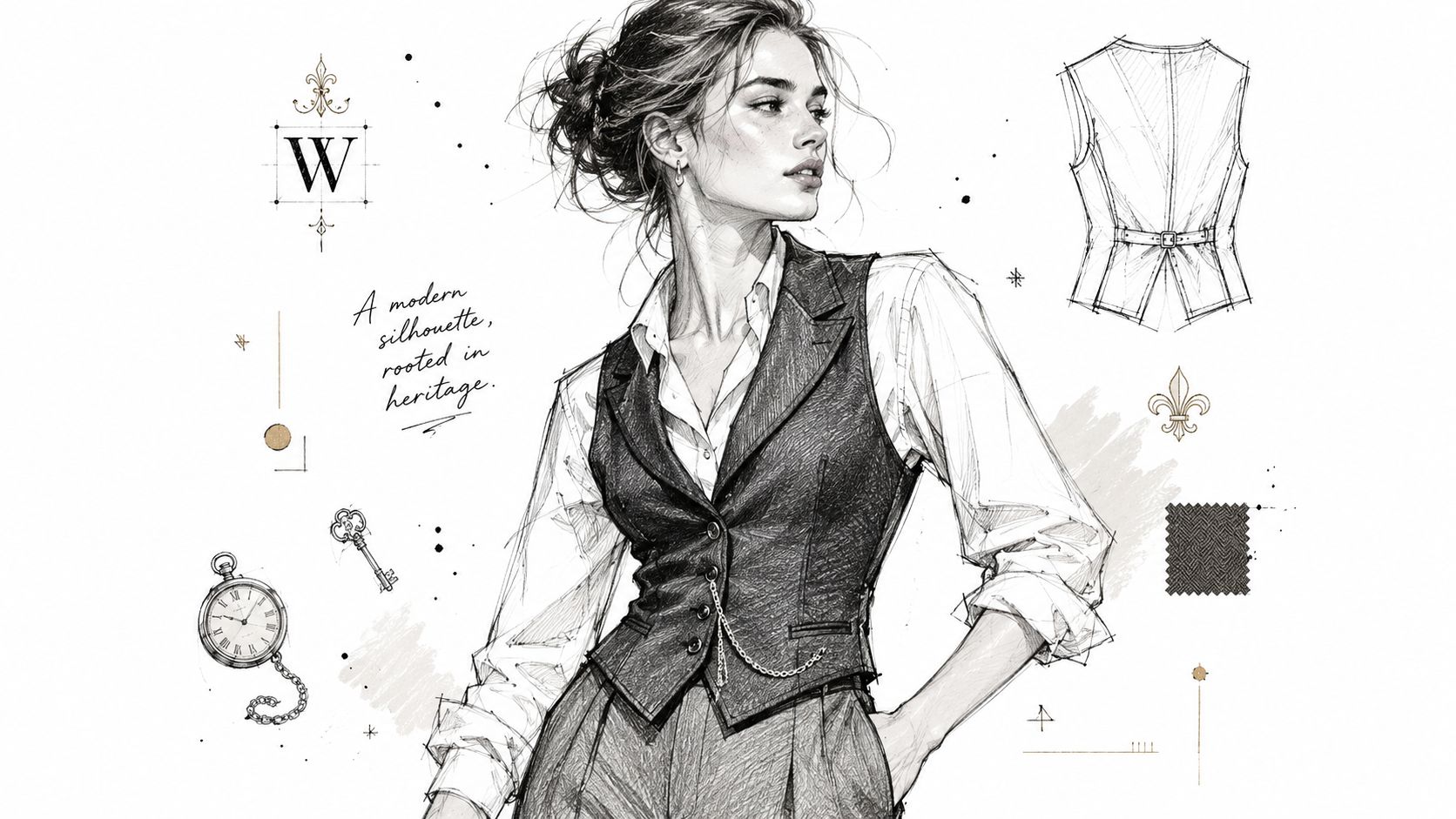
By the early 1620s, women's waistcoats had already begun to mirror fashionable gowns, with a high waistline and shorter length that altered the visual balance of the torso. That matters because it reminds us that the garment has always done more than complete a suit. It has always shaped proportion, posture and identity.
From historical staple to modern signal
The modern turning point came much later. The first widespread adoption of the waistcoat by women in modern fashion occurred in the early twentieth century, when Gabrielle Chanel introduced a feminine wardrobe inspired by masculine comfort, marking a significant milestone that redefined women's use of waistcoats from historical everyday wear to a symbol of modern, gender-fluid elegance, as described in this account of women's waistcoat history.
That shift still influences how the piece is worn now. Some women choose a waistcoat to look polished without appearing overworked. Others use it to interrupt a very feminine outfit with a sharper line. Others still treat it as the cleanest bridge between menswear codes and personal style.
A waistcoat works best when it looks intentional, not costume-like. The line should feel integrated with the rest of the wardrobe, not pasted on for effect.
Why it feels current again
The reason it has returned so strongly is simple. It solves modern wardrobe problems. It gives structure without the commitment of a blazer, and it can read formal, restrained, relaxed or directional depending on cut and cloth.
That flexibility is especially relevant now. The waistcoat has emerged as the dominant style staple for the summer of 2025, with trend coverage pointing to fabrics from breezy linen to fitted pinstripes, according to Elle UK's summer 2025 waistcoat report. Trend language comes and goes, but the practical appeal remains. A properly cut waistcoat offers clarity, and modern wardrobes are full of occasions that need exactly that.
Waistcoat Styles and Essential Fabrics
The first decision isn't colour. It's shape. A waistcoat succeeds when its silhouette matches how you typically dress, not how a product page suggests you should dress.
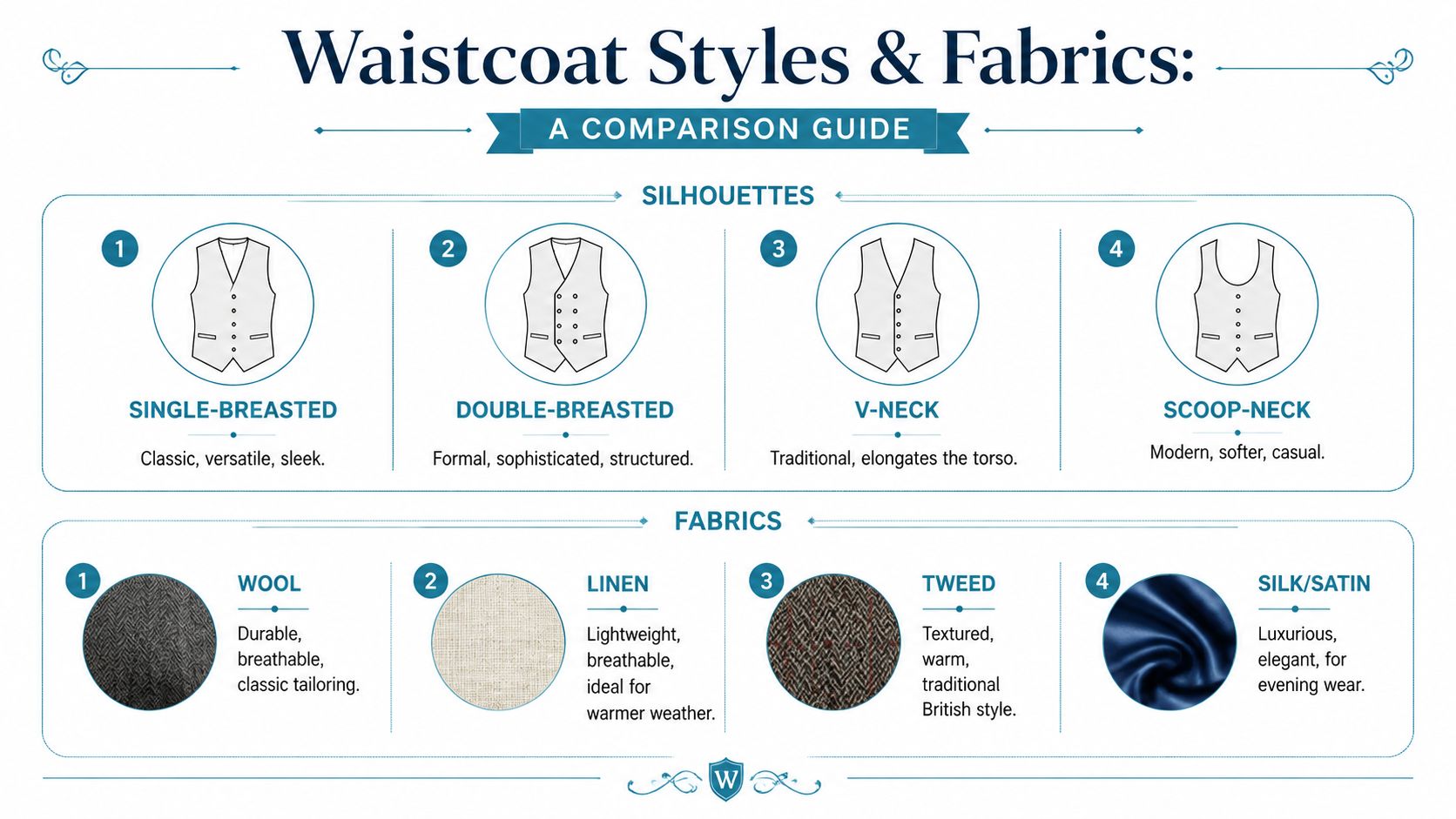
Choosing the right silhouette
A single-breasted waistcoat is still the most adaptable option. It layers easily under a jacket, works with trousers or skirts, and doesn't fight for attention. If someone is buying or commissioning a first waistcoat, this is usually the sensible place to begin.
A double-breasted waistcoat carries more authority. It looks more dressed, more architectural and more deliberate. It can be magnificent on the right frame, but it leaves less room for error. If the fronts are too wide or the button stance sits badly, the whole garment feels heavy.
The neckline changes the mood just as much.
- V-neck suits traditional tailoring. It lengthens the line and pairs well with shirts, ties and open collars.
- Scoop-neck feels softer and more contemporary. It can sit comfortably on its own as a top, especially in warmer months.
- Higher front cuts create modesty and structure, but they can visually shorten the torso.
- Lower fronts feel lighter and more elegant, though they rely on excellent bust shaping to avoid instability.
Traditional, longline and oversized cuts
A classic waist-length piece is easiest to wear with suiting. It meets the waistband cleanly and keeps the body looking balanced. That's why it remains a dependable choice for business dress and occasionwear.
Longline styles change the equation. They draw the eye vertically and often suit taller women particularly well, but they need discipline in the rest of the outfit. If the trousers are also wide and the shirt is blousy, the whole look can lose definition.
Oversized and asymmetrical waistcoats are where many women hesitate, and understandably so. These pieces can look sharp, but they can also drift into theatrical territory if styled too overtly. The trick is contrast.
Practical rule: If the waistcoat is oversized, keep at least one other element neat. That might be the trouser waist, the knit underneath, or the shoe.
Choosing Your Waistcoat Fabric
| Fabric | Key Characteristics | Ideal Season | Best For |
|---|---|---|---|
| Wool | Structured, breathable, dependable in tailored cuts | Most of the year | Business wear, formal dressing, everyday tailoring |
| Linen | Dry handle, airy feel, relaxed drape | Spring and summer | Warm-weather outfits, destination events, softer styling |
| Tweed | Textured, robust, distinctly British in character | Autumn and winter | Country wear, layered casual tailoring, statement pieces |
| Cashmere | Soft hand, refined surface, luxurious warmth | Cooler months | Elevated daywear, soft tailoring, discreet luxury |
| Mohair | Crisp, springy, holds shape well | Warmer tailoring seasons and evening use | Sharp dress pieces, sleek occasionwear, clean silhouettes |
For a broader view of cloth performance, it's worth reading Dandylion Style's guide to the best fabrics for suits.
What works in practice
Wool is the workhorse. It presses well, recovers well, and gives a waistcoat enough body to sit properly through the front. If someone wants one piece to wear often, wool is hard to fault.
Linen is attractive because it doesn't try to behave like wool. Its slight rumple is part of its charm. It works best when the cut acknowledges that informality. Trying to force linen into a severe, boardroom line rarely succeeds.
Tweed brings personality. It has grain, colour variation and presence. In a waistcoat, that texture can be enough to carry a simple outfit of shirt and trousers.
Cashmere in a waistcoat should be used with discretion. It gives quiet richness, not flash. The silhouette is best kept clean so the fabric can speak for itself.
Mohair has a very different role. It sharpens. If you want a waistcoat with a crisp edge for evening or formal use, mohair blends often do that beautifully.
A final note on satin and glossy cloths. They can work for evening wear, but only when the design is restrained. Shine exaggerates every fitting fault. In a poorly cut waistcoat, it announces the problem from across the room.
The Art of a Perfect Fit A Tailors Guide
Most disappointing waistcoats fail in predictable places. They gape at the armhole, pull at the fullest part of the bust, sit too long on a shorter torso, or collapse at the back because the front and back balance were never right to begin with.
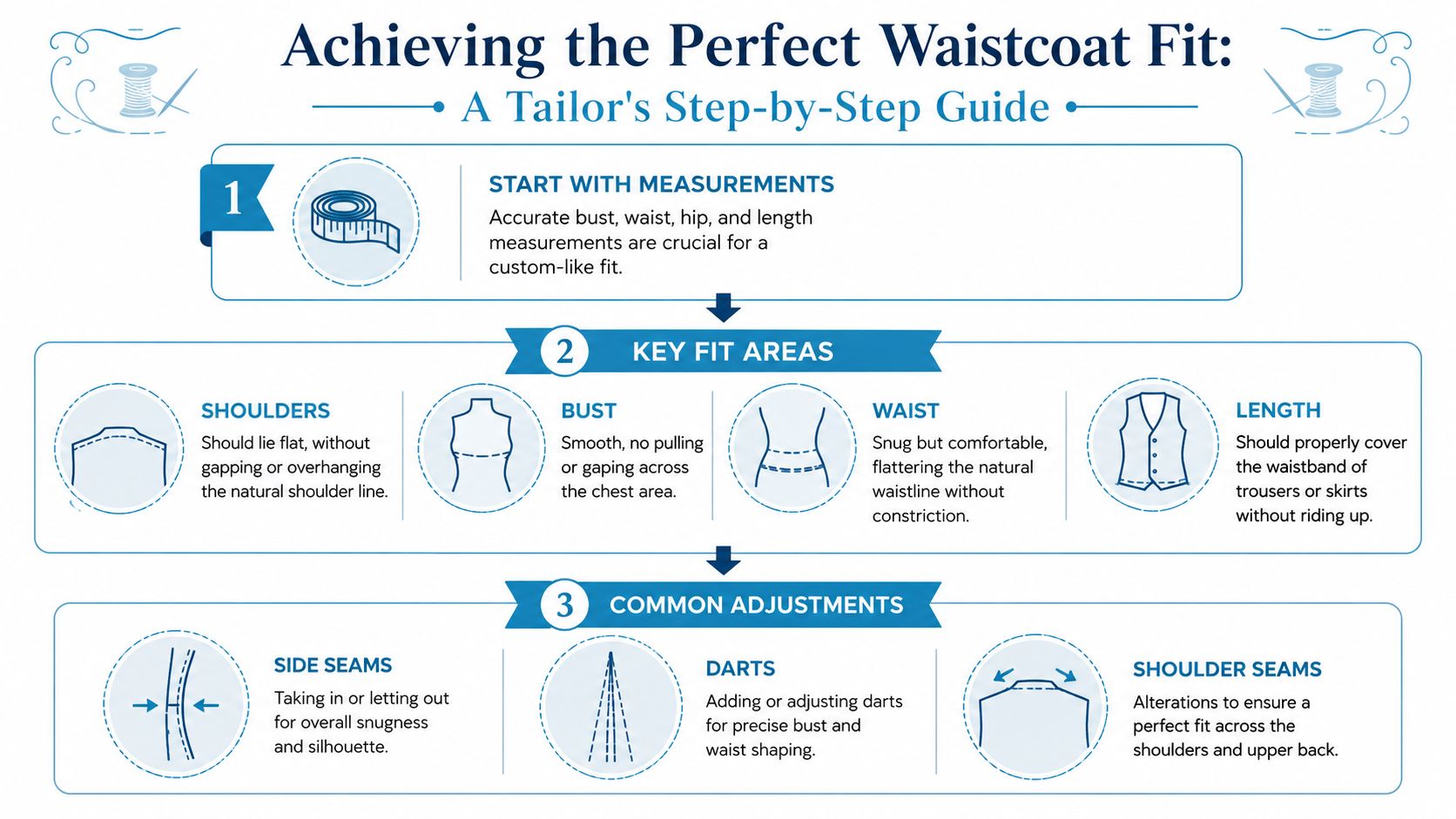
The measurements that matter
For women's waistcoats in UK sizing, the natural waist measurement must be taken at the body's narrowest point with the tape straight across, while the bust measurement is taken at the widest part of the chest, distinct from bra size, to ensure proper fit and prevent gaping at the shoulder or armhole, as explained in this women's tartan waistcoat sizing guide.
That distinction sounds basic, but it's where many off-the-rack problems begin. Bra size isn't a waistcoat measurement. A waistcoat has to travel cleanly from shoulder to bust to waist without distortion. If the bust is guessed incorrectly, the fronts strain or the armhole kicks away. If the waist is placed too high or too low, the garment loses shape even when buttoned.
For a clearer sense of how a proper measuring process works, Dandylion Style explains it well in this guide on how to measure for a waistcoat.
Why standard sizing often fails
Ready-made sizing assumes an average relationship between bust, waist, shoulder width and torso length. Many women don't have that relationship. Pear-shaped figures often need more room below with clean suppression at the waist. Athletic frames may need shape built in rather than taken for granted. Taller women frequently struggle with waistcoat length and button placement.
That's why a bespoke fitting isn't indulgence. It's method.
- Shoulders must lie flat: If the shoulder is too wide, the armhole never sits cleanly.
- The bust must be shaped, not squeezed: Pulling across the front is a cutting problem, not a styling problem.
- The waist must define without pinching: A waistcoat should follow the body, not clamp it.
- Length must relate to the rise: A lovely waistcoat can look wrong if it finishes at the wrong point against the trouser or skirt waistband.
A waistcoat should feel secure when you stand and natural when you sit. If you must keep adjusting it, the pattern is wrong.
The fit test I trust
Button the waistcoat. Let the wearer stand naturally, then sit, then raise the arms slightly. The fronts should stay composed, the neckline should remain close, and the hem shouldn't buck upwards aggressively.
If a waistcoat only looks good in one pose, it doesn't fit. It merely photographs well.
How to Style Your Waistcoat for Any Occasion
Styling a waistcoat well depends on understanding what role it's playing. Sometimes it replaces a jacket. Sometimes it acts as the focal point. Sometimes it provides just enough structure to stop an outfit drifting into vagueness.
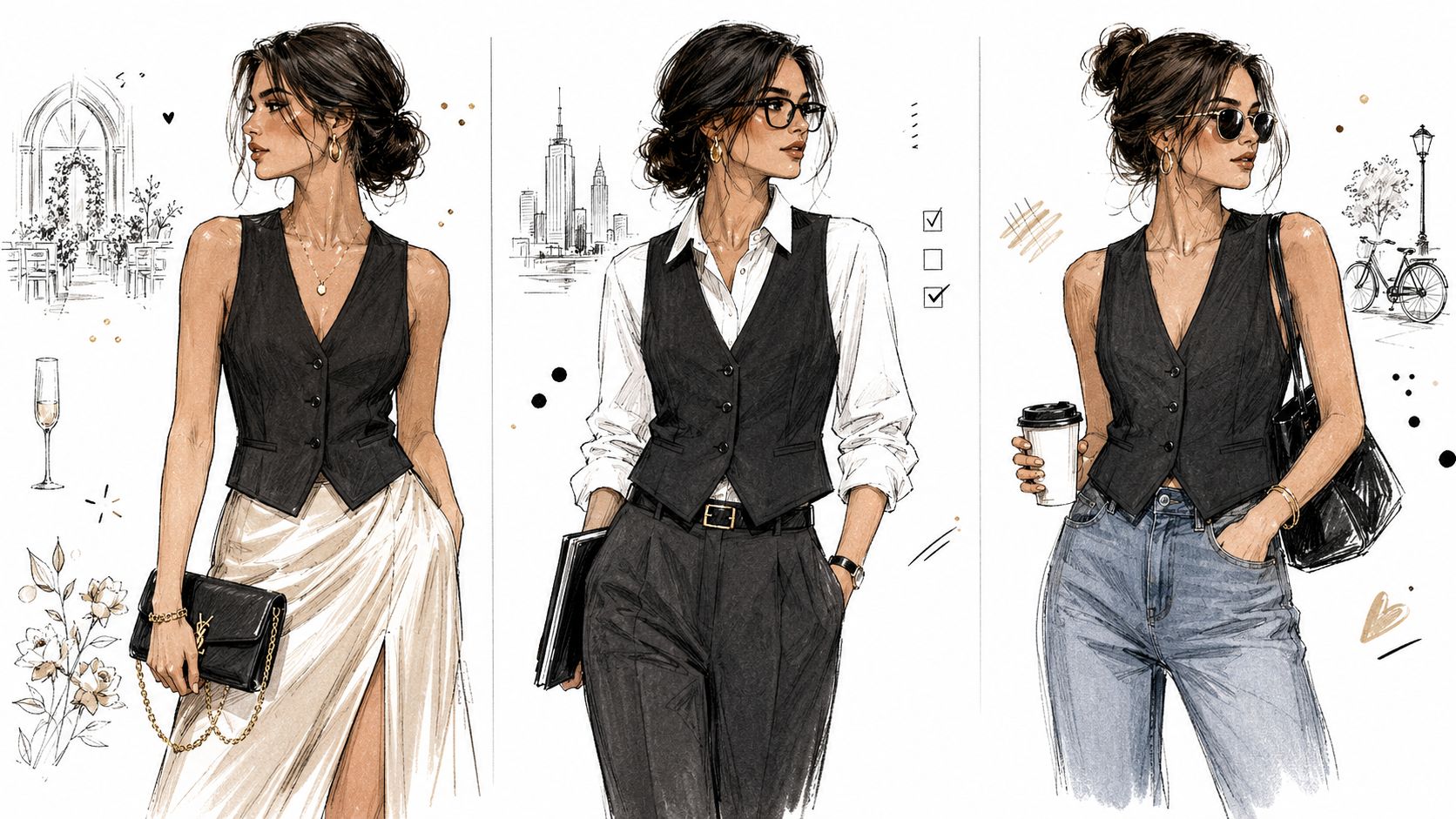
For 2025, styling coverage has highlighted that women's waistcoats pair well with loose linen trousers, fitted jeans, or smart dress pants for office looks and spring dressing, according to Favourbrook's guide to styling the summer waistcoat trend. Those combinations work because they give the waistcoat room to define the look without overcomplicating it.
For weddings and dressed occasions
A waistcoat for a wedding should look intentional, not like half of another suit. Softly cut wide-leg trousers in wool, linen or a silk blend can balance a fitted waistcoat beautifully. For those who prefer skirts, a long, clean line works better than excessive volume.
A few combinations that tend to work well:
- Matching waistcoat and trouser cloth: Elegant, lengthening and especially strong for civil ceremonies or contemporary dress codes.
- Textured waistcoat with plain separates: Useful when you want depth without full formal matching.
- Lower-cut neckline with jewellery kept spare: Lets the line of the garment remain the focus.
If the event is traditionally formal, a jacket may still be appropriate for part of the day. The waistcoat then becomes the piece that keeps the outfit polished once the jacket comes off.
For business dressing
In a professional wardrobe, the waistcoat earns its keep by adding authority without stiffness. Worn with well-fitting trousers and a proper shirt, it creates a composed line that feels less predictable than a standard two-piece suit.
Proportion matters most. The cleaner the environment, the more obvious every fitting error becomes.
| Setting | What Works | What Usually Doesn't |
|---|---|---|
| Client meetings | Single-breasted wool waistcoat with tailored trousers | Overly short cuts that expose too much shirt movement |
| Creative offices | Longline waistcoat over fine knit or open-collar shirt | Fussy detailing, loud contrast buttons |
| Formal business events | Matching three-piece tailoring | Casual linen with overly relaxed trousers |
A useful companion for cooler months is a well-cut outer layer in textured cloth. Dandylion Style's page on the British tweed jacket for women shows the sort of pairing that gives a waistcoat extra depth without losing discipline.
For casual wear and modern layering
Casual styling is where many women either underplay the waistcoat or overstate it. The easiest route is to treat it as a structured top. Wear it with good denim, simple jewellery, and shoes with some weight. Fitted jeans give sharp contrast to a sharply cut waistcoat. Loose linen trousers create a quieter, more relaxed silhouette.
Oversized and asymmetrical waistcoats need more judgement. They work best when everything around them is calm.
Keep the palette restrained if the shape is unusual. Let the cut be the talking point.
For example, an oversized waistcoat over a fitted rib knit with straight trousers can look modern and effortless. The same waistcoat over a billowing sleeve, wide cropped trouser and ornate shoe often looks like styling rather than dressing.
That distinction matters. Good styling still needs to feel lived in.
The Bespoke Waistcoat Journey at Dandylion Style
A bespoke waistcoat begins long before the first fitting. It starts with purpose. Is the garment meant to sit under a jacket, stand alone as a top, serve as part of wedding attire, or bridge work and weekend dressing? The answers shape everything that follows, from cloth weight to front height to button stance.
At Dandylion Style, the process begins in conversation. Igor works from Ardingly, West Sussex, and consults with clients in the studio as well as at home or office across Sussex, London and the South East. The discussion isn't limited to style references. It covers how the garment should feel, how often it will be worn, what else it must work with, and where the wearer usually struggles with fit.
Cloth, cut and first measurements
The house specialises in fine British fabrics including tweed, cashmere, linen, wool and mohair. Each behaves differently once shaped into a waistcoat. A soft cashmere blend asks for one sort of handling. A springier wool or mohair cloth asks for another.
The measuring stage is equally exacting. The goal isn't merely to produce a size. It's to establish balance. Front length, back length, bust distribution, waist suppression and shoulder placement all have to agree with one another. That's where bespoke separates itself from made-to-measure and from ready-made clothing entirely.
Clients can learn more about the house approach to bespoke tailoring for women.
The craft behind the garment
Construction matters because comfort lives inside the details. Technical construction of a custom-made women's waistcoat requires a 1cm (3/8”) seam allowance, prewashed fabric, and careful finishing of the four-layer side seam with an overlocker or zig-zag stitch to prevent fraying and ensure enduring comfort in bespoke garments, as described in this tailoring construction guide.
There are smaller mechanical disciplines too. In finely crafted canvas-front work, seam allowances must be marked cleanly and dart legs overlapped precisely to reduce bulk. Those choices don't show themselves as decoration. They show themselves as ease, smoothness and longevity.
The wearer notices good construction in the absence of irritation. Nothing twists, rubs, bunches or fights back.
Timeline and investment
Dandylion Style states a typical completion window of 8 to 12 weeks, with bespoke waistcoats from £395, according to the publisher information provided for the house. That places the garment where bespoke should sit. It's an investment, but not an abstract luxury. It's a practical commission for someone who wants a piece cut for her life rather than borrowed from a standard block.
The result is personal in the right way. Not loud. Not gimmicky. Perfectly correct.
Caring for Your Bespoke Investment
A bespoke waistcoat lasts when it's treated like tailoring, not casualwear. That starts with restraint. Don't send it for cleaning after every wear unless it needs it. Most waistcoats benefit more from airing, brushing, and a day of rest between uses.
Storage matters as much as cleaning. Use a proper hanger if the waistcoat is part of a suit, and keep it in a breathable garment cover rather than sealed plastic. If it's made in tweed, wool or cashmere, moth protection is sensible, but keep anything strongly scented away from the cloth itself.
Small issues should be addressed early.
- Loose button: Have it reinforced before the surrounding stitches weaken.
- Minor fit change: Adjust the side seams before strain marks develop.
- Surface spot: Blot gently and leave heavy cleaning to a professional familiar with precisely made garments.
For general guidance on maintenance cycles, Dandylion Style has a useful article on how often you should dry clean a suit.
About the Author
Igor Srzic-Cartledge is the founder of Dandylion Style, a bespoke tailoring house based in Ardingly, West Sussex. He specialises in one-of-a-kind garments cut from fine British fabrics, with a particular respect for traditional tailoring techniques and calm, precise service. His work spans wedding tailoring, business wear, casual pieces, waistcoats, shirts and alterations for both men and women. Although the house is rooted in gentlemen's tailoring, especially in its visual language, Igor's approach to women's garments is equally exacting, with close attention to fit, balance, comfort and individual expression.
Frequently Asked Questions
Can a waistcoat for women be worn without a shirt underneath?
Yes, provided the cut is designed for it. The front height, armhole shape and bust support all need to be handled carefully, otherwise the garment can feel exposed or unstable. Smooth lining and a neckline that sits close to the body make a great deal of difference. A waistcoat meant to be worn alone should be cut with that purpose in mind from the beginning.
What's the biggest fit mistake women make when buying a waistcoat?
Most buy for the waist or the label size and ignore the bust and shoulder relationship. That's when buttons pull, armholes gape, and the front edge refuses to lie neatly. A waistcoat isn't forgiving in the way a looser blouse can be. If one area is wrong, the whole line tends to suffer, which is why accurate measuring matters so much.
Are longline waistcoats harder to wear than classic waist-length styles?
They can be, but not because they're difficult by nature. They only demand better proportion in the rest of the outfit. A longline waistcoat already lengthens the body, so the trousers, skirt and shoes need to support that line rather than compete with it. If the surrounding pieces are too bulky or too cropped, the look loses clarity very quickly.
Which fabric should I choose for my first waistcoat?
Wool is usually the safest and most versatile starting point. It holds shape, breathes well, and works across a wide range of settings. Linen is excellent for warm weather but reads more relaxed. Tweed adds personality and depth, while cashmere and mohair serve more specialised purposes. If you want one waistcoat that works hard, a good wool cloth is difficult to beat.
Is bespoke worth it for a waistcoat rather than a full suit?
Often, yes. A waistcoat sits close to the body, so poor fit shows immediately. That makes it one of the garments most improved by bespoke cutting. For many women, a bespoke waistcoat is also a practical way into custom tailoring because it offers strong visual impact, excellent versatility, and a very personal fit without requiring the commitment of a full commission straight away.
If you're considering a waistcoat that fits properly, works with the rest of your wardrobe, and reflects your own style rather than a generic pattern block, Dandylion Style offers bespoke tailoring from Ardingly, West Sussex, with consultations in the studio, at home, or at your office across Sussex, London and the South East.