You put on a pair of trousers that fits at the waist, then the seat goes flat and the thigh pulls by mid-morning. Size up for the hip, and the back waistband stands away from the body. Shorten the hem on a petite frame, and the break may improve while the rise still sits too low. These are drafting problems, not personal failings, and they are exactly why so many women never feel fully at ease in ready-made trousers.
A good pair of custom-fit trousers solves more than appearance. It settles the line from waist to hem, gives the body room where movement needs it, and removes the small irritations that make a garment stay unworn. In practice, the best result comes from knowing which faults a tailor can correct after purchase and which ones need a new pattern from the start. For clients comparing options, bespoke tailoring for women becomes the sensible route once standard blocks repeatedly fail at the same points.
Key takeaways
- Trouser fit is built through the seat, hip, and thigh first. If those areas are wrong, the waistband and hem rarely look right for long.
- Back-waist gaping, pulling at the front rise, twisting legs, and collapsed drape usually point to balance and proportion issues in the pattern.
- Alterations are useful for hems, minor waist reduction, and small tapering changes. They are less effective when the rise, pocket placement, crotch shape, or hip-to-waist relationship is wrong.
- Bespoke is often the better answer for pronounced curves, fuller thighs, a smaller waist, petite proportions, tall frames, or posture differences that retail sizing does not account for.
- Hem length should be set with the shoes you will wear. A sharp line in a fitting room often fails once heel height changes.
- The right trousers change how a jacket sits, how a shirt tucks, and how confidently you move. That is the true value of precise cutting.
Your Guide to Bespoke Trousers
You try on one pair that closes at the waist but strains across the hip. The next skims the thigh yet leaves a gap at the back waistband. A third can be shortened, but the pockets sit too low, the knee breaks in the wrong place, and the rise never feels settled. That cycle is usually the point where bespoke starts to make sense.
Trousers carry a particular authority in a woman's wardrobe because they combine structure with ease. That legacy has developed over decades of dress history, but the modern question is less about symbolism and more about function. A well-cut pair sharpens the whole line of the body, supports the jacket or knit worn with it, and removes the constant small adjustments that make many ready-made pairs disappointing.
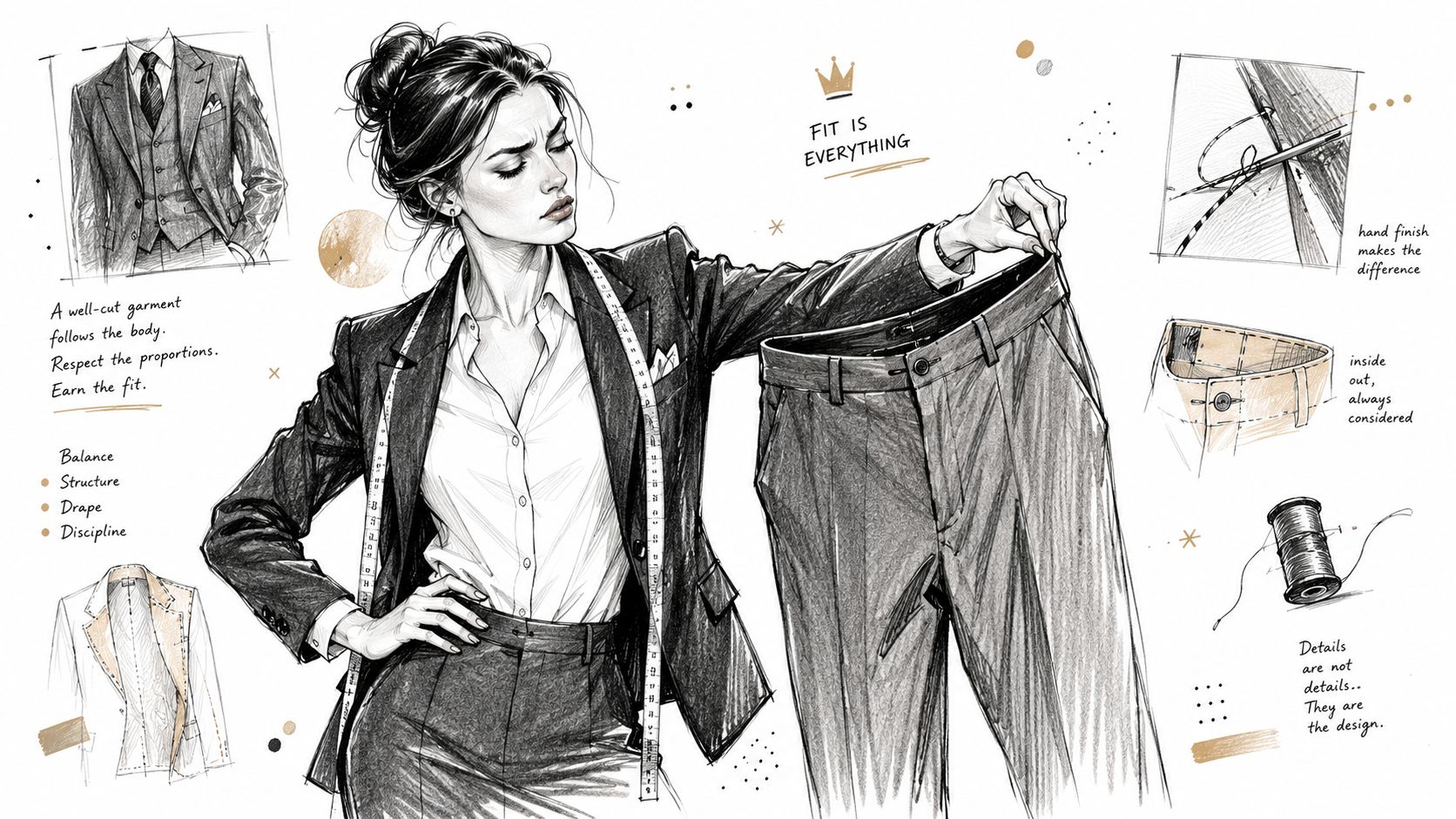
Why off-the-rack fails so often
Ready-made trousers are drafted from standardised blocks. Real bodies are not standardised. The trouble often shows up in predictable combinations: a smaller waist with a fuller seat, prominent thighs with a narrow knee, a petite frame with a short rise, or a longer torso that makes the whole balance sit too high.
Alterations can fix some of this. They can shorten a hem, reduce the waist a little, or clean up a leg that is only slightly too wide. They do much less once the problem starts in the pattern itself. If the hip-to-waist ratio is pronounced, if the fork shape is wrong, or if the rise has been placed for a different body length, the cloth will keep fighting you no matter how many small corrections are made afterward.
That is why a good trouser fitting starts with diagnosis, not pinning.
For women considering bespoke tailoring for women, the main benefit is precision. The pattern is built around your proportions, posture, and use case, whether you need polished work trousers, a clean evening line, or a hard-wearing pair that still looks composed after a full day.
What a discerning client should look for
A serious pair of trousers should work in motion as well as at rest. I look for these markers first:
- A waistband that stays close to the body without digging in or opening at the back.
- A smooth line over seat, hip, and thigh without stress lines or collapsed fabric.
- A rise that feels secure when sitting and does not pull forward or drop at the back.
- A leg line that holds its shape from the top block to the hem.
- Proportions that match your shoes and height, so the trouser reads correctly on your body rather than on the hanger.
This matters most for women whom mass retail tends to ignore. Petite clients often need more than a shorter hem. Women with a defined waist and fuller hips often need more than a simple waistband reduction. Tall clients may need a different knee position and pocket placement, not extra length alone. Bespoke earns its place when those fit faults repeat often enough that buying and altering becomes the more expensive, less satisfying route.
The phrase well-cut trousers ladies should mean more than smart styling. It should mean a pair that sits calmly, moves properly, and keeps its line without tugging, twisting, or compromise.
Decoding Trouser Silhouettes and Finding Your Style
A silhouette isn't just a trend label. It controls visual weight, movement, and how the eye reads proportion. The right cut can lengthen the leg, soften the hip, sharpen the ankle, or create more authority through the whole outfit.
The easiest way to choose well is to think architecturally. Ask where the volume begins, where it ends, and whether the leg line should read as fluid, straight, or tapered.
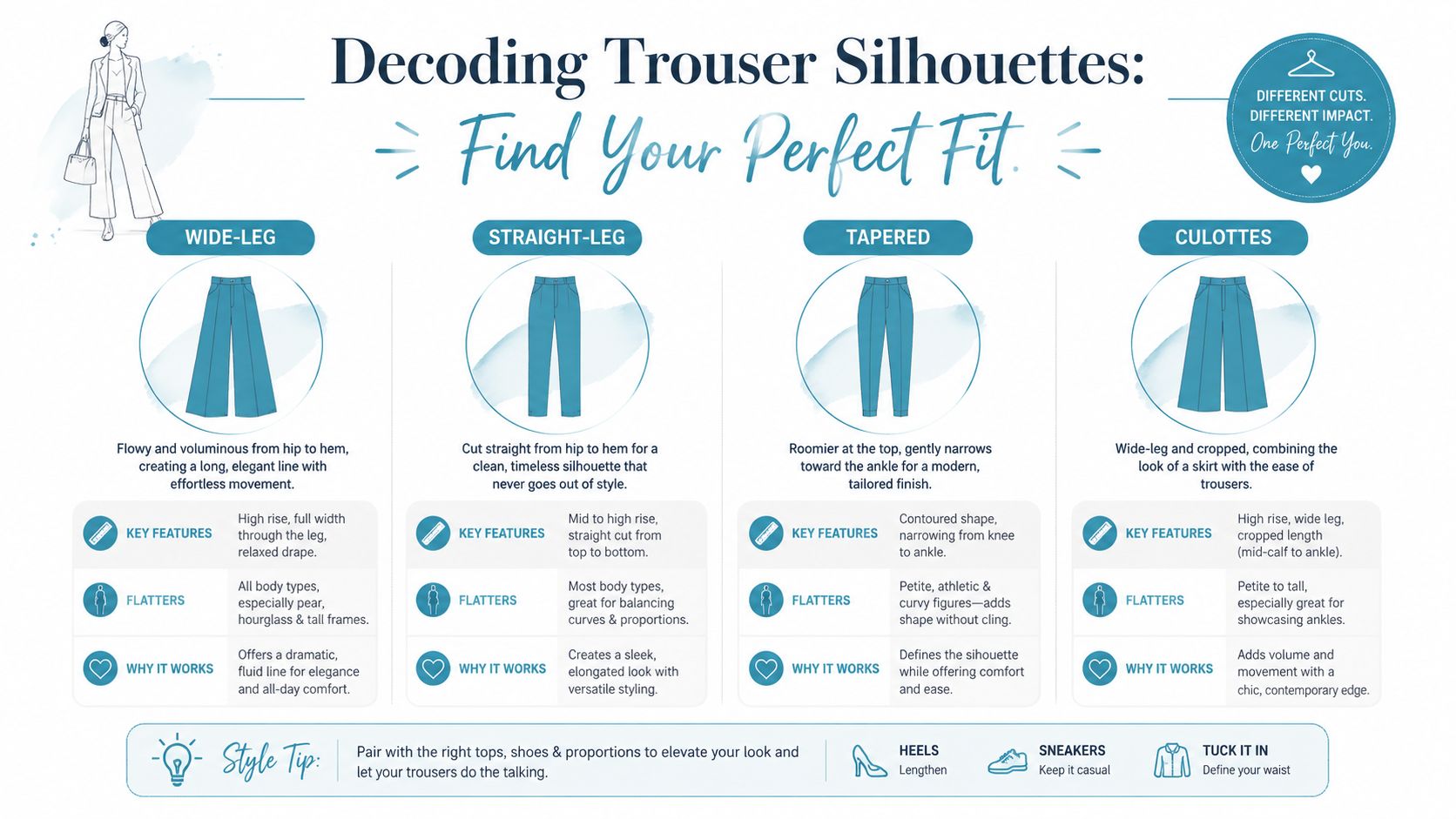
How each silhouette behaves
Wide-leg trousers create movement. They can look elegant and composed, but only when the top block is controlled. If the hip fit is loose as well as the leg, the result often feels vague rather than refined.
Straight-leg trousers are the most reliable foundation. They neither cling nor billow. For many women, this cut solves more wardrobe problems than dramatic shapes because it works across offices, travel, and formal events.
Tapered trousers concentrate visual neatness toward the ankle. They suit women who want a sharp line, but they demand accurate thigh and knee balance. If they're cut too aggressively, they expose every fit fault higher up the leg.
Culottes introduce breadth and crop. They can be chic, but they are proportionally less forgiving because the shortened length interrupts the vertical line. They depend heavily on height, footwear, and the width of the hem.
A guide to classic trouser silhouettes
| Silhouette | Key Characteristic | Best For |
|---|---|---|
| Wide-leg | Full shape falling from hip or upper thigh | Elegant movement, balancing broader shoulders, formal or fashion-led dressing |
| Straight-leg | Clean vertical line with even width through the leg | Versatility, professional wardrobes, clients who want longevity over novelty |
| Tapered | Narrower toward the ankle | A crisp modern line, neat footwear display, more structured outfits |
| Culottes | Cropped length with volume | Creative styling, warmer weather, women comfortable managing proportion at the ankle |
What works and what usually doesn't
A common mistake is choosing the silhouette you admire on someone else without checking whether your own proportions want the same distribution of volume. A fuller hip-to-waist ratio may look excellent in a straight or full-length cut, while an aggressively slim trouser can exaggerate waistband gaping and upper-leg strain.
Likewise, a petite client isn't always best served by cropping everything. Often a longer straight leg gives a better uninterrupted line than a shortened fashion cut.
The most flattering trouser isn't automatically the slimmest one. Proportion usually matters more than trend.
If you want structured trousers for ladies that earn their keep, start with what you need the garment to do. Commute? Sit all day? Wear with loafers? Pair with heels at weddings? The silhouette should answer those practical questions before it answers a trend cycle.
The Art of a Flawless Fit Understanding Key Measurements
You button a pair of ready-made trousers in the fitting room. The waist feels loose, the hips feel tight, and the hem puddles over the shoe. None of those problems sits in isolation. They usually come from a pattern drafted for an average figure that does not match your proportions.
A good trouser fitting starts with balance through the whole garment. Waist, seat, rise, thigh, knee, and hem all affect one another. Shift one point and another reacts. That is why a tape measure helps, but judgement matters more. A basic reference such as this suit measuring chart for tailored garments gives a useful starting framework. The key lies in reading what those numbers mean on an actual body, in motion as well as at rest.
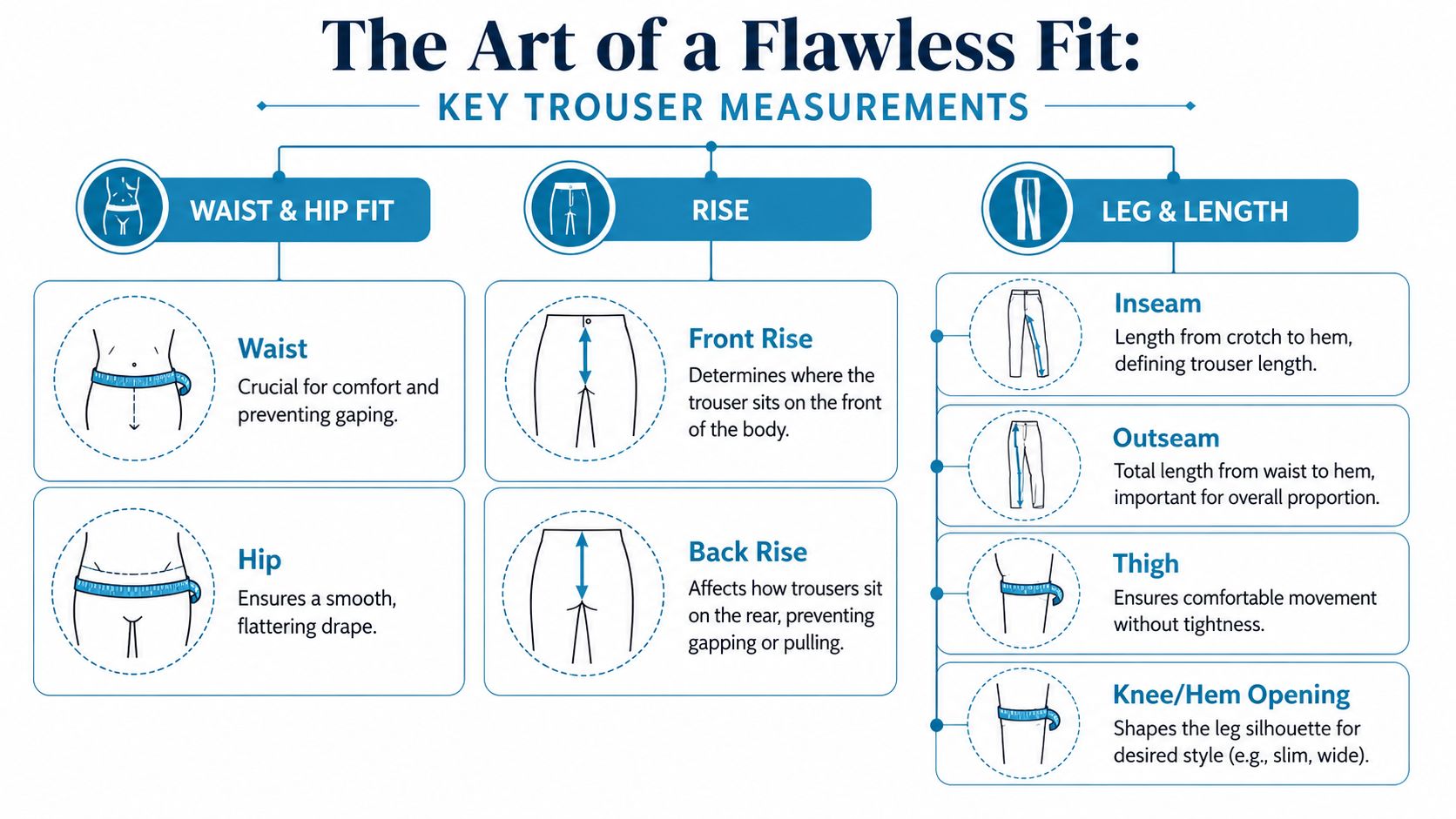
Waist and hip are not the same problem
The waistband often gets blamed first because that is where the client notices gaping or pressure. In practice, the upper block is usually at fault.
A fuller hip with a smaller waist is one of the most common fit problems in womenswear, and mass-market trousers rarely handle it well. The standard fix is to grade up for the hips and accept extra room at the waist. An alterations shop can remove some of that excess, but only to a point. If too much is pinched out at the waistband, the side seam is pulled off balance, pockets can flare, and the top edge stops sitting cleanly against the body.
Bespoke solves the problem earlier in the process. The draft is shaped for the client's hip-to-waist ratio from the outset, so the trouser hangs from the correct place instead of being forced into shape after the fact.
Rise decides how the trouser behaves
Rise is not only a style preference. It affects comfort, posture, and the way the trouser moves when you sit, walk, or climb stairs.
A rise that is too short tends to pull at the fork and drag down at the back. A rise that is too long can bunch under the waistband and look heavy through the front. Both faults are common in ready-made trousers because rise depth is tied to body proportions, not just height.
Petite clients run into this often. A simple hem takes length off the bottom, but it does nothing for a knee that sits too low or a rise that is too deep. I have seen many shortened trousers that still look wrong because the architecture above the hem remained drafted for someone taller. That is the point where bespoke becomes better value than repeated alterations.
A hem can shorten a trouser. It cannot rebuild its proportions.
Seat, thigh, and knee keep the line clean
A trouser can close at the waist and still fit badly. The seat needs enough room for movement without collapsing into excess cloth. The thigh needs enough width for the fabric to fall straight. The knee position has to align with the wearer's actual knee, or the leg will never look calm.
These details matter most on clients whose figures sit outside standard grading. A prominent seat, athletic thigh, fuller calf, or slight asymmetry from one leg to the other can all distort the line of a ready-made pair. Symptoms show up as diagonal drag lines, a crease that swings inward, or side seams that creep forward.
Those are pattern problems, not minor quirks.
Hem length finishes the proportion
Hem length should be set with the shoes that matter most. A trouser worn with loafers wants a different finish from one cut for heels. Wide-leg and full-length trousers are especially unforgiving here because extra cloth makes a poor hem obvious.
For a polished line, the hem usually wants to skim the shoe cleanly rather than collapse onto it. Too much break shortens the leg visually and makes the trouser look tired. Too little can make a fuller cut feel abrupt, particularly in fabrics with weight and drape.
This is also why one “perfect” length rarely serves every shoe in the wardrobe. Clients who plan to wear the same trousers with both flats and heels often need to choose which use matters more, or commission separate pairs for separate jobs.
When alterations stop being enough
Alterations are useful when the original block is broadly right and only needs refinement. Shortening the hem, reducing the waist slightly, or cleaning up the leg can all work well.
They stop being the best answer when several fit faults are connected. If the waistband gaps because the hip is too tight, the rise is too deep, and the knee breaks in the wrong place, each small alteration starts fighting the others. At that stage, bespoke is not a luxury add-on. It is the more rational solution.
The best custom-fit trousers for ladies solve the core problem at pattern level. That is why they look quieter, feel easier, and last longer in a working wardrobe.
The Bespoke Process Crafting Your Trousers with a Tailor
A bespoke trouser commission begins long before scissors touch cloth. The first appointment is a conversation about use, habits, and irritation points. A good tailor wants to know where you'll wear the trousers, which shoes matter, whether you sit for long periods, and which ready-made pairs have disappointed you.
That conversation often reveals more than measurements do. One client wants a clean line under a jacket but needs room through the thigh for movement. Another wants formal elegance but also insists on functional pockets. Those aren't minor details. They shape the draft.
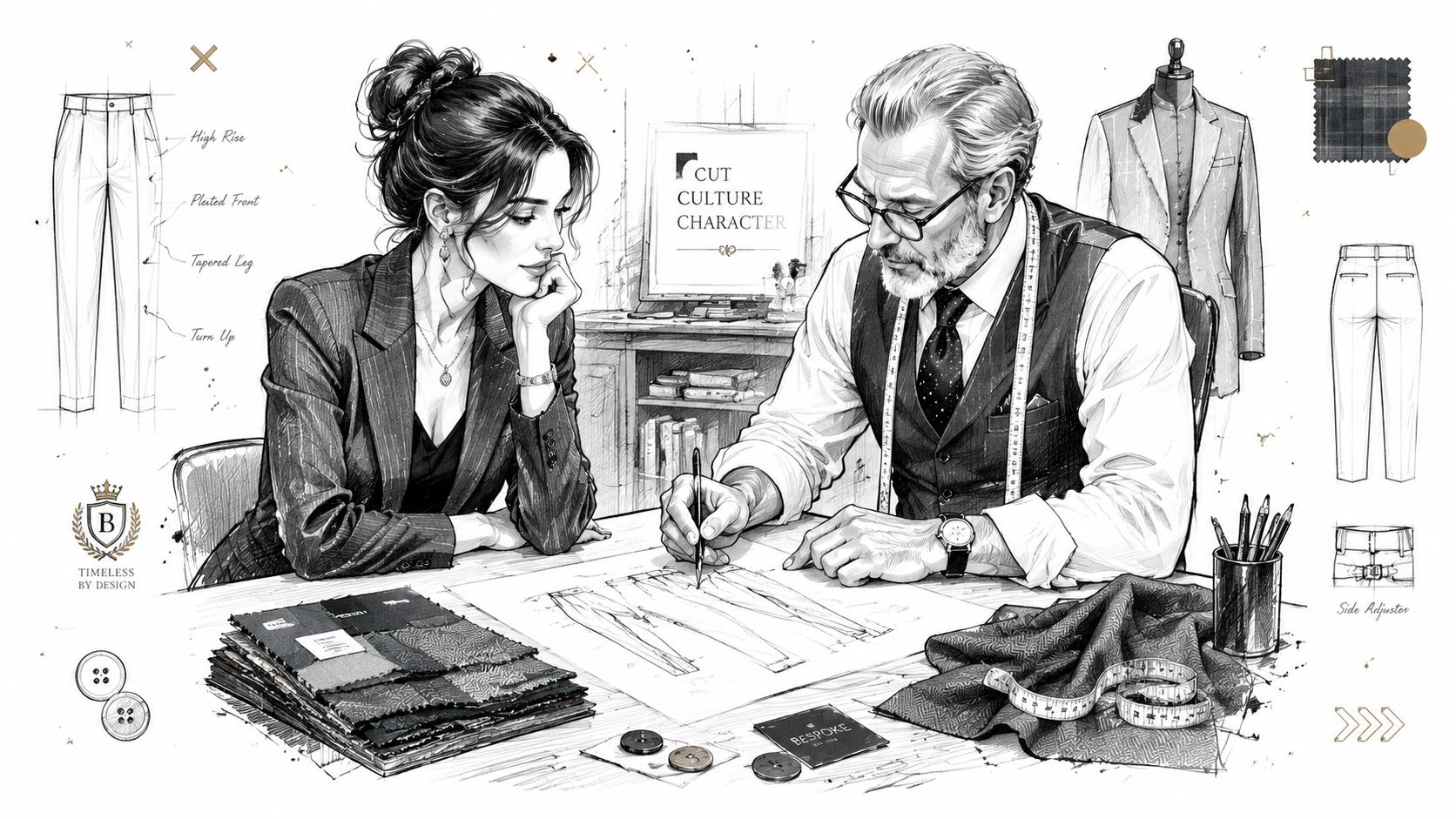
Consultation and cloth selection
Cloth should match the job. Wool offers structure and resilience. Linen gives ease and breathability but behaves more casually. Cashmere blends soften the handle. Tweed changes the mood entirely. The point isn't to choose the fanciest cloth. It's to choose the cloth that supports the cut you want.
During this stage, details also get settled. Pleats or flat front. Side adjusters or belt loops. Pocket style. Cuff or plain hem. Each choice affects both appearance and function.
For some clients, the decision sits between a customised existing block and a fully individual pattern. That's where this guide to made-to-measure vs bespoke is useful. Made-to-measure can solve many straightforward needs. Bespoke becomes more valuable when the body or the desired cut falls beyond what a standard block can absorb gracefully.
Pattern cutting and first fitting
In pattern development, the hip and thigh are critical control points. One technical sewing guide advises choosing size from the fullest part of the hips, usually 8–9 inches below the waistline, and distributing leg adjustments carefully across inseam and outseam so the leg hangs cleanly without twisting or pulling, as noted in this pattern fitting guide.
That principle sits at the heart of serious trouser cutting. The pattern must respect the body's true anchor points first. Only then can the waist, rise, and leg line be refined without distortion.
If the upper block is wrong, every later alteration becomes a compromise.
At a first fitting, the tailor studies balance rather than chasing surface perfection. Is the side seam vertical? Does the front break where intended? Is the seat smooth but not tight? Does the client move naturally, or is she adjusting herself every few minutes?
Refinement through fittings
Bespoke fitting is progressive. One appointment settles structure. Another sharpens the silhouette. A later fitting finishes details and confirms length with the correct shoes.
That process matters because some corrections can only be seen once the garment has begun to take shape. A trouser may look fine on the hanger and still need subtle redistribution through the thigh or seat once it's worn.
A properly managed fitting sequence usually deals with:
- Back waistband gaping by reshaping the top block rather than merely pinching excess at the centre back.
- Petite proportion issues by correcting rise and leg balance, not only the hem.
- Twisting or dragging legs through measured redistribution at the seams.
- Pocket function so the trouser remains useful, not decorative.
Used carefully, bespoke gives the client something retail rarely does. A pair of trousers that feels settled from the moment it goes on.
Styling and Caring for Your Bespoke Trousers
A well-cut pair of trousers should move easily between roles. The same straight or full-length structured pair can sit under a business jacket, carry a silk blouse at a dinner, or work with knitwear and loafers during the day. The difference usually comes from cloth, shoe, and the sharpness of the crease rather than from any dramatic styling trick.
That versatility is one reason women keep looking for better alternatives to mass retail. One widely cited comparison notes that women's jeans pockets are, on average, 48% shorter and 6.5% narrower than men's, which helps explain why many women look for garments where fit and function are treated more seriously, as noted in this overview of trousers as women's clothing.
Wearing them well
The easiest way to style well-cut trousers is to let the cut lead.
- For business wear, keep the top half clean. Fine-gauge knits, a proper shirt, or a softly structured jacket usually work better than fussy trims.
- For events, let the cloth do some of the talking. A richer wool, subtle texture, or darker palette can carry evening authority without becoming theatrical.
- For relaxed dressing, pair well-cut trousers with simpler pieces. Trainers can work with the right cut, but they need intention. A muddled hem and a casual shoe rarely improve each other.
For women considering a custom option, Dandylion Style offers bespoke and made-to-measure garments, including trousers, cut from British cloths and fitted through studio, home, or office appointments. The practical question isn't whether bespoke sounds luxurious. It's whether your fit issues are persistent enough to justify a garment built around them.
Looking after the cloth and shape
Precisely cut trousers keep their line when you treat them like structured garments rather than disposable separates. That means rest between wears, proper hanging, and restrained cleaning.
A few habits make a real difference:
- Hang by the waistband or hem so the crease can fall straight.
- Brush the cloth lightly after wear if it has picked up dust or surface marks.
- Steam or press carefully rather than crushing the crease flat at home with too much heat.
- Dry clean only when needed, especially for wool. Frequent cleaning can shorten the life of the cloth. This guide on how often to dry clean a suit gives a sensible framework that applies broadly to structured garments.
Bespoke trousers last longest when cleaning is occasional and maintenance is routine.
If the hem starts to wear or your preferred shoe height changes, bring the trousers back for assessment before the problem spreads. A small correction made early is usually neater than a larger repair made late.
Frequently Asked Questions
Are bespoke trousers only worth it if I have an unusual body shape
Not at all. Bespoke makes sense whenever the standard retail block keeps failing in the same places. That might mean back-waist gaping, a difficult rise, twisting through the leg, or trousers that only work with one shoe. Some women have very specific proportion challenges. Others desire a sharper silhouette, better cloth, and functional details handled properly from the start.
Can't I just buy a larger size and have the waist taken in
Sometimes you can, and sometimes that's the sensible route. But there's a limit. If the upper block is too large overall, taking in the waist alone can distort the balance of the seat, hip, and side seam. That's why some altered trousers still feel odd even after the waistband has been “fixed”. The original pattern may still be wrong for your shape.
What should I bring to a trouser fitting
Bring the shoes you expect to wear most often with the trousers. Hem length and break depend on shoe height, and guessing often leads to disappointment. It also helps to wear or bring a top that reflects how you'll style the trousers. If you have an existing pair you like, or dislike, that's useful too. It gives the tailor a clear starting point.
Which silhouette is safest if I want longevity rather than trend
A straight-leg or gently full-length cut is usually the most dependable choice. It wears well across different settings, works with more footwear, and doesn't date as quickly as more extreme shapes. “Safe” doesn't mean dull. The authority comes from proportion, cloth, and finish. A calm, beautifully cut trouser often looks more distinguished than a fashion-forward silhouette that only works in one season.
How many fittings do bespoke trousers usually need
That depends on the cut, the cloth, and the complexity of the fit issue. A straightforward commission may need fewer interventions than a pair correcting multiple balance problems. What matters is not the number of appointments for its own sake, but whether each fitting resolves something specific. Good tailoring is iterative. The garment improves because it is observed, adjusted, and refined at the right moments.
About Igor Srzic-Cartledge Founder of Dandylion Style
Igor Srzic-Cartledge is the founder of Dandylion Style, a bespoke tailoring house based in Ardingly, West Sussex. His work is rooted in classic tailoring principles, fine British fabrics, and a measured approach to fit that favours clarity over excess. Although the studio is closely associated with gentlemen's tailoring, the same standards of cut, cloth, balance, and hand-finished detail apply across commissions. Clients can learn more about Igor's background and approach on the Dandylion Style author page.
If you're ready to stop compromising with mass-market fit, Dandylion Style offers bespoke and made-to-measure tailoring for clients in Sussex, London, and the South East, with consultations available in the studio, at home, or at the office.