You're probably standing in front of a rail of shirts, or scrolling through collars online, and finding that the decision feels oddly larger than it should. The cloth may be right. The colour may be safe. The fit may be acceptable. Yet the collar changes the entire expression of the shirt, especially once a jacket and tie enter the picture.
That's why the point collar shirt still matters. It isn't merely a default. It's one of the clearest statements a gentleman can make about restraint, proportion, and taste. A point collar can look disciplined in the City, elegant at a wedding, and assured under a structured coat. It can also look wrong if the proportions are off, the construction is weak, or the occasion calls for a different mood.
Key Takeaways
A good point collar earns its place through balance. In British tailoring, it remains one of the clearest choices for a man who wants a shirt to sit cleanly with a coat and tie, without calling attention to itself.
A point collar is defined by a narrow opening and downward points. The effect is cleaner and more vertical than a spread collar, which is why it continues to suit sober business dress, formal daytime events, and tailored wardrobes built on restraint.
Its value depends on context, not simple face-shape advice. In current British dress, a point collar often reads as more traditional and more deliberate than the spread collars now common in London offices. That can be an advantage or a limitation, depending on your suit, your tie, and the room you are dressing for.
Proportion decides whether it looks correct. Point length, spread, collar stand, and tie clearance must relate to your neck, lapel width, knot size, and posture. Get those relationships right and the collar looks settled. Get them wrong and even an expensive shirt can appear strained or timid.
Construction matters because the collar has a job to do. A well-made point collar should sit neatly around the neck, hold its shape through the day, and frame the tie without collapsing at the edges or buckling at the stand.
Bespoke makes the style far more precise. On commission, the point collar can be adjusted to work with a soft roll, a firmer front, a specific jacket line, or a preferred knot. That is usually the difference between a collar that merely looks classic and one that actually serves the client.
Introduction
A client stands in front of the mirror before a City meeting. The suit is sound, the tie is sensible, yet something still looks slightly off. In many cases, the problem is the collar. A point collar settles the line of the shirt, frames the knot neatly, and keeps the coat looking orderly without asking for attention.
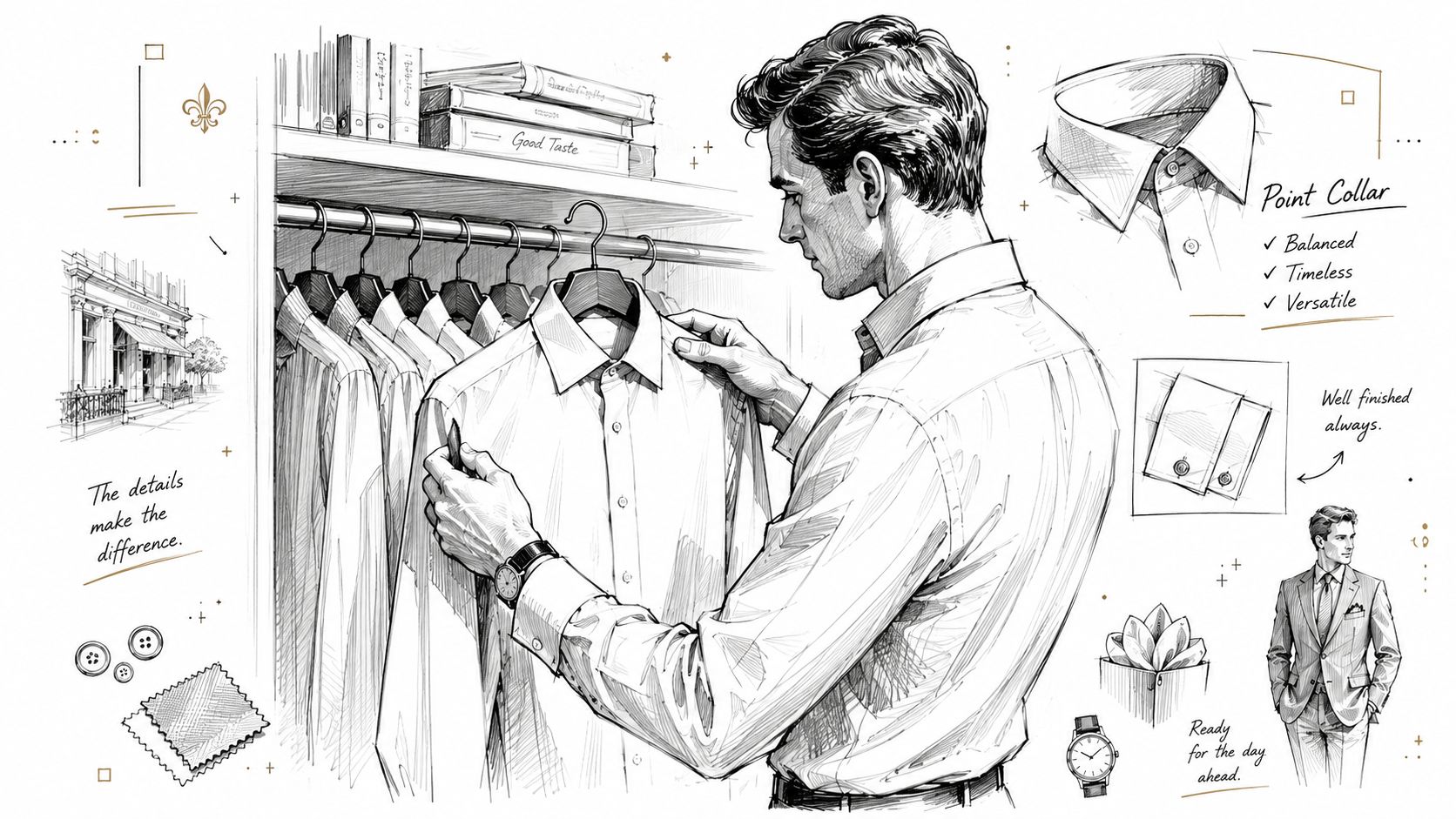
In British tailoring, that restraint has long been part of its appeal. The point collar belongs to a tradition of dress that values correctness of proportion over display. It is often the better choice when a client wants the shirt to support the coat and tie rather than compete with them, particularly in business dress, formal daytime use, and commissions built around classic lapels and measured detail.
That does not make it the automatic answer.
A point collar asks more of the wearer than the usual face-shape advice suggests. It has to work with your jacket line, your preferred knot, the height of your collar stand, and the tone of the room you are dressing for. In a modern office full of wider spreads, a point collar can read as authoritative or a touch too traditional. The difference comes down to proportion and context, which is exactly why it remains such a useful collar in bespoke work.
| Collar Style | Visual Character | Best With | General Impression |
|---|---|---|---|
| Point collar | Narrow, vertical, restrained | Smaller, neat tie knots | Classic, disciplined |
| Spread collar | Broader, more open | Medium to fuller knots | Modern business standard |
| Cutaway collar | Wide, assertive | Larger knots or open neck | Fashion-forward, bold |
| Button-down | Soft, fixed points | No tie or relaxed tie use | Casual, collegiate |
A well-judged point collar does not rely on nostalgia. It earns its place by making the whole rig look settled, which is why discerning clients still commission it now.
Understanding the Classic Point Collar Shirt
A client tries on a new coat, buttons it, and the whole front settles. Then the wrong collar goes on and the balance slips. The point collar avoids that problem when the shirt is meant to serve British tailoring rather than compete with it.
Its character comes from restraint. The points sit closer together than on a spread collar, so the eye travels down the shirt front in a clean line. Under a structured jacket, that vertical pull can make the tie, lapel, and collar read as one considered arrangement instead of three separate elements.
What defines the shape
In shirtmaking, a point collar is not one fixed draft. It is a range of proportions built around point length, spread angle, collar stand height, and the amount of interlining. Change any one of those and the collar can move from sober City businesswear to something softer and more relaxed.
A longer point gives more sweep and formality. A shorter point feels tidier and slightly sharper. A higher stand shows more collar above the coat line, which can be handsome on a taller man or under a higher gorge, but too much stand can look stiff if the jacket is low and soft. The make matters just as much. A softer collar rolls with the wearer and sits naturally open when worn without a tie. A firmer one holds a crisper edge and usually behaves better with a neat four-in-hand.
Practical rule: The best point collar makes sense with the coat it sits under and the knot it is asked to hold.
That is why bespoke commissions benefit from more than generic face-shape advice. In British dress, etiquette still values appropriateness and proportion. A point collar often suits clients who want a shirt for worsted suits, moderate lapels, and conventional business ties. It can look exactly right in chambers, finance, and formal daytime settings. In a more fashion-led office, the same collar may read deliberately traditional. Neither is wrong. The choice depends on the room and on how intentionally you want to signal classic dress.
Why it became such a standard
The point collar has lasted because it answers practical needs. It frames a tie knot neatly, sits well under a coat, and does not ask for visual attention. As detachable collars disappeared and attached collars became standard dress, the point collar remained one of the clearest expressions of correct, everyday formality.
This satisfies clients who want tradition without costume. A well-cut point collar carries history, but it does not feel theatrical. It looks settled with modern tailoring because its discipline is built into the proportions, not added as decoration.
Where it sits in today's wardrobe
Ready-made shirting now offers more spread and cutaway collars than it once did, so the point collar can feel like a more deliberate choice. That is part of its appeal. For many bespoke clients, it brings order back to the shirt front and keeps the coat as the leading garment.
If you are deciding between a classic dress collar and something sportier, the distinction between button-up and button-down shirts is worth getting right. The terms are often muddled, but the result on the body is quite different once ties, tailoring, and formality enter the picture.
Point Collar vs Other Styles A Visual Guide
A client tries on three shirts with the same navy worsted suit. The cutaway looks assertive before he puts the jacket on, the button-down feels too relaxed the moment the tie goes in, and the point collar settles the whole arrangement at once. That is usually how this choice is made in a British tailoring house. By effect, not theory.
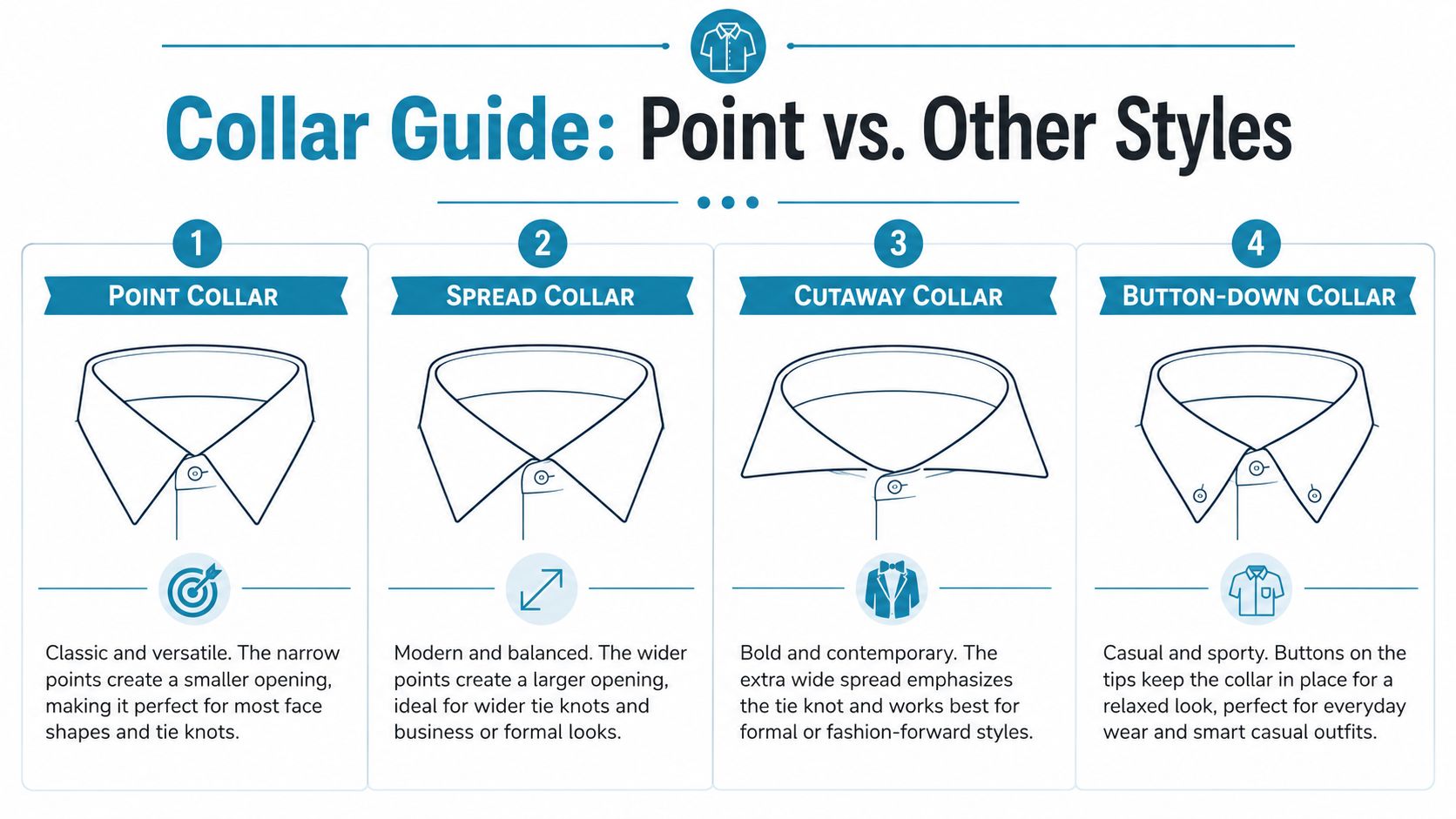
The usual advice about face shape is too thin to be useful on its own. Collar choice also depends on your tie habits, jacket lapel width, office culture, and how much authority you want the shirt to project. In British business dress, a point collar often keeps the coat as the leading garment. A wider collar shifts more attention upward and outward.
Guidance from traditional shirtmakers still places the spread collar at the centre of a contemporary city wardrobe, while the point collar reads as more classic and more restrained (modern UK collar guidance). That distinction matters in practice. On many modern bespoke commissions, the question is not which collar is more stylish. It is which one keeps the outfit coherent in the settings where it will be worn.
What each collar says
A point collar is disciplined. The longer, narrower line draws the eye down the tie and works especially well with structured British jackets, sober cloths, and compact tie knots. It is often the safest choice for clients who attend formal daytime events, work in law or finance, or prefer understatement.
A spread collar is more open and more common in ready-made business shirts. It gives a little more room for the tie knot and can suit a broader lapel line or a softer, more contemporary office wardrobe. For a closer comparison, this guide to the spread collar shirt explains where that extra width helps and where it starts to dominate.
A cutaway collar is sharper in attitude. It can be handsome with a well-built knot and a confident coat, but it is less forgiving. If the jacket is lightweight, the tie insubstantial, or the wearer not accustomed to stronger details, the collar can look detached from the rest of the rig.
A button-down belongs to a different tradition. It comes from sport and casual dress. It is excellent with tweed, flannel, corduroy, and soft tailoring, but it rarely handles ceremonial or boardroom formality as cleanly as a proper dress collar.
Collar Style Comparison
| Collar Style | Formality | Best Tie Knot | Primary Use Case |
|---|---|---|---|
| Point collar | High, especially in classic dress | Four-in-Hand or another compact knot | Conservative business, ceremonies, traditional tailoring |
| Spread collar | High and broadly contemporary | Moderate knot with a fuller shape | Standard business wear, versatile city dressing |
| Cutaway collar | Formal, but more expressive | Fuller knot | Dressier office settings, statement tailoring |
| Button-down | Lower in dress formality | Often best open-necked or with a simple knot | Business casual, relaxed tailoring, weekend wear |
The hidden technical difference
Outline is only the beginning. Two point collars can look similar on a hanger and behave very differently once worn with a tie and jacket.
What decides the result is the build. Interlining weight, collar stand height, the angle at which the collar is attached, edge stitching, and the precision of the turn all affect whether the points stay neat or drift outward by midday. Better shirts also tend to show cleaner seam work, steadier symmetry, and details such as split yokes or well-finished side gussets. Those are not showroom flourishes. They help the shirt keep its line through wear, laundering, and pressing.
The best comparison is always on the body, under your usual jacket, with the tie knot you wear.
The right collar does not compete for attention. It gives the suit, tie, and wearer a settled, intentional line.
Perfecting Proportions The Bespoke Difference
Off-the-peg shirts usually ask you to adapt to the collar. Bespoke shirting reverses that. The collar is drafted around your neck, your posture, your tie habits, and the shape of the jackets you wear.
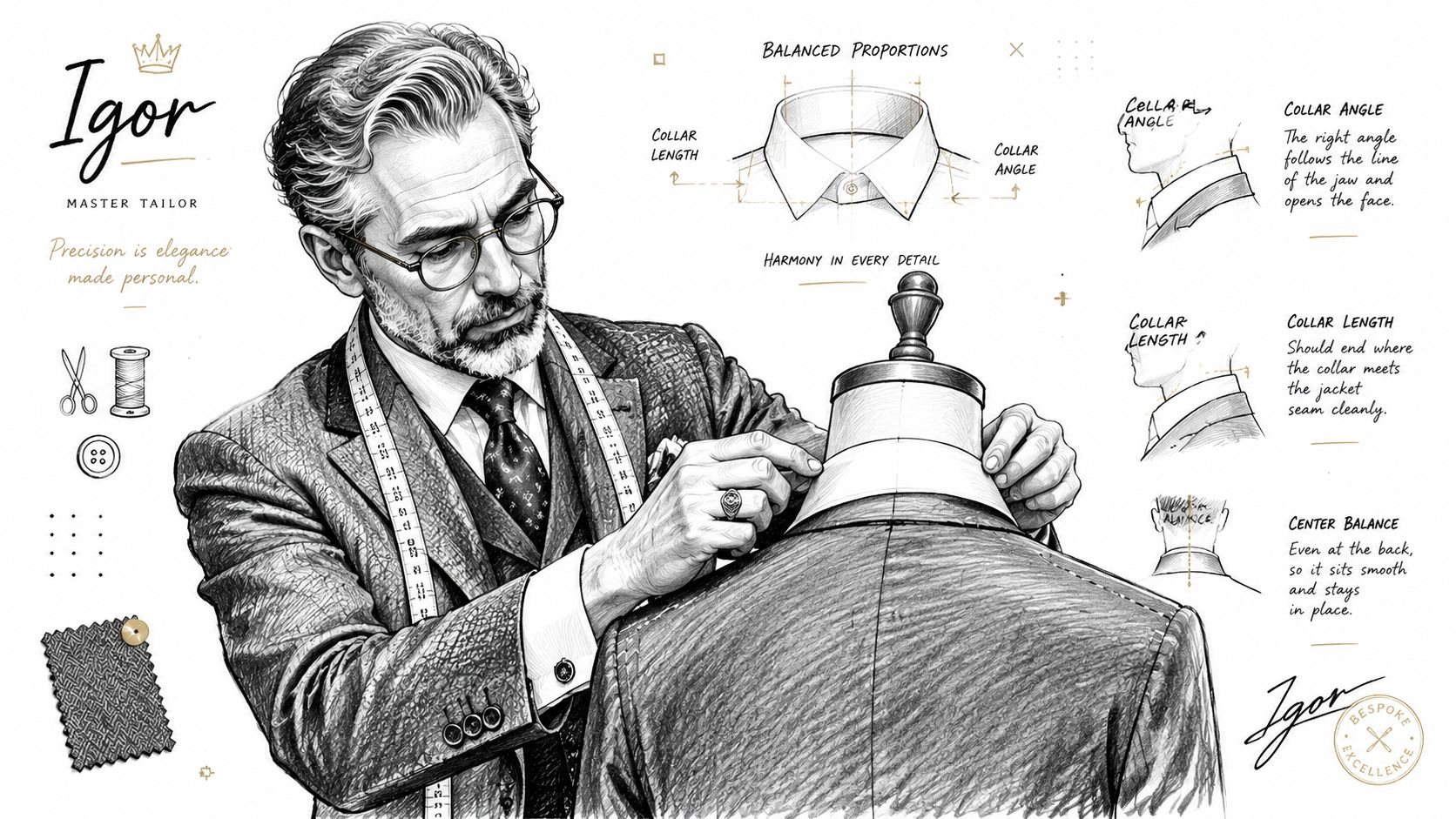
A well-cut point collar may be specified with a point length of 9 cm, a worn point distance of 16 cm, and a tiny 2 to 3 mm gap. That narrow geometry creates a strong vertical line and helps the collar sit cleanly at the neck while framing the tie properly (technical collar proportions in bespoke shirting).
The business shirt
A man who wears tailoring most weekdays often needs the collar to disappear into the harmony of the outfit. In that case, the best point collar usually has enough height to sit above the jacket line cleanly, but not so much that it presses into the jaw or dominates the face.
For business wear, what works is usually this:
- A tidy tie space that suits a compact knot.
- Points with enough length to sit under the jacket line gracefully.
- A clean collar roll rather than a board-flat, lifeless edge.
- Restraint in spread, so the shirt supports the suit instead of competing with it.
What doesn't work is mixing a very narrow point collar with an oversized tie knot or an aggressively wide lapel. The eye catches the mismatch immediately.
The wedding shirt
At weddings, a point collar can be excellent because it feels ceremonial without becoming theatrical. It suits the groom who wants polish and tradition, especially with a morning coat, lounge suit, or refined dinner jacket alternative.
The temptation is often to exaggerate. Bigger knot. Higher collar. Sharper points. That usually weakens the result. Wedding dressing improves when each piece is slightly calmer than expected.
A wedding shirt should still look elegant in ten years' time when the photographs matter more than the trend did.
The open-collar version
A point collar can also work without a tie, but the proportions must be considered differently. Too stiff, and it stands away from the neck awkwardly. Too long, and the points can droop. Too short, and the shirt loses its character.
For open-neck wear, a slightly softer construction often helps. The collar should sit with intention, not collapse.
The role of the tailor's eye
Bespoke tailoring finds its purpose in individual customization. One man may need a little more stand height to support a longer neck. Another may need slightly less point length because his features are finer and his lapels narrower. A third may wear only compact tie knots and need the collar tuned accordingly.
Men often use “bespoke” loosely, but if you want a clearer sense of what the term should mean in practice, it helps to understand what bespoke tailoring is. With shirts, the difference is not theatre. It is proportion, repeatability, and comfort.
Craftsmanship and Construction Details
A point collar proves its worth in use, not on the hanger. In a proper British wardrobe, that matters. A shirt may be worn under business suiting three days a week, then pressed again for a club dinner or a registry office wedding, so the collar has to hold its line through repeated laundering, ironing, and wear.
Begin with the collar and band. The points should mirror one another, the edge stitching should run cleanly without wandering, and the neckband should curve around the neck without buckling. If the collar twists after pressing or the band softens into ripples, the shirt was poorly built or badly fused. That fault shows quickly under a tie.
Good shirtmaking is full of small judgments. Interlining weight, stitch tension, button shank length, how firmly the collar is turned and pressed. None of these details advertise themselves, but together they decide whether the shirt still looks composed after a year of regular use.
What to inspect first
Turn the shirt inside out. That tells you more than the cloth on the outside.
A well-made point collar shirt usually shows several signs of control:
- Split yoke: Useful for balancing the shoulder line and improving pattern matching.
- French seams: Cleaner inside finish, less fraying, and a neater shirt after years of washing.
- Even collar stitching: The edge should be consistent from point to point, especially around the curve.
- Secure button attachment: Collar and cuff buttons take repeated strain and should be set to withstand it.
- Clean collar stand construction: The stand should feel supportive without becoming hard or bulky against the neck.
In bespoke commissions, I pay close attention to the collar stand and the turn of cloth at the points. That is where rushed shirtmaking often gives itself away. A handsome fabric can hide mediocre work for a few wears, but not for long.
Fabric and collar behaviour
The cloth changes how a point collar behaves. Poplin gives a crisp, dry line and suits more formal business dress. Twill has a softer hand and a slightly rounder expression, which works well with country cloths, brushed tailoring, and less severe office dress. Oxford cloth gives body and character, though it usually reads more relaxed than a fine city shirt.
This is one of the practical trade-offs clients often miss. A very soft cloth can feel pleasant on the body but leave the collar looking undernourished, particularly if worn open at the neck. A firmer cloth supports the points better, yet too much stiffness can make the shirt look brittle rather than elegant.
If you prefer softer shirting for travel or colder months, it helps to understand how merino wool shirts behave compared with cotton shirting. The body cloth affects warmth and drape, but it also changes how the collar frames the face and sits under a jacket.
The finishing work that clients actually feel
Much of shirt comfort comes from finishing. The collar should be pressed into shape, not crushed flat. The cuff should bend where the wrist bends. Side seams should sit cleanly without twisting the skirt of the shirt around the body.
British shirtmaking at its best has always balanced neatness with restraint. The shirt should look disciplined, but never overworked. For a modern bespoke client, that usually means choosing construction that supports the collar's line without making it feel rigid or over-engineered.
Maintenance begins at the workroom
A well-made shirt still needs proper care. Remove collar stays before washing. Reshape the collar by hand while it is still damp. Press from the underside first, then finish lightly on the face side so the collar keeps life and dimension.
Handled properly, a point collar develops character rather than fatigue. That is the standard to look for.
Styling the Point Collar for Modern Occasions
The point collar shirt is at its best when the rest of the outfit respects its tone. That doesn't mean dressing stiffly. It means dressing coherently.
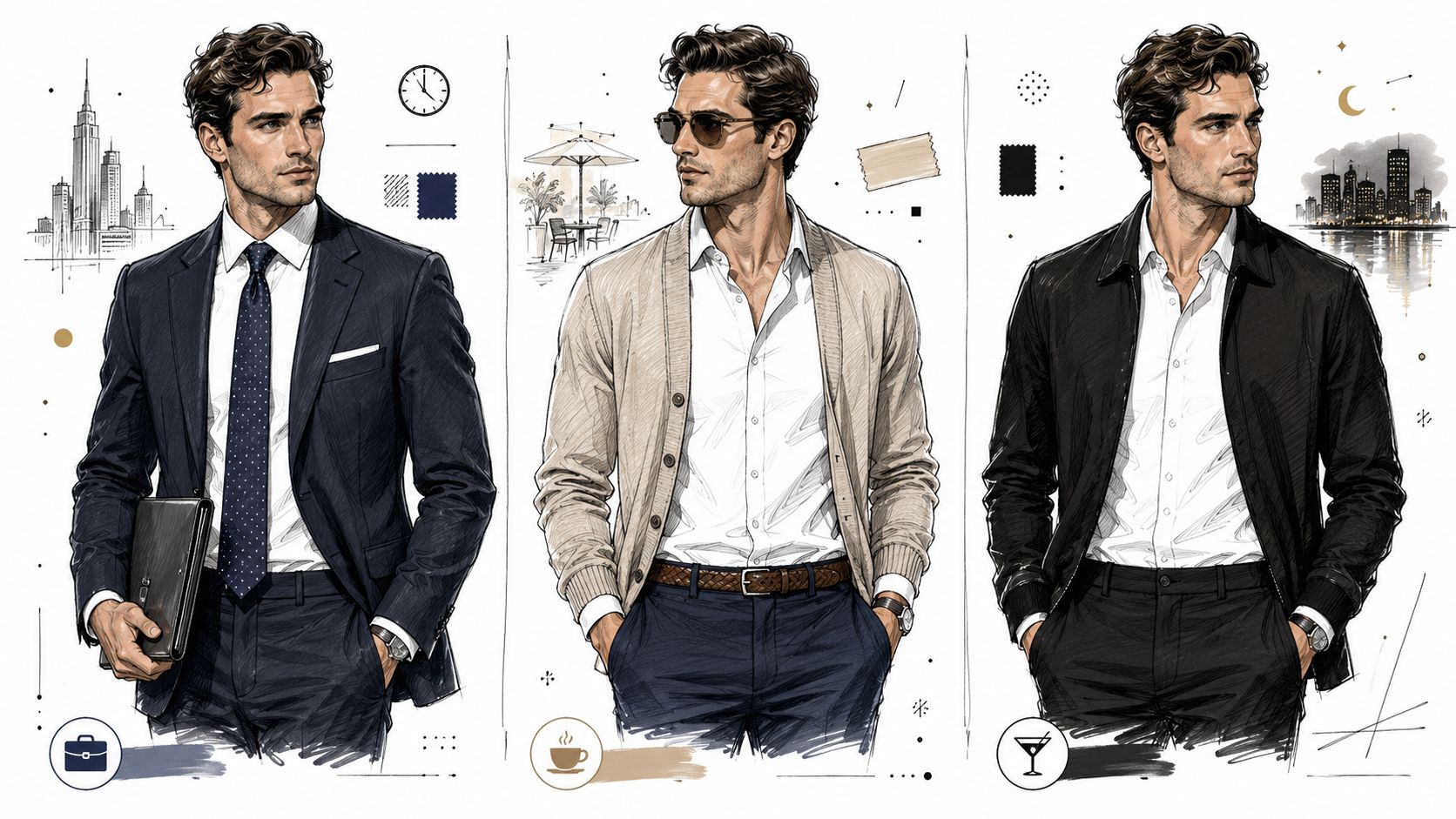
Business
In professional dress, the point collar is strongest with conservative tailoring. Navy, charcoal, and mid-grey suits give it the right setting. The tie should be neat rather than expansive, because the collar opening is narrower and looks best when the knot stays compact and controlled.
A few dependable pairings:
- White point collar shirt with navy suit: The most reliable option for formal business.
- Pale blue with charcoal: Slightly softer, still properly professional.
- Fine stripe with dark worsted tailoring: Useful when you want interest without informality.
Avoid forcing a large, symmetrical knot into a narrow collar space. The shirt will look strained, and the knot will sit like a plug rather than part of a balanced whole.
Weddings and ceremonies
For weddings, the point collar is excellent when the dress code leans elegant rather than theatrical. It gives the groom a composed, classic frame. Guests can use it to look polished without appearing to compete.
Good combinations include:
- A white point collar with a sober silk tie for the groom in a lounge suit.
- A cream or pale shirt with textured tailoring for country weddings where formality is present but softened.
- A properly cut formal shirt with a point collar for men who want black-tie-adjacent polish without a wing collar.
Evening and formal dressing
For black tie, the wing collar remains the more overtly ceremonial option. Still, some men prefer a point collar because it feels less costume-like and more integrated with the rest of their wardrobe. The result can be elegant if the shirt is properly formal in every other respect and the bow tie is proportioned carefully.
What fails is halfway dressing. A point collar in evening wear needs clarity of intention. If the rest of the outfit is muddled, the collar won't rescue it.
Choose a point collar for evening only if the rest of the ensemble is equally disciplined. Otherwise, wear the collar that the dress code is asking for.
Casual and open-neck dressing
The point collar can relax well, but not every point collar should. A very formal, fused, highly sharp collar often looks awkward when worn open. For casual use, softer construction and sensible point length make all the difference.
A few combinations that tend to work:
- Point collar shirt under an unstructured blazer
- Point collar shirt with knitwear layered over it
- Point collar shirt open at the neck with dress trousers
A practical commissioning checklist
If you're ordering a shirt rather than buying one quickly, ask yourself:
| Question | Why it matters |
|---|---|
| Will I wear it mostly with a tie or open-necked? | This changes collar stiffness and shape |
| What lapel width do I wear most often? | Collar and jacket should speak the same visual language |
| Do I prefer compact or fuller tie knots? | The opening must suit the knot |
| Is the shirt for business, weddings, or mixed use? | Occasion determines how classic or expressive the collar should be |
| Do I want sharpness or softness at the collar edge? | Construction affects both look and comfort |
Long-Term Care and Finishing Your Shirt
A point collar shirt lasts because of how it is treated between wears. Collars fail first. They collect oil, take the strain of pressing, and show every mistake in laundering.
Washing and preparation
Remove collar stays before the shirt goes anywhere near water. Fasten the shirt lightly so it doesn't whip around in the wash. Use a gentle detergent and avoid overloading the machine, because friction does more harm to collars than many people realise.
If you use a professional cleaner, choose one that understands garment finishing rather than treating every shirt like a commodity. For readers who want an example of how specialist services present that process, LaundryRun Gold Coast dry cleaning is a useful reference point for what careful garment care looks like in practice.
A broader wardrobe habit matters as well. Men often over-clean garments and shorten their life without meaning to. The same logic appears in fine garments generally, which is why guidance on how often you should dry clean a suit is worth applying to shirts in spirit, even though the maintenance cycle differs.
Pressing the collar properly
Press the collar before the body and sleeves. Start on the underside, moving from the points inward. Then press the upper side with the same discipline. Don't grind the iron back and forth, and don't crush the collar into total flatness if it has been designed to roll.
Use this sequence:
- Remove stays first: Never press over them.
- Shape the points carefully: They are the first place carelessness shows.
- Press the band neatly: This is what keeps the collar standing correctly.
- Let it cool on a hanger: Heat sets shape. Cooling helps preserve it.
Finishing touches
Reinsert collar stays only when the shirt is fully dry and cool. Button the top button occasionally, even if you won't wear a tie that day, just to confirm the collar is still sitting as intended.
The shirt should look composed before the jacket goes on. If the collar already looks tired at that stage, the rest of the outfit will never feel fully right.
Frequently Asked Questions
Is a point collar shirt still suitable for modern business wear?
Yes, if the rest of your wardrobe supports it. In the UK, spread collars are often treated as the default for contemporary business dress, so a point collar now reads as a more intentional choice. That can be a strength. If you want to project restraint, professionalism, and a classic sense of dress, a point collar shirt remains entirely appropriate, particularly with sober suits, neat ties, and conservative office environments.
Which tie knot works best with a point collar?
A compact, slightly asymmetric knot usually works best because the collar opening is narrower. The goal is to let the knot sit comfortably without pushing the collar points outward. Large, overbuilt knots often overwhelm the space and make the shirt look forced. In practice, a neat knot with a little character looks much better than one that is trying to fill every millimetre of the collar opening.
Can a point collar shirt be worn without a tie?
It can, but only if the collar has the right temperament. A very rigid, aggressively formal point collar can look uncomfortable when worn open. Softer construction usually works better for open-neck wear because the collar settles more naturally against the neck and chest. The points should still hold shape. If they flop or curl, the shirt stops looking elegant and starts looking tired.
Is the point collar only for older or more traditional dressers?
No. The issue isn't age. It's intention. A point collar looks old-fashioned only when it is poorly proportioned or paired with outdated styling. When cut well and worn with confidence, it looks precise and elegant. Many men choose it because it avoids the fashion-heavy feel of wider collars. It's a traditional option, certainly, but traditional does not mean stale when the proportions are correct.
What should I look for in a high-quality point collar shirt?
Start with how the collar sits, not just how it looks laid flat. The points should align cleanly, the collar band should feel stable, and the edge stitching should be even. Technical details matter too. Better shirts may use high stitch density, French seams, and a split yoke because those details help the shirt keep its shape over time. Good construction shows itself most clearly after repeated wear and pressing.
About the Author
Igor is the founder of Dandylion Style, a bespoke tailoring house based in Ardingly, West Sussex. He specialises in one-of-a-kind garments cut from fine British fabrics and shaped around the client rather than the hanger. His work spans business tailoring, wedding attire, shirts, black tie, and refined casual pieces. Known for a calm approach and precise eye, Igor helps clients across Sussex, London, and the South East build wardrobes that feel personal, comfortable, and enduring.
If you're considering a shirt or full wardrobe built around proportion rather than guesswork, Dandylion Style offers bespoke tailoring with consultations in West Sussex, London, and across the South East.