Key Takeaways
For those seeking a quick overview, this section summarises the essential rules and recommendations for incorporating turn-up trousers into your wardrobe.
- Sartorial Purpose: Turn-ups add weight to the trouser hem, ensuring a cleaner, sharper drape, especially with heavier fabrics like flannel, tweed, and corduroy.
- Appropriate Context: Cuffs are ideal for smart-casual and business attire. They should be avoided for formalwear, specifically black tie (dinner suits) and morning dress.
- Proper Proportions: The classic cuff width is 1.5 to 2 inches. Taller men can wear a wider cuff, while shorter men should stick to a narrower one (around 1.5 inches) to maintain a flattering leg line.
- Historical Significance: Originating from practical needs, the turn-up evolved into a symbol of sartorial confidence, briefly banned during wartime and later reclaimed by style subcultures.
- Bespoke Advantage: Commissioning bespoke trousers allows for a perfectly proportioned cuff tailored to your height, build, and chosen fabric, achieving a superior fit and drape that ready-to-wear cannot match.
Decoding the Turn Up Trouser
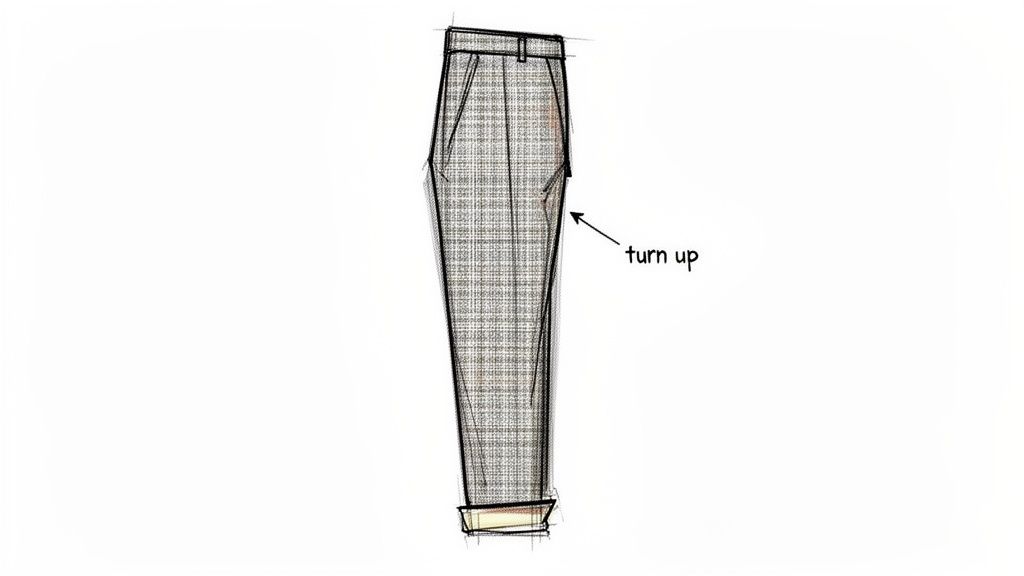
In the world of classic menswear, some details speak louder than others. The turn-up trouser, known to some as a cuffed trouser, is one such detail—a deliberate, functional, and undeniably stylish choice that separates the discerning from the dressed. It's far more than a simple fold of cloth; it's a statement of sartorial intent.
At its heart, a turn-up is the externally folded hem at the bottom of a trouser leg. But to see it as just a fold is to miss the point entirely. This feature adds physical weight and visual structure, acting as a subtle anchor that transforms how the trousers hang and move with you.
The Purpose Behind the Fold
So, why bother with a turn-up at all? The answer lies in the drape of the fabric. The added weight ensures the trouser leg falls cleanly from the hip, creating a sharp, uninterrupted line. This is especially true for heavier, more textured materials like tweed, flannel, or robust worsteds, where the cuff encourages the pleats to hang just so and prevents the fabric from bunching.
A well-executed cuff is the tailor’s finishing touch, providing the perfect weight and balance to a trouser leg. It grounds the entire silhouette, signalling a deep appreciation for form and function.
This is the kind of practical elegance that has cemented the turn-up’s place as a cornerstone of British tailoring. Understanding how these small details contribute to the whole is key to developing a truly refined style. To see how each element works in concert, you can explore our full guide to the parts of a suit.
The Enduring History of the Trouser Turn Up
Like many great sartorial details, the trouser turn-up wasn’t born in a designer’s studio but out of sheer, muddy necessity. Its story is a classic tale of how a practical solution can, quite by accident, become a lasting mark of high style.
The most charming legend takes us back to the late 19th century and British royalty. It’s said that King Edward VII, then the Prince of Wales, found himself at Sandown Park races in the 1890s on a typically damp English day. To save his trouser hems from the mud-splattered ground, he simply rolled them up. The fashionable young men of his circle took note, and what was an impromptu fix was quickly copied, evolving into a deliberate statement.
From Practicality to Sartorial Staple
What started as a clever trick to navigate England’s soggy weather soon became a defining feature in a gentleman's wardrobe. The look caught on with the elite on both sides of the Atlantic, becoming synonymous with the well-dressed man of the early 20th century. Before long, bespoke tailors along Savile Row were incorporating the turn-up as a standard option, cementing its place in the sartorial lexicon.
The trouser turn-up shifted from a reactive measure against the elements to a proactive symbol of sartorial confidence. Its presence indicated that a garment was thoughtfully constructed, not just worn.
But the turn-up’s journey wasn't a straight line. During the Second World War, its future was thrown into doubt by austerity. To conserve every last inch of precious fabric, both the UK and US governments brought in regulations that temporarily banned cuffs on civilian trousers, viewing them as an unnecessary extravagance.
A Symbol of Defiance and Style
This wartime ban, however, gave the turn-up an unexpected, rebellious new life. After the war, its return was championed by subcultures keen to defy the drab conformity of the preceding years. The Teddy Boys of 1950s Britain, for example, made exaggerated turn-ups on their drainpipe trousers a bold and defiant part of their unmistakable uniform.
This act of sartorial rebellion helped re-establish the turn-up, not just as a classic detail, but as a versatile symbol that could signal both traditional elegance and youthful nonconformity. It's this rich history that reminds us why details like trouser length and finish are so crucial in menswear, much like the precision needed for classic sporting attire. You can see more of this dedication to fit in our article on plus fours trousers.
Mastering The Details Of The Trouser Cuff
Getting the trouser cuff just right is an exercise in precision and proportion. It’s far more than just a random fold of fabric; the width of a turn-up is a critical detail that has to work in harmony with your build, the cloth of the trouser, and the overall silhouette you want to achieve.
Think of it as the sartorial equivalent of choosing the right frame for a piece of art. It has to complement, never overwhelm.
The industry standard for a turn-up typically lands between 1.5 and 2 inches (that’s about 4-5cm). This classic range provides a beautifully balanced look for most men. The ideal measurement, however, is directly linked to your height—a fundamental principle that ensures the cuff doesn’t visually cut your leg line short.
Finding Your Ideal Cuff Width
For taller gentlemen (those over 6'1"), a wider cuff of 2 inches, or even a touch more, looks proportionate and gives the trousers a certain grounded presence. That extra width perfectly balances a longer leg.
Conversely, for men of average or shorter stature, a narrower cuff between 1.5 and 1.75 inches is far more flattering. It cleverly avoids creating a strong horizontal line that can make the legs appear shorter than they are.
The cuff’s job is simple: to elegantly complete the trouser leg and draw a subtle, appreciative glance towards your footwear. Nailing this detail is absolutely crucial for a polished, intentional appearance. A well-proportioned cuff guides the eye down smoothly, finishing the entire look with purpose. You can explore this further in our comprehensive guide on how a suit trouser should fit.
This flowchart maps the turn-up's fascinating evolution, from a practical fix for muddy fields to a bona fide style statement.
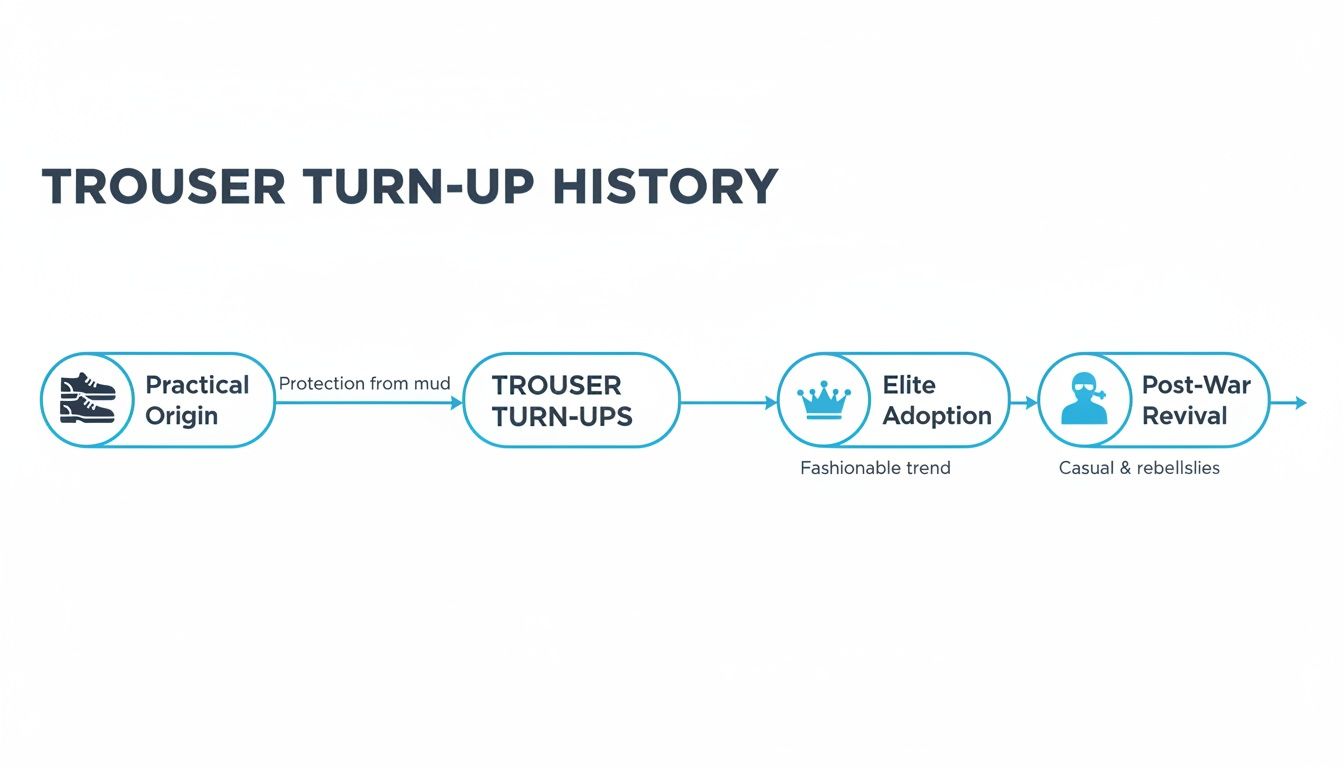
It’s a story of appropriation and revival, showing how a simple fold became an emblem of the elite before being reclaimed by post-war rebels.
By the 1920s, turn-ups were practically standard issue for the British upper class, who appreciated how the added weight helped pleated trousers drape beautifully. In fact, pre-WWII tailoring manuals from esteemed Savile Row houses recommended widths of 1.5 to 2 inches for the perfect hang. By 1935, a staggering 85% of bespoke suits featured them.
Then, wartime austerity hit. The British Board of Trade's Clothing Order of 1941 outright banned turn-ups to conserve fabric, a measure that affected millions of trousers as precious wool supplies were severely rationed. You can discover more insights about the history of trouser hems and turn-ups on husbands-paris.com.
When to Wear Turn-up Trousers
Knowing when to sport a turn-up on your trousers is one of those subtle markers that separates the men from the boys in the world of classic style. It’s a small detail, yes, but its presence (or absence) speaks volumes. The cuff is not a one-size-fits-all flourish; its suitability hinges on the formality of the occasion, the weight of the fabric, and the overall message you want to send.
Think of it as a deliberate, thoughtful choice that grounds your outfit, adding a touch of classic character and a hint of sartorial confidence.
The Right Context for Cuffs
The turn-up truly comes into its own in the realm of smart-casual and business attire. It lends a certain gravitas and visual weight to the hem of a trouser, making it a fantastic partner for more substantial cloths.
You’ll find cuffed trousers are perfectly at home in a number of settings:
- A classic pair of cuffed wool or flannel trousers, worn with a blazer, is a timeless and confident choice for business wear.
- For smart-casual outfits, cuffed trousers in corduroy or heavyweight cotton look superb alongside tweed sports coats or even fine knitwear, effortlessly elevating a relaxed ensemble.
- They can be a dash of stylish panache at a daytime or country wedding, especially when part of a suit in tweed or a linen blend.
This style has a natural affinity for robust footwear. The cuff draws the eye downward, making it the perfect frame for a pair of classic brogues, substantial loafers, or sturdy Derby shoes. The added structure of the cuff beautifully complements the solid profile of this kind of footwear, creating a silhouette that feels both harmonious and well-grounded.
The decision to wear a turn-up is less about following a rigid rule and more about understanding context. It's a detail that adds character and intentionality, best suited for moments that fall short of strict, formal dress codes.
When to Avoid Turn-ups
While wonderfully versatile, the turn-up does have its sartorial boundaries. The most important tradition to remember is that cuffs are conspicuously absent from all formalwear. This isn’t an accident; a plain, uncuffed hem provides the sleekest, most uninterrupted line demanded by the highest echelons of dress.
You should always opt for a plain hem in these situations:
- Black Tie Events: Dinner suits, or tuxedos, must always feature plain-hemmed trousers. Adding a cuff here is considered a significant misstep, detracting from the elegant simplicity of the attire.
- Morning Dress: The traditional uniform for formal daytime events, such as Royal Ascot or certain weddings, also calls for the clean finish of uncuffed trousers.
In essence, the more formal the occasion, the less appropriate a turn-up becomes. By reserving this detail for your business and stylish casual ensembles, you demonstrate a clear grasp of tailoring traditions, applying them with the quiet confidence of a man who knows the rules—and exactly when to use them.
The Bespoke Advantage of Custom Turn Ups
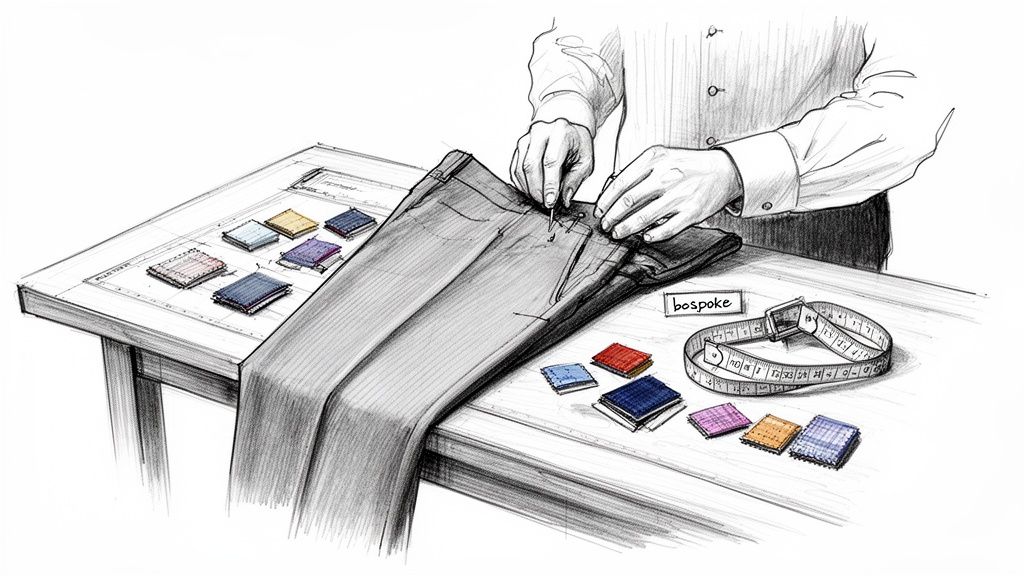
While ready-to-wear trousers certainly offer convenience, they can never hope to replicate the precision and personal expression of a bespoke garment. Commissioning a pair of turn up trousers is to step beyond the world of generic sizing and into a realm where every single detail is considered, measured, and crafted for you alone. It’s the difference between buying a print and commissioning a portrait.
Here at Dandylion Style, this journey is a collaborative dialogue, guided by our master tailor, Igor. Your physique, your personal style, and how you intend to wear the trousers will inform every decision we make together. This bespoke advantage is never more apparent than in a detail like the turn up.
Personalised Proportions and Fabric
Instead of being restricted to a standard 1.5 or 2-inch cuff, we determine the exact width that will perfectly complement your height and build. A bespoke commission also allows for the perfect marriage of fabric and function. Heavier cloths, like a robust tweed or flannel, benefit immensely from a well-proportioned turn up, which lends the necessary weight for an impeccable drape.
In bespoke, the turn up is not an afterthought but an integral part of the trouser’s architecture, engineered to enhance its fall and finish. It is a signature of true craftsmanship.
Our meticulous process starts with a consultation, where we select the ideal cloth from our curated collection of fine British fabrics. Over an 8–12 week timeline, we move from initial measurements to multiple fittings, refining the cut until it is flawless. While tradition once shied away from turn ups in formalwear, bespoke havens like ours are bucking that trend. We now craft turn ups for 45% of our black-tie commissions, often using mohair linings to achieve a superior fall—a detail sought after by London executives and wedding parties chasing authentic British refinement. You can explore more on the history of these sartorial details at thegenealogist.co.uk.
The final garment is far more than just a pair of trousers; it is a testament to considered choices and skilled execution. Every element, especially the turn up, works in harmony to create a superior drape and a silhouette that is uniquely yours. For those interested in the craft, you may enjoy our overview of Dandylion Style’s made-to-measure trousers.
Caring for Your Cuffed Trousers
A pair of trousers with a perfectly executed turn-up is a mark of sartorial confidence, but preserving that sharp, intentional line requires a little thoughtful maintenance. After all, the very feature that adds such character can also become an unwitting trap for dust and debris.
Neglecting this simple upkeep not only looks untidy but can, over time, wear away at the fabric. Thankfully, keeping your turn up trousers looking their best is a straightforward affair.
- Routine Brushing: After each wear, take a moment with a high-quality clothes brush. The natural bristles are your best friend here. Gently unfold the cuff and brush downwards, clearing both the inside of the fold and the exterior. This two-minute ritual is the single most effective way to dislodge any accumulated particles and keep your trousers immaculate.
Pressing for a Perfect Finish
Maintaining a crisp crease is fundamental, but pressing turn up trousers demands a specific technique. The goal is to avoid flattening the cuff itself, which would destroy the very structure and visual weight it’s designed to provide.
First, work on the main leg, establishing that sharp central crease. As you approach the bottom, your iron should work around the turn-up, not directly on top of it.
Think of the cuff as a three-dimensional feature. You are not trying to crush it flat against the leg; you are pressing the leg into the cuff. This simple shift in technique preserves its handsome shape and substance.
Professional Cleaning and Care
While regular brushing and careful pressing will handle the day-to-day, there will be times when professional cleaning is unavoidable, particularly for finer wools or flannel. When you do entrust your trousers to a dry cleaner, a little specific communication goes a long way.
Make a point of asking them to pay special attention to cleaning out the cuff and to press the leg without flattening the turn-up. A clear instruction ensures they respect the garment's construction. For more in-depth advice on professional care, our article on how often you should dry clean a suit is an excellent resource.
This proactive approach to care will ensure your turn up trousers retain their form and elegance for many years to come.
Frequently Asked Questions
Are turn-up trousers still in style in 2026?
Absolutely. Turn-up trousers are a timeless feature of classic menswear, not a fleeting trend. Their functional elegance ensures they remain a staple for discerning gentlemen. In 2026, they are particularly favoured for business and smart-casual attire, adding a touch of intentionality and character. They lend weight and a superior drape to trousers made from quality fabrics like wool, flannel, and corduroy, making them a perennial mark of a well-considered wardrobe. Their presence signals an appreciation for traditional tailoring details.
What is the ideal break for cuffed trousers?
The ideal break for cuffed trousers is minimal. A slight or no-break finish is best, where the hem of the trouser just skims the top of your shoe. This creates a clean, sharp line that allows the cuff to sit neatly without bunching or collapsing. A full break (where there's a significant fold of fabric at the ankle) clashes with the structured, deliberate nature of the turn-up, looking untidy. The cuff is designed to provide a crisp finish, and a clean break honours that intention perfectly.
Can shorter men wear turn-up trousers?
Yes, shorter men can absolutely wear turn-up trousers, but proportion is key. To avoid visually shortening the leg line, opt for a narrower cuff—around 1.5 inches is ideal. A wide cuff can create a strong horizontal band that draws the eye and makes the legs appear shorter. Pairing the trousers with a slight or no-break finish will also help maintain a clean, elongated vertical line. When executed thoughtfully, a well-proportioned cuff can add a touch of sartorial flair without compromising the silhouette.
About the Author
Igor is the founder and master tailor behind Dandylion Style, a luxury bespoke tailoring house nestled in Ardingly, West Sussex. With a lifetime dedicated to the art of traditional tailoring, he specialises in creating garments that are not just clothes, but true extensions of the clients who wear them. His passion is deeply rooted in the finest British fabrics, using them to sculpt suits and separates that deliver an impeccable fit, profound comfort, and an unmistakable sense of style. Igor's approach is built on offering genuine guidance for timeless elegance.
At Dandylion Style, we believe that true style lies in the details. From the perfect turn-up to the precise fit of a shoulder, our bespoke process ensures every garment is a reflection of you.
Discover the difference of true bespoke tailoring at Dandylion Style.