Key Takeaways
- What “Bespoke” Really Means: A genuine Savile Row suit is born from a paper pattern cut by hand for one person, and one person only. It's an art form built on multiple fittings, endless hand-stitching, and a real partnership between you and your tailor.
- Bespoke vs. Made-to-Measure: The difference is all in the pattern. Bespoke starts from a blank page, sculpting a suit to your body. Made-to-measure just tweaks an existing template—it’s a compromise on customisation and the precision of the fit.
- An Investment That Lasts: This is about more than a perfect fit. A bespoke suit is built to last for decades, becoming a true extension of your personal style. The 8-12 week process is a testament to the meticulous work that goes into creating a garment of this calibre.
- The Savile Row Standard: This isn't just a postcode in London; it's a promise. It represents the absolute pinnacle of tailoring, a legacy of quality and a dedication to the craft that has been polished over centuries.
The Pinnacle of Personal Style
A Savile Row suit is the art of bespoke tailoring in its purest form—a garment you don't just buy off a peg, but one you commission.
It all starts with a unique paper pattern, drafted from scratch to become your personal sartorial blueprint. This is a commitment to true individuality, and with over 50 hours of hand labour poured into every suit, it stands as the ultimate expression of personal style.
The journey is a conversation between you and your tailor, an experience built on trust, expertise, and a shared vision. This guide is here to walk you through every single step of this time-honoured craft.
What Defines the Art of Bespoke Tailoring?
At its very heart, bespoke tailoring is a complete rejection of the one-size-fits-all world. It’s an acknowledgement that every body is unique, from the slope of your shoulders to the specific arch of your back.
A true bespoke suit is sculpted directly to your form through a series of crucial stages that simply can't be skipped:
- The Unique Pattern: Unlike made-to-measure, which just modifies a standard block, bespoke begins with a blank sheet of paper. Your measurements and posture notes are translated into a one-of-a-kind pattern.
- Multiple Fittings: You can expect at least three fittings. The first, the "baste" fitting, uses temporary stitches, giving the tailor the freedom to shape the suit's very foundation on your body.
- Hand Craftsmanship: From hand-padded lapels that roll beautifully to buttonholes sewn meticulously with silk thread, the construction is almost entirely manual. This creates a softer, more responsive garment that moulds to you over time.
A Savile Row suit is more than clothing. It's a wearable piece of history, defined by generations of uncompromising craftsmanship and an intimate understanding of the human form.
This guide will unpack these principles, demystifying what makes a Savile Row suit the undisputed gold standard in menswear. You'll gain a clear understanding of the process, the history, and the enduring value of investing in something built just for you.
The Enduring Legacy of Savile Row
To really get to the heart of bespoke tailoring, you first have to understand its spiritual home: Savile Row. This single London street is far more than just a location; it's a byword for the absolute pinnacle of craftsmanship, a reputation built brick by brick over three centuries. Looking at its story reveals exactly why a Savile Row suit isn't just clothing, but a wearable piece of history.
It all started not with tailors, but with aristocrats. Tucked away in Mayfair, the street was originally developed between 1731 and 1735 as an exclusive residential spot. Its proximity to the Royal Court and London's high society created the perfect conditions for what was to come. Gentlemen of significant means needed skilled artisans to craft their wardrobes, and naturally, the tailors followed the money.
The Birth of a Tailoring Mecca
By the late 18th century, the area was already becoming the epicentre for gentlemen's outfitters. Tailors first congregated on nearby Cork Street around 1790 before making the short move over to Savile Row itself by 1803, drawn in by their wealthy patrons. The street's destiny was truly sealed in 1846 when Henry Poole & Co. opened its doors at No. 32. This single move would cement its reputation as the 'golden mile of tailoring' and earn Poole the title 'Founder of the Row'.
It was right here that the dinner jacket was invented—a garment that completely changed formalwear and was later adopted in America as the tuxedo. This period marked the golden age of British tailoring, a time of incredible innovation.
"A Savile Row suit is the ultimate sartorial statement. It carries the weight of history in its very threads, representing a lineage of masters who have perfected their craft for generations."
The Row became a laboratory for style, dressing everyone from monarchs and military heroes to politicians and Hollywood stars. Each house developed its own signature "cut"—from the structured, almost military-inspired silhouette of Gieves & Hawkes to the softer, draped look championed by Anderson & Sheppard.
Facing Down Challenges and a Modern Revival
The 20th century, however, brought enormous challenges. Two World Wars, the explosion of ready-to-wear fashion, and shifting social norms threatened the very existence of this time-honoured craft. The painstaking, multi-week process of creating a bespoke suit seemed completely at odds with the fast-paced modern world.
And yet, the legacy of Savile Row endured. Its stubborn refusal to compromise on quality became its greatest strength. While the world sped up, the Row remained a bastion of meticulous, by-hand construction and unparalleled personalisation. This fierce dedication has fuelled a powerful modern resurgence.
Today, the street is a vibrant mix of historic, storied houses and innovative newcomers. Contemporary artisans like Ozwald Boateng brought bold colour and a fresh perspective in the 1990s, proving that tradition and modernity could coexist beautifully. The core principles, though, remain unshakable. Every true Savile Row suit still begins with a unique paper pattern, multiple fittings, and countless hours of skilled handwork. You can explore our guide on finding the best bespoke suits in London to see how these principles are applied today.
This enduring commitment is precisely why the Savile Row suit remains the benchmark for excellence. It’s a testament to the idea that true style isn't fleeting; it’s built with skill, patience, and a deep, unwavering respect for heritage.
The Bespoke Journey from Consultation to Final Fitting
Stepping into the world of bespoke is about more than just buying a suit; it’s a creative partnership between you and your tailor. It’s a fascinating process that sees a simple bolt of cloth transformed into a garment that’s yours and yours alone. While it might sound formal, it’s really a collaborative journey, turning the abstract idea of your perfect suit into a tangible reality.
This sequence of events is the very heart of the Savile Row suit the art of bespoke tailoring. It’s a structured yet deeply personal experience that always, without fail, starts with a simple conversation. That initial chat lays the foundation for every single step that follows.
This timeline shows some of the pivotal moments that shaped the tailoring traditions we still honour on Savile Row today.
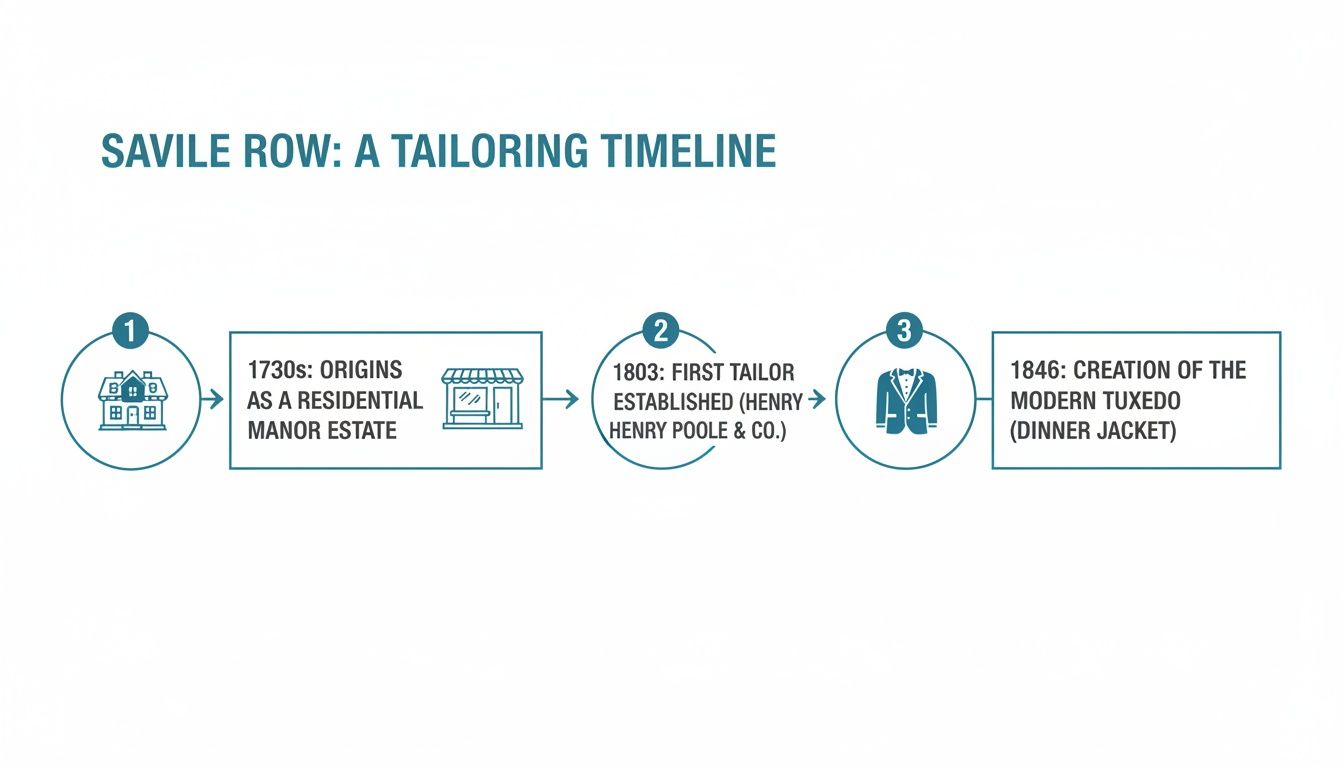
You can see how the street evolved from a quiet aristocratic neighbourhood into the absolute epicentre of fine tailoring, giving birth to iconic garments like the tuxedo and cementing its global reputation.
The Initial Consultation and Measurements
Your journey doesn’t begin with a tape measure, but with a cup of tea and a good talk. This is where your tailor gets to know you—your lifestyle, your work, and what this suit is really for. Is it for a wedding? A make-or-break board meeting? Or simply to elevate your daily style? Your answers guide every decision, from the weight of the cloth to the final silhouette.
Only after this do we get to the measurements. This is an art form in itself. A master tailor will take well over 20 individual measurements, but they’re capturing far more than just numbers. They’re observing your "figuration"—the subtle nuances of your posture, like the natural slope of your shoulders, the curve of your back, and the way you stand.
"Rock of eye" is a term you’ll hear Savile Row cutters use. It’s that instinct, born from years of experience, to size up a client’s build and personality the moment they walk through the door. Those crucial observations are then translated into the suit's design.
This holistic approach means the suit won't just fit your measurements; it will flatter your natural stance and move with you. It’s a level of detail that’s simply impossible to achieve any other way, setting the stage for a garment that is authentically yours.
Creating the Unique Paper Pattern
With a notebook full of measurements and observations, the tailor heads to the cutting room. Here, your personal pattern is drafted from scratch on a large sheet of brown paper. This pattern is the very soul of your bespoke suit—a two-dimensional architectural blueprint of your body that will exist for you and you alone.
This is the absolute, non-negotiable line in the sand between true bespoke and made-to-measure. A made-to-measure service simply tweaks an existing block pattern. Bespoke starts with a blank canvas. Every line is drawn specifically for your form, creating a harmony and balance that cannot be replicated.
The cutter then lays this unique paper pattern onto your chosen cloth and, with immense precision, "strikes" it, cutting the fabric with heavy shears. Crucially, they leave generous inlays—extra cloth hidden away in the seams. These allow for future alterations, ensuring your suit can evolve with you over a lifetime.
The Crucial Basting and Forward Fittings
Now, the suit starts to take shape on your body. The cut pieces of cloth are loosely stitched together with distinctive white basting thread to create a skeletal version of the final garment. This is the first fitting, often called the "baste." There are no pockets, no lining, no buttons—it's a raw shell.
The whole point of this fitting is to check the suit’s fundamental balance and proportions. Your tailor will cover it in chalk marks, pinning and tucking the fabric to sculpt the garment directly onto your frame. This is where the "rock of eye" assessment really proves its worth, as the cutter refines the hang of the jacket and the line of the trousers in real-time.
After this, the suit is taken apart completely. The chalk adjustments are transferred back to your paper pattern, which is re-cut and perfected. The garment is then re-assembled for a second, or "forward," fitting. Now, details like pockets and lapels are in place, and the focus shifts to finer points like sleeve pitch and collar height. This iterative process—fitting, deconstructing, and refining—is what leads to a flawless result. It's exactly how we at Dandylion Style ensure every commission meets our exacting standards; you can begin to design a suit with us and experience this meticulous process firsthand.
The number of fittings can vary, but typically two or three are needed before the suit is ready for finishing. To protect these traditions, the Savile Row Bespoke Association was established in 2004. This body ensures members adhere to the craft's rigorous standards, demanding a minimum of 50 hours of hand labour for a two-piece suit—a benchmark that protects the integrity of this incredible art form.
Understanding Bespoke vs Made-to-Measure
Walk into the world of custom suiting and you’ll quickly hear two terms thrown about, often as if they mean the same thing: "bespoke" and "made-to-measure". They absolutely do not. Getting to grips with the difference is the first step any gentleman should take before investing in a suit that’s truly his own.
The simplest way to picture it is to think of a sculptor. Bespoke tailoring is like creating a statue from a fresh block of marble, carving every single line and curve from scratch to perfectly capture the subject. Made-to-measure, on the other hand, is more like an expert restorer taking an existing statue and skilfully altering it to be a better fit.
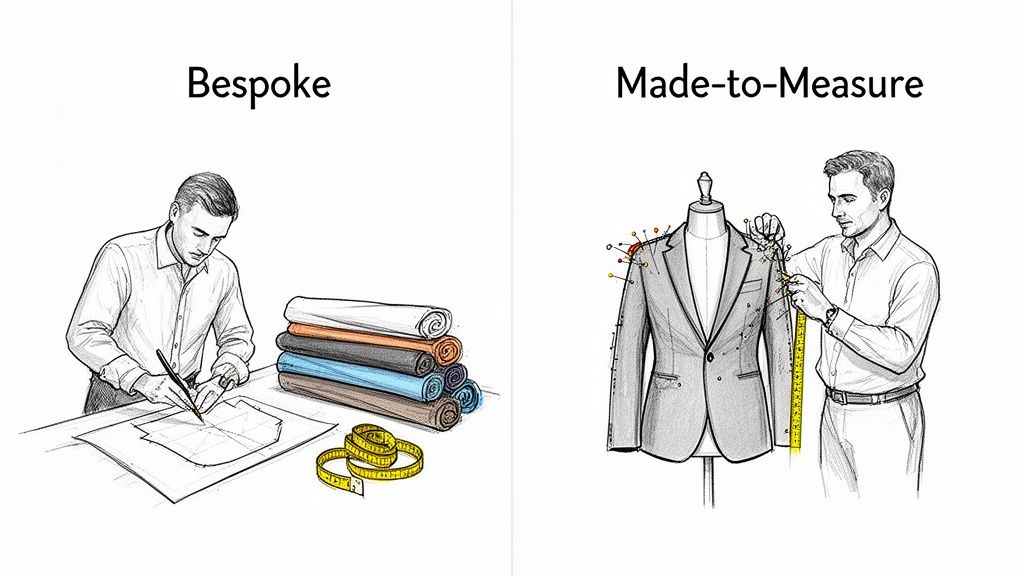
It all boils down to one crucial element: the pattern. This single component is the soul of the suit. It dictates the level of customisation, the number of fittings you'll need, and ultimately, how flawlessly the garment drapes over your body. It is the very heart of the Savile Row suit the art of bespoke tailoring.
The Soul of the Suit: The Pattern
In a true bespoke house, your tailor starts with a blank sheet of brown paper. From this, they will draft a unique pattern entirely from scratch, using more than 20 individual measurements and their trained "rock of eye" to account for your unique posture and build. This pattern is a sartorial blueprint of you, and only you. No one else on the planet will have one like it.
Made-to-measure (MTM) operates from a different playbook. It starts with a pre-existing, standardised block pattern—a template for a size 40 Regular, for example. Your measurements are then used to make adjustments to this standard block, rather than creating a new one.
- Bespoke: Begins with a blank page to create a pattern that is 100% original to you.
- Made-to-Measure: Starts with a pre-made template and modifies it.
This isn’t just a technicality; it has a profound effect on the finished product. A bespoke pattern can accommodate every personal nuance—one shoulder slightly lower than the other, a prominent curve in your back, an athletic V-shape—with a level of precision that MTM simply cannot replicate. For a closer look at this critical distinction, you can dive deeper into the differences between made-to-measure vs bespoke suits in our comprehensive guide.
The Impact on Fit and Process
Because bespoke begins from a blank slate, it demands a much more involved and collaborative journey. This is precisely why multiple fittings are a non-negotiable part of the experience. The initial "baste" fitting, where the suit is loosely stitched together, allows the tailor to literally sculpt the cloth on your body, making fundamental changes that are impossible once an MTM suit has been cut.
The bespoke process is a dialogue in cloth. Each fitting is a conversation, allowing the tailor to refine the garment until it becomes a true second skin, perfectly balanced and effortlessly comfortable.
Conversely, the made-to-measure process is much more direct. It usually involves one measuring session at the start and maybe a single final fitting to check the alterations. The customisation options are also more constrained, limited by what the original block pattern allows. While MTM is a fantastic step up from anything off-the-peg, it remains an adaptation of a standard size, not a truly original creation born from your own form.
To put these differences into sharper focus, let's break them down head-to-head.
Bespoke vs Made-to-Measure: A Head-to-Head Comparison
This table clearly lays out the fundamental differences between the two main types of custom tailoring, helping you understand what truly defines a bespoke suit and where its value lies.
| Feature | Bespoke Tailoring | Made-to-Measure |
|---|---|---|
| Pattern | A unique paper pattern is created from scratch for each client. 100% original. | An existing, standardised block pattern is modified to the client’s measurements. |
| Fittings | Multiple fittings are essential (usually 3+), including a "baste" fitting for major adjustments. | Typically 1-2 fittings, often just one at the beginning and a final check. |
| Customisation | Virtually unlimited. Every detail, from lapel width to pocket angle, can be specified. | Limited to pre-set options offered by the manufacturer (fabric, lining, button style). |
| Craftsmanship | Primarily handmade, involving 50+ hours of skilled artisan labour. | Mostly machine-made, with some hand-finishing possible depending on the tailor. |
| Fit | Unparalleled. Designed to accommodate all unique body shapes, postures, and asymmetries perfectly. | A very good fit, but can struggle with non-standard body types as it's an altered standard. |
| Timeline | Longer process, typically 8-12 weeks or more, due to multiple fittings and handwork. | Faster turnaround, often 4-6 weeks. |
| Price | Higher investment, reflecting the intensive labour, skill, and complete personalisation involved. | More accessible price point, offering a custom experience without the full bespoke cost. |
Ultimately, the choice between bespoke and made-to-measure depends on what you're looking for. MTM provides an excellent, personalised fit far superior to ready-to-wear. But for those seeking a garment that is a true extension of themselves—flawlessly sculpted, utterly unique, and built to last a lifetime—nothing compares to the art of bespoke.
Investing in a Suit That Lasts a Lifetime
Think of a bespoke suit not as a fleeting fashion purchase, but as a long-term investment in your personal style. It's a cornerstone piece for a sustainable wardrobe. Unlike off-the-peg garments designed to last a season or two, a bespoke suit is constructed to endure for decades, making the initial cost a remarkably sensible proposition over time.
That price tag represents an immense amount of work that often goes unseen. It accounts for the finest British cloths, thousands of meticulous hand stitches, and the master tailor's years of accumulated skill. To really grasp its value, you have to look beyond the initial figure. For more insight, you can explore our detailed breakdown of how much a bespoke suit costs and see exactly what goes into the final price.
The Value of Time and Craftsmanship
Creating a bespoke suit is a deliberate, unhurried process. The typical 8-12 week timeline isn’t just an arbitrary waiting period; it’s a fundamental requirement for achieving a perfect outcome. Each of those weeks is filled with precise, methodical stages, from drafting and cutting your unique pattern to the multiple fittings where the garment is literally sculpted directly onto your body.
This patient approach allows for a level of refinement that’s simply impossible to achieve with faster production methods. Rushing the process would mean compromising on the very principles that define the Savile Row suit—the art of bespoke tailoring. It’s a steadfast commitment to getting every single detail right.
This tradition of excellence is upheld by modern standards. For instance, each suit demands multiple fittings and can take up to 12 weeks to complete, a timeline we mirror at Dandylion Style for our clients in Sussex and London. This dedication, requiring over 50+ hours of handwork per suit, is a legacy that has dressed icons from royalty to rock stars, proving why Savile Row remains Britain's pinnacle of precise, personal tailoring. You can learn more about this enduring client legacy on The Independent.
Ensuring Decades of Wear
The remarkable longevity of a bespoke suit isn't just down to its initial construction; it also depends heavily on proper care. With the right maintenance, your suit can last for decades, adapting with you as your life and body change over the years.
Think of it like owning a classic car; it requires a little attention to keep it performing at its best. Following a few simple rules will preserve its shape, fabric, and internal structure, ensuring it remains a treasured part of your wardrobe for a very long time.
A well-cared-for bespoke suit doesn't age; it matures. The cloth softens, the canvas moulds perfectly to your shape, and it becomes a true second skin—a testament to enduring quality.
Here are a few essential care tips to maximise its lifespan:
- Rest Your Suit: Never wear the same suit two days in a row. Letting it rest for at least 24 hours helps the natural fibres recover their shape and shed wrinkles.
- Use a Proper Hanger: Always use a wide-shouldered wooden hanger. This is crucial for supporting the jacket's structure and preventing the shoulders from puckering or losing their shape.
- Brush, Don't Over-Clean: After each wear, give your suit a gentle brush with a soft-bristled clothes brush to remove any dust and debris. Try to avoid frequent dry cleaning, as the harsh chemicals can damage the delicate fibres and internal canvas. Instead, opt for steaming and spot cleaning whenever possible.
Experience Savile Row Standards with Dandylion Style
The principles that define the art of bespoke tailoring aren’t confined to a single London street. They’re a philosophy of craftsmanship, a deep respect for individuality, and an uncompromising standard of quality that has been honed over centuries. At Dandylion Style, we bring this revered tradition directly to you, whether you're in Sussex, London, or across the South East.
Our founder and master tailor, Igor, lives and breathes the same core tenets that have guided the world's finest tailors. He understands that the journey for every client begins not with a tape measure, but with a conversation. We believe that truly understanding your lifestyle, your needs, and your personality is the real foundation of any exceptional garment.
The Bespoke Promise, Delivered to You
This commitment to the craft is tangible in every single step of our process. We start by creating a unique paper pattern for every client—a sartorial blueprint that is yours and yours alone. This is the non-negotiable heart of true bespoke, ensuring the final garment is a perfect extension of your own form.
We work exclusively with the finest British cloths, offering a curated selection from renowned mills that are the envy of the world. This focus on superior materials is matched by our meticulous multi-fitting process, which always includes the critical 'baste' fitting. This is where we sculpt the suit directly on your body, allowing us to achieve a flawless hang and a level of comfort that ready-to-wear can only dream of.
"True bespoke is a dialogue in cloth. It's about translating a client's personality and needs into a garment that feels as good as it looks, built with integrity from the very first stitch."
Personalised Consultations, Wherever You Are
We know that your time is valuable. That’s why we offer personalised consultations at our welcoming studio in Ardingly or at a location of your choosing. Whether it’s your home or your office, we bring the entire bespoke experience—from cloth selection to the final fitting—directly to you. This individual attention is central to how we work.
By adhering to these time-honoured methods, we make world-class craftsmanship accessible. We are dedicated to delivering a suit that not only fits impeccably but also embodies the heritage and artistry of genuine bespoke tailoring. To see how we put these principles into practice, you can explore our detailed guide to Dandylion bespoke tailoring. It’s the first step in your own creative journey towards a garment built with passion, precision, and a deep respect for tradition.
About the Author: Igor, Founder of Dandylion Style
Behind every exceptional suit is an artisan whose passion is woven into every stitch. For Dandylion Style, that artisan is Igor, our founder and master tailor. Igor’s journey into the world of bespoke tailoring was a calling driven by a profound respect for the time-honoured techniques that define a truly great garment—the very same principles that give Savile Row its legendary status. He believes in starting with the best materials, using only the finest British cloths, and is unwavering in his commitment to the art of creating a unique paper pattern for every client. This dedication is your assurance that every Dandylion Style commission is in the hands of a true craftsman who honours the heritage of his art.
Frequently Asked Questions
How long does a bespoke suit take to make?
The entire bespoke process typically takes between 8 and 12 weeks. This timeframe is essential to accommodate the meticulous craftsmanship involved, from drafting your unique paper pattern to the multiple fitting sessions required. Each stage, including the crucial 'baste' fitting where the suit is sculpted on your body, demands patience and precision. Rushing this journey would compromise the flawless fit and finish that defines a true Savile Row standard suit. This deliberate pace ensures every detail is perfected, resulting in a garment built to last a lifetime.
What is the most important difference between bespoke and made-to-measure?
The most critical difference is the pattern. A bespoke suit is built from a pattern created entirely from scratch, specifically for you. It's a unique blueprint of your body. Made-to-measure, however, starts with a pre-existing standard block pattern which is then altered to fit your measurements. This fundamental distinction means bespoke can perfectly accommodate every nuance of your posture and shape, offering a level of fit and comfort that made-to-measure, being an adaptation of a template, simply cannot replicate.
How many fittings are required for a bespoke suit?
A genuine bespoke suit will always require a minimum of three fittings after the initial consultation. The first is the 'baste' fitting, where the suit is temporarily stitched together to assess its initial shape on your body. Subsequent fittings are where the tailor meticulously refines the fit, making precise adjustments to accommodate your posture and movement. This multi-stage process is a non-negotiable hallmark of true craftsmanship and is essential for sculpting the garment perfectly to your frame, ensuring it hangs flawlessly.
Can I choose every detail of my bespoke suit?
Absolutely. The true beauty of bespoke is the complete creative control it offers. From thousands of fabric choices to the lining, the style of the lapel, the configuration of the pockets, the material of the buttons, and even the colour of the buttonhole stitching—every single element is your decision. Your tailor acts as an expert guide, helping you navigate these options to ensure the final design is coherent, stylish, and perfectly suited to your personality. It is the ultimate expression of personal style.
How should I care for my bespoke suit?
To ensure your suit lasts for decades, always store it on a wide-shouldered wooden hanger to maintain its structure. It is vital to let the suit rest for at least 24 hours between wears, allowing the natural fibres to recover. After wearing, give it a gentle brush with a soft-bristled clothes brush. Avoid frequent dry cleaning, as the chemicals can damage the delicate fibres. Instead, opt for spot cleaning and professional pressing. Proper care ensures your investment matures beautifully over time.
At Dandylion Style, we uphold these revered traditions to create garments that are truly yours. Experience the art of bespoke tailoring by scheduling your personal consultation today.