A silk bow tie is so much more than a finishing touch for formal wear; it’s a quiet nod to a gentleman's appreciation for detail and a sign of true sartorial confidence. The quality of the silk weave is what gives it texture and sets its level of formality, while your choice between a classic self-tie and a pre-tied bow instantly reveals where you stand on traditional style.
Key Takeaways
- Weave Defines Formality: The texture of the silk is crucial. Smooth satin is essential for black-tie events, while textured weaves like grenadine or twill offer versatility for smart-casual or business settings, adding depth and character.
- Self-Tie is Superior: While pre-tied bows offer convenience, a hand-tied (self-tie) bow is the hallmark of authentic style. Its subtle, natural imperfections, known as 'sprezzatura', signal confidence and sartorial skill.
- Proportion is Paramount: A bow tie's width should be balanced with your facial features, shirt collar, and jacket lapels. It should not extend past the outer corners of your eyes for a harmonious and polished look.
- Bespoke Offers Uniqueness: For the ultimate expression of personal style, a bespoke silk bow tie allows for complete control over fabric, shape, and size, ensuring a perfect match for your individual proportions and taste.
Your Guide to Silk Bow Ties: The Essentials
When you start to understand the small but crucial details of a silk bow tie, it stops being just another accessory and becomes a powerful part of your look. Every element—from the specific weave of the silk to the occasion you’re dressing for—works together to create a polished and deliberate appearance. Think of this guide as your map to mastering this timeless piece of menswear.
Before we dive into the finer points, let's cover the core principles. Consider this your quick-reference checklist for getting it right every time.
- The Silk Weave Dictates the Mood: Your bow tie's texture sets the tone. A smooth, lustrous satin is the undisputed champion for black-tie events, no question. For smart-casual or business occasions, something with a bit more character, like a textured grenadine or twill, offers far more versatility.
- Self-Tie Always Wins: Pre-tied bows have their place for convenience, but nothing beats the authenticity of a hand-tied bow. Those subtle, natural imperfections aren't flaws; they're character. It's the hallmark of a man who knows his style.
- Proportion is Everything: A great bow tie works in harmony with the rest of your outfit. Its width should feel balanced with the width of your jacket's lapels and the scale of your shirt collar. Get this right, and the whole look clicks into place.
- Bespoke is the Ultimate Statement: For an accessory that is truly and uniquely yours, a bespoke bow tie is the final word. It gives you complete control over the fabric, shape, and size, ensuring it’s a perfect match for your features and personal style.
The Enduring Elegance of Silk Bow Ties
In the world of classic menswear, few accessories say as much as the silk bow tie. It isn't just a piece of fabric you wear around your neck; it's a powerful statement of personality and sartorial confidence. Choosing to wear one is a deliberate act—a nod to tradition and a flash of individuality that sets a man apart.
The bow tie’s story is a rich one, tracing its roots all the way back to Croatian mercenaries in the 17th century. Yet, its unwavering appeal in modern tailoring speaks to its timeless nature. Unlike its longer cousin, the necktie, which can often feel like part of a uniform, the bow tie remains a choice of distinction. It signals a true appreciation for the finer details of an ensemble.
A Statement of Intent
Wearing a silk bow tie isn't about simply following a dress code; it's about elevating it. It communicates a certain self-assurance, a comfort with standing out in the most refined way possible. This small piece of silk has the power to transform an entire outfit, turning a simple dinner jacket into a picture of pure elegance.
For many gentlemen, the act of tying a bow tie is a cherished ritual—a moment of quiet preparation that sets the tone for an important occasion. It's a skill that, once mastered, connects the wearer to a long tradition of well-dressed men.
Beyond the Black Tie Event
While it's deeply connected to formalwear, the versatility of the silk bow tie extends far beyond the ballroom. A textured silk bow can add a dash of character to a tweed sports coat or a smart business suit, breaking the monotony of corporate attire. The key is understanding its context and its power.
Of course, its enduring appeal is perhaps best seen in its most classic form. For those moments that demand absolute formal precision, like a gala or a sophisticated wedding, mastering the details is everything. You can explore our complete guide on perfecting your black tie outfit for man to ensure every element is flawless. This accessory isn’t just about looking good; it's about feeling impeccably put-together.
Understanding Silk Weaves and Textures
The true character of a silk bow tie isn’t just in its colour, but in the very fabric itself. Think of it like this: just as different types of wood create distinct furniture, different silk weaves produce bow ties with unique personalities. These differences dictate how they look, how they feel, and, crucially, how they knot. Getting your head around these weaves is the first real step towards choosing an accessory that genuinely elevates your outfit.
When most people think of silk, they picture a high-lustre, incredibly smooth finish. That’s usually satin, the undisputed king for black tie events. Its reflective surface catches the light beautifully, creating a look of pure, classic elegance that’s the perfect dance partner for a tuxedo.
But not all silk is designed to shine so brightly. For a more subtle and textured appearance, discerning gentlemen often turn to weaves like grenadine. Imagine the difference between a polished marble floor and a rustic slate tile; both are stone, but they feel completely different underfoot. Grenadine silk has a unique, almost gauze-like texture that adds real depth and a touch of understated character. This makes it a fantastic choice for pairing with a sports coat or a tailored suit in a less formal setting.
Distinguishing Key Weaves
Beyond satin and grenadine, a few other weaves bring their own distinct properties to the table. Each one affects how the bow tie drapes, how substantial the knot appears, and the overall impression it leaves.
To help you tell them apart, here’s a quick comparison of the most common silk weaves you'll encounter.
Comparing Common Silk Weaves for Bow Ties
| Weave Type | Key Characteristic | Best Suited For | Knot Style |
|---|---|---|---|
| Satin | High lustre, smooth surface | Black tie, formal weddings | Sharp, clean, classic |
| Grenadine | Textured, gauze-like feel | Business suits, smart casual | Substantial, textured knot |
| Twill | Fine diagonal ribs, soft matte finish | Business, weddings, patterns | Versatile, holds shape well |
| Charmeuse | Lightweight, brilliant sheen (one side) | Luxurious evening wear | Fluid, delicate knot |
Each of these weaves offers a different way to express your style. It's about finding the right texture for the right moment.
The UK has a rich heritage in silk bow-tie manufacturing, dating all the way back to the 19th century and still concentrated in specialist British tailoring hubs. Savile Row in London and several East London ateliers continue to produce hand-finished silk bow ties. Heritage firms established throughout the 20th century are still operating today; for example, Savile Row Company (founded in 1938) and Drake’s (founded in 1977) really illustrate a continuous domestic craft tradition.
This little map helps visualise how a silk bow tie is so much more than just neckwear—it's a blend of history, personality, and confidence.
As you can see, this single accessory is a powerful tool for self-expression, rooted in tradition while giving a real boost to the wearer's modern-day presence.
How Weave Impacts Your Look
Choosing the right weave is really about matching the fabric's character to the occasion. A high-sheen satin bow tie might feel completely out of place with a rugged tweed jacket, where a matte twill or a textured grenadine would feel perfectly at home.
The choice of weave is a sartorial detail that speaks volumes. A man who understands the difference between satin and twill is a man who appreciates nuance and craftsmanship in all its forms.
This appreciation for fabric isn't just for accessories, of course. A solid knowledge of materials is essential for building any distinguished wardrobe. You can learn more about the properties and advantages of various materials in our guide to the best fabrics for suits.
Ultimately, the goal is to create a harmonious look. The fabric of your bow tie shouldn’t compete with your suit; it should complement it. To get a better handle on the fundamentals of this luxurious material, it's well worth exploring a comprehensive guide to white silk fabric. By paying attention to these subtleties, you move beyond simply wearing a bow tie to truly styling it with purpose.
The Art of Construction: Self-Tie vs. Pre-Tied
Beyond the weave and feel of the silk, the very way a bow tie is put together shapes its soul. This brings us to a fundamental fork in the road for any gentleman: the choice between a self-tie and a pre-tied bow. While they look similar from a distance, they represent two completely different philosophies of personal style.
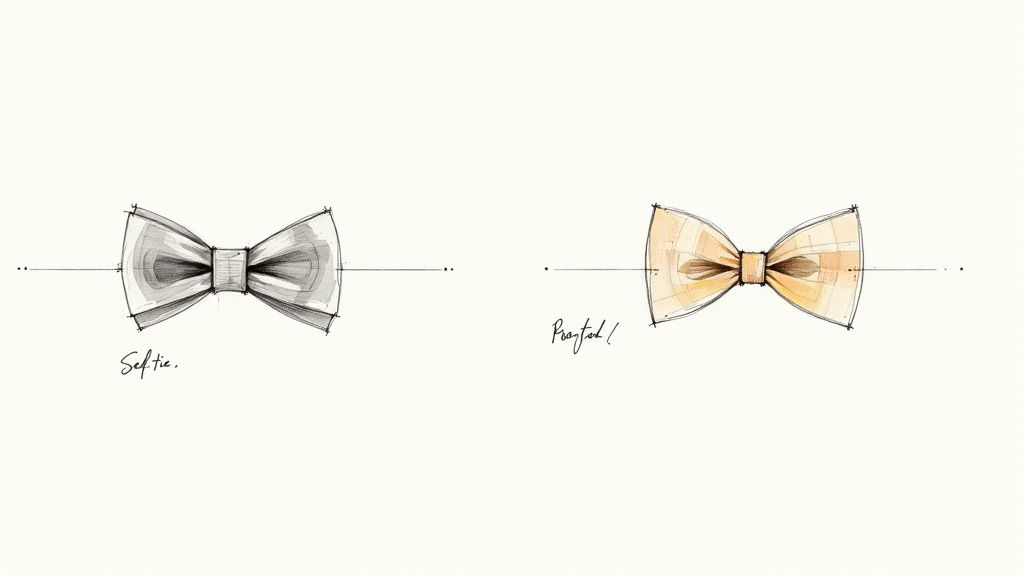
The pre-tied bow is an exercise in perfect, machine-made symmetry. It shows up with a flawless, factory-set knot and an adjustable neckband, promising pure convenience. But for the discerning eye, this very perfection is its downfall. It often looks flat, a bit stiff, and lacks the unique character that makes a bow tie truly special.
The self-tie bow tie, on the other hand, is the purist's choice. It’s a simple length of silk that demands to be tied by hand, resulting in a knot that is wonderfully unique every single time you wear it. It's those subtle, organic imperfections—the slight asymmetry, the gentle dimples in the silk—that telegraph real authenticity and quiet confidence.
Embracing Studied Nonchalance
This appreciation for a perfectly imperfect knot is captured beautifully by the Italian concept of 'sprezzatura'. The word describes a kind of studied nonchalance, an artful dishevelment that makes an elegant look feel effortless and deeply personal.
A hand-tied silk bow tie is the embodiment of sprezzatura. It signals that you’ve mastered the art of tying it, but you aren’t obsessed with achieving a sterile, machine-like finish. This small detail speaks volumes about your approach to style—it’s confident, it’s personal, and it’s refreshingly human.
The self-tie bow is not merely an accessory; it is a skill and a statement. It signals an understanding that true elegance lies not in flawless uniformity, but in character and authenticity.
Choosing a self-tie bow tie is an investment in your sartorial education and a nod to a long tradition of genuine craftsmanship. In any formal setting, it’s one of those details that truly separates the men from the boys.
Looking Beyond the Knot: Quality Markers
Whether you opt for self-tie or pre-tied, the hidden elements of construction are what really determine a bow tie's longevity and performance. Two key components to look for are the interlining and the stitching, as these are the true markers of a quality piece.
- The Importance of Interlining: This is the unseen fabric sewn between the layers of silk. A quality interlining, often made of wool or a wool blend, gives the bow tie its structure and helps it maintain a full, handsome shape after being tied. Without it, a bow would feel flimsy and create a weak, lifeless knot.
- The Mark of Hand-Stitching: Look closely at the seams. High-quality silk bow ties often feature hand-stitching, which allows for far greater flexibility and resilience compared to rigid machine stitching. This level of craftsmanship ensures the bow tie can endure repeated tying and untying without losing its form.
These markers of quality are especially important given the robust demand for premium neckwear. The global bow tie market was valued at approximately USD 1.2 billion in the early 2020s and is projected to grow towards USD 2.3 billion by the early 2030s. Market analyses identify Europe, with the UK as a key player, as a major hub for luxury silk bow ties, underscoring the value placed on superior construction. You can explore further bow tie market trends to see how quality drives consumer choice.
Ultimately, understanding these construction details empowers you to invest wisely. A well-made silk bow tie isn't a disposable accessory; it's a lasting piece for your wardrobe, one that will hold its shape and elegance for years to come.
How to Style Your Silk Bow Tie
Knowing how to style a silk bow tie isn't about memorising a stuffy rulebook; it’s about learning the language of different occasions. Once you understand the nuances, you can pick a bow tie that doesn't just fit in but actively elevates your entire look, ensuring you appear polished and perfectly put-together.
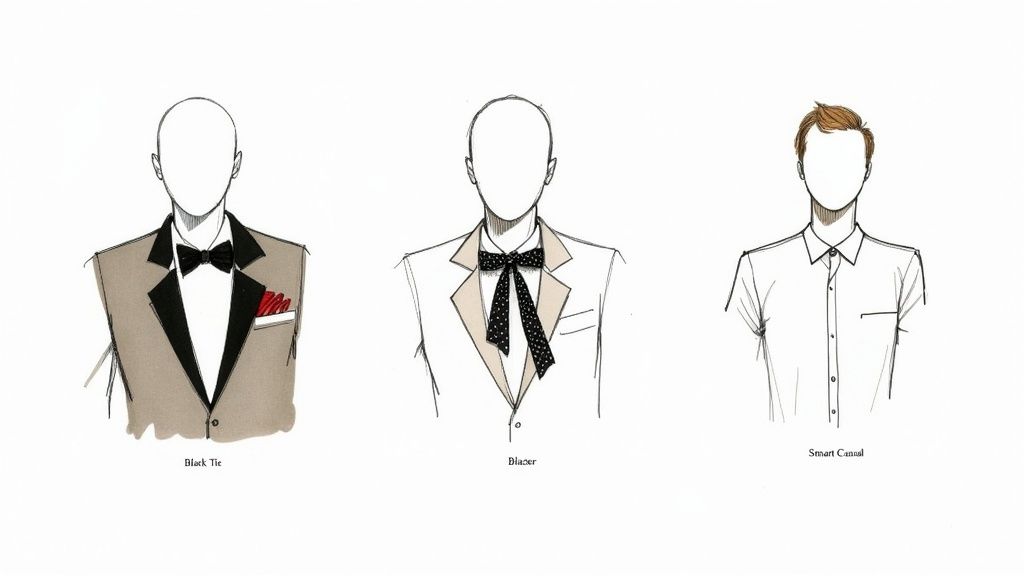
The world of menswear runs the gamut from the rigidly formal to the casually cool, but a few core principles will always see you right. For the most buttoned-up events, simplicity and luxurious texture are king. As the dress code loosens, you have more room to play with colour, pattern, and different weaves, letting your personality come to the fore.
Mastering Formal Dress Codes
When an invitation arrives with a formal dress code, there's no room for interpretation. This is where the classic black silk bow tie asserts its timeless authority, serving as the absolute cornerstone of proper eveningwear.
- White Tie: This is the pinnacle of formality, the absolute zenith. The only correct choice here is a white marcella (piqué cotton) bow tie. However, all the principles of proportion you learn with silk bows are just as vital.
- Black Tie: This dress code demands a black satin or grosgrain silk bow tie. Its subtle lustre is specifically designed to harmonise with the satin or grosgrain facings on a dinner jacket's lapels. No other colour or fabric can achieve that same classic, cohesive look.
For these occasions, a self-tie bow is non-negotiable. Its slight, organic asymmetry signals a genuine appreciation for tradition and an eye for detail that a perfectly uniform, pre-tied bow simply can't match.
Navigating Semi-Formal and Smart-Casual Occasions
Once you step away from the strictures of black tie, the world of silk bow ties opens up beautifully. This is your chance to experiment with textures, patterns, and colours to craft a look that feels both sophisticated and distinctly you.
A patterned twill silk bow tie, for example, can be the perfect finishing touch to elevate a simple navy blazer and grey trousers. The diagonal weave of twill takes a pattern beautifully, adding a dash of visual interest without being loud. In the same vein, a grenadine bow tie introduces a wonderfully rich, yet subtle, texture that works brilliantly with a tweed or flannel sports coat for a refined, relaxed autumnal feel.
For more laid-back settings, a knitted silk bow tie is an excellent choice. Its less structured form gives it a modern, relaxed sophistication, making it perfect for smart-casual events or creative business environments.
The secret to great styling is coherence. Your bow tie should feel like a considered part of your outfit—a piece that complements the textures and colours of your jacket and shirt, rather than one that shouts for attention.
The Crucial Rules of Proportion
Beyond the dress code, the single most important factor in looking sharp is proportion. An ill-fitting bow tie can throw off the balance of your entire look, no matter how beautiful the silk. The aim is to create visual harmony between your bow tie, your shirt collar, and your jacket.
Keep these simple guidelines in mind for a perfectly balanced look:
- Match the Bow to Your Face: The width of your tied bow should never extend beyond the outer corners of your eyes, and it certainly shouldn't be wider than your ears. A bow that's too big or too small for your face will immediately look out of place.
- Align with Your Collar: The height of the bow's wings should be roughly the same as the height of your shirt collar points. A tall, wide-spread collar needs a more substantial bow, while a shorter point collar calls for a slimmer, more discreet one.
- Complement Your Lapels: The width of your bow tie should feel in proportion to the width of your jacket lapels. A narrow bow tie will look lost against wide, peaked lapels, while a large, flamboyant bow can easily overwhelm a slim notch lapel.
Getting this balance right ensures your bow tie integrates seamlessly into your outfit, creating a polished and intentional silhouette. For those who want to achieve that perfect harmony, exploring bespoke accessories can provide a solution tailored precisely to your measurements and personal style.
The Bespoke Difference at Dandylion Style
While a beautifully chosen off-the-rack silk bow tie is a clear sign of a well-dressed man, a bespoke commission is something else entirely. It’s the ultimate expression of personal style. You’re moving beyond simply selecting an accessory to actively shaping its creation. This is where the true art of gentlemen’s tailoring comes alive, resulting in a piece that is unequivocally, indisputably yours.
A bespoke bow tie is a conversation between you and the artisan, a genuine collaboration. We don't start with a product on a shelf; we start by talking. Together, we’ll explore an exclusive selection of silks—from lustrous satins to richly textured grenadines—making sure the cloth itself is the perfect match for the occasion and the rest of your ensemble.
A Creation Tailored to You
The bespoke process puts you in control of the most critical design elements, guaranteeing a result that is both flawless and harmonious. You aren't just buying a bow tie; you are defining its very character.
This level of personalisation extends to:
- Defining the Perfect Shape: We work together to land on a shape and size that perfectly complements your unique facial structure, the spread of your shirt collar, and the width of your jacket lapels. It’s all about achieving that perfect visual balance.
- Selecting Fabric and Pattern: You’ll get access to a curated library of the finest silks, letting you choose the exact colour, pattern, and weave that truly resonates with your personal taste.
- Controlling the Finer Details: From the weight of the interlining that gives the bow its body, to the specific style of the finishing stitch, every component is chosen to create a bow tie with the ideal knot and drape.
This meticulous approach ensures the final product isn't just an accessory, but an integral part of your sartorial identity. To see how this same philosophy applies to larger garments, you can learn more about the complete Dandylion bespoke tailoring experience.
An Investment in Uniqueness
Opting for a bespoke silk bow tie is an investment in unparalleled craftsmanship and individuality. It’s a chance to own something no one else has—a piece crafted with precision, care, and a deep understanding of the principles of classic menswear. This commitment to quality British neckwear is part of a proud tradition that extends well beyond our shores.
A bespoke silk bow tie is the final word in sartorial refinement. It’s a subtle yet powerful declaration that you value true craftsmanship and appreciate that the finest details make all the difference.
Even in a niche market, the international appreciation for this level of quality is clear. UK trade data for "ties, bow ties & cravats, not knitted" shows consistent demand from discerning buyers abroad. For instance, recent compilations reported UK exports to Finland at US$10.59 thousand, affirming that British-made neckwear is a valued commodity. You can discover more UK trade insights on neckwear. Here at Dandylion Style, we bring that world-class standard directly to your personal commission.
Frequently Asked Questions
Can I wear a silk bow tie to a business meeting?
Yes, but context is key. For traditional corporate environments, a standard necktie remains the safer choice. However, in creative industries or for a smart-business setting, a textured silk bow tie can be a stylish statement. Opt for a subtle pattern or a rich, solid colour in a matte weave like twill or grenadine. Avoid shiny satin, as it’s too formal for the office. Paired with a blazer or a sports coat, it projects confidence and individuality without appearing out of place.
How do I choose the right colour for my silk bow tie?
Your bow tie should complement, not clash with, your outfit. For formal black-tie events, black is the only option. For other occasions, consider the colours in your shirt and jacket. A solid-coloured bow tie in a classic hue like navy, burgundy, or forest green is always a safe and elegant choice. If you opt for a pattern, ensure at least one of its colours coordinates with your suit or shirt. This creates a cohesive and intentionally styled appearance.
What is the best shirt collar to wear with a silk bow tie?
The best collar frames the bow tie perfectly. A spread or semi-spread collar is the most versatile and flattering choice, as it leaves just the right amount of space for the bow tie to sit comfortably without being crowded. A point collar can also work, especially with a smaller bow tie. The one to avoid is the button-down collar; its casual nature clashes with the formality of most silk bow ties, creating a disjointed look. Proportionality is key.
How should I store my silk bow ties?
Proper storage is crucial for maintaining the shape and longevity of your silk bow ties. Always untie your bow after wearing it to prevent permanent creasing in the delicate silk fibers. The best method is to hang it on a designated tie rack, which allows any wrinkles to fall out naturally. Alternatively, you can gently roll it from one end and place it in a compartmented drawer. This prevents it from being crushed by other items and keeps it ready for its next outing.
About the Author
Igor is the founder and creative mind behind Dandylion Style, a brand born from a deep-seated passion for the art of bespoke tailoring. With an unwavering commitment to classic elegance and true craftsmanship, Igor has built a reputation for creating garments that are not only timeless but intensely personal. His journey into tailoring was fuelled by the simple belief that clothing should be a true extension of one's character. At Dandylion Style, he masterfully blends traditional techniques with a modern eye, ensuring every single piece—from a full suit down to a silk bow tie—is crafted to perfection. You can discover more about Igor’s tailoring philosophy and what drives his work.
At Dandylion Style, we see the perfect bow tie not as a product, but as a partnership. Let's work together to create something truly yours, from the choice of silk to the final, perfect stitch.