The real heart of the matter is formality. Think of a morning suit as the absolute height of traditional British daytime formalwear, something you’d pull out for a society wedding or a day at Royal Ascot. A lounge suit, on the other hand, is the workhorse of a modern gentleman's wardrobe—perfectly at home in the office, at parties, and for the vast majority of weddings you'll attend as a guest.
Key Takeaways
- Formality is Key: The morning suit is the pinnacle of daytime formalwear, reserved for ceremonial events like traditional weddings and Royal Ascot. The lounge suit is the versatile standard for business and most social occasions.
- Construction Defines Them: A morning suit features a distinctive cutaway tailcoat, contrasting trousers (often striped), and a waistcoat. A lounge suit consists of a matching jacket and trousers made from the same fabric.
- Occasion Dictates the Choice: Wear a morning suit only when the dress code explicitly requires it. For nearly all other events, from business meetings to parties and most weddings, a lounge suit is the appropriate and stylish choice.
- Accessorising Rules Differ: Morning suit accessories are traditional and strict (top hat, specific tie, black Oxfords). Lounge suit accessories offer a canvas for personal expression with varied shoes, ties, and pocket squares.
Key Differences: Morning Suit vs Lounge Suit
Deciding between a morning suit and a lounge suit really comes down to understanding the occasion and respecting tradition. While both have their place in a well-rounded wardrobe, they send completely different signals. One is a statement of the highest daytime formality, steeped in history. The other is the versatile backbone of almost all contemporary professional and social events.
Getting the context right is everything. It's as crucial as knowing when to wear a blazer versus a full suit jacket (you can read more on that distinction here: https://dandylionstyle.co.uk/blazer-vs-suit-jacket).
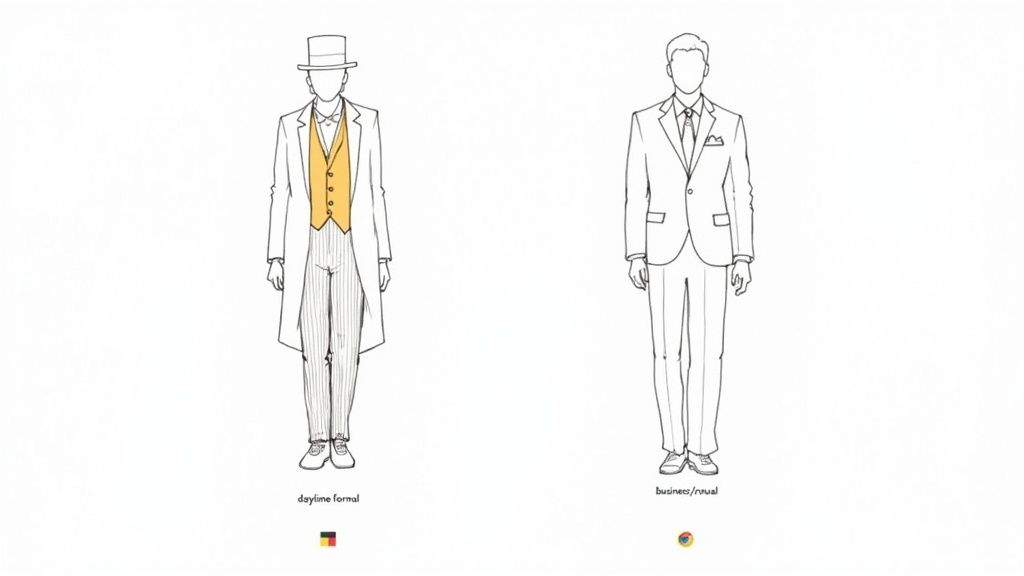
Comparison At a Glance
To make the distinctions crystal clear, this table breaks down the core attributes of each suit. Think of it as a quick reference guide before we dive deeper into the nuances of construction, fabric, and styling.
| Attribute | Morning Suit | Lounge Suit |
|---|---|---|
| Formality | Pinnacle of Daytime Formalwear | Versatile Business & Social Wear |
| Jacket Style | Cutaway tailcoat, single-breasted | Standard-length jacket, single or double-breasted |
| Trousers | Contrasting striped or houndstooth | Matching fabric to the jacket |
| Occasions | Royal events, traditional weddings (groom/groomsmen) | Business meetings, most weddings, parties |
| Typical Colour | Black or grey coat, grey trousers | Navy, charcoal, grey, or other colours |
Ultimately, this table highlights the fundamental divide: the morning suit is a specialised, event-driven uniform with strict rules, while the lounge suit is defined by its adaptability and modern relevance.
Understanding the Heritage of Formal British Attire
To really get to the heart of the morning suit versus the lounge suit, you have to look at where they came from. These two garments weren't dreamed up in the same breath; they were born from completely different social moments and needs. Their history is what defines their roles today. The morning suit, for instance, is a direct descendant of the 19th-century gentleman's riding coat, which itself evolved from the heavier frock coat to become the go-to for any smart daytime affair.
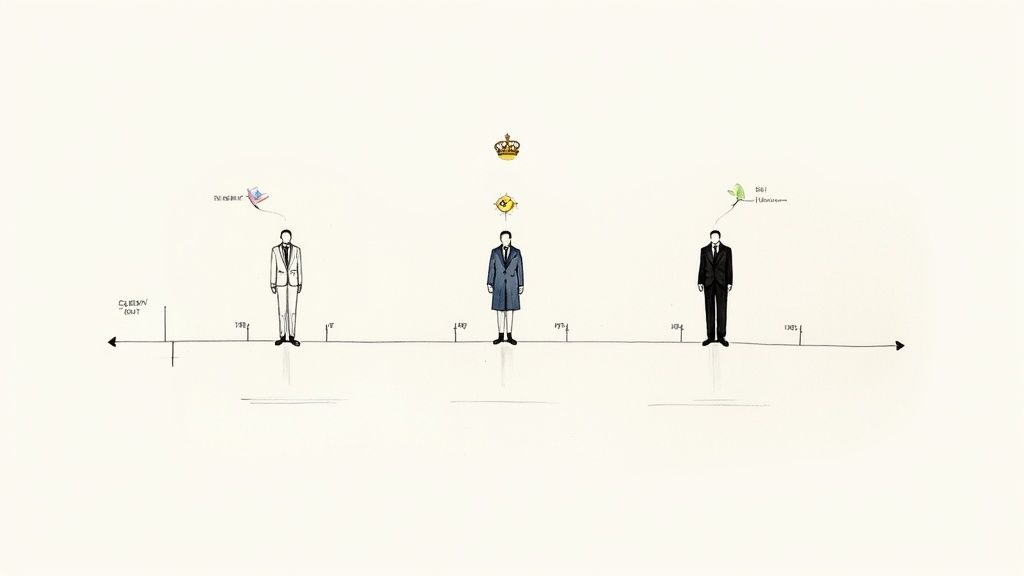
This evolution locked in its status at the very top of the formal daywear pyramid. It was the uniform for doing business, being seen at the right events, and moving through high society. Its lineage is pure aristocracy, tied to an era when dressing properly was a serious, rule-bound business.
The lounge suit, on the other hand, arrived as a breath of fresh air—a genuinely relaxed alternative. First appearing in the mid-19th century, it was designed for leisure time. It was the comfortable, easy-going choice for “lounging” far from the stiff constraints of city life, marking a major turn towards clothes that were practical and comfortable.
The Royal Influence on Morning Dress
The morning suit’s lofty status was cemented by the British royal family. Both King Edward VII and, later, his son Edward VIII, were instrumental in championing the morning coat over the old frock coat for formal daytime appearances at court in the early 20th century. This royal seal of approval made morning dress the undisputed uniform for the upper classes.
This history is crucial: the morning suit was never meant for anything casual. Its DNA is rooted in ceremony, tradition, and the highest standards of public appearance. That’s precisely why it remains the required dress for events like Royal Ascot even today.
The Rise of the Versatile Lounge Suit
While the royals were setting the standard for morning dress, big societal shifts were making way for the lounge suit. The rise of the middle class and the new face of business after World War I created a need for something more practical. Suddenly, the lounge suit, once seen as informal, became the new default for professional life.
It quickly shed its leisurely reputation to become the bedrock of the modern business wardrobe. By the middle of the 20th century, the lounge suit was worn in over 80% of formal and semi-formal situations across the UK. Its history explains its incredible versatility; it was created to fill the gap between rigid formality and outright casual wear. The famous Prince of Wales check, for example, became a hugely popular pattern, adding a touch of personality to this new staple. You can explore more about the iconic Prince of Wales suit in our detailed guide.
Anatomy of the Suit: Key Components and Construction
While their histories set the stage, the real story of the morning suit versus the lounge suit is told in their construction. When you deconstruct each ensemble piece by piece, you uncover the specific sartorial rules that give them such distinct silhouettes.
It’s in these details—the cut of a jacket, the pairing of trousers, the role of a waistcoat—that their fundamental differences in formality and function become crystal clear. A quick glance shows you that one is a coordinated uniform, while the other is a versatile, matched set. Getting to grips with these components is the key to understanding why each is built for its specific purpose.
The Morning Suit Dissected
The morning suit is an assembly of specific, non-negotiable parts that work in harmony to create its unique and highly formal appearance. Each piece has a traditional role, and to alter any of them would be to fundamentally change the outfit itself.
- The Tailcoat: This is the defining garment, no question. The morning coat is single-breasted and fastens with just one button (though it's often left open). Its signature feature is the sharp cutaway front, which sweeps back from the waist into a pair of tails that fall to the back of the knees.
- The Trousers: Unlike a lounge suit, the trousers are never made from the same cloth as the coat. Traditionally, they are grey with black stripes (known as 'cashmere stripes'), but you'll also see houndstooth or other subtle check patterns as acceptable formal alternatives.
- The Waistcoat: This adds a crucial layer of formality and a splash of colour. It can be single- or double-breasted and is typically dove grey, buff, or a pastel shade that creates a handsome contrast with the dark coat.
The core principle of morning dress is contrast and coordination, not matching. The separation of coat, waistcoat, and trousers is entirely intentional. It creates a layered, traditional aesthetic that is instantly recognisable and steeped in sartorial history.
The Lounge Suit Unpacked
In stark contrast, the lounge suit’s identity is built on unity and versatility. Its construction is far simpler and allows for much more variation, which is exactly why it has become the undisputed standard for modern business and social wear.
Its most fundamental feature is that the jacket and trousers are cut from the exact same bolt of cloth. This creates a cohesive, streamlined look that is the very definition of a "suit" in the modern sense. For those interested in adding a third element to this classic, learning what a 3-piece suit means offers great insight into elevating the ensemble.
Key Construction Differences
Let's break down the direct comparisons in a clearer format to see how they truly stack up against one another.
| Component | Morning Suit Construction | Lounge Suit Construction |
|---|---|---|
| Jacket | Single-breasted tailcoat with a cutaway front and tails at the back. | Standard-length jacket, available in single- or double-breasted styles. |
| Trousers | Made from a contrasting fabric, typically striped grey wool. | Made from the same fabric as the jacket for a matching appearance. |
| Waistcoat | Almost always required; typically a contrasting colour like grey or buff. | Optional; when included, it usually matches the suit fabric. |
| Lapels | Almost exclusively peak lapels, which add to the formality. | Notch lapels are standard, with peak lapels offering a more formal option. |
These structural differences aren't just minor stylistic choices; they are the very grammar of formalwear. The morning suit's specific components create an ensemble bound by tradition, while the lounge suit's matched construction offers a canvas for modern interpretation.
Choosing Your Attire for the Right Occasion
https://www.youtube.com/embed/4fb4GyOylK8
Knowing the anatomy of a suit is one thing, but understanding precisely when to wear it is another beast entirely. The choice between a morning suit and a lounge suit isn't just about personal taste; it's about speaking the right sartorial language and adhering to long-established social codes. Getting it right shows respect for the event and your hosts, ensuring you avoid any awkward missteps.
A morning suit is the uniform for the most formal daytime events on the British social calendar. Its use is incredibly specific and is almost always spelled out on an invitation. Think of it as the required attire for occasions steeped in tradition, where anything less would feel jarringly out of place. The lounge suit, on the other hand, is the versatile workhorse of modern menswear, appropriate for an exceptionally wide range of events.
The Domain of the Morning Suit
The morning suit is non-negotiable for a very select, yet significant, group of occasions. These are events that typically wrap up before 6 p.m. and carry a great deal of ceremonial importance. If you find yourself invited to any of the following, morning dress is almost certainly what's required:
- Traditional Weddings: Especially if you're a key part of the wedding party—think groom, groomsmen, or father of the bride or groom.
- Royal Ascot: It's mandatory for gentlemen within the Royal Enclosure. In fact, over 95% of male guests in this exclusive area will be in full morning dress.
- Prestigious Ceremonial Events: This covers state occasions like certain investitures, state funerals, or grand services at St Paul's Cathedral.
Choosing a morning suit is less a style choice and more an act of observing tradition. Its purpose is to create a uniform, elegant look among guests at events where heritage and formality are paramount.
The Versatility of the Lounge Suit
For almost every other occasion on your calendar, the lounge suit is your default. Its real strength is its remarkable adaptability. You can dress it up with a waistcoat for more formal affairs or pare it back with an open collar for a relaxed feel. It navigates different levels of formality with an ease that has made it the most commissioned style of suit in the UK.
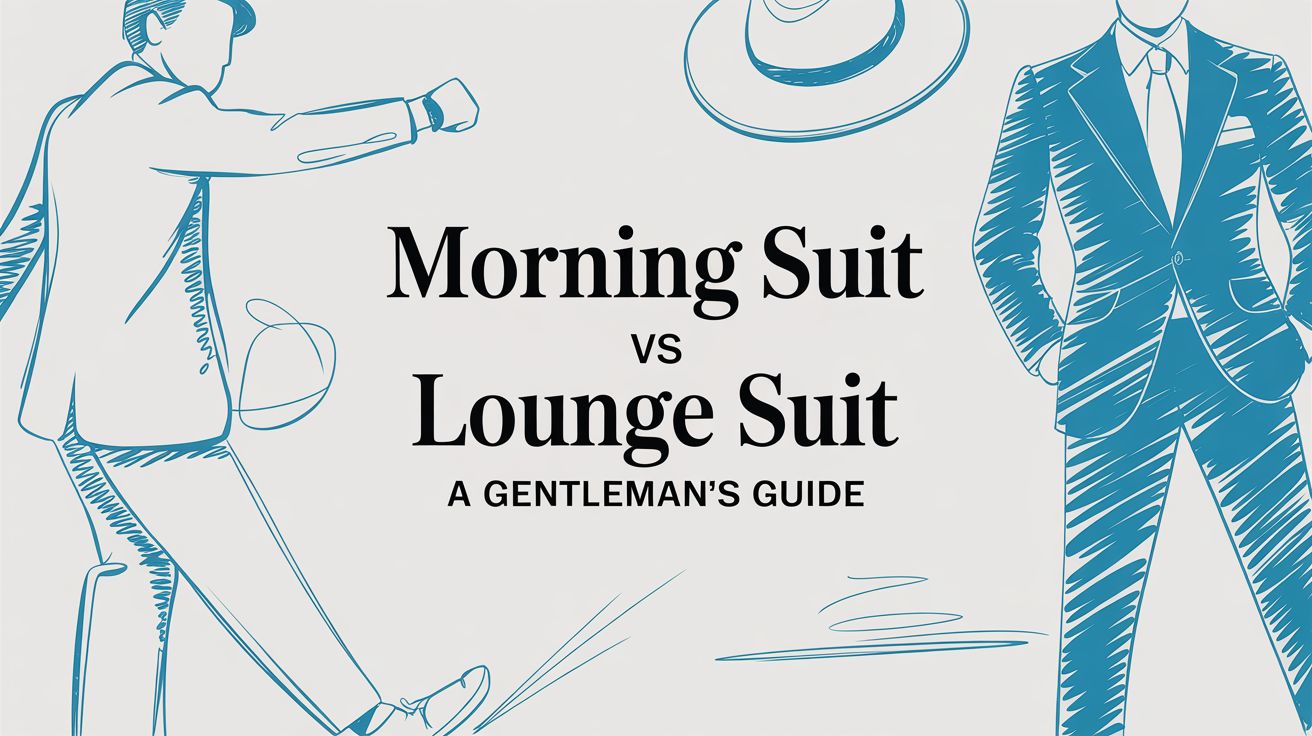
This diagram helps visualise the key components that distinguish each suit's anatomy, guiding you toward the right choice.
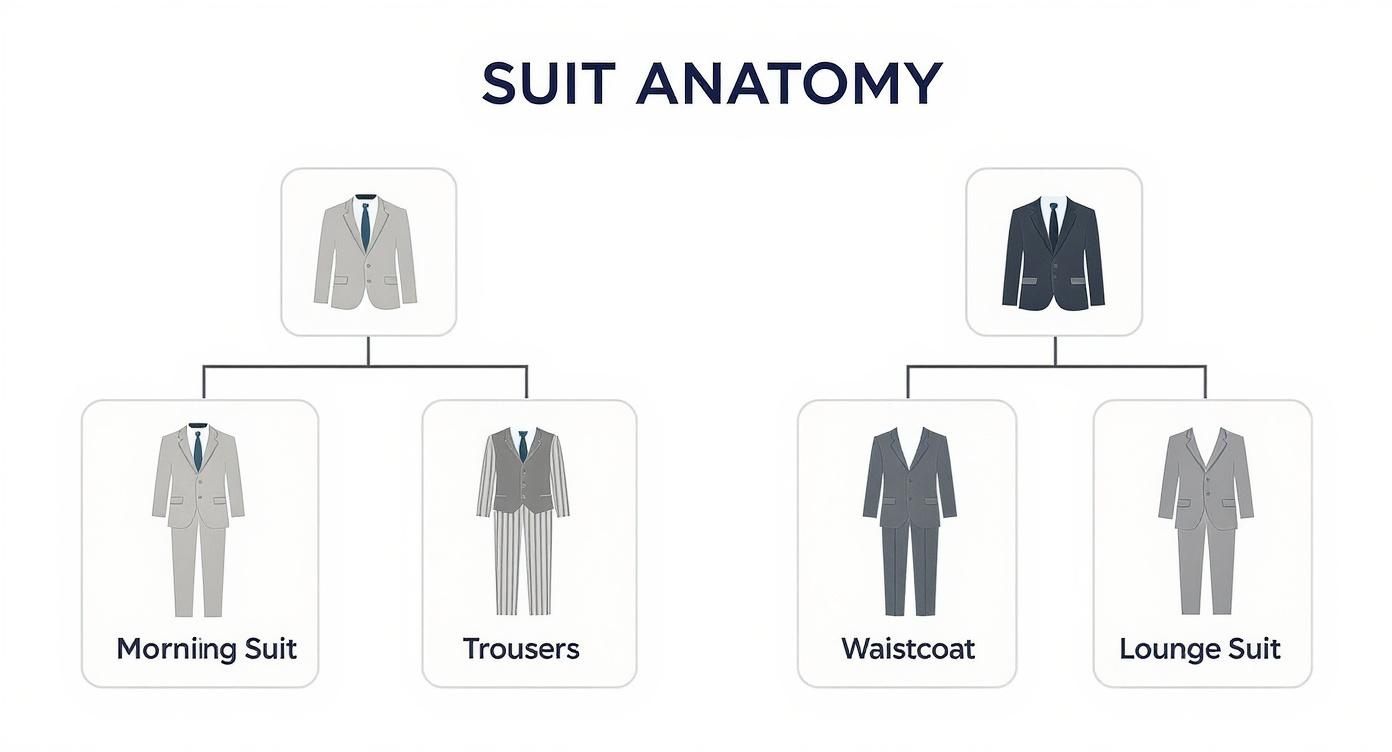
The image clearly illustrates the composed, contrasting elements of the morning suit against the unified, matching construction of the lounge suit.
The lounge suit is your go-to for:
- Business Meetings and Corporate Life: It remains the undisputed uniform of the professional world.
- Most Weddings as a Guest: Unless the invitation explicitly specifies 'morning dress', a smart lounge suit is the perfect choice. Our guide on suits to wear for a wedding offers more detailed advice on this.
- Social Gatherings: From christenings and formal dinners to parties and race days outside the strictest enclosures.
The lounge suit’s popularity soared after the 1920s as it began to replace the morning coat for daily professional wear. Today, it accounts for a staggering 85-90% of tailor-made suits commissioned by British men each year.
Styling and Accessorizing Each Suit
The suit itself sets the stage, but it’s the accessories that really tell the story. When we’re talking about a morning suit versus a lounge suit, accessorising isn’t just an afterthought—it’s a fundamental part of the look that either honours tradition or expresses your unique character. Each suit comes with its own set of rules and, more importantly, opportunities.
For a morning suit, the accessories are as prescribed and traditional as the garments themselves. This isn't the arena for breaking the mould; it's about adhering to a time-honoured code of elegance. The lounge suit, however, is the complete opposite. Accessories are your primary tool for injecting personality, transforming a standard suit into a distinctive statement.
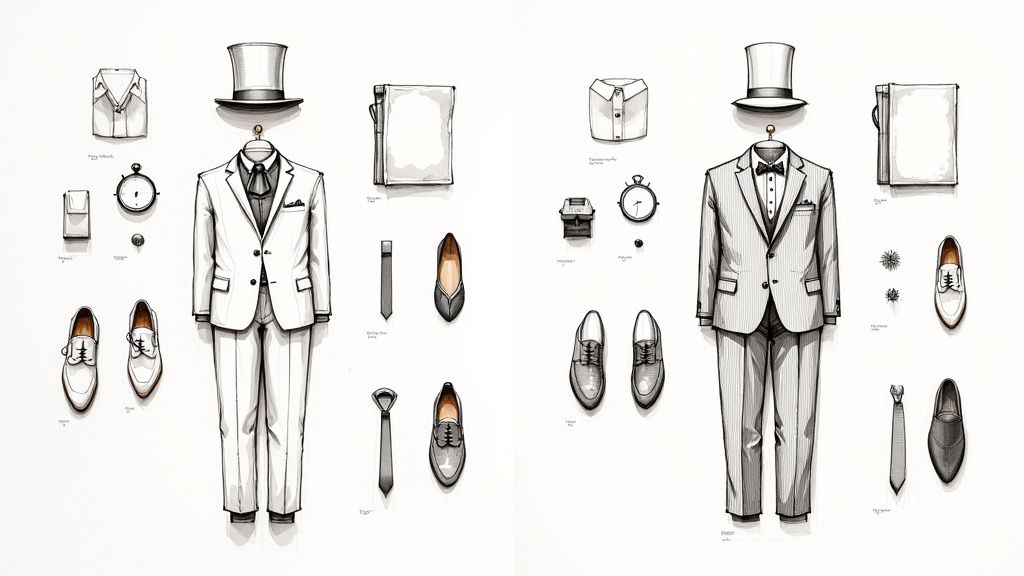
Morning Suit Finishing Touches
Accessorising a morning suit is really an exercise in classic, understated elegance. The goal is to complement the ensemble, not distract from its inherent formality. Every single item has a specific, traditional part to play.
- Footwear: Highly polished black Oxford shoes are the only correct choice. Anything else, like brogues or even Derbys, is considered far too casual for the occasion.
- Neckwear: A formal cravat or a beautifully woven silk tie is essential. The colour should coordinate with the waistcoat—think silver, grey, or perhaps a subtle pastel.
- Shirt: A crisp white shirt is the standard, always with a stiff turn-down collar and double cuffs for cufflinks. While you might occasionally see wing collars, they are more traditionally reserved for white tie events.
- Headwear: The crowning glory is a black or grey felt top hat. It’s worn outdoors and always removed when you step inside.
The rule of thumb for morning dress is to achieve harmony through tradition. The accessories aren’t meant to stand out individually; they should contribute to a cohesive, impeccably formal whole.
Expressing Style with a Lounge Suit
Where the morning suit lays down rigid rules, the lounge suit offers a blank canvas for your personal style. The accessories you choose can completely alter the look and feel of the suit, effortlessly adapting it from a business meeting to a wedding reception.
This is where you can truly make the outfit your own. The choice of tie, pocket square, shoes, and even socks allows for a level of self-expression that is simply not possible with morning dress.
Key Accessory Comparisons
The approach to accessorising each suit is fundamentally different, perfectly reflecting their distinct roles in a gentleman's wardrobe.
| Accessory | Morning Suit Guideline | Lounge Suit Guideline |
|---|---|---|
| Shoes | Black Oxfords, highly polished | Oxfords, Derbys, brogues, or loafers in black or brown |
| Tie | Formal cravat or woven silk tie | Silk, wool, or linen tie in any colour or pattern |
| Pocket Square | White linen or silk, folded flat | Any colour, pattern, or fabric; can be folded creatively |
| Cufflinks | Understated silver, gold, or mother-of-pearl | Can be classic, novelty, or colourful to express personality |
This freedom is what makes choosing the perfect final touches for a lounge suit a genuine art form. You can explore our curated selection of fine handmade ties and other embellishments in our range of bespoke accessories. Ultimately, the lounge suit invites you to create a look that is polished yet distinctly, and personally, yours.
Frequently Asked Questions
Can I wear a lounge suit to a wedding?
Absolutely. For the vast majority of modern weddings, a smart lounge suit is the ideal attire for a guest. It strikes the perfect balance between showing respect for the occasion and maintaining a contemporary feel. Opt for classic colours like navy or charcoal. The only time you should avoid it is if the wedding invitation explicitly requests 'morning dress', which is a binding dress code, particularly for those in the wedding party. For guests, a lounge suit is almost always a stylish and appropriate choice.
Is a three-piece lounge suit as formal as a morning suit?
No, it isn't. While adding a matching waistcoat certainly elevates a lounge suit, making it significantly more formal than a two-piece, it does not reach the same level of ceremony as a morning suit. Morning dress occupies its own unique tier of daytime formalwear, defined by its tailcoat, contrasting trousers, and traditional accessories. A three-piece lounge suit is the height of business or smart social wear, whereas a morning suit is reserved for occasions of the highest tradition and formality.
What is the main difference between a morning coat and a dinner jacket?
The primary difference is the time of day they are worn. A morning coat is strictly for formal daytime events held before 6 p.m. and is defined by its cutaway front that sweeps into long tails at the back. In contrast, a dinner jacket (or tuxedo jacket) is exclusively for evening events as part of a black-tie dress code. It has a standard jacket length with no tails and features satin or grosgrain lapels. They are anchors of two completely separate formalwear codes.
Do I have to wear a top hat with a morning suit?
Traditionally, yes. A top hat is considered an essential component of full morning dress, especially for highly formal events like Royal Ascot or a society wedding. It is always worn outdoors and should be removed once you are inside. While some may choose to forgo it at less stringent events, adhering to tradition means including the top hat. It completes the classic silhouette and signals a true commitment to the formal dress code, setting the entire ensemble apart with its historic elegance.
Can I wear a black lounge suit to a formal event?
It's generally best to avoid a plain black lounge suit for celebratory events like weddings or parties. In tailoring, solid black suits are traditionally associated with funerals or evening wear like black tie. For a formal daytime event, a dark charcoal grey or a deep navy blue suit is a much more sophisticated and versatile choice. These colours convey the same level of formality without the sombre connotations of black, making them more appropriate and stylish for business or social occasions.
Has the popularity of morning suits declined?
Yes, there's been a massive shift over the last century. Morning suits were once the standard for formal daywear, but the lounge suit's sheer practicality saw it take over. By the 1930s, around 70-80% of UK businessmen had already made the switch. Today, lounge suits make up roughly 90% of all suit purchases in the UK. The morning coat now represents less than 5%, reserved for very specific traditions like Royal Ascot or formal weddings. You can read more about this sartorial evolution over on Permanent Style.
About The Author
Igor is the founder and master tailor behind Dandylion Style. His lifelong passion for classic gentlemen's tailoring is built on the philosophy that a suit is more than just a garment—it's a statement of individuality and timeless elegance. Igor believes in a collaborative process, working closely with clients to create perfectly fitted pieces that feel uniquely their own. This commitment to sartorial excellence and personal expression is the thread that runs through every creation and every piece of advice from Dandylion Style.
At Dandylion Style, we believe the right suit is a cornerstone of a gentleman's wardrobe, crafted with precision and personal attention. Whether you require timeless morning dress or a versatile bespoke lounge suit, we are here to guide you.