Key Takeaways
- Distinctive Silhouette: The double-breasted waistcoat for men is defined by its overlapping front panels and two columns of buttons, creating a powerful V-shape that broadens the shoulders and slims the waist.
- Heightened Formality: Its structure is inherently more formal than its single-breasted counterpart, making it an excellent choice for weddings, black-tie events, and important business engagements.
- Essential Fit: A perfect fit is non-negotiable. The waistcoat must lie flat against the chest, cover the trouser waistband completely, and feature high-cut armholes for a clean, sharp look.
- Versatile Styling: While a cornerstone of the three-piece suit, it can also be worn standalone with tailored trousers for a confident and polished smart-casual look.
- Bespoke is Best: Custom tailoring ensures every detail, from the lapel style (peak or shawl) to the button stance, is crafted to your precise measurements and personal style.
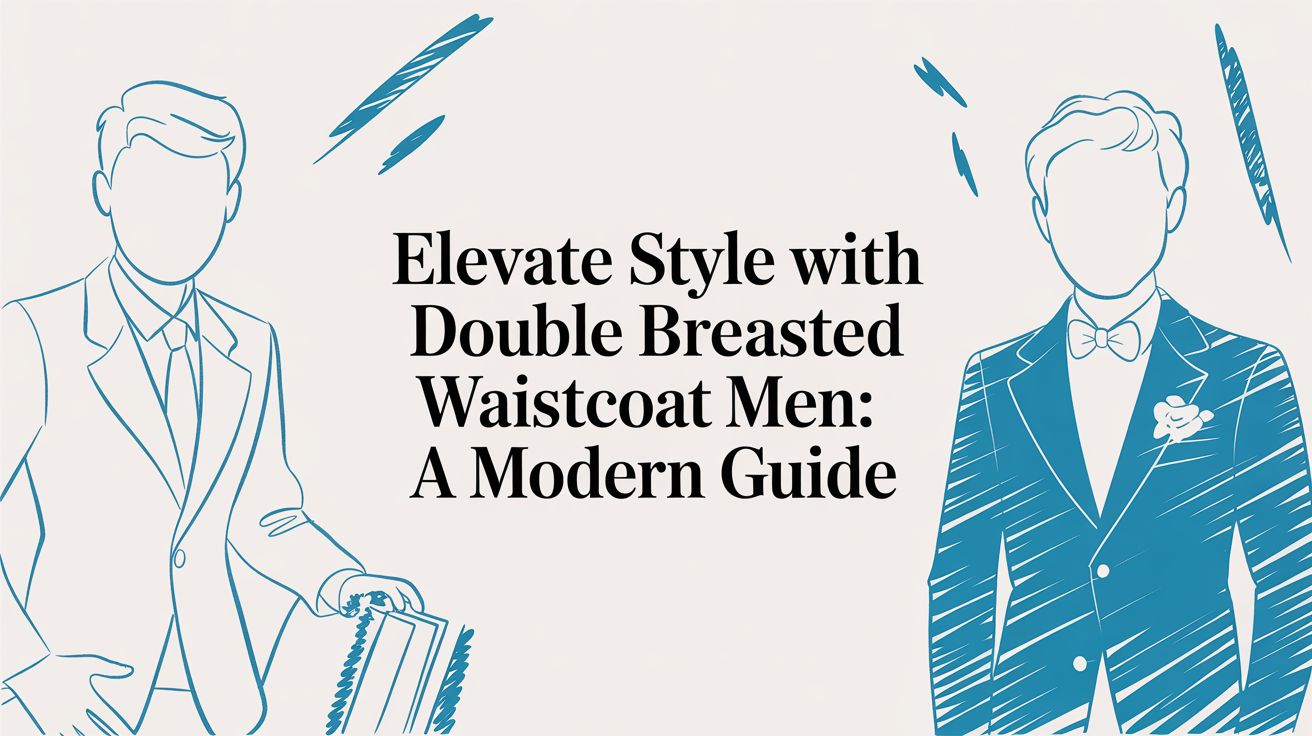
The double-breasted waistcoat for men is a true icon of classic tailoring, instantly recognisable by its overlapping front panels and two columns of buttons. It's a more formal and structured piece than its single-breasted cousin, creating a powerful V-shape that has the clever effect of broadening the shoulders and slimming the waist. The result is a commanding, sophisticated silhouette that elevates any formal outfit.
Understanding the Double-Breasted Waistcoat
For any gentleman looking to add a touch of sartorial authority to his wardrobe, this waistcoat is a definitive style statement. A well-made double-breasted waistcoat is so much more than just another layer in a three-piece suit; it’s a standalone piece that projects confidence and a real appreciation for the finer points of classic menswear.
Unlike the far more common single-breasted style, its overlapping construction gives a cleaner, more commanding look. This design naturally draws the eye upwards towards the chest and face, creating a streamlined silhouette that makes it an exceptional choice for formal events like weddings or crucial business meetings.
Key Features and Benefits
- Enhanced Silhouette: The overlapping fabric and dual button columns create a distinct V-shape. This masterfully broadens the shoulders while visually trimming the waistline for a flattering effect.
- Increased Formality: Its very structure and deep roots in formalwear make it inherently dressier than a single-breasted waistcoat. It carries a certain gravity and intention.
- Versatile Styling: While it's the heart of a full three-piece suit, it also has a life of its own. You can wear it separately with a pair of sharp, tailored trousers for a polished, jacket-free look that still feels complete.
Ultimately, choosing a double-breasted waistcoat is a deliberate style choice. It signals an understanding of tailoring traditions and a desire to stand apart with quiet, refined elegance. To see how it forms the core of a classic ensemble, learn more about what is a three piece suit in our detailed guide.
The Enduring Appeal of a Sartorial Icon
The double-breasted waistcoat is so much more than a piece of clothing; it's a slice of living history, a symbol of authority and good taste that has effortlessly sailed through centuries of changing fashions. Its lasting charm comes not just from its unique construction, but from the story it tells—a tale of sartorial confidence born in the grand halls of British formalwear, and one that continues today in the wardrobes of the sharpest dressers.
Unlike its more common single-breasted cousin, the double-breasted waistcoat makes an immediate, powerful statement. Its defining feature is that generous overlap of the front panels, held in place by two parallel columns of buttons. This creates a clean, unbroken line from chest to waist, projecting a sense of structure and formality that’s hard to beat.
A Legacy Woven in British History
The waistcoat's family tree is firmly planted in British soil. It saw its most significant evolution during the Georgian era, becoming a true signature of a gentleman's attire. Historical tailoring patterns from cities like Bath and Edinburgh show that between 1750 and 1790, double-breasted styles went from being a novelty to the dominant choice. By the 1780s, they had become slimmer and more waist-focused, making up a staggering 75% of formal daywear. This period also saw waistcoats shrink dramatically, going from thigh-length to a much sharper, hip-skimming cut, a nod to the clean lines of Neoclassical ideals.
It's this historical weight that gives the modern double-breasted waistcoat its undeniable character. To wear one is to connect with a long lineage of masculine elegance. It conjures images of Regency dandies and Victorian industrialists—men for whom dressing well was an outward sign of their status and self-respect.
A double-breasted waistcoat doesn't just complete an outfit; it commands it. Its structured silhouette has a unique ability to shape the torso, broadening the shoulders and creating a tapered waist for a truly commanding presence.
The Modern Symbol of Sartorial Confidence
Today, this iconic piece holds onto its formal edge while offering a surprising degree of versatility. It’s the cornerstone of a classic three-piece suit, lending an air of gravitas to business meetings and unparalleled elegance to a wedding day. Yet, it's also strong enough to stand on its own, worn without a jacket over tailored trousers for a look that is both polished and effortlessly cool.
The fundamental difference in its commanding presence compared to other styles is explored further when you compare double-breasted vs single-breasted suits and their components. While a single-breasted waistcoat is a timeless classic, the double-breasted version is a choice—a deliberate one.
Opting for one signals a real appreciation for detail and a deeper understanding of menswear. It's a garment that doesn't just blend in; it stands out with a quiet authority, making it the perfect choice for any man looking to project confidence, heritage, and an impeccable sense of style.
The Anatomy of a Bespoke Waistcoat
To really get to the heart of a double breasted waistcoat for men, you need to understand its individual parts. Think of it like a finely tuned engine, where every single component has to work in perfect harmony to create something far greater than the sum of its parts. Let's break down what truly separates an exceptional bespoke waistcoat from a standard, off-the-peg garment.
Getting to grips with these details empowers you to make confident, informed choices when you sit down for your consultation. This is about more than just picking a fabric; it’s about sculpting a silhouette that is entirely your own, from the shape of the lapels right down to the last button.
This visual guide shows the waistcoat's evolution from its historical roots to its place today as a true symbol of refined style.
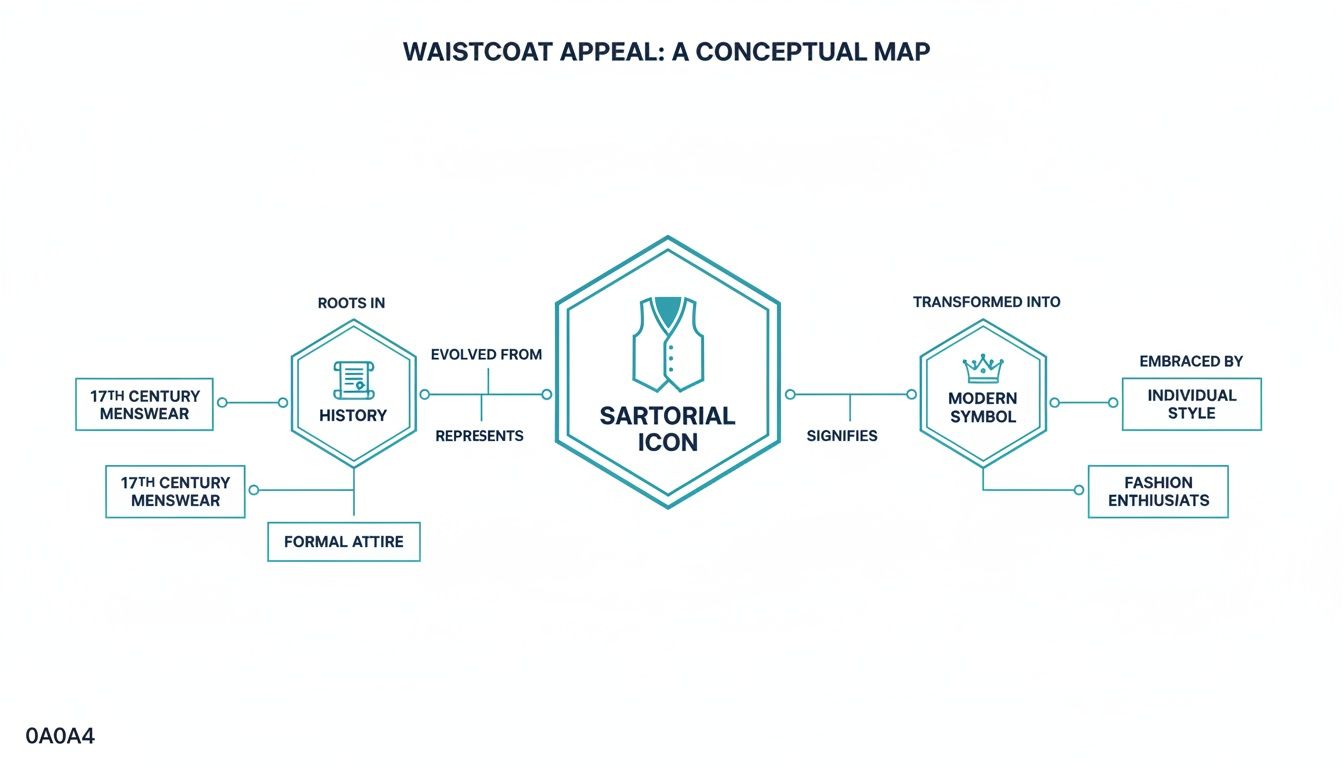
As the map illustrates, the waistcoat is a sartorial icon, one that elegantly bridges its deep history with its modern status as a hallmark of true style.
The Importance of Lapels
Lapels are, without a doubt, the most character-defining feature of a double breasted waistcoat. They have the crucial job of framing your chest and face, which in turn sets the entire tone for the garment. At Dandylion Style, we'll walk you through the two main choices.
- Peak Lapels: Sharp, dramatic, and pointing confidently up towards the shoulders. Peak lapels are the most traditional and formal choice, creating a powerful effect that broadens the chest and sculpts a strong V-shape.
- Shawl Lapels: With a smooth, uninterrupted curved edge, the shawl lapel gives off a softer, more elegant feel. You'll most often see this style on evening wear and black-tie attire, where it lends a certain old-world glamour.
Deciding between them really comes down to personal taste and the occasion. A peak lapel makes a bold statement in a business or wedding suit, while a shawl lapel is the perfect partner for a sophisticated dinner jacket or tuxedo.
Button Configuration and Stance
The way the buttons are laid out on a double breasted waistcoat is far from just decorative; it's fundamental to its structure and fit. Different arrangements create different visual lines, and the "button stance"—that is, the height of the top fastened button—is absolutely critical for a flattering silhouette.
A classic, time-honoured arrangement is the 6×3 configuration. This means six buttons in total, with three that are functional. However, a gentleman only ever fastens the top two, leaving the bottom one undone for comfort and style. It's a specific setup that creates a balanced, timeless look and really enhances the waistcoat's V-shape.
The "button stance" is a tailor's secret weapon. A higher stance elongates the legs and lends a more formal, traditional look, whereas a slightly lower stance can feel more contemporary and relaxed. It's a subtle detail, but one we obsess over during the bespoke process to get it just right.
Pockets and Back Adjustments
Pockets add a dash of both function and sartorial flair. While you'll see a few styles out there, the most fitting choice for the clean, uninterrupted lines of a double breasted waistcoat are jetted pockets. These are sewn into the lining, so all you see is a subtle horizontal slit. This preserves that sleek silhouette without adding any bulk.
The back of the waistcoat is every bit as important as the front. Traditionally, it's made from a silky lining fabric, which allows your jacket to glide smoothly over it without catching.
A back cinch, or adjuster, is a small but vital feature. This little buckle and strap lets you make fine adjustments to the fit around your waist, ensuring the waistcoat always lies flat against your lower back for a perfectly neat finish. Each of these details plays a role in the overall structure, a topic we explore more in our guide to the different parts of a suit.
How a Double Breasted Waistcoat Should Fit
A bespoke waistcoat is an exercise in precision. More than almost any other tailored garment, its impact hangs entirely on a flawless fit. A single centimetre here or there makes the difference between an unforgettable silhouette and a sartorial disaster. A jacket has sleeves and a full body to hide minor sins, but a waistcoat? It has nowhere to hide.
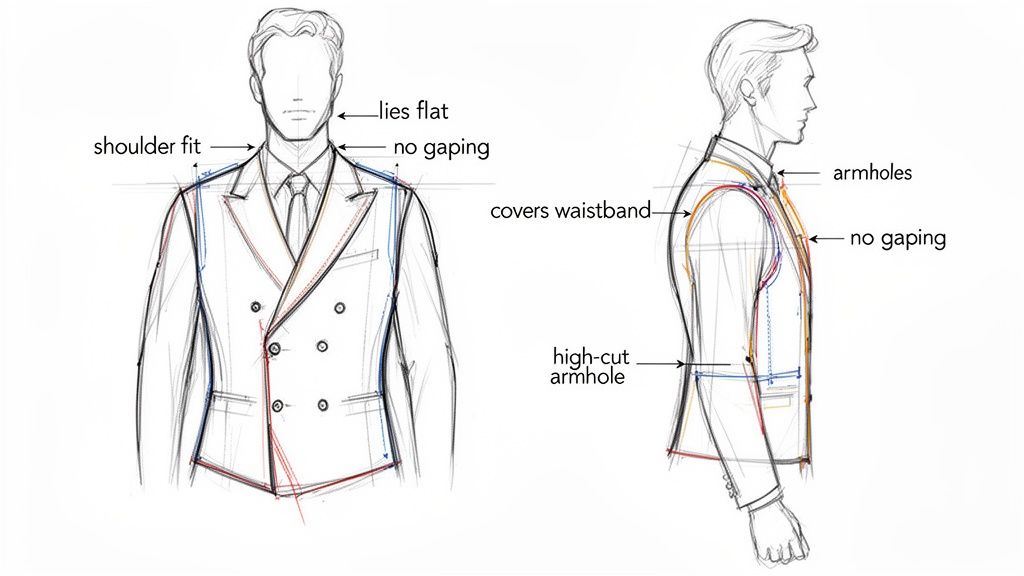
This is why getting the fit of a double breasted waistcoat for men spot-on isn't just a detail; it's an art form. It must be sculpted to your unique contours to create that clean, uninterrupted line that truly enhances your physique. From the shoulders down to the waistband, every single element has to work in perfect harmony.
The Shoulders and Chest
The foundation of any great fit starts at the shoulders. The waistcoat's shoulder seams must sit exactly where your natural shoulder ends, lying completely flat and smooth without a hint of pulling or bunching. If they're too wide, the fabric will droop unceremoniously; too narrow, and you’ll see ugly pulling across your upper back and chest.
From there, the waistcoat must lie cleanly against your chest. There should be absolutely no gaping or bowing between the buttons. When you’re standing naturally, the fabric should follow the contours of your torso, creating that sharp, V-shaped line that draws the eye up towards your face.
A tell-tale sign of a poor fit is the dreaded "collar gap," where the waistcoat pulls away from your shirt collar at the back of your neck. In a bespoke garment, this is simply unacceptable. The waistcoat’s neckline should hug the shirt collar perfectly, creating a single, seamless, elegant line.
Armholes and Torso
The armholes are critical for both comfort and appearance, yet they're so often overlooked. A bespoke waistcoat should always feature high-cut armholes. This might sound restrictive, but it’s quite the opposite—it actually gives you a much better range of motion by stopping the whole garment from lifting when you raise your arms.
Low-cut armholes, a common feature in off-the-peg waistcoats, cause the fabric to bunch up and look sloppy. High armholes, in contrast, keep the waistcoat locked in place, maintaining its sharp silhouette no matter how you move.
The body of the waistcoat should be cut close, but never tight. It needs to gently skim your torso, giving you definition without feeling like a straitjacket. The goal is to get rid of any excess fabric that might billow or bunch, particularly around your waist and lower back. A well-placed adjustable back cinch allows for those final minor tweaks to achieve that perfect, streamlined finish. For more guidance on achieving a perfect fit, you might find it helpful to learn how to measure yourself for a suit with our expert tips.
The Correct Length
Finally, let’s talk about length, which is entirely non-negotiable. The waistcoat must be long enough to completely cover the waistband of your trousers and the top of your shirt. You should never see that sliver of shirt fabric peeking out between the two garments; it instantly breaks the clean, vertical line that works to elongate your torso.
A waistcoat that’s too short looks awkward and unbalanced. One that’s too long will bunch up over your hips the moment you sit down. The points at the front should just brush the top of your trouser pockets, striking that perfect, harmonious balance. It’s this kind of precise tailoring that separates a masterful garment from just another piece of clothing.
How to Style Your Waistcoat for Any Occasion
The real magic of a double-breasted waistcoat for men is just how adaptable it is. It's far from a one-trick pony; you can style it for everything from the grandest ceremonies to relaxed yet sophisticated get-togethers. The secret lies in knowing what to pair it with to strike the right note.
Once you get these combinations right, you unlock the waistcoat's true potential. It stops being just an item you wear and becomes the anchor for a thoughtful, cohesive, and confident look.
The Pinnacle of Wedding Attire
For a wedding, whether you're the groom or a guest of honour, a double-breasted waistcoat delivers an unbeatable level of formality and polish. It's the very definition of celebratory elegance, cutting a sharp and memorable silhouette that’s absolutely perfect for such a momentous day.
When worn with a classic three-piece morning suit, a contrasting waistcoat in a lighter colour like dove grey, sky blue, or buff is a timeless move. Set against a charcoal or navy morning coat, it creates a look of traditional British refinement. For a more modern wedding suit, a matching waistcoat gives you a powerful, unified aesthetic.
- Fabric Choice: Think light worsted wools, linen blends for summer, or even a silk brocade for a dash of opulence.
- Pair With: A crisp white shirt, a silk tie or cravat, and impeccably polished Oxford shoes.
Authority in the Business World
In a professional setting, the double-breasted waistcoat projects a quiet authority and a sharp eye for detail. It elevates a standard business suit, taking it from everyday workwear to a real statement of intent. It sends a clear message: you take your appearance, and by extension your work, very seriously.
The foundation of this look is a waistcoat in classic navy or charcoal worsted wool, worn with its matching suit. The sharp, clean lines of the waistcoat add a layer of structure that is both flattering and commanding. This isn't a new idea, either. Back in 19th-century Britain, double-breasted waistcoats were standard issue for professionals, prized for their robust and formal appearance.
A double-breasted waistcoat in the boardroom is a kind of sartorial armour. It ensures you look polished and put-together—even if you take your jacket off—maintaining an air of formality and control.
Refined Smart Casual Style
One of the most stylish ways to wear a double-breasted waistcoat is to let it stand on its own, without a jacket. This is a confident move, perfect for smart-casual events like a gallery opening or an elegant dinner, where a full suit would feel a bit much, but you still want to look sharp.
For this look to land, the fit must be absolutely impeccable, especially across your back and torso. Try pairing a tweed or flannel waistcoat with tailored wool trousers in a complementary shade. A crisp, open-collared shirt finishes the look, creating an outfit that feels relaxed yet undeniably sophisticated.
Of course, a truly refined look goes beyond the waistcoat itself; check out some essential grooming tips to look dapper to complete your polished appearance.
Perfecting the Black-Tie Ensemble
When it comes to black-tie, the waistcoat plays a vital role in perfecting the look. While a cummerbund is a classic choice, a low-cut, U-shaped double-breasted waistcoat offers a superior level of elegance and old-world glamour. It creates a seamless line from the trousers to the shirt, making sure no flash of white fabric is seen below the jacket's button.
The waistcoat for a tuxedo should ideally be cut from the same black barathea wool as the suit. For a touch of real luxury, black silk or velvet also works beautifully. It is typically designed with elegant shawl lapels that echo those on the dinner jacket itself. This is that final, essential detail that lifts a standard tuxedo into an exceptional one.
The Dandylion Style Bespoke Journey
There’s something truly special about commissioning a bespoke garment. It’s less like shopping and more like starting a conversation—a collaboration between you and your tailor. It's the process of translating your personal style, your needs, and your vision into a perfectly crafted waistcoat that is yours and yours alone. At Dandylion Style, this journey is about more than just a piece of clothing; it's an investment in lasting quality and a fit that feels like second skin.
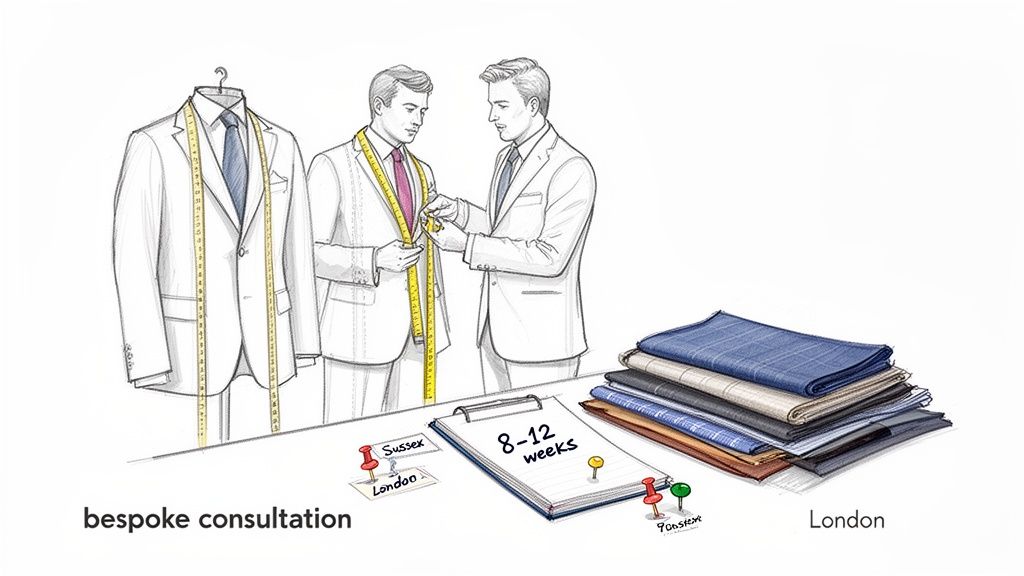
It all starts with an initial consultation with our founder, Igor. This is a relaxed, thoughtful chat where we get to the heart of what you’re looking for. Is this double breasted waistcoat for men for a wedding? Part of a new business suit? Or a versatile piece you can wear on its own? This first meeting lays the groundwork for everything that follows.
The Creation Process Step By Step
Once we have a clear idea of your needs, we move on to two of the most enjoyable stages: choosing the cloth and taking your measurements. You'll explore our curated collection of fine British fabrics, from hard-wearing tweeds to sumptuous worsted wools. Then, we take a comprehensive set of measurements, ensuring the final garment is sculpted precisely to the unique contours of your body.
The journey unfolds over several key appointments:
- Initial Consultation: We’ll discuss your style, the occasion, and your preferences for everything from the cut and lapels to the button configuration.
- Cloth Selection & Measuring: You choose the perfect fabric and lining before we take over 20 unique measurements to create your personal paper pattern.
- Baste Fitting: This is a crucial "skeleton" fitting. The waistcoat is loosely stitched together, allowing us to assess the drape, balance, and core fit before any final stitches are made.
- Forward Fitting: The waistcoat is much further along now. We’ll check the finer points like the armholes and collar, making precise adjustments.
- Final Fitting: The waistcoat is practically complete. We conduct one last review to make sure every single detail is perfect before it’s ready for you to take home.
The bespoke journey is a partnership. Your feedback at each fitting is essential, allowing us to refine the garment until it not only fits perfectly but feels like a natural extension of yourself. This collaborative spirit is the heart of true bespoke tailoring.
The entire process typically takes between 8-12 weeks, a timeframe that reflects the immense care and hand-work invested in every piece. To make things as convenient as possible, we offer fittings at our Sussex studio or at your home or office across London and the South East. We want the experience to be seamless and personal from start to finish.
You can learn more about our process by exploring our guide to tailor-made waistcoats.
Frequently Asked Questions
Should you leave the bottom button undone on a double-breasted waistcoat?
Yes, you should always leave the bottom button unfastened. This is a time-honoured rule rooted in practicality, as it prevents the waistcoat from pulling and creasing when you sit down. This ensures greater comfort and helps the garment maintain its sharp, clean lines whether you are seated or standing. A bespoke waistcoat is specifically cut with this convention in mind, so adhering to it allows the piece to drape correctly and look its best, signalling a true understanding of classic tailoring.
Can men wear a double-breasted waistcoat without a jacket?
Absolutely. Wearing a double-breasted waistcoat for men without a jacket is a confident and stylish choice, ideal for smart-casual occasions. For this look to succeed, the fit must be impeccable, especially across the back and torso, with no bagginess. When paired with well-fitting tailored trousers and a crisp shirt, the waistcoat becomes the centrepiece of a polished and sophisticated ensemble. It's a fantastic way to showcase the craftsmanship of the garment while staying comfortable in warmer settings or less formal environments.
What is the difference between a single and double-breasted waistcoat?
The primary difference lies in their construction and formality. A single-breasted waistcoat has one column of buttons down the centre, offering a classic and versatile look. In contrast, a double-breasted waistcoat features overlapping front panels with two columns of buttons. This structure creates a more formal and commanding V-shape that broadens the shoulders and slims the waist. Due to its more pronounced silhouette, the double-breasted style is often preferred for more significant occasions like weddings and formal business meetings.
Which lapel style is best for a double-breasted waistcoat?
The choice between peak and shawl lapels depends on the occasion and your personal style. Peak lapels are the more traditional and formal option, with sharp points that direct the eye upwards, creating a powerful, structured look ideal for business or wedding suits. Shawl lapels, with their smooth, rounded edges, offer a softer, more elegant feel. They are most commonly associated with evening wear, lending a touch of old-world glamour to a black-tie ensemble or dinner jacket.
About the Author
Igor, the founder of Dandylion Style, is a master tailor driven by a profound respect for the heritage of classic British tailoring. His philosophy centres on quiet, understated refinement, a commitment reflected in his exclusive use of the finest cloths from Britain's most esteemed mills. Igor views the bespoke process as a personal collaboration, a conversation aimed at translating a client's unique vision into a timeless garment. This focus on building connections and crafting pieces with true longevity is what defines the Dandylion Style experience.