A double-breasted dinner jacket is more than just formalwear; it's a statement. It radiates a kind of old-world confidence, offering a powerful and distinctly elegant alternative to the more common single-breasted style you see everywhere. What sets it apart is the way the front panels overlap, secured by two vertical rows of buttons, which carves out a strong, V-shaped silhouette that visually broadens the shoulders and cinches the waist. With its aristocratic roots and bold lines, it’s an exceptional choice for any man looking to make an impression at a black-tie event.
Key Takeaways
Before we dive in, here are the essential points to remember about the double-breasted dinner jacket:
Aristocratic Roots: Evolving from 19th-century naval uniforms, this jacket was championed by style icons like the Duke of Windsor, cementing its status as a symbol of high-society elegance and commanding presence.
Defining Features: The classic 6×2 button stance and sharp peak lapels are non-negotiable elements. They work in harmony to create the jacket's signature V-shaped silhouette, broadening the shoulders and slimming the waist.
Fit is Paramount: A flawless fit is crucial. Without proper waist suppression and shoulder construction, the jacket loses its powerful lines and can appear boxy. The fit is what transforms it from a piece of clothing into a statement of style.
Bespoke is Best: For a garment this specific, a bespoke commission is the ultimate investment. It ensures every detail, from the lapel roll to button placement, is perfectly tailored to your body and personal taste, achieving an unparalleled fit and finish.
What This Guide Covers
Think of this guide as your complete reference for mastering the double-breasted dinner jacket. It’s an iconic piece, and truly understanding its subtleties is the key to wearing it with the authority it deserves. Whether you're a groom meticulously planning your wedding day attire or a gentleman preparing for a formal gala, this article will arm you with the essential knowledge to pull it off flawlessly.
Before we get into the finer details, here are the core principles you’ll walk away with:
Aristocratic Roots: This isn't just a jacket; it's a piece of history. It evolved from 19th-century naval uniforms into a symbol of high-society style, famously championed by icons like the Duke of Windsor. That commanding presence is woven right into its DNA.
Defining Features: The classic 6×2 button stance and sharp peak lapels are fundamental, non-negotiable elements. These features work in harmony to create that visually striking and flattering shape you simply can't get with any other garment.
The Fit is Everything: I can't stress this enough—a flawless fit is paramount. Without proper waist suppression and the correct shoulder construction, the jacket loses its signature elegant lines. It goes from commanding to clumsy.
Bespoke is Best: For a garment this specific, a bespoke commission is the ultimate investment. It ensures every single detail, from the lapel roll to the button placement, is tailored perfectly to your body and your personal style. You can explore more about perfecting your formal look in our guide to the black tie outfit for man.
The Enduring Legacy of an Iconic Garment
To really get a feel for the confident character of the double-breasted dinner jacket, you have to look back at its rich and storied past. This isn't just a piece of clothing; it's a slice of sartorial history, born from pure function and later elevated to the absolute peak of masculine elegance. Its journey from military decks to aristocratic drawing rooms is exactly why it carries such a powerful legacy today.
The jacket’s beginnings are surprisingly rugged, tracing back to the naval "reefer" jackets worn by sailors in the 19th century. The overlapping double-breasted closure was a purely practical design choice, offering far better protection against the harsh wind and sea spray. It was functional, durable, and built for a purpose—a world away from the stiff, restrictive tailoring that defined high society back then.
From Naval Decks to High Society
It was this very contrast that caught the eye of the tastemakers. As the Victorian era gave way to the Edwardian, a new generation of aristocratic gentlemen started looking for more comfortable, relaxed ways to dress. They began adopting the reefer jacket for sporting and leisure, seeing it as a stylish rebellion against the rigid formality of the age. This was the garment's first real step into the world of high fashion.
At first, the jacket was considered quite informal, just a casual alternative to the single-breasted styles that dominated evening wear. But its commanding silhouette and naval heritage gave it a unique and distinctly masculine appeal that simply couldn't be ignored. It quickly became a firm favourite among the well-dressed elite, setting the stage for its eventual ascent.
The double-breasted jacket embodies a unique duality. It has the structure and authority of its military past, yet it was popularised as a symbol of relaxed, modern elegance. This blend of power and ease is what makes it so timeless.
The Royal Seal of Approval
The garment's status was forever cemented in the 1920s and '30s, a true golden age of menswear. The transformative moment for the double-breasted dinner jacket came when Edward VIII, then the Prince of Wales and later Duke of Windsor, famously championed the style in Britain. A renowned trendsetter, his endorsement elevated the jacket from a fashionable choice to the ultimate symbol of sophisticated evening wear.
The Duke favoured a softer, more draped version of the jacket, a deliberate move away from the stiff construction of its predecessors. His preference for midnight blue fabric over traditional black also set a new standard, one that bespoke tailors still favour today for its incredible richness under artificial light.
Through decades of changing trends, the double-breasted dinner jacket has remained a constant in high-end tailoring. Its remarkable ability to project both authority and effortless grace ensures its place as an icon of formalwear. For a deeper understanding of its stylistic impact, explore our detailed comparison of double-breasted vs single-breasted suits. Its legacy isn't just about aesthetics; it’s about a history of confident, forward-thinking style that continues to resonate.
Anatomy of a Modern Classic
A double-breasted dinner jacket is more than just a piece of clothing; it's a statement. Its power comes from a few key architectural details that work together to create that signature, commanding look. Unlike a regular suit jacket where you can play with the details, the double-breasted dinner jacket follows a much stricter set of rules. Think of it as a finely tuned instrument—change one part, and the whole melody falls flat.
To really get what sets this garment apart, you have to break it down into its core components. These aren't just minor style choices; they're the foundations that build its powerful and elegant silhouette. Understanding these details is the first step to wearing one with genuine confidence. For a broader look at how jackets are put together, you can explore the different parts of a suit in our detailed guide.
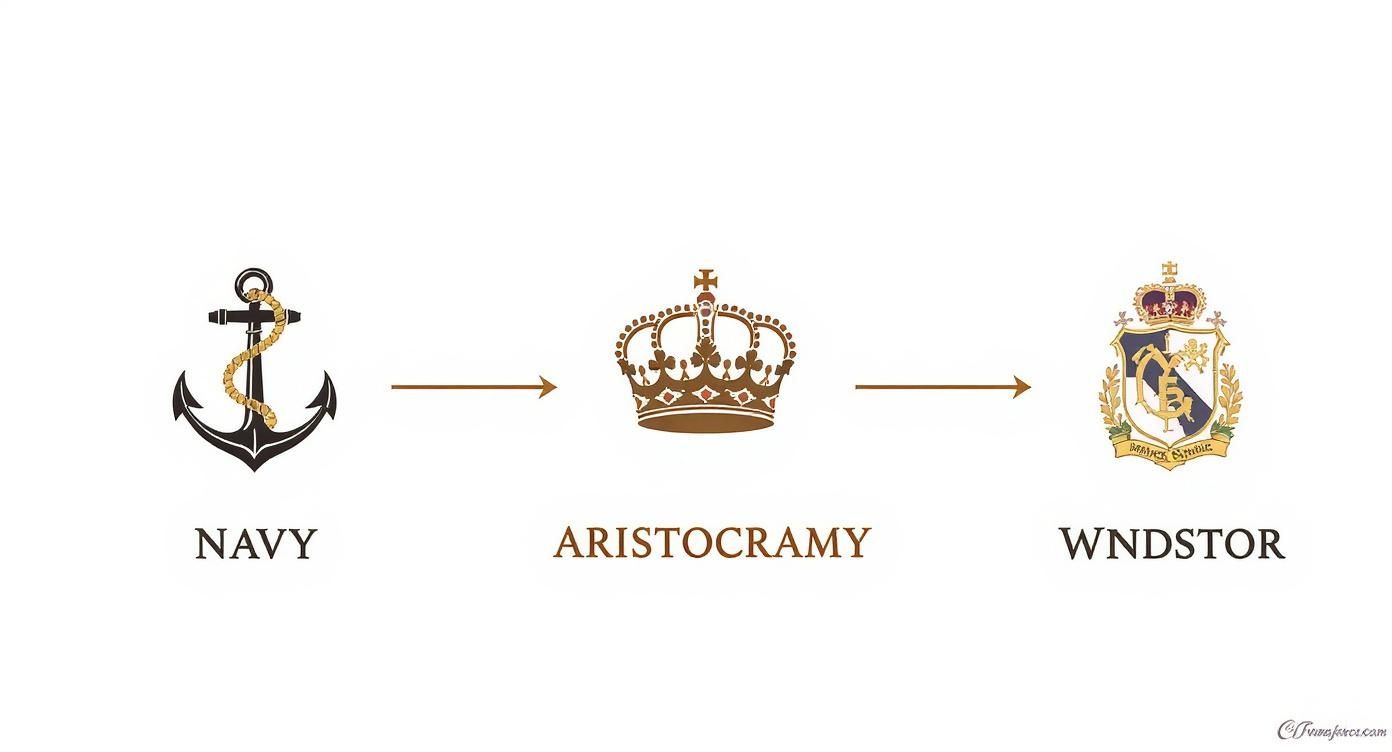
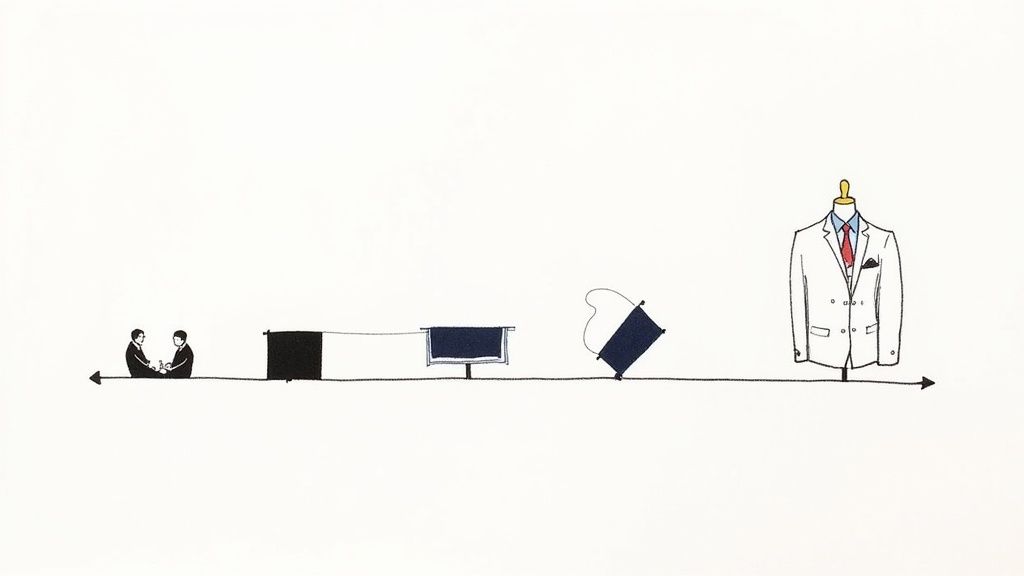
This visual captures the garment's journey from functional naval wear to a powerful symbol of aristocratic and, ultimately, royal style.
You can clearly see how its authoritative origins were adopted and refined by high society, cementing its status as a timeless piece of formalwear.
The Crucial Button Stance
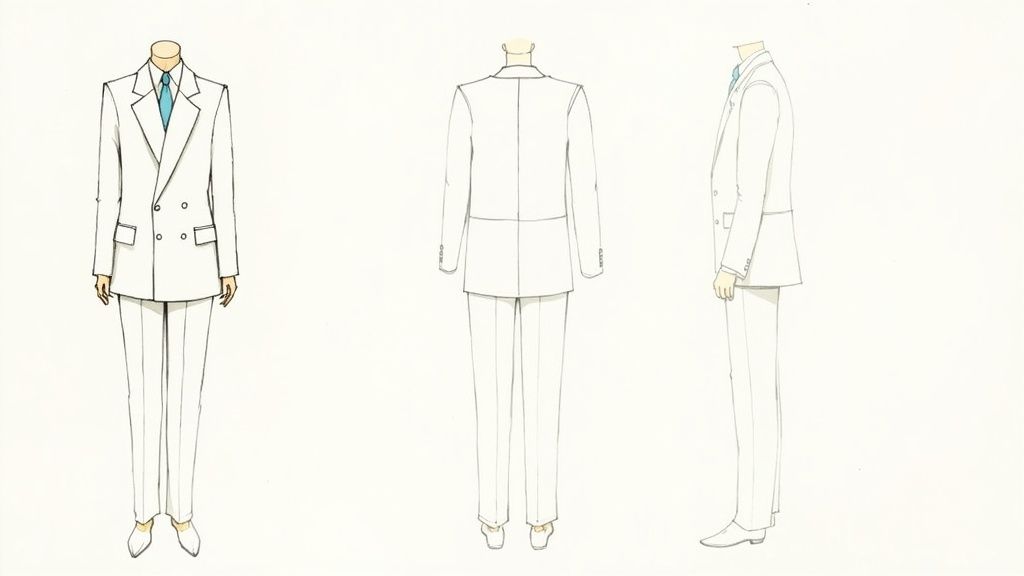
The button layout is probably the most defining feature of the jacket. While you might see different configurations on suiting, the quintessential double-breasted dinner jacket almost always uses the 6×2 configuration. That means six buttons are visible, but only the bottom two are designed to fasten.
This layout is no accident. The placement of the buttons creates a strong diagonal line that sweeps the eye upwards and outwards. This has the brilliant effect of visually broadening the shoulders while carving out a sharp V-shape that slims the waist. It’s this clever geometry that sculpts the torso so effectively and gives the wearer such a commanding presence.
The Non-Negotiable Peak Lapel
Other jackets might give you a choice between notch, peak, or shawl lapels, but for a double-breasted dinner jacket, peak lapels are the only correct option. There's no debate here. Their sharp, upward-pointing tips work in perfect harmony with the diagonal lines of the button stance, amplifying the jacket's powerful aesthetic.
Think of the peak lapels as arrows pointing towards the shoulders, enhancing their width and helping to create that heroic V-shaped silhouette. Shawl collars are reserved for single-breasted dinner jackets, and notch lapels? They're simply far too casual for a garment with this much formality and stature. The peak lapel is absolutely essential to the jacket's DNA.
The Clean, Ventless Back
For the cleanest possible silhouette, a double-breasted dinner jacket should be ventless. Vents—the slits at the back of a jacket—were originally a functional detail for horse riding, allowing the jacket to spread over the saddle.
A dinner jacket, however, is designed for standing, mingling, and looking impeccably sharp at evening events. A ventless back allows the cloth to drape in a smooth, unbroken line from the shoulders right down to the hem. This creates the clean, sculpted appearance that is the hallmark of true bespoke formalwear.
To see how these elements come together, it helps to compare the double-breasted dinner jacket directly against its more common cousin, the single-breasted tuxedo.
Double Breasted Dinner Jacket vs. Single Breasted Tuxedo Jacket
This table breaks down the key structural differences, showing how each feature contributes to a distinct look and feel.
Feature
Double Breasted Dinner Jacket
Single Breasted Tuxedo Jacket
Closure
Overlapping front with two rows of buttons, creating a strong V-shape.
Single row of buttons, typically one, offering a classic, simpler line.
Lapels
Peak lapels are mandatory, enhancing shoulder width and formality.
Can feature peak, shawl, or (less formally) notch lapels.
Button Stance
Typically a 6×2 configuration, which actively sculpts the torso.
Usually a single button, which creates a deep, open V-neck.
Back
Ventless, for the cleanest and most formal silhouette.
Can be ventless, single-vented, or double-vented.
Visual Impact
Projects authority, confidence, and a strong, structured silhouette.
Offers a timeless, understated elegance with a more vertical emphasis.
Getting to grips with this anatomy is key. Each component—the button stance, the lapels, and the ventless back—is a deliberate choice. Together, they create a singular, powerful aesthetic that is impossible to ignore.
Achieving the Perfect Fit and Style
Wearing a double-breasted dinner jacket is one thing, but wearing it well is another entirely. The power of this garment isn’t just in its iconic design; it’s in the execution. Getting the fit right is non-negotiable—it’s the foundation that supports the jacket's commanding presence.
The jacket must sit cleanly across your shoulders, with no hint of pulling or bunching. Then there's the waist suppression—that subtle tapering around your midsection. This is the crucial detail that creates the powerful V-shape, broadening the shoulders and slimming the waist for that distinctly masculine, elegant line. Without it, the jacket just looks boxy and loses all its character.
Mastering the Art of Buttoning
There’s a certain etiquette to buttoning that maintains the jacket’s intended silhouette. The golden rule couldn't be simpler: a double-breasted jacket should always remain fastened when you are standing. This isn't just about old-school tradition; the overlapping fabric is cut to drape correctly only when it's properly secured.
Always fasten the internal anchor button (the jigger) first. This small step ensures the jacket lies flat against your body. Then, on a classic 6×2 configuration, you fasten the middle exterior button. The bottom button is always left undone, allowing the jacket's quarters to curve away gracefully at the hem.
The only time it's acceptable to unbutton your jacket is when you sit down. It allows for comfort and stops the fabric from pulling awkwardly across your lap. The moment you stand up again, you fasten it. This simple act preserves the garment’s clean, sharp lines and shows a real respect for sartorial tradition.
Building the Perfect Black Tie Ensemble
A double-breasted dinner jacket might be the centrepiece, but the supporting cast is just as vital for a polished, cohesive look. Every component needs to be chosen with care to complement the jacket, not compete with it.
Here’s how to build the perfect ensemble:
Trousers: These should be cut from the exact same cloth as the jacket. They must feature a satin stripe down the outer leg and should never have belt loops. Instead, opt for side-adjusters to create a clean, uninterrupted waistline.
Shirt: The only correct choice is a formal evening shirt, often called a dress shirt. Look for one with a pleated or marcella (piqué) bib, a turn-down collar, and double cuffs for your cufflinks.
Shoes: There is really only one option here: patent leather shoes. Their high-gloss finish is the formal standard and perfectly mirrors the sheen of the jacket's satin lapels. Oxfords or elegant dress slippers are both excellent choices.
Accessories: A self-tied bow tie in black silk is non-negotiable. Finish the look with a simple white linen or silk pocket square, given a neat, crisp fold.
The goal of a black tie ensemble isn’t to stand out with flashy details, but to create an image of understated, harmonious elegance. Every piece should work together to present a single, impeccably refined picture.
Though a niche item, its appeal is enduring. Modern British tailors and luxury brands have consistently offered double-breasted dinner jackets, which account for approximately 20-30% of formal jacket sales in some premium menswear markets, showing a steady demand for this classic style. You can discover more insights about this trend on Wikipedia.
Ultimately, the difference between a good fit and a perfect one is what separates the wearer from the truly well-dressed. For those looking to understand these nuances further, our guide comparing slim vs tailored fit offers some valuable insights.
The Bespoke Journey with Dandylion Style
An off-the-rack double-breasted dinner jacket can certainly look sharp, but a bespoke commission is where this iconic garment truly comes alive. It's an investment not just in clothing, but in a piece of personal artistry, crafted from the ground up to your exact specifications. This is where every line, curve, and detail works in perfect harmony with your physique, unlocking the jacket's full potential.
More than a simple purchase, the bespoke journey is a collaborative experience. It's a conversation between you and your tailor, a partnership that culminates in a garment that is unequivocally yours.
The Foundation of Quality Cloth
The process always begins with the most fundamental element: the cloth. Your choice of fabric is what dictates the jacket's handle, its drape, and its entire character. While many options exist, a few materials are simply perfect for a double-breasted dinner jacket.
Midnight Blue Barathea Wool: A classic for a reason. This tightly woven wool has a subtle, almost imperceptible ribbed texture that absorbs light beautifully, appearing richer and darker than pure black under artificial lighting.
Black Mohair Blend: Blending wool with mohair introduces a slight sheen and incredible crease resistance—ideal for surviving an entire event looking pristine. The fabric has a crispness that helps maintain the jacket's sharp, architectural lines all evening long.
Rich Black Velvet: For a more opulent, textural statement, velvet is an exceptional choice. It offers a deep, luxurious finish that is both visually and tactilely striking, making it perfect for festive black-tie occasions.
The Art of Bespoke Construction
Beyond the cloth, the true soul of a bespoke jacket lies in its construction—the hidden architecture that creates its signature shape and ensures its longevity. This is what separates a truly personal garment from a mass-produced one.
A key component is the full floating canvas. Think of this as the jacket's internal skeleton, a layer of horsehair canvas stitched loosely between the outer fabric and the inner lining. Unlike the fused (glued) constructions found in most off-the-rack garments, this allows the jacket to mould to your body over time, providing an unmatched drape and comfort that actually improves with age.
The hand-padding of lapels is another hallmark of bespoke craftsmanship. Tiny, almost invisible stitches are used to create that gentle, elegant ‘roll’ from the jacket’s edge. This detail ensures the lapels never lie flat or lifeless, giving the garment its three-dimensional character.
Your Journey from Start to Finish
Commissioning a bespoke garment is a structured yet deeply personal process. At Dandylion Style, we guide you through each stage to ensure the final piece doesn't just meet your expectations, but exceeds them.
Initial Consultation: We sit down to discuss your needs, style preferences, and the occasion you have in mind. This is where we’ll select the cloth, lining, and finishing details like buttons and lapel facings.
Measurements and Pattern Cutting: We take a comprehensive set of measurements. From these, a unique paper pattern is drafted exclusively for you—your personal blueprint.
The Fittings: You will typically have two to three fittings. The first is the ‘baste’ fitting, where the jacket is loosely stitched together for initial, broad-stroke adjustments. Subsequent fittings refine the shape until the fit is perfect.
Final Delivery: Once every last detail is perfected, your finished double-breasted dinner jacket is ready for you.
This meticulous journey, which usually takes between 8–12 weeks, ensures a garment that is a true expression of you. You can learn more about the complete experience by exploring the world of Dandylion bespoke tailoring.
Looking After Your Bespoke Investment
A bespoke double-breasted dinner jacket is built to last. We’re not talking about a few years, but generations. Think of it less as a piece of clothing and more as an heirloom in the making. Looking after it properly is the key to preserving its flawless structure, luxurious feel, and perfect drape, ensuring it remains the highlight of your wardrobe for decades to come.
This isn’t about some complicated, time-consuming routine; it’s about a few simple, consistent habits. And the most important step happens the moment you take the jacket off. Its shoulders, with their carefully padded canvas and hand-set sleeves, are what give the garment its soul.
The Hanger is Everything
A flimsy wire or cheap plastic hanger is the sworn enemy of a bespoke jacket. It forces the entire weight of the garment onto two tiny points, which inevitably causes the shoulders to sag, pucker, and lose their shape over time.
To protect its structure, you absolutely must use a proper wooden hanger with wide, curved shoulders. This design mimics the natural shape of your own shoulders, giving the jacket complete support and allowing the cloth to hang and recover as it should. This simple tool is the single most critical element in your jacket’s long-term care.
A well-made jacket has a memory. Storing it correctly on a supportive hanger allows the natural fibres of the wool or mohair to relax, shed the wrinkles from an evening's wear, and reset its intended form.
Cleaning and Maintenance Essentials
Whatever you do, resist the urge to dry-clean your dinner jacket often. The harsh chemicals and intense heat used in the process can strip the natural oils from the fabric, making the cloth brittle and dull over time. A bespoke jacket should only see a professional cleaner when it’s visibly stained or soiled.
For day-to-day upkeep and keeping it fresh, just follow these simple rules:
Spot Clean Immediately: If a small spill happens, tackle it with a damp cloth, gently dabbing the area. Never, ever rub, as this can easily damage the fabric's weave.
Steam, Don’t Iron: If you spot any wrinkles, reach for a handheld steamer. The direct, intense heat from an iron can crush the fabric’s pile and leave an unsightly sheen. Steaming is a much gentler way to relax the fibres.
Let It Breathe: After you've worn it, hang your jacket outside of the wardrobe for at least 24 hours. This gives any moisture time to evaporate and helps the garment air out naturally.
By sticking to these fundamental practices, you’ll ensure your bespoke double-breasted dinner jacket stays in pristine condition, ready for any black-tie occasion that comes your way.
Frequently Asked Questions
Can I wear a double-breasted dinner jacket to a wedding?
Absolutely. For a black-tie wedding, it is an exceptionally sophisticated choice for a guest or the groom. Its powerful silhouette creates a distinguished look that stands apart. The only caveat is ensuring the dress code is explicitly formal enough to warrant its presence. For the groom, it offers a commanding aesthetic perfect for a momentous occasion. As a guest, it demonstrates a refined understanding of formalwear etiquette and a respect for the event. When styled correctly, it’s a flawless celebratory garment.
Should I ever leave my double-breasted jacket unbuttoned?
No, not while standing. The structure of a double-breasted jacket is designed to be worn fastened to maintain its sharp lines. The internal anchor button (jigger) is key, ensuring the fabric drapes correctly without pulling. The only acceptable time to unbutton it is when you sit down, purely for comfort and to prevent creasing. The moment you stand up again, you should immediately re-fasten it. This simple act is a crucial point of sartorial etiquette that preserves the garment's elegance.
Is a double-breasted style suitable for all body types?
Yes, provided it has been cut correctly by a skilled tailor. A bespoke double-breasted jacket is incredibly versatile and can flatter any physique. Its peak lapels and diagonal button stance create a strong V-shape, which broadens the shoulders and slims the waist. For shorter gentlemen, a slightly higher button stance can create an elongating effect. For those with a heavier build, a master tailor can use softer construction and clean lines to sculpt a flattering silhouette without adding any bulk.
What is the difference between a dinner jacket and a tuxedo?
Essentially, there is no difference; the terms are a matter of regional preference. ‘Dinner jacket’ is the classic British term for the formal jacket worn as part of a black-tie ensemble. ‘Tuxedo’ is the American equivalent for the same garment. In the UK, we refer to the entire outfit as a ‘dinner suit,’ while in the US, it’s a ‘tuxedo.’ So, a double-breasted dinner jacket and a double-breasted tuxedo are the exact same piece of clothing, just with different terminology.
About the Author
My name is Igor, and I am the founder of Dandylion Style. With over two decades of experience in bespoke tailoring, I have dedicated my career to the art of creating perfectly fitted garments that are a true extension of the wearer's personality. My passion lies not just in the craft of cutting and sewing, but in understanding how clothing can build confidence. I believe a well-made suit is a powerful form of self-expression, blending timeless Savile Row techniques with a contemporary perspective.
At Dandylion Style, we create garments that are a true expression of you. Discover the difference of bespoke craftsmanship by scheduling your personal consultation today. Learn more at https://dandylionstyle.co.uk.
Written by:
Igor Srzic-Cartledge
Igor is the founder of Dandylion Style, a tailoring house built on the simple, deeply held belief that a suit should be like a second skin—a true extension of a gentleman’s personality. For Igor, tailoring isn't just about cutting cloth; it's an art form dedicated to creating unique, perfectly fitted attire for the discerning man. His passion is rooted in classic sartorial traditions, yet he maintains a keen eye for contemporary style, ensuring his creations are both timeless and relevant. This approach has cemented his reputation for genuine craftsmanship and a truly personal service.
Key Takeaways The Core Two: Navy blue and charcoal grey are the essential, non-negotiable suit colors for any professional wardrobe. Navy offers versatility and approachability, while charcoal projects authority and seriousness. Context is Crucial: The best suit color...
When you find a piece of clothing you absolutely love, getting the fit just right is the final, transformative touch. But how much should you expect to pay? In the UK, alteration costs can be as modest as £15 for a simple trouser hemming, or climb to £150 and beyond...
Getting the right pink shirt and tie combination is the mark of a well-dressed man. It’s a detail that separates the novices from those who truly understand their wardrobe. For a look that’s classic and can’t miss, pair your pink shirt with a navy, grey, or burgundy...
Key Takeaways For those seeking a quick overview, this section summarises the essential rules and recommendations for incorporating turn-up trousers into your wardrobe. Sartorial Purpose: Turn-ups add weight to the trouser hem, ensuring a cleaner, sharper drape,...
Deciding what colour tie to wear with a pink shirt is a common style query I hear from clients. For a classic, professional look that never fails, your safest and most effective choices are navy blue and charcoal grey. If you're heading to a more contemporary or...
You've just picked up a newly finished bespoke suit, and the cloth still has that clean, disciplined line only a real fitting room can give it. The temptation is to put it straight in the wardrobe and trust the label to do the rest. That's where expensive...
Book Your Tailoring Consultation
Looking for a suit or garment made specifically for you?
At Dandylion Style, we create bespoke and made-to-measure
garments tailored to your individual shape, style and occasion.
From suits and shirts to dresses, waistcoats and alterations,
our experienced tailors can help you create something truly unique.