When you hear the term ‘custom suit’, what probably comes to mind is an experience, a process, and an outcome far superior to just picking something off a hanger. And you’d be right. A custom suit is an investment in a garment crafted specifically for your body.
It’s a journey that involves choosing between two very distinct approaches—bespoke or made-to-measure—then diving into the world of fabrics, and finally, engaging in a detailed fitting process to sculpt the suit to your exact form.
Key Takeaways
Bespoke vs. Made-to-Measure: The fundamental choice in custom tailoring. Made-to-measure (MTM) adjusts a pre-existing pattern to your measurements, offering a superior fit. Bespoke creates a unique pattern from scratch just for you, allowing for unlimited customisation and a perfect fit.
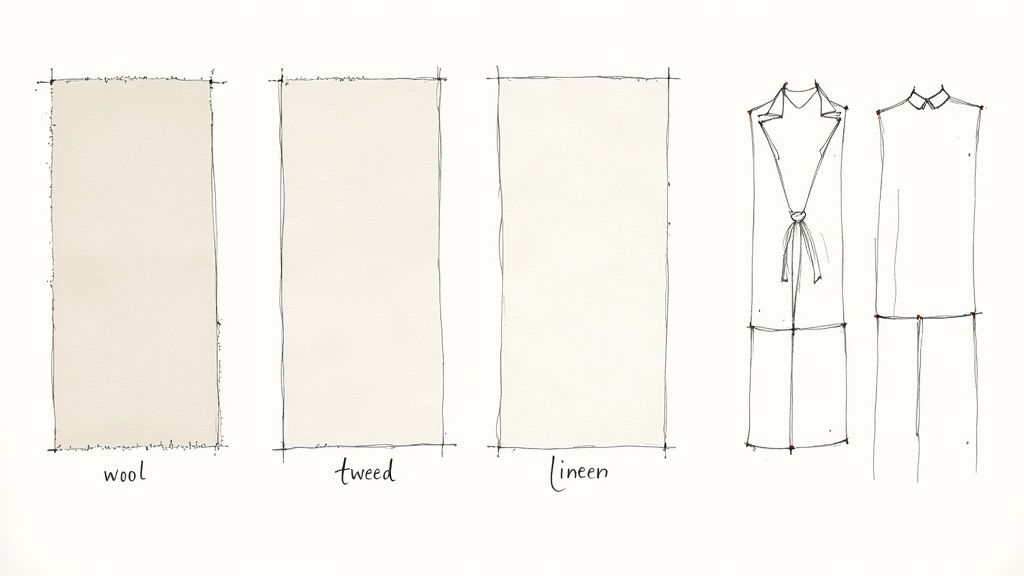
Fabric is Foundational: The material you select—be it versatile wool, rugged tweed, or breezy linen—defines the suit's character, comfort, and suitability for different occasions. This choice is as important as the cut itself.
The Fitting Process is Crucial: A custom suit requires multiple fittings. This collaborative process with your tailor ensures the garment is meticulously shaped to your body, resulting in a flawless drape and unparalleled comfort.
A Long-Term Investment: A custom suit is not just a purchase; it's an investment in your personal brand and a cornerstone of a timeless wardrobe, designed to last for years.
Why Invest in a Custom Tailored Suit
Let's be honest. Grabbing a suit off the rack is a transaction. It fills a need, but it rarely feels like you. It's a garment made for a generic shape, and we've all felt that slight disappointment in the fitting room. The sleeves are just a touch too long, the shoulders bunch up in a way that feels unnatural, or the waist simply doesn't sit quite right.
These aren't just minor flaws; they compromise your entire silhouette. They whisper a story of imprecision when you want to project confidence and authority. Investing in custom suits for men isn't just about buying clothing; it's a creative partnership. It's about crafting a piece that is a true extension of who you are.
A custom tailored suit flips the entire script. Instead of forcing you to conform to a standard size, the suit is meticulously crafted to conform to you. This obsessive focus on your individual form doesn't just make you look better—it completely changes how you feel. There's a powerful sense of ease and confidence that comes from wearing a garment that moves with you, not against you.
Beyond the Perfect Fit
A custom suit is where your personal style truly comes to life. Forget the limited selection of fabrics and colours on the high street. Suddenly, you have a world of sartorial possibilities at your fingertips. Every single detail, from the width and style of the lapel to the colour of the button stitching, is a deliberate choice you make. The final garment is a genuine reflection of your taste.
This level of personalisation means your suit is no longer a single-use item for a specific event. It becomes a versatile, hard-working cornerstone of your wardrobe. It’s a quiet statement of enduring style over fleeting trends, built to serve you impeccably for years to come. This growing appreciation for quality and individuality is a clear trend across the UK.
The market reflects this shift. Custom suits in the United Kingdom are valued at approximately $192.449 million in 2025 and are projected to climb to $243.863 million by 2033. This growth is largely driven by professionals who want unique, perfectly fitted garments that align with a more considered approach to fashion. You can delve deeper into the men's suits market trends and growth on businessresearchinsights.com.
Your Partner in Craftsmanship
At Dandylion Style, we see ourselves as your expert guides on this journey. Our job is to demystify the entire process, bringing our dedicated craftsmanship and personal service to the table from the first conversation to the final fitting. We believe commissioning a suit should be an enjoyable, collaborative, and deeply rewarding experience.
A well-made suit is more than just clothing; it's a tool that empowers a gentleman with confidence. It's about building a garment that tells your story with quiet refinement.
We’re here to translate your vision into a tangible, perfectly executed suit. To get a better sense of what this process entails and the true value it delivers, you might find our guide exploring whether bespoke suits are worth it insightful. Let's create something truly exceptional together.
Decoding Bespoke vs Made-to-Measure
When you step into the world of custom suits for men, you’ll immediately hear two terms: bespoke and made-to-measure. While both are a world away from off-the-rack, they represent two very different philosophies of suit making. Getting them confused is easy, but it can lead to mismatched expectations on everything from fit and personalisation to the final price tag.
Let's try a simple analogy. Think of made-to-measure like configuring a high-end car. You start with an exceptional base model, then you choose the engine, the interior leather, and the paint colour from a curated list of premium options. The car's fundamental structure is already designed, but the final vehicle is tailored to your tastes.
Bespoke, on the other hand, is like commissioning a car to be designed and built from the ground up, just for you. Every single element, from the chassis to the engine's tuning and the hand-stitching on the steering wheel, is engineered exclusively for you. It's a completely unique creation with no pre-existing blueprint. Understanding this fundamental difference is the most important first step on your tailoring journey.
The Made-to-Measure Process
The made-to-measure (MTM) journey begins with a "master pattern" or "block" – a standardised suit template that has been refined by the tailor over years. Your tailor takes your core measurements (chest, waist, inside leg, arm length) and uses them to adjust this existing pattern. For instance, if your arms are longer than the standard block, the sleeve pattern is simply extended.
The key word here is modification. The foundational silhouette of the suit is pre-determined, but it's altered to better fit your body. You'll have a great selection of fabrics, linings, and buttons to choose from, but the suit's underlying structure isn't created from zero. MTM is a fantastic option for gentlemen with fairly standard body types who want a vastly superior fit and a personal touch that off-the-rack simply can't offer.
The Bespoke Philosophy
The bespoke process is a completely different animal; it's an immersive, detailed art form. There is no pre-existing pattern. Instead, your tailor drafts a unique pattern entirely from scratch, using an extensive set of over 20 measurements. This goes far beyond size, capturing the subtle nuances of your posture, the exact slope of your shoulders, and the way you naturally stand.
A bespoke suit doesn’t just fit your measurements; it is sculpted to your body. The pattern is your personal architectural blueprint, ensuring the final garment drapes flawlessly and moves in perfect harmony with you.
This approach opens up a world of near-infinite personalisation. Every last detail, from the height of the lapel's gorge to the precise angle of the pockets, is decided by you in collaboration with your tailor. Bespoke always involves multiple fittings, including a crucial "basted" fitting where the suit is loosely stitched together for a first trial on your body. It’s this meticulous, unhurried process that guarantees a fit that is truly one of a kind.
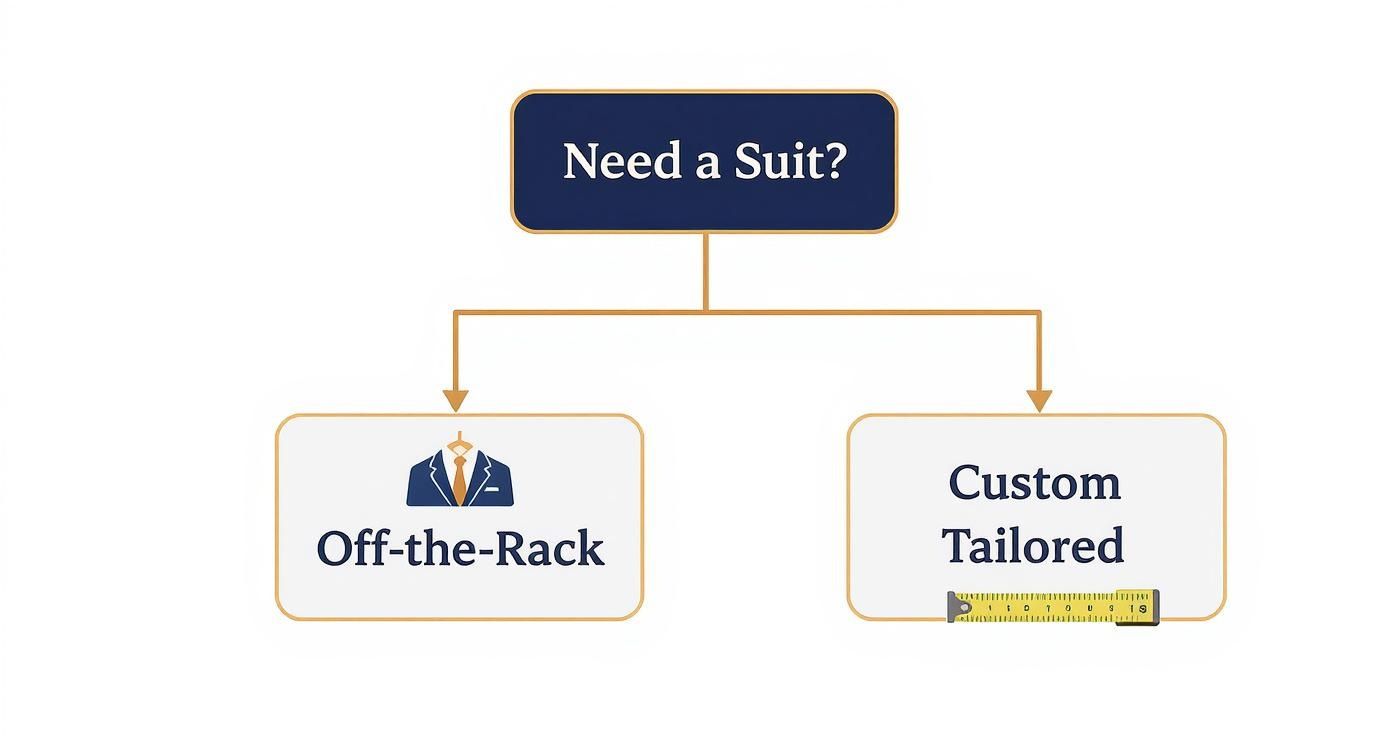
This infographic gives you a simple way to visualise which path might be right for your first custom suit.
As you can see, the first big decision is moving from ready-to-wear to the world of custom tailoring, a step that completely changes how you experience clothing.
Ultimately, choosing between these two paths comes down to what you need. For a much deeper dive, we've put together an in-depth comparison of made-to-measure vs bespoke. It will give you all the clarity you need to make the right investment for your wardrobe.
Selecting the Right Fabric and Design
Once you’ve decided between the bespoke and made-to-measure paths, you arrive at what is arguably the most creative part of the journey: choosing the fabric and design. This is where your personality truly gets woven into the suit. It’s where your lifestyle, taste, and the suit's purpose all come together.
Think of the fabric as the soul of the suit, and the design as its character.
The cloth you select will dictate everything from how the suit hangs on your frame to its comfort, durability, and whether it’s right for a summer wedding or a winter board meeting. The design details, on the other hand, are the architectural choices that build its silhouette and set its formal tone. Together, they make sure the final garment doesn't just fit your body, but fits your life.
The Language of Suit Fabrics
Choosing a fabric isn't just a visual decision; it's a tactile one. Every material has its own handle, weight, and texture, and each tells a different story. Getting to know the core options is the first step in commissioning a suit that performs exactly as you need it to.
Wool – The Quintessential Choice: There’s a good reason wool is the cornerstone of classic tailoring. It's incredibly versatile, tough, breathable, and naturally resists wrinkling. From light, crisp worsted wools perfect for a sharp business suit to heavier flannels that offer real warmth in winter, it's the undisputed all-rounder.
Tweed – Rugged Country Charm: Hailing from Scotland and Ireland, tweed is a hardy woollen fabric famed for its warmth and resistance to a bit of damp weather. Its rich, earthy textures and classic patterns like herringbone or houndstooth give a tweed suit an intellectual, slightly rustic character. It’s perfect for the cooler months and smart-casual affairs.
Linen – Effortless Summer Elegance: When the temperature climbs, nothing beats linen. It’s made from flax fibres, making it exceptionally light and breathable, which is exactly what you want to stay cool and comfortable. Its tendency to wrinkle is part of its charm, giving it a relaxed, continental vibe, but it’s best saved for warm-weather events. For a little more inspiration, have a look at our guide on styling a summer linen suit.
Velvet – Opulent Eveningwear: For those moments that demand a bit of drama and luxury, velvet is your answer. Its soft pile and rich lustre create an immediate impact, making it the go-to for dinner jackets, smoking jackets, and statement suits for festive or black-tie events.
Defining Your Silhouette with Design Details
With the fabric settled, we move on to the suit's architecture. These design choices are anything but random; they work in concert to shape your silhouette, signal formality, and inject your personal style. Every decision is another brushstroke in the final portrait.
The first big decision is how the jacket closes. This choice fundamentally changes the suit’s visual impact and how formal it feels.
A suit’s design is a conversation between fabric and form. The structure must honour the material, and the material must give life to the structure. Getting this balance right is the essence of true tailoring.
A good tailor will guide you through these choices, making sure every single element works in harmony to flatter your physique and suit the occasion perfectly.
Jacket Styles and Lapel Choices
The front of the jacket really sets the tone for the entire outfit. You have two main options, and each brings a distinct personality to the table.
Jacket Fronts:
Single-Breasted: This is the most common and versatile style you'll see, with one column of buttons (usually one, two, or three). It creates a clean, slimming V-shape at the torso and works for just about any occasion, from the office to a wedding.
Double-Breasted: A more formal, commanding style with two parallel rows of buttons. The overlapping front has the effect of broadening the shoulders and pulling in the waist, creating a powerful silhouette.
Next up, you'll choose the lapel, which frames your chest and face.
Lapel Styles:
Notch Lapel: The standard for single-breasted suits. The lapel meets the collar at a clear angle, or 'notch'. It's a timeless, can't-go-wrong choice.
Peak Lapel: More dramatic and formal, with points that sweep upwards towards your shoulders. It's the default on double-breasted jackets but makes a sharp, confident statement on a single-breasted one.
Shawl Lapel: A smooth, rounded lapel with no notches or peaks at all. You'll see this almost exclusively on dinner jackets and tuxedos, where it conveys pure evening elegance.
These key decisions, along with finer details like the style of the pockets or the choice of buttons, are where your vision truly begins to take shape, resulting in a custom suit that is unmistakably, unequivocally yours.
Mastering the Suit Fitting Process
The journey to a truly custom suit is a precise, collaborative art, and the fitting process is where the real magic happens. This is the stage where abstract measurements and a beautiful piece of cloth are transformed into a garment that feels like it was made just for you. Think of it as a series of conversations between you, your tailor, and the suit as it takes shape, ensuring every single detail aligns with your vision.
Unlike buying off-the-rack, where you’re forced to adapt to the suit’s limitations, here the suit is meticulously sculpted to your form. It's a transparent, step-by-step refinement that shows you exactly how we achieve a fit that ready-to-wear simply cannot touch.
The Initial Consultation and Measurements
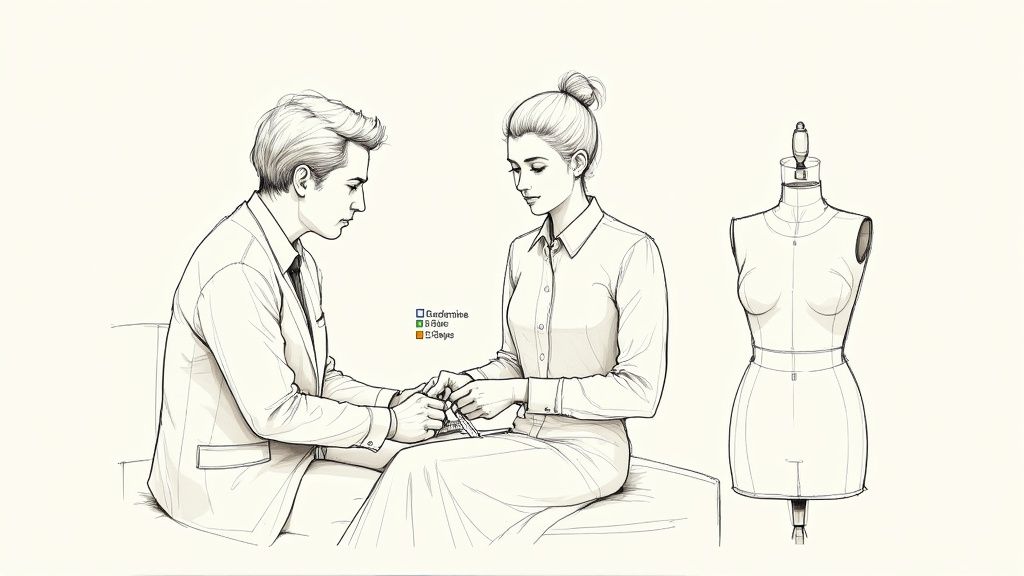
Your first appointment is a deep dive into your personal style and your unique physique. This goes far beyond a simple chest and waist measurement. A skilled tailor takes dozens of detailed measurements, capturing not just your size, but your posture, the slope of your shoulders, and all the subtle asymmetries that make you, you.
This comprehensive set of data becomes the architectural blueprint for your suit; it's the foundation on which everything else is built. While we handle all the expert measuring in our studio, understanding the basics can be empowering. You can get a sense of the detail involved by exploring our guide on how to measure yourself for a suit.
The Basted Fitting: A Bespoke Hallmark
For a truly bespoke suit, the basted fitting is a pivotal moment. The suit is constructed in a temporary, skeletal form, held together with loose "basting" stitches. There are no finished buttonholes or linings just yet—it's a canvas, ready for its first critique.
The basted fitting is the first time you and the suit truly meet. It’s a crucial trial run where we assess the drape, balance, and silhouette, making foundational adjustments that are impossible to execute on a finished garment.
During this session, you’ll try on the jacket and trousers, and your tailor will chalk, pin, and tweak the garment directly on your body. This is where we perfect the length, suppress the waist for a sharper silhouette, and ensure the collar sits cleanly against your neck. It’s an interactive process that guarantees the final suit moves with you, not against you.
Subsequent Fittings and Final Touches
Whether you’ve chosen made-to-measure or full bespoke, the subsequent fittings are where the suit truly comes to life. For an MTM suit, this might be your first chance to try on the nearly completed garment, where we can make those small but critical adjustments to sleeve length or trouser hem.
For a bespoke piece, you may have what's called a 'forward' fitting after the basted stage, where more permanent stitching has been applied. Each session refines the fit further, honing the silhouette until it is absolutely perfect. This meticulous, multi-stage process ensures every seam, button, and lapel works in harmony to deliver unparalleled comfort and a flawless finish.
Wearing Your Custom Suit With Confidence
A perfectly crafted custom suit is an investment, absolutely. But owning an exceptional garment is only half the story. The real magic happens when you know how to wear it with purpose and panache, adapting it to the occasion at hand. This is where you truly master your personal style.
This adaptability is one of the greatest strengths of investing in custom suits for men. The very same foundational piece can be completely transformed with a few considered choices, taking you from a formal ceremony to a critical business meeting without missing a beat.
Styling For Weddings
Whether you’re the groom or a distinguished guest, a wedding suit needs to respect the gravity of the day. Grooms often gravitate towards richer fabrics, maybe a lightweight wool-mohair blend for its subtle sheen, or a textured tweed for a more rustic, countryside affair.
The aim is to stand out with a quiet elegance. A three-piece suit is a classic choice for a reason; it allows the groom to remove his jacket during the reception and still look impeccably sharp in his waistcoat. To truly complete the ensemble for such a grand occasion, the right scent is non-negotiable. You can discover some of the best fragrances for the groom to find the perfect final touch.
Commanding Respect In The Boardroom
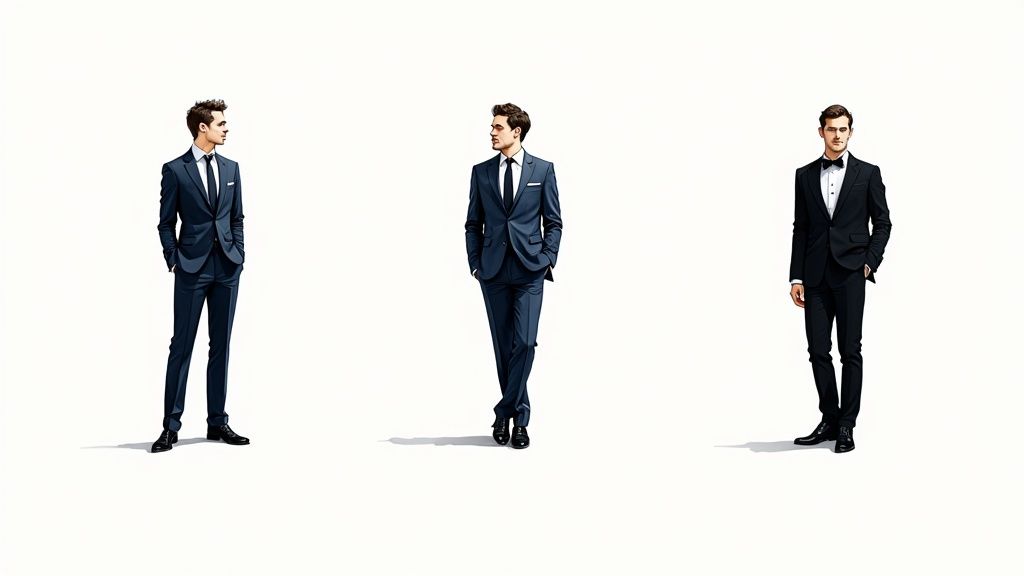
In the professional world, your suit is your armour. It should communicate authority, competence, and a sharp eye for detail before you’ve even said a word. The absolute cornerstones of any business wardrobe are classic suits in navy and charcoal grey.
These colours are universally respected and act as a versatile canvas for any number of shirt and tie combinations. A well-fitted, single-breasted two-button suit is the gold standard here. The key is projecting a clean, sharp silhouette that radiates confidence. For a look that's still polished but a touch less formal, you might find our guide on styling a suit without a tie particularly useful.
In business, simplicity is power. A perfectly fitted navy or charcoal suit, paired with a crisp white shirt and a quality silk tie, remains the most potent uniform for a gentleman. It is timeless and speaks volumes about your professionalism.
Mastering The Black Tie Dress Code
Black tie events call for a very specific and elegant uniform: the dinner suit, or as it's more commonly known, the tuxedo. This is where the finer points of custom tailoring really get to shine. A proper dinner suit is defined by its satin-faced lapels—usually in a peak or shawl style—which provide a beautiful, subtle contrast against the wool body of the jacket.
Getting the details right is everything. The essential components for a correct black tie outfit include:
A Classic Bow Tie: Always, always go for a self-tied bow tie. The fabric should match your lapels.
A Formal Shirt: A shirt with a pleated or Marcella bib front is traditional, worn with studs instead of buttons.
Polished Footwear: Patent leather Oxford shoes are the only truly correct choice for this level of formality.
Sticking to these conventions isn’t about being stuffy; it’s about showing respect for the occasion and demonstrating a sophisticated grasp of classic menswear. It ensures you look nothing less than impeccable.
About the Author: Igor, Founder of Dandylion Style
My name is Igor, and I'm the founder of Dandylion Style. My career is built on a deep passion for classic gentlemen's tailoring and the transformative power of a perfectly fitting suit. I believe that investing in custom suits for men is about more than just clothing; it's about crafting a second skin that empowers you with confidence. My role is to act as a trusted style consultant, building lasting relationships and guiding clients to create a timeless wardrobe that truly reflects their personal brand.
Frequently Asked Questions
What is the difference between made-to-measure and bespoke suits?
The key difference lies in the pattern. A made-to-measure suit starts with an existing standard pattern which is then altered to fit your measurements. It’s a great way to achieve a superior fit. A bespoke suit, however, is the pinnacle of tailoring. A unique pattern is drafted entirely from scratch based on over 20 of your specific measurements, offering limitless customisation and a garment sculpted perfectly to your body. This method provides an unparalleled level of precision and personalisation.
How long does it take to get a custom suit made?
The timeline depends on the complexity of the process. A made-to-measure suit generally takes between 6 to 8 weeks from the initial consultation to the final fitting. Because it involves creating a new pattern and typically requires more detailed fittings to perfect the silhouette, a full bespoke suit has a longer timeline, usually around 10 to 12 weeks. We always provide a clear schedule at your first appointment so you know exactly what to expect.
How much should I budget for a custom suit?
The cost varies based on the construction method and fabric choice. A high-quality made-to-measure suit typically starts from £1,000 to £1,500. For a fully bespoke suit, where a unique pattern is created just for you, prices generally begin around £3,000 and can increase depending on the exclusivity of the cloth. Think of it as a long-term investment in a perfectly fitted garment that is built to last for many years to come.
How should I care for my custom suit?
To ensure your suit lasts a lifetime, proper care is essential. Always hang it on a wide, wooden hanger to maintain the shoulder shape and allow it to air out for 24 hours after wearing. Avoid frequent dry cleaning; once or twice a year is sufficient unless it's visibly stained. Use a garment steamer for wrinkles, as direct ironing can damage the fabric. A regular gentle brushing with a soft suit brush will also help keep the material in pristine condition.
Begin your journey towards a truly exceptional wardrobe with Dandylion Style. To discuss your vision and book a personal consultation, please visit us at https://dandylionstyle.co.uk.
Written by:
Igor Srzic-Cartledge
Igor is the founder of Dandylion Style, a tailoring house built on the simple, deeply held belief that a suit should be like a second skin—a true extension of a gentleman’s personality. For Igor, tailoring isn't just about cutting cloth; it's an art form dedicated to creating unique, perfectly fitted attire for the discerning man. His passion is rooted in classic sartorial traditions, yet he maintains a keen eye for contemporary style, ensuring his creations are both timeless and relevant. This approach has cemented his reputation for genuine craftsmanship and a truly personal service.
Key Takeaways The Core Two: Navy blue and charcoal grey are the essential, non-negotiable suit colors for any professional wardrobe. Navy offers versatility and approachability, while charcoal projects authority and seriousness. Context is Crucial: The best suit color...
When you find a piece of clothing you absolutely love, getting the fit just right is the final, transformative touch. But how much should you expect to pay? In the UK, alteration costs can be as modest as £15 for a simple trouser hemming, or climb to £150 and beyond...
Getting the right pink shirt and tie combination is the mark of a well-dressed man. It’s a detail that separates the novices from those who truly understand their wardrobe. For a look that’s classic and can’t miss, pair your pink shirt with a navy, grey, or burgundy...
Key Takeaways For those seeking a quick overview, this section summarises the essential rules and recommendations for incorporating turn-up trousers into your wardrobe. Sartorial Purpose: Turn-ups add weight to the trouser hem, ensuring a cleaner, sharper drape,...
Deciding what colour tie to wear with a pink shirt is a common style query I hear from clients. For a classic, professional look that never fails, your safest and most effective choices are navy blue and charcoal grey. If you're heading to a more contemporary or...
You've just picked up a newly finished bespoke suit, and the cloth still has that clean, disciplined line only a real fitting room can give it. The temptation is to put it straight in the wardrobe and trust the label to do the rest. That's where expensive...
Book Your Tailoring Consultation
Looking for a suit or garment made specifically for you?
At Dandylion Style, we create bespoke and made-to-measure
garments tailored to your individual shape, style and occasion.
From suits and shirts to dresses, waistcoats and alterations,
our experienced tailors can help you create something truly unique.