You've chosen the jacket. The shirt is pressed. The tie works. Yet when you look in the mirror, the outfit still feels unfinished.
That last degree of refinement often comes from a single square of cloth. A well-made custom pocket square doesn't shout. It completes. It introduces colour, texture and intent in a way that off-the-peg accessories rarely manage, especially when the rest of your wardrobe has already been chosen with care.
For gentlemen dressing for a wedding, a black-tie evening, or a week of important meetings, the difference is usually in the details nobody notices separately but everyone feels together. A pocket square is one of those details.
Key Takeaways
- A custom pocket square is the finishing touch that turns a correct outfit into a personal one.
- History matters because tradition shapes taste. The pocket square reaches back to ancient Egypt and became a recognisable part of British tailoring in the 1930s.
- Natural fibres remain the best choice for elegance, texture and proper drape in formalwear.
- Material claims deserve scrutiny. Many listings speak of “premium fabric” without clearly guaranteeing natural silk or linen.
- Size is not a minor detail. A square that's too small drops into the pocket and never presents well.
- Construction affects performance. Proper hems help prevent curling and keep folds looking composed.
- Exact tie matching is a common mistake. A pocket square should complement the tie, not duplicate it.
- The one-point fold is one of the strongest formal choices when the square has enough body and size to hold its line.
- Monograms work best when handled quietly. They should feel like a private signature, not a logo.
- Care protects the investment. Remove the square after wear, press it properly, and store it flat or lightly folded.
The Mark of Distinction Why a Custom Pocket Square
A fine jacket without a pocket square can still be elegant. It leaves a little character on the table. The reason discerning clients come back to this accessory isn't necessity. It's distinction.
The pocket square has deep roots. According to Rampley & Co's history of the pocket square, it traces its origins to ancient Egypt, where small linen cloths were dyed red for ceremonial use. Over time, that utilitarian and symbolic cloth evolved into the modern pocket square. The same history notes that the silk pocket square became a defining icon in British tailoring in the 1930s, with Turnbull & Asser's earliest known silk squares dating to that era.
That lineage matters because good tailoring always carries memory. When a gentleman places silk or linen in his breast pocket today, he isn't adding a novelty. He's continuing a dress code that has been refined rather than reinvented.
Why bespoke makes the difference
Off-the-rack squares often fail in quiet ways. The fabric feels lifeless. The edges are too flat or too crude. The proportions don't suit the pocket. The colours look right in isolation but wrong against the cloth of the jacket.
A custom pocket square resolves those faults before they appear. It allows you to choose the right scale, the right cloth, the right finish, and the right note of personality for your wardrobe. That's the difference between accessorising and dressing with purpose.
For gentlemen building a more coherent wardrobe, accessories deserve the same attention as the suit itself. The best starting point is a considered accessories wardrobe rather than a collection of impulse buys, which is why a curated approach such as Dandylion Style accessories makes far more sense than chasing isolated pieces.
Natural fibres are the proper standard
There's also a practical reason seasoned tailors prefer silk, linen and wool over synthetic blends. Natural fibres breathe better, fold more elegantly and age with more dignity. Their surfaces catch light with subtlety rather than glare. Their irregularities often enhance their appeal instead of undermining it.
Practical rule: If the square looks glossy in a harsh, plastic way, it will usually cheapen the jacket around it.
The custom route matters because pocket squares are small, but they sit in one of the most visible places on the body. A weak cloth in the breast pocket can undo the authority of excellent tailoring beneath it.
Choosing Your Canvas Fabric and Material Mastery
The first decision is fabric. It's the decision that determines how the square folds, how it catches light, and whether it feels in harmony with the rest of the outfit.
What each cloth does well
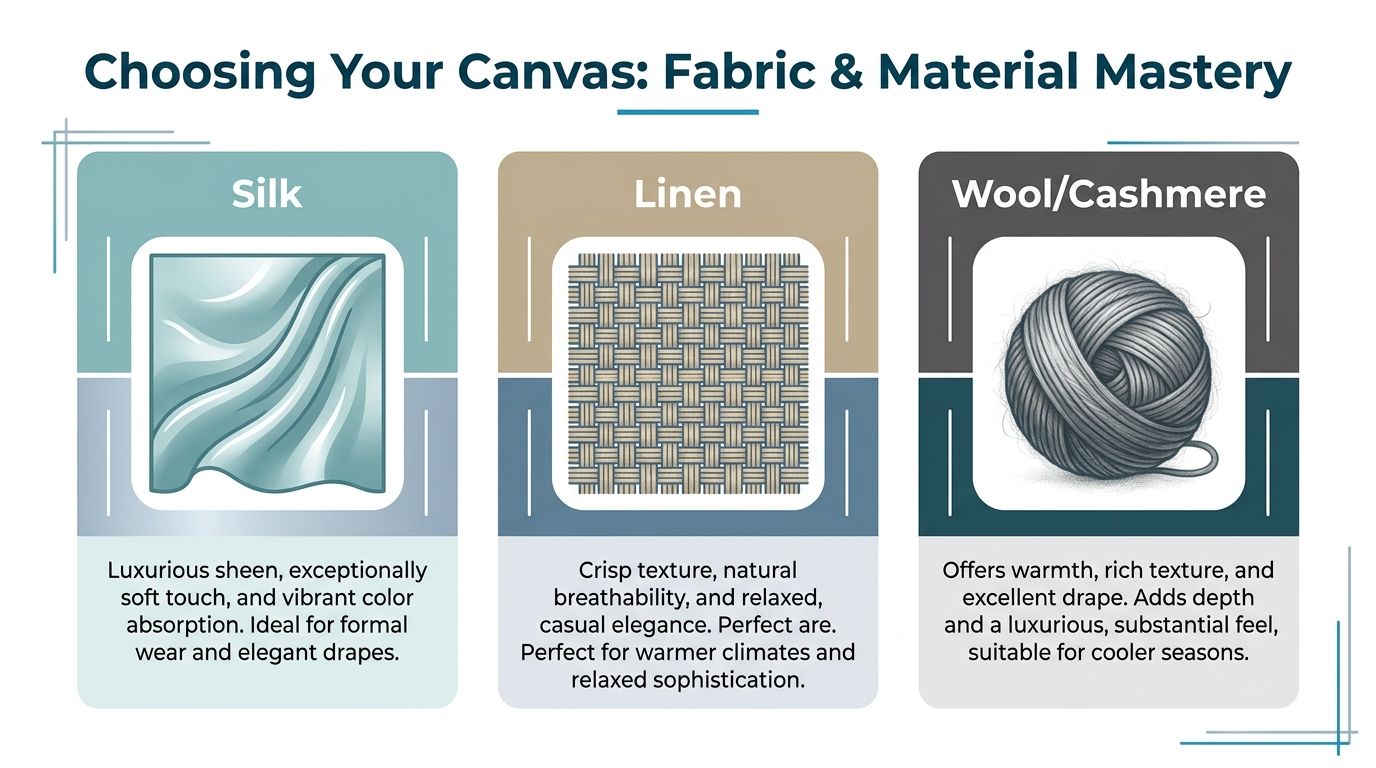
Silk is chosen for fluidity and richness. It takes colour beautifully and gives a softer, more relaxed presentation in the pocket. For evening wear, weddings, and polished business dress, silk often gives the most graceful result.
Linen behaves differently. It has a crisper hand and a drier surface. That makes it superb when you want a fold with cleaner definition and a fresher, more architectural look. In warmer months, linen also feels entirely at home with lightweight jackets.
Wool and cashmere bring depth. They aren't the standard answer for every client, but they can be excellent with seasonal tailoring, especially when a jacket already has visible texture. A soft wool square in a flannel or tweed jacket often looks more convincing than glossy silk.
For readers who enjoy understanding cloth beyond accessories, More Sewing's fabric guide for sewists is a useful reference for how fibre character changes feel, structure and behaviour in finished pieces.
Pocket Square Fabric Comparison
| Fabric | Best For | Texture & Sheen | Fold Style |
|---|---|---|---|
| Silk | Weddings, black tie, refined business dress | Smooth, soft, luminous | Puff, one-point |
| Linen | Summer tailoring, daytime events, crisp formality | Dry, crisp, matte to low sheen | One-point, straight edge |
| Wool/Cashmere | Autumn and winter tailoring, textured jackets | Soft, rich, substantial | Puff, relaxed point |
The authenticity question
Material honesty has become a real dividing line. According to James Morton Ties on pocket squares and handkerchiefs, 78% of UK groomers prefer handkerchiefs made from 100% natural fibres like silk or linen for wedding attire, while only 32% of UK-based custom pocket square listings explicitly guarantee 100% natural silk or linen fabrics. That gap tells you something important. Many sellers know the language of luxury better than they know the standard of it.
If a listing leans on phrases such as “premium finish” or “silk-feel” without stating the fibre plainly, caution is wise. Synthetic blends can have a place in low-cost accessories, but they seldom satisfy a client who has already invested in proper tailoring.
Choosing with your jacket, not against it
The cleanest way to choose fabric is to look at the jacket first.
- For smooth worsted suits, silk usually provides the most natural companion.
- For open-weave summer cloths, linen often feels more believable.
- For flannel, tweed or cashmere jackets, wool or cashmere can create a more coherent surface.
- For gifts or initials, a silk base often carries embroidery with more elegance, particularly when paired with discreet placement on a silk pocket square commission.
A pocket square shouldn't look imported from another outfit. It should look as though it belongs to the jacket that carries it.
The Finer Points Sizing Edges and Monograms
A pocket square can be made from beautiful fabric and still fail if the construction is wrong. Many mass-market pieces often come unstuck for this reason. They look acceptable in the box and disappointing in the pocket.
Why size matters more than most men realise
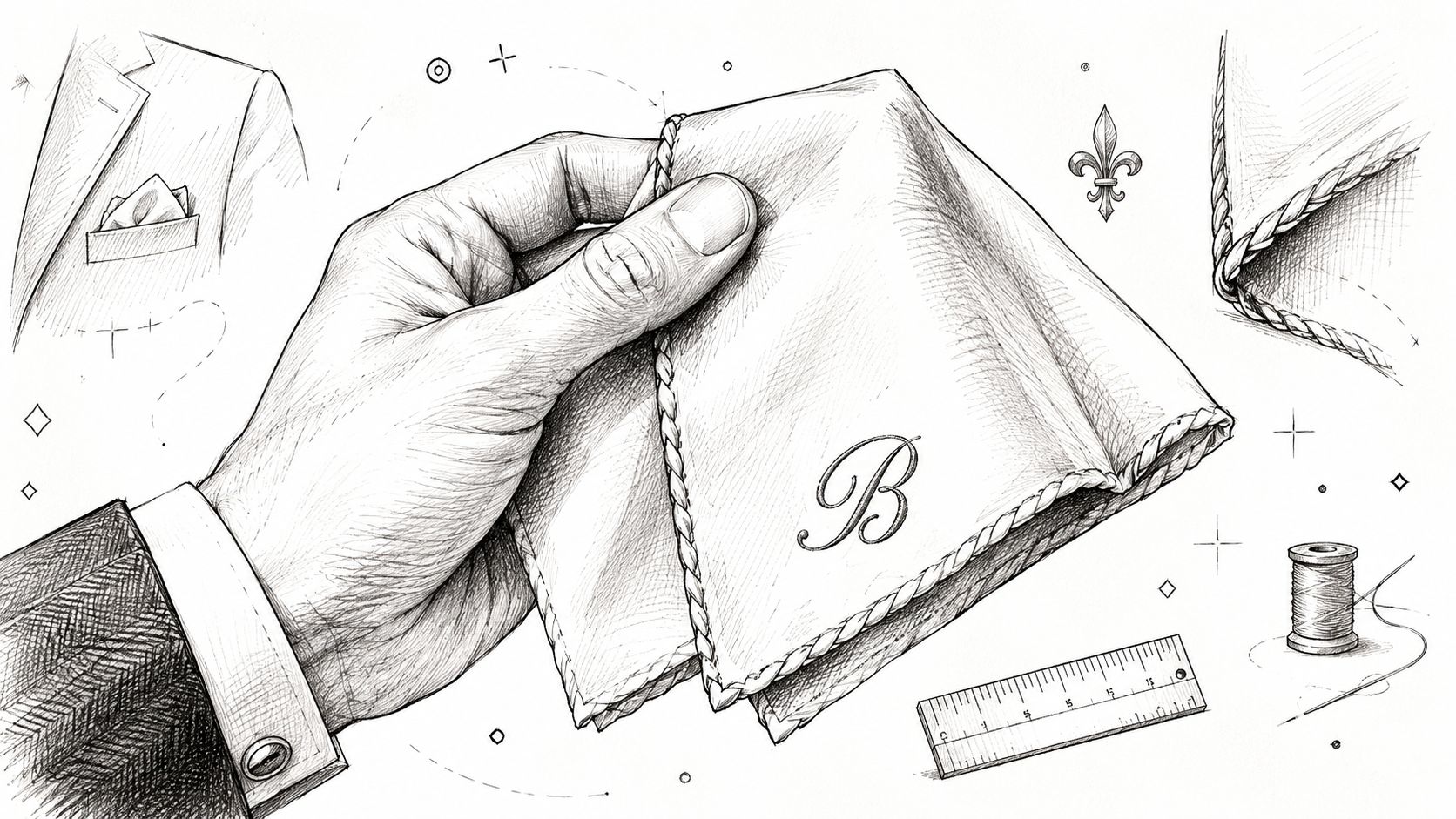
According to Trendhim's pocket square guide, a high-quality custom pocket square for bespoke tailoring in the UK market should measure no less than 25cm square, and a luxury specification often begins with a 12-inch by 12-inch (30cm x 30cm) fabric cut to allow for a 1/2-inch total double-fold hem on all four edges. That hem structure helps prevent curling and gives folds such as the puff more stability.
In practical terms, a square that's too small sinks. You arrange it in the mirror, button the jacket, move once, and it disappears below the pocket line. A larger square gives you enough reserve cloth to anchor the fold and enough visible cloth to shape it properly.
Edges that hold their dignity
The edge is not trim. It's structure.
A poor edge curls, frays or stiffens awkwardly. A well-finished edge allows the square to sit naturally while still holding enough firmness at the perimeter to look composed. Tailors notice this immediately because the edge controls whether a fold feels alive or merely crumpled.
Think of the edge as the frame around a miniature painting. If the frame is clumsy, the image never looks quite right.
Monograms done properly
Monograms are best when they remain slightly private. The gentleman wearing the square should know they're there. Others may only notice them on closer inspection.
Good placement usually sits away from the most visible top edge so the initials appear only when the square is unfolded or styled in a more relaxed way. Loud placement can make the square feel promotional rather than personal. For clients considering embroidered initials across shirts and accessories, custom monogram ideas from 1021 Events are useful for seeing how personalisation shifts in tone depending on scale and placement.
For those who already appreciate discreet embroidery on shirting, the logic carries over neatly from custom shirt embroidery options. The principle is the same. The mark should feel intentional, balanced and restrained.
- Choose initials sparingly. One to three letters is usually enough.
- Keep thread colour subtle. Tone-on-tone or soft contrast ages better than high contrast.
- Avoid oversized lettering. If the eye goes straight to the monogram, it's too large.
- Place for discovery, not display. A monogram should reward attention, not demand it.
The Art of Presentation Folds and Pairing Principles
Most men start by asking how to fold a pocket square. The better question is what the fold should communicate.
A client arrives for a wedding fitting in a navy suit, white shirt and patterned tie. He places an identical patterned square beside it because the set was sold together. That's where the conversation usually begins. The outfit isn't wrong, but it feels prearranged. Once the square is changed, the whole coat front gains life.
Folds that speak differently
The puff fold is soft and effortless. It works particularly well when the cloth has fluidity and when the occasion doesn't require a hard, graphic line. It can look elegant, but only if the fabric has enough volume to fill the pocket without collapsing.
The one-point fold is sharper. It shows intention without stiffness and often suits formal dress beautifully. Its strength lies in geometry. When the square is properly made, the point sits with confidence rather than drooping.
The straight fold is simpler and quieter. In the right setting it can be disciplined and clean, though it risks looking flat if the fabric lacks body or the proportions aren't right.
Pairing colour with judgement
According to James Morton Ties' guide to pocket squares, in UK bespoke tailoring a pocket square should complement, not identically match, the tie, because exact matching creates a flat look. The same guide notes that a contrasting square adds depth, and that the one-point fold is considered technically superior for formal occasions in the UK because it relies on proper size to hold its shape.
That principle is one of the most useful in dress. Matching repeats information. Complementing creates composition.
If the tie says one thing and the pocket square says the same thing at the same volume, the outfit becomes monotonous.
A practical method for clients
When advising a gentleman on his first proper square, I usually narrow the decision through three questions:
What is the jacket cloth saying already?
Smooth cloth often invites a cleaner contrast. Textured cloth often benefits from a softer one.Is the tie the lead voice or supporting voice?
If the tie is bold, the square should steady it. If the tie is restrained, the square can introduce more personality.What does the occasion reward?
A wedding can take a little flourish. A boardroom generally prefers control.
For men who struggle with tie and shirt combinations before they even reach the pocket square, a thoughtful colour foundation helps, and guidance on tie colours for a blue shirt is a useful starting point.
The Dandylion Style Commission A Bespoke Journey
A bespoke commission should feel calm, not theatrical. The best process removes uncertainty. It doesn't overwhelm the client with jargon.
For a gentleman ordering a custom pocket square alongside tailoring, the work usually starts with the wardrobe he already owns or plans to wear. The square doesn't live in isolation. It's chosen in relation to lapel shape, cloth texture, shirt tone and the role the garment will serve. If the commission is part of wedding dress, the pocket square also has to sit correctly within the visual language of the day.
What a proper commission includes
Dandylion Style is based in Ardingly, West Sussex, and works with clients across Sussex, London and the South East through studio, home, office and remote appointments. The house offers bespoke and made-to-measure tailoring, wedding and black-tie clothing, shirts, accessories and alterations. Typical timelines for a suit are 8 to 12 weeks, and pricing begins at £1,495 for a bespoke two-piece, £1,795 for a three-piece, with handmade ties and handkerchiefs from £125.
Those figures matter because they place the accessory in its proper context. A pocket square is a small object, but in a bespoke wardrobe it's part of a larger, coherent system.
How the process protects the result
A good commission usually moves through these decisions in order:
- Cloth selection first. Fibre, texture and colour are chosen with the jacket, shirt and occasion in mind.
- Finish second. Edge treatment and handle are considered according to the preferred fold.
- Personalisation last. Monograms, gift presentation and final details come only after the fundamentals are settled.
For clients giving a pocket square as a present, presentation matters too. Thoughtful packaging can enhance a modest-sized gift, and UK gift box solutions from Packaging Panda offer useful ideas for keeping the presentation polished without becoming flashy.
Care starts the day you receive it
A bespoke accessory lasts because the owner handles it properly.
- Remove it after wear. Don't leave it compressed in the breast pocket for days.
- Let the cloth rest. Natural fibres recover better when they aren't permanently creased.
- Press with care. Use appropriate heat and a pressing cloth where needed.
- Store it flat or lightly folded. Avoid crushing several squares into one drawer corner.
Workshop advice: Treat the pocket square as you would a fine tie. It's not fragile, but it does remember rough handling.
Preserving Your Investment Long-Term Care
A good pocket square should age gracefully. That only happens if the owner respects the cloth.
Silk benefits from gentle treatment. If it has taken on a light crease from wear, a careful press with protection between iron and cloth is safer than aggressive direct heat. Linen can tolerate firmer pressing and often looks best with a little crispness left in it. Wool and cashmere deserve the most restraint. If they aren't visibly soiled, airing and light steaming are often kinder than overcleaning.
Daily habits that make the difference
The most damaging habit is neglect rather than use. Men wear the square, leave it in the jacket pocket, hang the coat away, then wonder why the folds start to set oddly. Remove the square after each wear and let it return to shape before storing it.
Storage should be simple.
- Keep squares clean before storing so marks don't settle into fibres.
- Store away from direct sunlight to protect colour.
- Avoid overpacking drawers because pressure creates stubborn creases.
- Separate heavily textured pieces from delicate silk if they might snag.
For clients who maintain a larger bespoke wardrobe, care standards should be consistent across the jacket and the accessories that live with it. Thoughtful guidance on how often you should dry clean a suit helps place pocket square care in the wider rhythm of garment maintenance.
Pressing without harming the finish
Never rush the pressing stage. Reshaping is more important than flattening. A square that has been scorched, glazed or crushed loses the very qualities that made it appealing in the first place.
A pocket square isn't difficult to care for. It asks for the sort of attention that any worthwhile piece of tailoring deserves.
Your Questions Answered and About the Author
FAQ
What's the difference between a pocket square and a handkerchief?
A pocket square is decorative. It belongs in the breast pocket and is chosen to enhance the line and personality of a well-fitted ensemble. A handkerchief is functional and should be carried elsewhere. Even when the terms overlap in retail language, a gentleman should keep the two roles separate. What touches the face shouldn't return to the jacket pocket as ornament.
Can I use custom artwork or a personal motif on a pocket square?
Yes, if it suits the purpose of the piece and the rest of the wardrobe. Personal artwork, family motifs or wedding references can work beautifully when handled with restraint. The test is whether the design still reads as elegant when folded. A breast pocket shows only part of the cloth, so the strongest custom designs are those that remain attractive even in fragments.
Should my pocket square always be silk?
Not at all. Silk is excellent for many formal settings because it drapes softly and carries colour well, but it isn't the only correct answer. Linen gives a crisper, drier expression and often looks sharper in daylight or warm-weather tailoring. Wool or cashmere can be more convincing with textured jackets. The best cloth is the one that supports the jacket and the occasion rather than competing with them.
Is a monogram tasteful or too much?
It depends entirely on scale, placement and thread choice. A discreet monogram can be very tasteful because it turns the square into a personal object rather than a generic accessory. The trouble starts when initials are oversized, high contrast or positioned to be seen immediately in every fold. Personalisation should feel like a signature inside good tailoring, not branding on top of it.
How many pocket squares should a gentleman own?
A small, intelligent rotation is better than a large, careless collection. Start with one white or off-white option for formal use, one silk square with richer colour for celebratory dressing, and one textured piece for softer jackets or seasonal tailoring. That covers most needs. After that, add only pieces that create a distinctly new effect rather than near-duplicates.
About the author
Igor is the founder of Dandylion Style, a luxury bespoke tailoring house based in Ardingly, West Sussex. He specialises in one-of-a-kind garments cut from fine British fabrics, with a calm, exacting approach to fit, cloth selection and finishing details. His work spans bespoke and made-to-measure suits, wedding and black-tie attire, shirts, waistcoats, alterations and accessories for clients across Sussex, London and the South East. His guiding principle is simple. Clothes should feel personal, elegant and enduring.
If you're ready to commission a wardrobe with the right finishing details, Dandylion Style offers bespoke tailoring, shirts and accessories with consultations in the studio, at home, at the office, or remotely.