
You're probably here because someone has handed you a deceptively simple brief. Order a set of shirts for the wedding party. Dress a client-facing team. Coordinate a group that needs to look aligned, polished, and properly turned out.
Then the complications start. Not every man takes the same collar. Not every shoulder sits the same. White isn't always the same white. And the moment you move from one shirt to several, the task stops being personal shopping and becomes a small production exercise.
That's where many buyers go wrong. They approach custom shirts in bulk as if they were ordering promotional garments, when in reality a good group shirt order sits much closer to tailoring. It demands choices about fit, cloth, construction, consistency, timings, and how much risk you're willing to carry on sizing.
Key Takeaways
A group shirt order goes well when it is treated like a tailoring project with shared standards, not a pile of garments with a logo added at the end.
- Decide the service level before you discuss price. Bespoke, made-to-measure, and customised wholesale produce very different results. The right choice depends on whether fit, speed, repeatability, or branding matters most.
- Good planning beats broad market claims. For buyers in the UK, the practical advantage is access to established makers, cloth merchants, alteration support, and repeat ordering options. That matters more than a headline industry figure, especially if the source is talking about printed T-shirts rather than dress shirts.
- Fabric sets the standard early. It shapes drape, breathability, opacity, crease resistance, and how the shirt looks after a full day of wear.
- Measurement discipline protects the whole order. One inaccurate neck, sleeve, or shoulder measurement can turn a coordinated commission into a box of near misses.
- A sample shirt saves money. It lets you check collar scale, cuff depth, body balance, cloth weight, and finishing before the full run is cut.
- The quoted unit price is only one part of the cost. Setup charges, VAT, delivery, alterations, remakes, and the cost of poor fit often matter more than a cheap starting number.
- Time gives you better choices. Adequate lead time allows for cloth selection, fitting corrections, and cleaner production control.
- Fit carries more visual authority than loud detailing. A clean collar, correct sleeve length, and balanced chest-to-waist shape will usually outclass aggressive monograms or novelty trims.
- Use a supplier set up for proper shirtmaking. If you are comparing remote ordering routes, reviewing options for custom shirts online helps clarify what can be standardised and what still needs personal fitting.
- Group clothing works best when the garment matches the use case. Casual team kit follows a different logic from dress shirting, which is why a guide to team sports hoodies is useful for contrast, but not a template for dress shirts.
Planning Your Bulk Custom Shirt Order
A group shirt order usually starts under pressure. The wedding date is fixed, the conference is booked, or the senior team wants everyone polished for a client-facing event. That is exactly when buyers make the wrong comparison. They weigh a properly made shirt against cheap decorated stock, as if both solve the same problem.
They do not.
A custom group order asks different questions from a promotional apparel order. The priority is fit, consistency, cloth, and how the shirts will look after hours of wear, not just whether the logo or colour matches. The UK has a mature network of makers, cutters, cloth merchants, and specialist workshops, so buyers have real choice. The hard part is choosing the right route before asking for prices.
Three routes buyers usually compare
| Route | What it means in practice | Best for | Main limitation |
|---|---|---|---|
| Bespoke | A shirt pattern is developed around the individual | High standards, unusual proportions, formalwear | Slowest and most labour-intensive |
| Made-to-Measure | An existing pattern is adjusted to individual measurements | Weddings, offices, repeatable group orders | Less freedom than full bespoke |
| Customised Wholesale | Standard shirts are selected and decorated or lightly customised | Promotions, large casual groups, event branding | Limited fit sophistication |
The mistake I see most often is starting with quantity instead of use. Twenty shirts for a wedding party are not the same job as twenty shirts for a product launch. One needs collar balance under jackets, clean lines in photographs, and enough fitting accuracy that no one looks borrowed from someone else's wardrobe. The other may only need colour consistency and fast delivery.
If your project leans casual or athletic rather than sartorial, a practical companion read is this guide to team sports hoodies, which shows how group apparel decisions change when performance, team identity, and repeat ordering matter more than a precise fit.
What to settle before you ask for quotes
- Purpose: Set the standard first. A wedding shirt, a hospitality shirt, and a boardroom shirt should not be specified the same way.
- Lifespan: A shirt worn once can accept more compromise than one expected to survive weekly laundering and regular pressing.
- Visual standard: Decide whether the group needs to look merely coordinated or properly dressed. That single decision changes the cloth, construction, and fitting method.
- Body range: Mixed builds, longer arms, fuller midsections, or sloping shoulders quickly expose the limits of stock sizing.
- Ordering method: If the group is spread across different locations, use a supplier with a clear process for ordering custom shirts online with a structured remote fitting workflow.
One clear brief saves time. A vague brief produces vague prices, mismatched expectations, and expensive corrections.
A good starting brief covers who will wear the shirts, what they will be worn with, whether jackets are involved, how formal the result should feel, and whether the order may need repeats later. That last point matters more than buyers expect. If one shirt is damaged a week before an event, you need a supplier who can identify the cloth, collar, cuff, and fit history without starting from scratch.
Practical rule: If the shirts need to hold up under close photography, formalwear, or repeated professional use, commission them as shirts, not as merchandise.
Decoding Your Custom Shirt Options
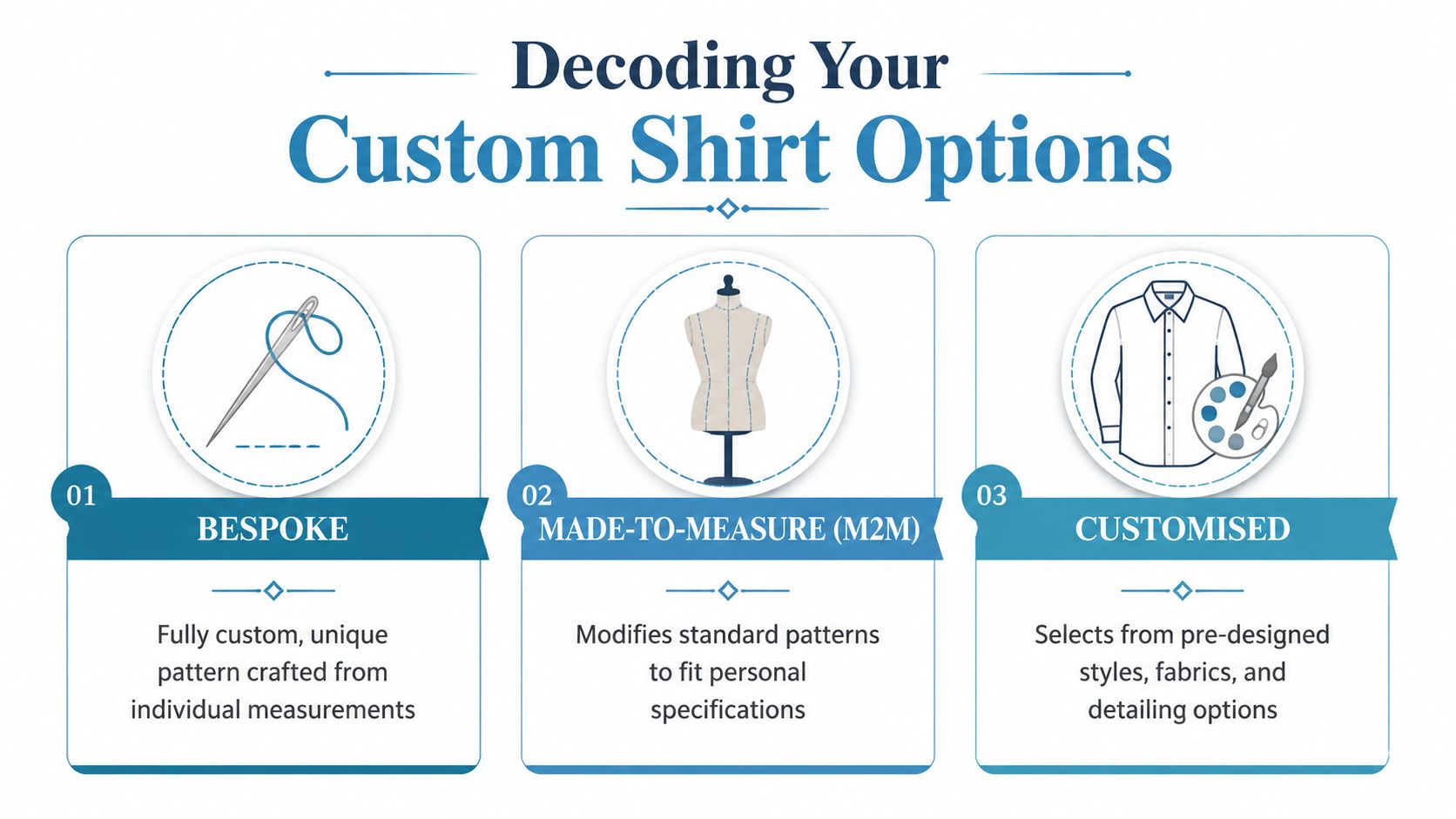
The phrase “custom shirts in bulk” hides three very different products. Buyers often compare prices across them as if they were interchangeable. They aren't.
Bespoke means a shirt built from the man outward
A bespoke shirt begins with the body in front of the cutter or tailor. The pattern responds to that body. Neck shape, shoulder slope, chest balance, posture, seat, arm position, and cuff preference all influence the result.
For a group order, bespoke makes sense when visual refinement matters more than speed. Think groomsmen in eveningwear, executives who know what a poor collar stand feels like, or clients with proportions that stock sizing handles badly. It's the most exact route, but it also asks the most from the buyer in time and fittings.
Made-to-measure is often the most intelligent middle ground
Made-to-measure starts with an existing block and adjusts it. Done well, it offers a disciplined way to produce multiple shirts with consistency while still respecting individual bodies.
For most wedding parties and professional teams, quality and practicality converge. You can standardise cloth and certain design details while still adjusting sleeve length, waist suppression, collar size, cuff depth, and body fit. If a group needs athletic comfort rather than formal shirting, there are also more casual routes such as custom Dri-FIT shirt options, though that's a different proposition from classic fitted dress shirts.
Customised wholesale serves a different purpose
This route usually means starting with stock garments, then selecting colours, sizes, and decoration. It can be useful, but it isn't tailoring. The shirt body is largely predetermined.
That distinction matters. If you're trying to outfit a conference team with logos or manage a large event run, wholesale customisation can be sensible. If you need elegant collars under jackets and clean body lines in photographs, it often disappoints.
For readers comparing decorative routes, these custom printing solutions from Dirt Cheap Headwear are a useful example of how the print-led market thinks about production. It's a different discipline from shirtmaking, but understanding that mindset helps buyers avoid mixing up two separate categories.
Comparing bulk shirt customisation methods
| Feature | Bespoke | Made-to-Measure (M2M) | Customised Wholesale |
|---|---|---|---|
| Pattern | Created for each individual | Adapted from a house block | Pre-existing stock sizing |
| Fit precision | Highest | Strong when measurements are accurate | Limited by stock grading |
| Fabric flexibility | Broad | Broad | Usually narrower |
| Design freedom | Extensive | Moderate to high | Usually surface-level |
| Best use case | Formal groups, demanding fit | Weddings, offices, repeatable groups | Casual events, branded apparel |
| Reorder consistency | Good with records | Very good with stable blocks | Depends on supplier continuity |
| Main trade-off | Time and labour | Less absolute freedom than bespoke | Fit is the weak point |
A buyer who wants proper collar roll, clean cuffs, and a flattering body shape should choose the shirt method first, then compare prices inside that category.
Choosing Fabrics and Customisation Details
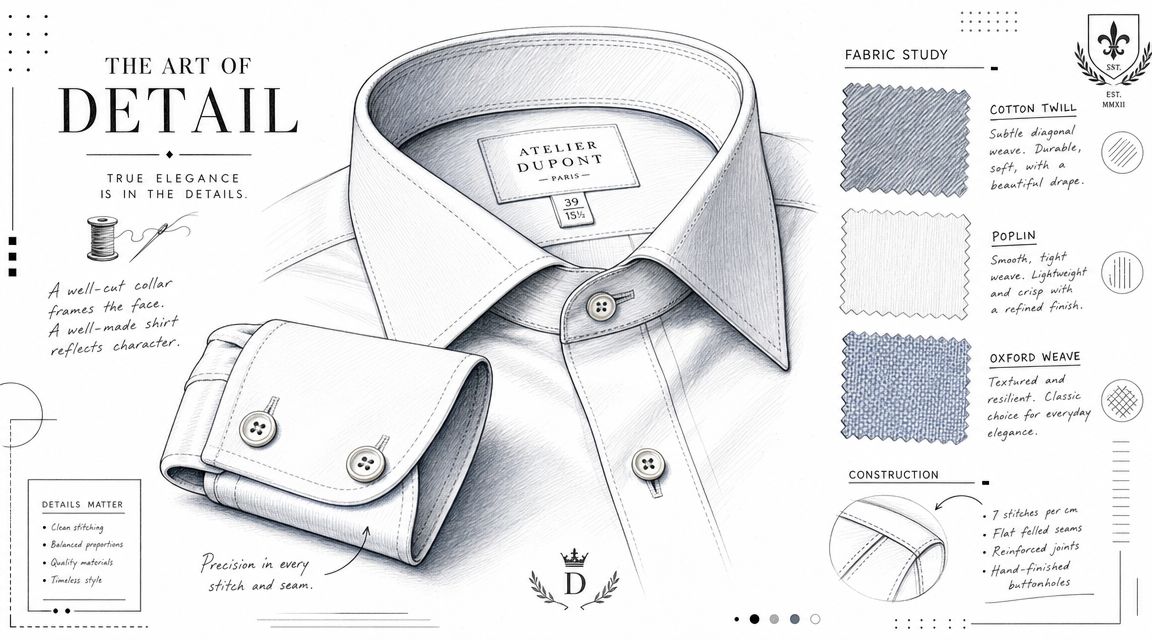
Cloth is where a shirt reveals its seriousness. Two garments may look similar on a screen, but once they're worn for a full day, the differences appear quickly in breathability, crease behaviour, transparency, handle, and how the collar frames the face.
Cloth decisions that change the result
A formal wedding shirt usually benefits from a finer, cleaner weave. Poplin gives crispness and polish. Twill offers a softer hand and often irons more forgivingly. Oxford brings texture and a slightly more relaxed character. Herringbone can add quiet visual interest without looking busy.
The correct choice depends on lighting, season, and how the shirt will be worn. Under a dinner jacket, a dense white cloth with a stable collar usually matters more than decorative flourish. In an office, a blue twill with a balanced semi-spread collar may earn far more wear over time.
Details worth specifying properly
The best custom shirts in bulk don't look mass-coordinated. They look coherent because the shared elements were chosen carefully.
Consider these points early:
- Collar shape: Spread, point, and cutaway each frame the face differently. Lapel width and tie knot size matter.
- Cuff style: Barrel cuffs suit daily wear. French cuffs enhance formal dress but add complexity.
- Front construction: Plain fronts read cleaner. Plackets can look sportier and slightly more casual.
- Buttons and thread: Mother-of-pearl, resin, tonal stitching, or contrast stitching each send a different message.
- Monogramming: Best kept discreet. Placement and thread colour should feel intentional, not promotional.
Why tailored pricing behaves differently
Mass apparel pricing tends to reward quantity. Custom shirt pricing reflects labour, cloth quality, pattern adjustment, cutting accuracy, and finishing. That's why a custom group order should be assessed on value over wear, consistency across the group, and how much post-delivery fixing is likely to be needed.
A common mistake is to compare a decorated stock shirt with a properly cut made-to-measure shirt as if both were solving the same problem. They aren't. One prioritises throughput. The other prioritises fit and finish.
If embellishment matters, there's a place for controlled detailing such as custom shirt embroidery. The trick is restraint. On gentlemen's shirting, embroidery should support the garment, not compete with it.
Better cloth usually earns its keep quietly. It sits cleaner at the collar, drapes better under a jacket, and survives repeat washing with less fatigue.
Navigating Pricing and Order Minimums
Buyers often ask the wrong opening question. They ask, “What's your cheapest price per shirt?” The better question is, “What pricing model am I entering?”
For mass-market customisation, screen printing is generally the economical route once quantities rise, because setup time and screen preparation are spread across more units, lowering unit cost as order size increases, as explained in this guidance on bulk custom apparel production. Tailoring works differently. The cost sits in the work done for each wearer.
Why shirtmaking doesn't scale like print
In custom group orders, several cost drivers remain stubbornly human:
Measurement handling
Someone has to check neck, chest, waist, sleeve, cuff, and back length data for each man.Pattern adjustment
Even within made-to-measure, individual alterations to the block affect the cutting process.Cloth and trim choices
Better shirtings, interlinings, and buttons cost more, but they also influence the life of the shirt.Fitting correction risk
The more complex the body shapes in the group, the more valuable a careful process becomes.
That's why very low minimums are easier in stock apparel than in serious tailoring. A tailor can still produce a small group order, but the economics won't mirror promotional merchandise.
What works when you need budget control
Some buyers benefit from looking beyond custom garments for an analogy. This article on buying lacrosse balls in bulk is useful not because shirts and sports balls are alike, but because it shows a principle that often misleads buyers. Commodity items reward volume cleanly. Custom garments rarely do.
Use these levers instead:
- Standardise the cloth: Keep everyone in the same fabric to simplify production.
- Limit decorative variation: Too many custom details create avoidable complexity.
- Approve one standard first: A clear sample reduces expensive corrections later.
- Choose the right service level: For many groups, custom shirts in the UK through a made-to-measure process provide a better balance than either full bespoke or stock wholesale.
Low unit price is a weak metric if you later pay for alterations, rush handling, or replacement shirts.
Mastering Measurements and Fitting Logistics
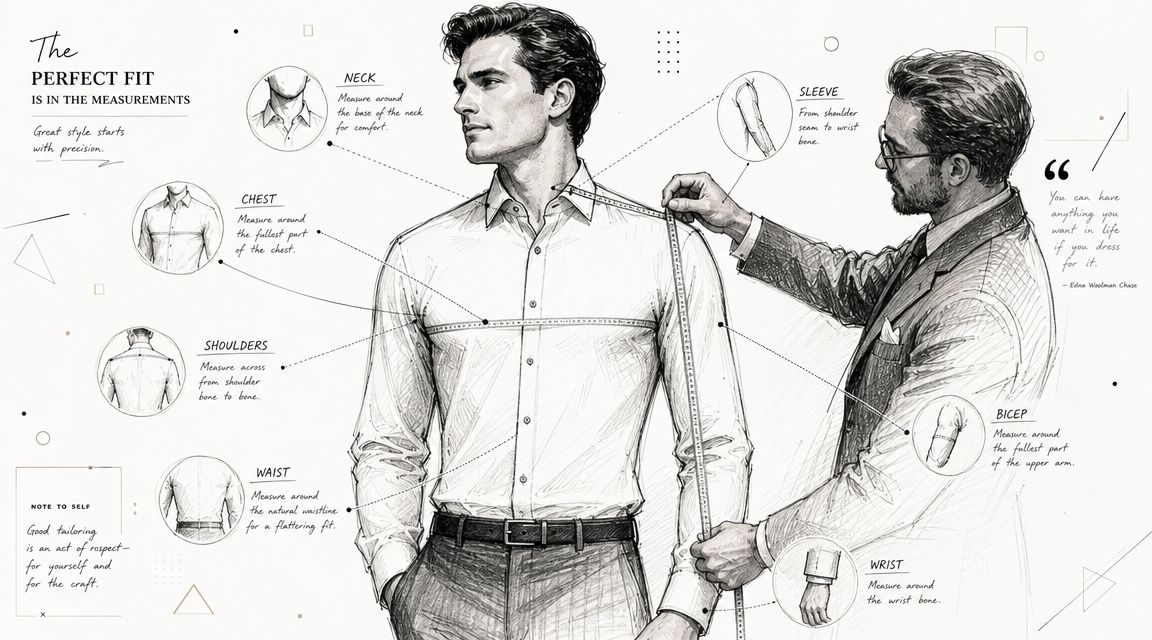
Frequently, otherwise sensible orders unravel. One man sends measurements taken over a jumper. Another rounds down his neck because he prefers a close collar. A third uses an old favourite shirt as reference, without noticing that the cuffs have shrunk and the collar has softened with age.
For group commissions, logistics matter almost as much as craftsmanship.
A reliable way to manage a scattered group
The smoothest commissions usually follow a simple sequence. First, appoint one organiser who controls names, deadlines, and approvals. Second, fix the shared specifications early. Third, gather measurements in a consistent format rather than letting everyone submit them in their own style.
If the group is local, in-person fittings remove a great deal of uncertainty. If people are spread across the country, remote coordination can still work, but only with a disciplined guide and a review step. A practical route is to use a service that supports tailor-made shirts near you while also allowing remote consultation where needed.
The timeline a tailor actually watches
From the workroom's perspective, the critical checkpoints are rarely the ones clients expect.
Specification lock
Cloth, collar, cuff, front, and any monogram details must be fixed before measurements are finalised.Measurement review
Outlier figures get checked. Neck-to-chest balance, sleeve asymmetry, or unusual posture should trigger follow-up questions.Sample approval
One approved sample can save a group order. It shows whether the collar stands correctly, whether the cloth has the expected body, and whether the chosen fit flatters the intended wearers.Production release
Only after approval should the full run be cut.Delivery and issue buffer
Leave room for the odd adjustment. Good planning includes contingency.
Fit quality is also a waste issue
An overlooked point in UK bulk orders is the sustainability trade-off. As noted in this discussion of bulk custom t-shirts and rewear potential, extending the life of clothing significantly reduces waste, and prioritising premium fabrics, inclusive size runs, and a better fit from the start can reduce returns and improve rewear.
That principle applies strongly to custom-fit shirting. A shirt that fits properly is more likely to be worn again. A shirt that pinches at the collar, pulls at the chest, or balloons at the waist often ends up at the back of the wardrobe after one outing.
“Measure once” is bad tailoring advice. Measure, review, compare, and then approve.
The Process from Sample to Final Delivery
A good shirt order should feel calm. The client shouldn't have to guess what happens next, chase every update, or discover late in the day that “custom” really meant selecting from stock.
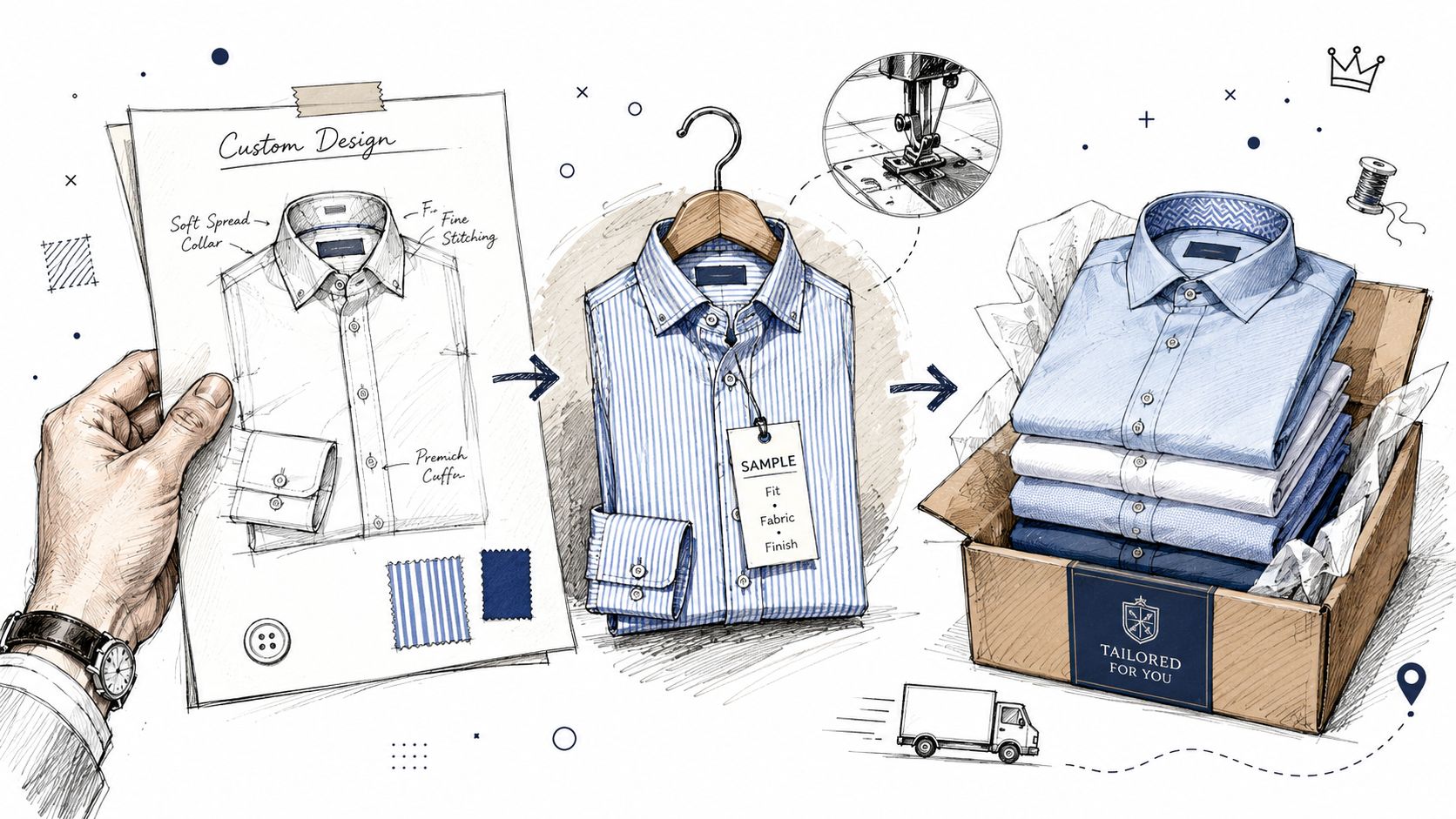
The stages that protect the final result
The first conversation should settle function. Is this a wedding shirt under morning dress, a business shirt under navy tailoring, or a more relaxed open-collar piece? That answer drives cloth, collar, cuff, and fit.
Next comes specification. Once the design is agreed, a proper sample becomes the decisive checkpoint. Buyers sometimes try to skip this stage to save time or cost. That usually proves false economy. A sample catches mistakes while they're still cheap to fix.
After approval, the full order can be produced with confidence. Delivery should include a final review against the approved standard, especially for collar shape, cuff finish, and sizing consistency.
Why digital coordination now matters
The UK's move online has changed how these orders are managed. Online retail sales reached 26.7% of all retail sales in 2024, up from 8.0% in 2014, according to this market summary referencing the shift in UK digital retail behaviour. For buyers of custom shirts in bulk, that matters because remote approvals, file sharing, quantity confirmation, and reorder management now sit comfortably inside digital workflows.
That's helpful for wedding parties split across cities or businesses with staff in several locations. Digital coordination is excellent for admin. It is not a substitute for thoughtful specification.
Why total landed cost beats headline price
The shirt that looks cheapest on the quote can become the expensive one by the time VAT, delivery, remake risk, and emergency fixes are counted. This is especially true when buyers choose a low-cost option with loose sizing control, then spend the final week before an event paying for alterations and replacements.
The strongest process always reduces correction work. Sample first. Confirm sizing. Keep communication centralised. Don't release production on assumptions.
Common Pitfalls and How to Avoid Them
The first pitfall is leaving the order too late. Rushes force narrow cloth choice, limited fitting opportunity, and hurried decision-making. A group shirt order becomes fragile the moment there's no time left for corrections.
The second is assuming matching means identical. It often shouldn't. A coherent group may need the same cloth and collar family, but not necessarily the same body shape or cuff depth. Uniformity without regard to the individual wearer is how shirts end up looking borrowed.
The cost traps buyers miss
A critical mistake is ignoring the true total landed cost. Many UK buyers fixate on unit price, then discover VAT, setup charges, and delivery later. As noted in this discussion of bulk shirt buying and hidden cost layers, the lowest per-shirt quote often isn't the lowest risk-adjusted price, especially where fit accuracy and short lead times matter.
Watch for these trouble points:
- Unclear sizing process: If no one owns measurement quality, errors multiply.
- No approved sample: You won't spot collar, cuff, or cloth issues early enough.
- Colour assumptions: White, sky blue, and ivory can vary more than buyers expect.
- Too many decision-makers: Group orders need one final approver.
- Reorder blind spots: If one extra shirt is needed later, can the supplier match the original cleanly?
The safer approach
Buyers usually get the best outcome when they:
- Fix the shared brief early
- Choose the correct service category
- Measure with discipline
- Approve one standard before release
- Budget for the whole order, not only the garment line
A refined group shirt order isn't difficult. It primarily rewards planning and punishes improvisation.
About the Author
Igor Srzic-Cartledge is the founder of Dandylion Style, a bespoke tailoring house in Ardingly, West Sussex. He works across bespoke and made-to-measure commissions, including wedding attire, shirts, business tailoring, and more complex group orders where consistency and fit both matter. His approach is grounded in calm guidance, precise measurement, and careful cloth selection rather than fashion noise. Clients work with him in the studio, at home, or at the office across Sussex, London, and the South East, with remote consultations available when practical.
Frequently Asked Questions
Is bespoke always the best option for bulk shirt orders
Not always. Bespoke is the most exact route, but it isn't automatically the most sensible one for every group. If you have a wedding party or office team with moderate fit variation and a clear shared brief, made-to-measure often gives the strongest balance of quality, consistency, and practicality. Bespoke becomes especially valuable when individual body shapes are more complex or when the shirts sit inside a highly formal dress code.
How many shirts should each person order
That depends on use. For a one-day wedding, one shirt per person may be enough if timing and fit are secure, though some organisers prefer a spare for peace of mind. For business use, ordering more than one per wearer usually makes sense because it improves rotation, keeps the look consistent, and reduces the chance that one damaged shirt disrupts the entire programme.
Should everyone in the group wear exactly the same shirt
Usually not in the strictest sense. The best group orders share a common language rather than forcing absolute sameness. Keep the cloth, overall colour, and key style details aligned, then allow fit adjustments and, where needed, small refinements to collar or cuff proportions. That way the group looks coherent, but each man still looks properly dressed rather than squeezed into a generic template.
Are online measurements good enough for a quality result
They can be, but only when the process is controlled. Remote measurement works best with a clear guide, a consistent submission format, and review by someone experienced enough to spot odd figures before production starts. If the group includes men with unusual posture, broad shoulders, prominent midsections, or strong fit preferences, at least one in-person fitting or sample check is often worth arranging.
What's the single biggest mistake buyers make
They chase the lowest quoted shirt price without costing the whole project. Group orders can pick up hidden expense through VAT, delivery, alteration work, remakes, and the time spent fixing preventable mistakes. A slightly higher initial price attached to a disciplined process is often the cheaper decision overall because it reduces rework, lowers fit risk, and produces shirts people will wear again.
If you're planning custom shirts in bulk for a wedding party, business team, or private group, Dandylion Style offers bespoke and made-to-measure shirt services with fittings in the studio, at home, or at the office. It's a practical route for buyers who want coordinated shirts handled with a tailoring process rather than a generic merchandise workflow.