The moment usually arrives in a fitting room. The collar is comfortable, but the body billows. The shoulders sit acceptably, but the sleeves are too long. Or the waist is neat enough, yet the neck feels tight by mid-afternoon. Most gentlemen know this compromise well. Off-the-rack shirts ask you to choose which flaw you can live with.
A true bespoke shirt changes that conversation. Instead of forcing your body into a standard block, the shirt is drafted around your posture, proportions, habits, and preferences. It doesn't just look sharper. It moves better, sits cleaner under a jacket, and feels easier to wear from morning to evening.
An Introduction to Perfect Shirt Design
If you're considering custom shirts design for the first time, you're probably not chasing novelty. You're trying to solve a practical problem. You want a shirt that fits your collar, follows your shoulders, closes neatly through the waist, and still feels comfortable when you sit, drive, work, or dine.
In the UK, ordering personalised clothing has become more natural than ever. Official retail data cited in this market overview shows that internet sales accounted for 26.5% of all UK retail sales in December 2024, while the British Fashion Council notes that London Fashion Week was first held in 1984. That combination matters. It means bespoke and personalised clothing now sit within a mature fashion culture and a strongly digital buying environment.
The danger is that the word custom gets used loosely. A shirt with your initials added isn't necessarily bespoke. A shirt ordered online from a size algorithm isn't necessarily cut for your body. A proper commission starts with the person who will wear it.
Key Takeaways
- Bespoke means a shirt is built from your pattern: It isn't just a standard size with small adjustments.
- Fit comes before decoration: Collar shape, cuffs, monograms, and buttons only shine when the underlying cut is right.
- Fabric changes everything: The weave affects drape, breathability, formality, and how the shirt behaves after repeated wear.
- Small design choices have large visual effects: Collar spread, cuff style, placket, and yoke all alter how the shirt frames the face and sits under tailoring.
- Luxury lies in restraint: The finest custom shirts design usually relies on proportion, cloth, and finishing rather than obvious gimmicks.
- A bespoke shirt can be practical value: When a shirt is worn often and kept in active rotation, its worth extends beyond appearance.
- The process should feel collaborative: A good tailor guides decisions clearly, without pushing you towards options you don't need.
A gentleman's first bespoke shirt doesn't need to be adventurous. In fact, the wisest first commission is often the one you can wear constantly. Pale blue poplin for business. White twill for formal use. Oxford cloth for weekends and travel. The artistry lies in making the familiar feel unmistakably yours.
A fine shirt shouldn't ask for attention. It should quietly improve everything worn over it.
Beyond the Label What Is a True Custom Shirt
The modern shirt market uses three terms as though they mean the same thing. They don't. If you understand that distinction, you avoid the most common disappointment in custom shirts design.
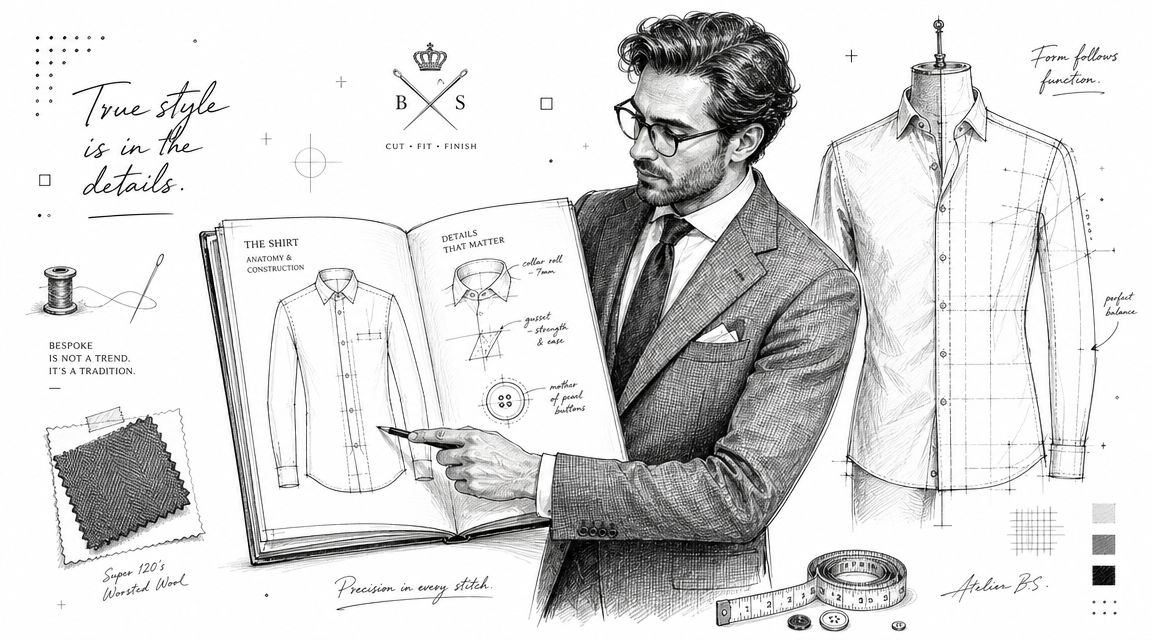
Bespoke versus made-to-measure versus personalised retail
Bespoke starts with a unique pattern drafted for your body. The cutter accounts for your shoulder line, stance, chest shape, waist suppression, arm position, and preferred balance. That pattern becomes the foundation for future shirts and evolves as your wardrobe and preferences evolve. If you'd like a fuller explanation of the craft itself, what bespoke tailoring means in practice is worth reading.
Made-to-measure usually begins with an existing house block. Measurements are taken, then the base pattern is adjusted within limits. Done well, MTM can be a sensible option. But it's still an edited standard, not an original draft.
Customised off-the-rack is something else entirely. That might mean choosing a fabric, adding a monogram, selecting collar and cuff options, or adjusting sleeve length. Useful, sometimes. Bespoke, no.
Why the distinction matters on the body
A stock shirt is built for an average shape. Most clients are not average in the way garment blocks assume. One shoulder often sits lower than the other. One arm rotates slightly forward. Some men carry a fuller chest with a clean waist. Others need room across the back without extra fullness at the front.
The broader fit problem is real. As noted in this discussion of fit uncertainty in apparel retail, bespoke tailoring addresses issues such as posture, uneven shoulders, and larger neck-to-waist drops, which standard retail and basic alterations often fail to solve properly.
Consider the difference this way:
| Approach | Starting point | What it can solve well | Where it usually falls short |
|---|---|---|---|
| Bespoke | New pattern drafted for you | Complex balance and posture issues, asymmetry, refined silhouette | Requires time, fittings, and a skilled cutter |
| Made-to-measure | Existing pattern adjusted | Moderate fit correction, cleaner proportions | Limited by the original block |
| Personalised ready-to-wear | Standard shirt with options | Surface customisation, convenience | Core fit remains largely standard |
Practical rule: If the problem is structural, such as shoulder balance or body proportion, surface customisation won't fix it.
A true bespoke shirt feels different because it was conceived differently. It does more than fit your measurements. It reflects how you stand, move, and live.
The Foundation of Quality Choosing Your Fabric
Clients often begin with colour. Tailors begin with cloth. That isn't snobbery. Fabric determines how the shirt performs before collar, cuff, or monogram enters the conversation.
The best custom shirts design starts by asking where the shirt will live. Under business tailoring five days a week. Open-necked at dinner. Packed for travel. Worn in high summer. Layered under flannel or cashmere. Cloth answers those questions better than ornament ever can.
Fibre and handle
Long-staple cotton is prized because it can be spun finer while remaining strong. The result is a smoother, cleaner yarn and a more graceful finish. In practice, what matters most to the wearer is handle. Some cloths feel crisp and cool. Others feel rounder, softer, and more forgiving.
If you're comparing shirting options, this explanation of different cotton fabrics gives a useful grounding in how fibres and weaves affect the final garment.
A gentleman commissioning his first shirt usually does well to avoid extremes. Cloth that is too fine can feel precious. Cloth that is too heavy can look clumsy under tailoring. Good shirting finds balance.
A gentleman's guide to shirt weaves
| Weave | Texture | Formality | Best For |
|---|---|---|---|
| Poplin | Smooth, crisp, clean surface | High | Business shirts, formal wear, sharp city dressing |
| Twill | Soft with a subtle diagonal character | Medium to high | Daily office wear, travel, shirts that need a little more drape |
| Oxford | Basket weave with visible structure | Medium to low | Weekend shirts, smart-casual dressing, button-down collars |
| Herringbone | Subtle patterned weave with depth | Medium to high | Gentle visual richness under jackets, understated interest |
What works and what doesn't
Poplin works when you want clarity. It pairs beautifully with structured jackets, formal collars, and cleaner wardrobes. It doesn't hide creasing as generously as some other weaves.
Twill works for men who want softness and a slightly richer drape. It can be especially flattering if you dislike a shirt that feels too papery. Twill usually travels better than very crisp cloths.
Oxford works when you want ease. It is not the obvious choice for black tie or a rigid business dress code, but it is one of the most versatile options in a gentleman's wardrobe.
Herringbone works when plain cloth feels too plain, yet overt pattern feels too loud. Under office lighting it reads almost solid. Up close it has life.
For clients exploring branded casualwear or business uniform ideas alongside shirting, a practical comparison such as this guide to logo polo shirts can help clarify when a polo makes more sense than a formal shirt.
Cloth should suit the life of the garment. A beautiful fabric in the wrong setting is still the wrong choice.
When a shirt disappoints, the cloth is often the hidden reason. It may have looked elegant in a bunch, then proved too sheer, too rigid, too warm, or too casual once made up. Touch the fabric. Bend it. Crush it lightly. Hold it to the light. Ask how it behaves after a long day. Those are the questions that produce a shirt you'll reach for repeatedly.
Defining Your Style with Collars and Cuffs
The collar sits nearest the face. It changes expression more than any other part of the shirt. The cuffs do something similar for the hands. Get both right and the shirt feels coherent before anyone notices why.
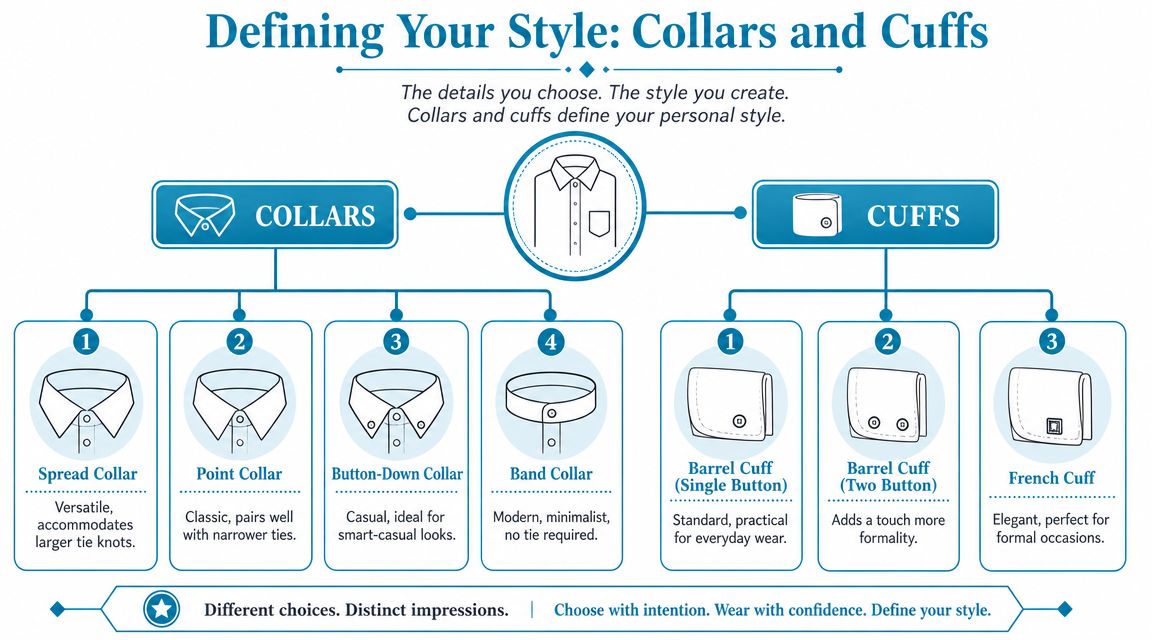
Choosing a collar that flatters
The spread collar is the most adaptable option for many gentlemen. It frames the face cleanly, accepts a tie comfortably, and doesn't look stranded when worn open at the neck.
The point collar is more traditional. Its longer lines can be elegant on a broader face, and it pairs naturally with narrower tie knots. It has a quieter presence than a cutaway.
The button-down collar carries a different tone altogether. It feels informed, sporting, and slightly relaxed. In Oxford cloth, it can be one of the smartest casual choices available. For readers interested in that specific style, this note on the button-down collar shirt offers a helpful reference.
The band collar strips the shirt back to essentials. It can be handsome, particularly in linen or soft cottons, but it belongs to a more contemporary and informal wardrobe.
Cuffs, plackets, and the line of the shirt
Cuffs are less about drama than discipline.
- Barrel cuff, one button: Clean, practical, and suitable for everyday business use.
- Barrel cuff, two button: Slightly more formal in appearance and useful if you want a neater wrist adjustment.
- French cuff: Folded back and worn with cufflinks. Best reserved for eveningwear, ceremony, or occasions where added formality is welcome.
The placket also deserves attention. A front placket gives the shirt a firmer, more conventional business look. A French front, with no visible placket strip, appears cleaner and slightly dressier.
Then there's the yoke, the panel across the upper back. A well-cut yoke affects comfort across the shoulders and helps the shirt sit correctly when you move your arms forward. It is not decorative trivia. It is part of the shirt's architecture.
How to decide without overdesigning
A simple set of pairings usually serves well:
| Need | Collar choice | Cuff choice |
|---|---|---|
| Business versatility | Spread | Single barrel |
| Formal and ceremonial wear | Cutaway or refined spread | French cuff |
| Smart-casual wardrobe | Button-down | Single barrel |
| Minimal modern look | Band collar | Single barrel |
Too many first commissions collapse under the weight of indecision. The client wants a dramatic collar, contrasting inner trims, unusual buttons, and an assertive monogram all on one shirt. Restraint is usually more elegant.
The shirt should support the gentleman's presence, not compete with it.
The Personal Touch Monograms and Finishing Details
Once the structure is settled, the intimate pleasures begin. Custom shirts design then becomes personal in a quieter way. Not loud. Not theatrical. Just unmistakably yours.
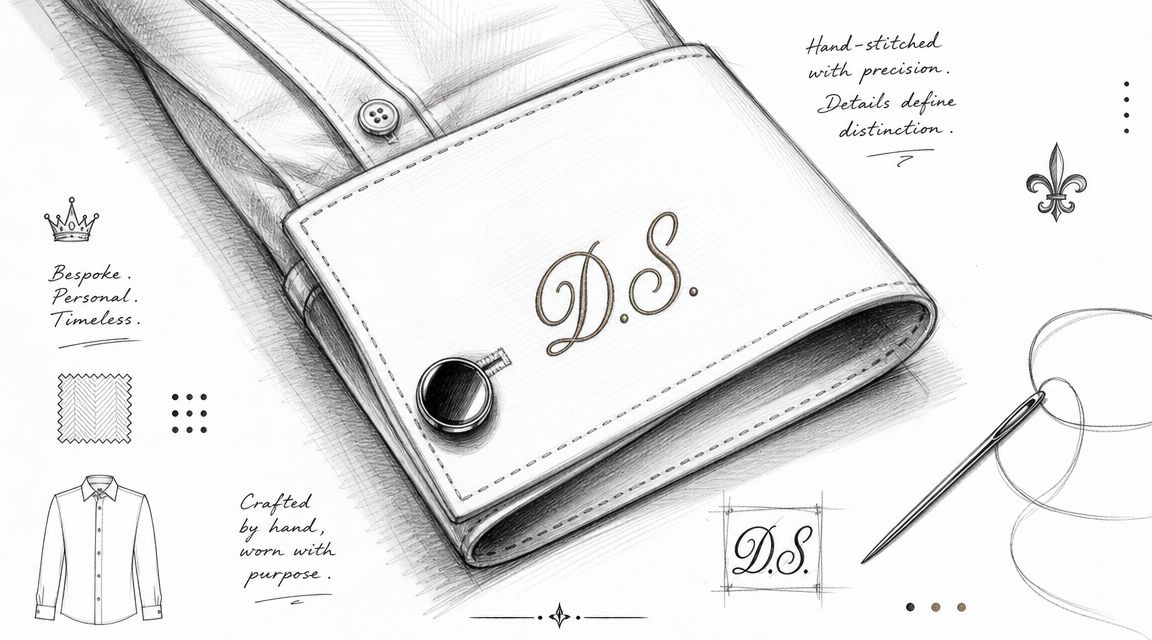
The monogram should whisper
The most elegant monograms are usually small, well placed, and thoughtfully coloured. A cuff placement has a traditional charm. Near the hem can feel discreet and private. On the chest it becomes more visible, which some clients enjoy and others later regret.
Scale matters as much as placement. A monogram that is too large stops looking refined and starts looking branded. For ideas on placement and execution, custom shirt embroidery details can help you judge what feels classic and what feels excessive.
Buttons and quiet signatures
Mother-of-pearl buttons bring a depth that plastic never quite achieves. They catch the light softly, and they age with more grace. The difference is subtle in a box. It is obvious on the shirt.
Other finishing details can be equally satisfying:
- Contrast last buttonhole: Best kept restrained. Think tonal interest, not novelty.
- Collar and cuff lining choices: Useful when you want extra character inside the shirt rather than on display.
- Side gussets: Small reinforcement points that also offer a chance for a discreet colour accent.
- Hand-finished touches: The sort of details you don't announce, but feel every time you fasten the shirt.
A gentleman once commissioned two near-identical white shirts. One was for boardroom use, one for his wedding day. The difference was almost invisible to anyone else. The wedding shirt carried mother-of-pearl buttons with a softer lustre, French cuffs, and a tiny monogram in ivory rather than blue. That is how good personalisation works. It respects context.
The Bespoke Journey From Consultation to Final Fitting
Many first-time clients imagine the process is mysterious or intimidating. In reality, it is orderly and very human. A shirt is discussed, measured, drafted, tested, refined, and finished. Each stage removes guesswork.
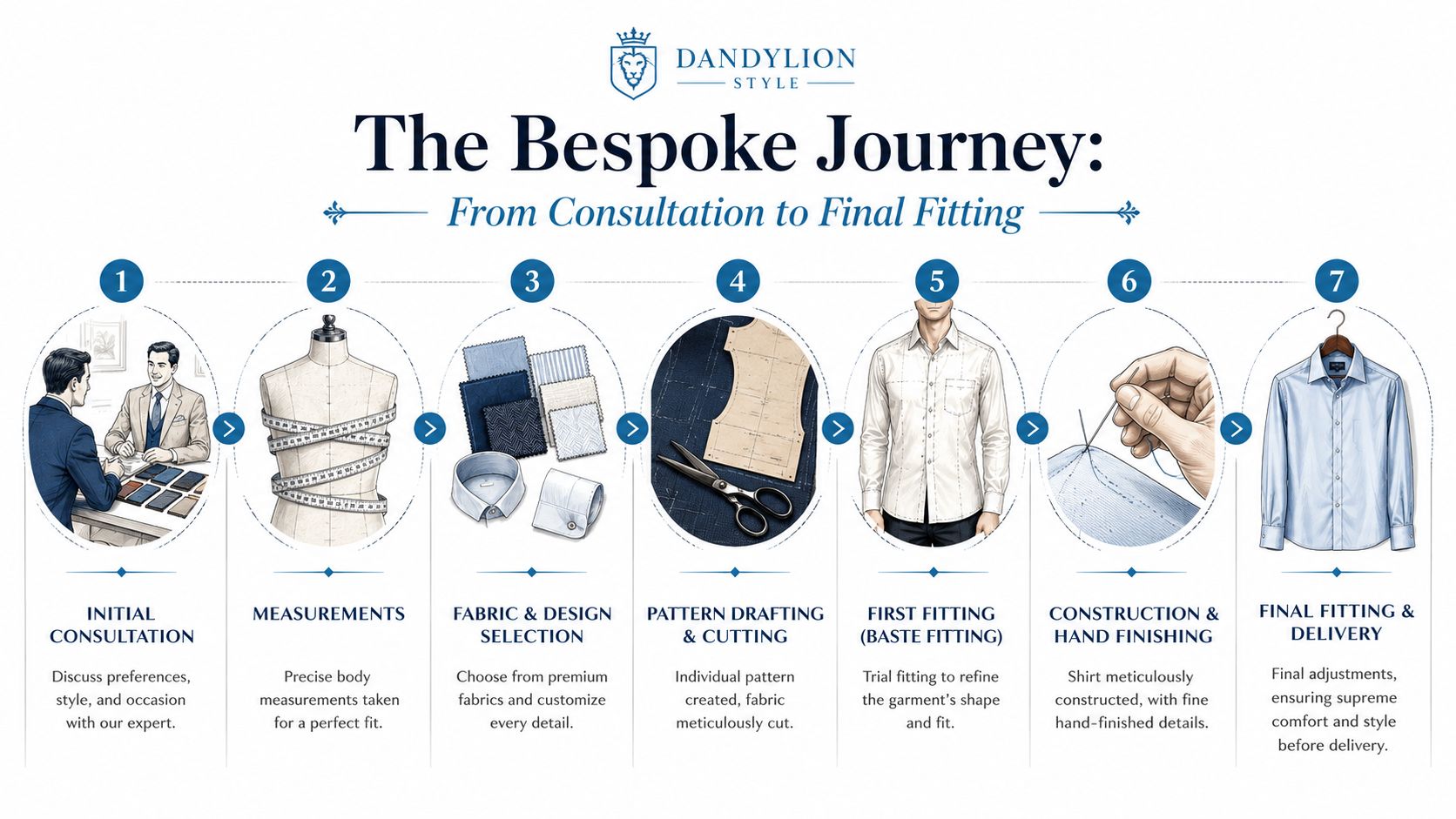
What happens during a proper commission
The opening conversation matters more than many clients expect. A good tailor doesn't begin by asking which collar you fancy. He asks where the shirt will be worn, what jackets you own, whether you wear a watch daily, whether you prefer room when seated, and whether you usually wear your shirts tucked firmly or with a little ease.
Measurements follow, but measuring alone is not enough. The cutter studies your stance and balance. He notes whether one shoulder drops, whether the neck sits forward, whether the chest is prominent, and how your sleeves should break at the wrist.
Then come fabric and design decisions. This is the moment to choose with discipline. At this stage, one option among many is to commission through Dandylion Style's custom shirt service, where shirts are discussed in relation to the client's wider wardrobe rather than as isolated products.
The fitting stage
A first fitting reveals things tape measures cannot. You see where the collar stands, how the sleeve hangs, whether the chest has enough expression, and whether the waist suppression is flattering or too eager.
Common corrections include:
- Collar balance: A collar can be technically correct in measurement yet still need rebalancing if the client's posture differs from the pattern draft.
- Shoulder pitch: This affects how the sleeve falls and whether the front of the shirt pulls.
- Waist and seat ease: Especially important for gentlemen who sit for long periods or move between office and travel.
- Sleeve rotation: A subtle but important detail if the arm naturally rests forward.
The final fitting should feel calm. You aren't looking for tightness. You are looking for clean lines with enough ease for life.
Cutting note: The best fit is not the smallest fit. A shirt must allow movement without collapsing into excess cloth.
How to prepare for your appointment
You will get better results if you arrive with a little clarity. Not a mood board. Just useful information.
- Bring a shirt you like: Even if it isn't perfect, it reveals what you respond to.
- Bring a shirt you dislike: That often teaches more. A choking collar or ballooning waist tells the tailor where standard shirts fail you.
- Know the setting: Office, wedding, travel, weekend, black tie, or all-purpose. Each changes the cloth and construction.
- Wear or bring your usual jacket: A shirt doesn't live alone. Its collar and cuff need to work with the tailoring worn over it.
- Think about habits: Watch on left or right wrist, preference for tucked shirts, tie usage, and laundering routine all affect the build.
A bespoke appointment is not an exam. The client doesn't need technical language. He needs preferences, honesty, and a willingness to be guided.
Caring for Your Investment and Understanding Value
A bespoke shirt earns its value over time. Not in the first wear, though that is satisfying. Its real worth appears in repeat use, reliable comfort, and the fact that you keep reaching for it while lesser shirts stay in the wardrobe.
One practical way to judge whether bespoke is worth commissioning is to compare it against the alternatives. A minor issue in an off-the-rack shirt can sometimes be corrected through alteration. But when the flaw lies in proportion, balance, or recurring discomfort, a better pattern often makes more sense than repeated compromise.
That value also has a sustainability dimension. As discussed in this note on clothing longevity and value, WRAP's research supports the idea that extending a garment's active life is one of the primary ways to reduce fashion's environmental footprint. A shirt that fits properly and is worn for years does more good than one bought cheaply and abandoned quickly.
Care that preserves a fine shirt
- Wash gently: Use a mild cycle and avoid overloading the machine so collars and cuffs don't suffer unnecessary abrasion.
- Treat marks early: Collar grime and cuff staining respond better to prompt care than aggressive washing later.
- Iron while slightly damp: The finish is cleaner, and you put less stress on the fibres.
- Use proper hangers: A shaped hanger supports the shoulder line better than a narrow wire frame.
- Rotate your shirts: Repeated wear without rest shortens the useful life of any garment.
What not to do
| Good practice | Poor practice |
|---|---|
| Air the shirt after wear | Ball it into a laundry basket while damp |
| Press with control | Scorch the collar with excessive heat |
| Store with space around it | Crush it tightly between heavy garments |
A gentleman doesn't need dozens of shirts if the ones he owns are right. Buying better often means buying less, with more satisfaction in each piece.
Frequently Asked Questions About Custom Shirt Design
How is a bespoke shirt different from an online custom shirt?
A bespoke shirt starts with a pattern drafted for your body and adjusted through fitting. Most online custom shirts rely on standard base blocks and measurement inputs, even when they offer many style choices. That can work for straightforward proportions, but it won't address posture, asymmetry, or balance in the same way. If your main problem is true fit rather than surface personalisation, bespoke is the more precise route.
What should my first bespoke shirt be?
Start with the shirt you'll wear most. For many gentlemen, that's a pale blue or white shirt in poplin or twill, with a moderate spread collar and single cuffs. Keep the detailing restrained. The first commission should establish your pattern and your preferences. Once that foundation is right, later shirts can become more expressive through cloth, collar shape, cuff choice, or monogram placement.
Can a bespoke shirt really fix problems alterations can't?
Often, yes. Alterations are useful when the underlying shirt is broadly correct and needs modest refinement. They are far less effective when the issue involves shoulder balance, collar stance, chest-to-waist proportion, sleeve pitch, or the way the shirt hangs on your frame. Those problems belong to the pattern itself. Bespoke works from the start of the process, which is why it can solve issues that alteration alone cannot.
Is a monogram worth adding?
It depends on your temperament and the role of the shirt. A monogram can be elegant when it's discreet, well placed, and proportionate to the garment. It tends to work best on cuffs or lower placements rather than boldly across the chest. For a first shirt, many clients do well to leave it off or keep it understated. Once you've lived with the shirt, you'll know whether you enjoy that extra personal detail.
How many bespoke shirts should I order first?
One is enough if you're testing the process carefully. Two or three can make sense if you already know your needs and want a small, useful rotation built around the same pattern. In that case, vary the purpose rather than chasing novelty. A business shirt, a slightly softer shirt for everyday wear, and a more formal option create a practical starting wardrobe without duplication.
Are bespoke shirts only for formal business dress?
Not at all. A bespoke shirt can be formal, but it can also be one of the most useful casual garments a gentleman owns. Oxford cloth button-downs, brushed cottons, soft linens, and relaxed collar styles all benefit from proper fit. The point of bespoke isn't stiffness. It is proportion, comfort, and intention. A casual shirt cut properly often looks better precisely because it appears effortless rather than forced.
About the Author
Igor is the founder of Dandylion Style, a luxury bespoke tailoring house in Ardingly, West Sussex. He specialises in one-of-a-kind garments shaped to the individual, with a particular focus on precise cutting, refined proportion, and fine cloth. His approach is calm, honest, and practical. Clients come to him for garments that feel personal and wearable, not theatrical. From bespoke suits to custom shirts, Igor's work centres on comfort, craftsmanship, and enduring style for the modern gentleman.
If you're ready to commission a shirt that fits your life as well as your frame, Dandylion Style offers bespoke consultations in the studio, at home, or at your office across Sussex, London, and the South East.