A shirt is nearly finished. The collar sits cleanly, the cuffs break correctly at the wrist, the cloth feels right in the hand, and the fit no longer needs debate. Then comes the last decision, which is often the most personal one. Do you leave it pristine, or add a mark that makes it unmistakably yours?
That is where custom shirts embroidery earns its place. Not as decoration for its own sake, but as a finishing detail with intention. On a proper shirt, a monogram, motif, or crest should feel integrated with the garment's character, not pasted onto it after the fact. It should suit the cloth, the setting, and the man wearing it.
In the UK, that instinct sits inside a much larger culture of dress. The country's fashion industry generated £62 billion in Gross Value Added in 2023 and supported 1.3 million jobs, which helps explain why personalised garments remain part of a living tailoring tradition, not a novelty purchase, as noted in this UK embroidery market overview. If you're considering a shirt commission through custom shirts online, embroidery is best treated as the final signature rather than an optional extra.
The Final Touch A Guide to Bespoke Shirt Embroidery
Embroidery changes the meaning of a shirt. A plain bespoke shirt says you care about fit, cloth, and finish. An embroidered one says you also care about identity. The distinction is subtle, which is exactly why it matters.
For a gentleman commissioning his first embroidered shirt, the temptation is often to think in terms of initials alone. That's too narrow. The better question is what role the detail should play. Should it be visible only when you remove a jacket, noticed only at close range, or legible as part of your public dress? The answer governs every choice that follows.
Key takeaways
- Start with purpose: decide whether the embroidery is private, social, or ceremonial.
- Choose the right form: monograms suit restraint, motifs add personality, crests carry heritage.
- Placement changes the message: cuff and collar feel different even with the same design.
- Scale matters: small embroidery usually looks more expensive than oversized embroidery on a dress shirt.
- Proofing is essential: test sew-outs on the actual fabric prevent puckering and disappointment.
- Pricing reflects labour: stitch count matters, but setup, alignment, and handling matter too.
- Care preserves the finish: wash gently, press carefully, and treat the stitched area with respect.
Why embroidery belongs at the end of the process
Good embroidery responds to the shirt already chosen. Poplin behaves differently from oxford. A formal white shirt asks for different restraint than a weekend linen button-down. Even the shape of the cuff can affect where a monogram sits best.
This is why I advise clients to resist choosing embroidery too early. Once the shirt's proportions, use, and cloth are settled, the embroidery becomes easier to judge properly. It stops being an abstract idea and becomes part of a complete garment.
The most successful embroidered shirts rarely announce themselves across the room. They reward a closer look.
What clients often get wrong
The common mistake isn't choosing embroidery. It's choosing too much of it. Too large, too colourful, too ornate, or placed where the shirt can no longer do its primary job, which is to look elegant on the body.
A bespoke shirt already carries plenty of visual information through fit, collar shape, cuff style, placket choice, and cloth. Embroidery should complement that language, not interrupt it.
Deciding on Your Design Monogram Motif or Crest
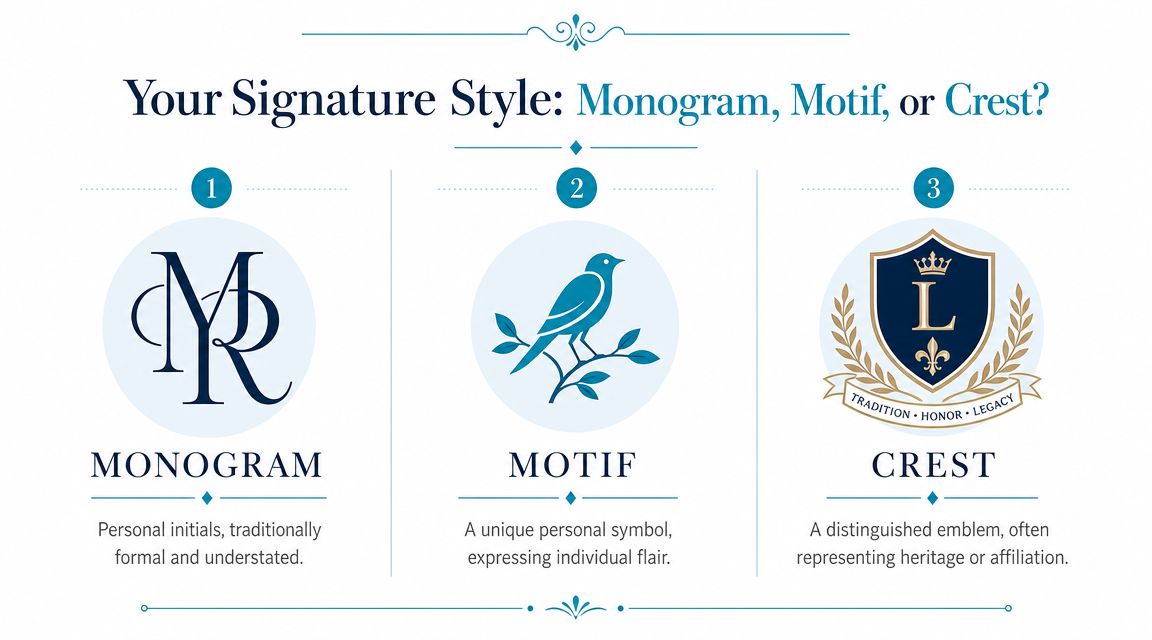
The first decision is not technical. It's personal. You're deciding what kind of presence the shirt should have.
Some men want a detail that feels old-world and private. Others want a small emblem that says something about profession, passion, or humour. A few want to honour family or club heritage. All can work. What matters is matching the design to the life of the shirt.
The quiet classic
A monogram is still the safest and often the most elegant choice. Initials suit business shirts, wedding shirts, travel shirts, and gifts because they personalise the garment without changing its category. The shirt remains formal. It becomes yours.
Font choice matters more than most clients expect. Interlocked script can feel traditional and slightly ceremonial. A cleaner serif looks crisp and architectural. Sans serif can work, but only if the rest of the shirt has enough modern clarity to support it.
The expressive option
A motif gives more room for individuality. It might be a small bee, a geometric mark, a discreet symbolic object, or a simplified signifier connected to sport, travel, or family life. This route works best when the wearer has a clear reason for it.
UK providers commonly position embroidery as a premium finish with a higher setup cost for one-off items, yet also note that its durability and tactile prestige make it especially suitable for formalwear and executive wardrobes, where refinement matters more than bulk-order economics, as described in this discussion of embroidered shirts. That is why a motif must be chosen with discipline. If it feels gimmicky at the design stage, it will feel even less convincing once stitched.
The heritage statement
A crest is the most demanding option. It can look exceptional on the right shirt, especially when tied to real family, school, regimental, or club significance. It can also look theatrical if forced onto a shirt that doesn't support that degree of symbolism.
Keep crests simplified. Dense heraldic detail often loses clarity when reduced to shirt scale. If the original artwork is intricate, the best version is usually edited for embroidery rather than copied exactly.
| Style | Best For | Impression |
|---|---|---|
| Monogram | Business shirts, wedding shirts, gifts, first commissions | Understated, personal, timeless |
| Motif | Casual luxury shirts, social dressing, expressive personal style | Individual, modern, conversational |
| Crest | Heritage pieces, ceremonial use, club or family significance | Distinguished, traditional, formal |
For clients who enjoy coordinated personal details beyond shirting, it can also be useful to browse personalized leather collection examples. Not to copy directly, but to understand how initials and insignia behave across accessories and clothing. The best wardrobes tend to repeat a visual language without becoming repetitive.
If your shirt sits within a more business-focused wardrobe, made-to-measure business shirts usually benefit from the monogram route far more often than from motifs or full crests.
Placement and Scale The Grammar of Style
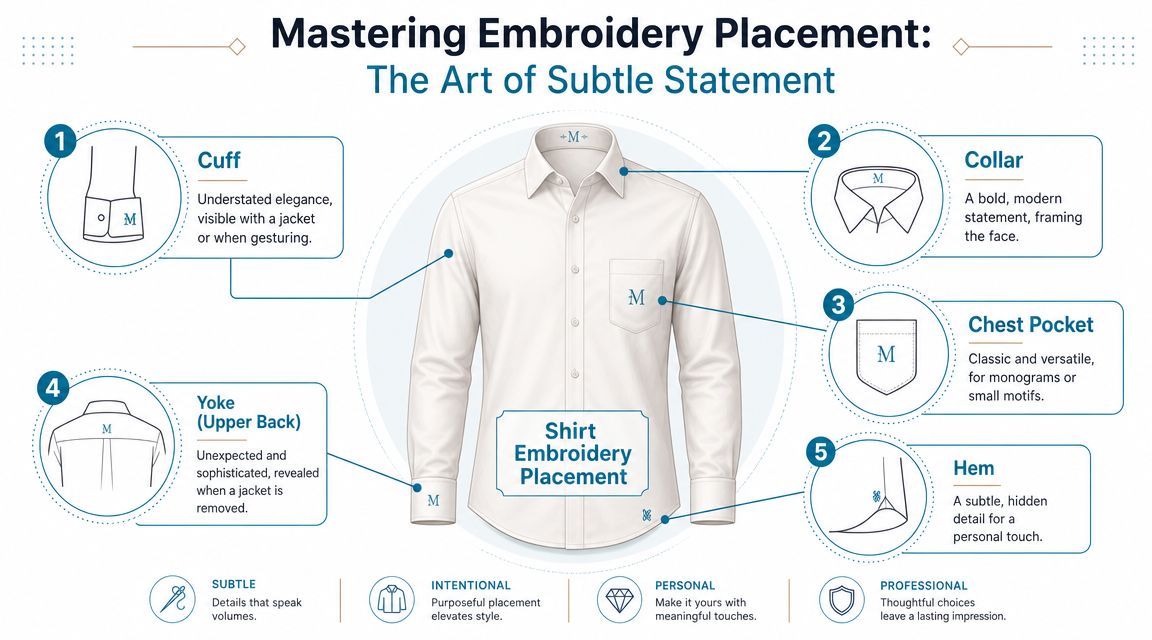
Placement decides whether embroidery reads as private refinement or deliberate statement. The same initials can feel aristocratic on the cuff, contemporary on the collar, or corporate on the chest. This isn't accidental. Shirt embroidery has its own grammar.
Historically, embroidered shirts gained status value in the UK during the Tudor period, when blackwork embroidery became popular on collars and cuffs, a legacy that still shapes what modern dressers perceive as refined placement, as outlined in this overview of custom apparel history.
Where each position speaks differently
The cuff remains the most elegant choice for first commissions. It appears only in movement. You see it when fastening cufflinks, reaching for a glass, or taking off a jacket. That gives it intimacy.
The collar is more assertive. It frames the face and gets noticed sooner. On the right casual or fashion-forward shirt, it can look sharp. On a conservative business shirt, it can feel too eager.
The chest area works for logos and visible insignia, but on bespoke shirting it requires care. Too large and it begins to borrow the language of uniforms or promotional apparel. For a gentleman's shirt, smaller is almost always stronger.
The hem and yoke are for men who enjoy a hidden signature. They are less traditional, but often more interesting than obvious placements because they reveal themselves selectively.
A good placement doesn't ask for attention. It receives it at the right moment.
Scale is where taste shows
Small embroidery tends to age better than large embroidery. That isn't a hard rule, but it is a reliable one. A monogram should sit comfortably within the space assigned to it, leaving enough surrounding cloth for the shirt to breathe.
Use these checks before approving scale:
- Look at distance: if the embroidery dominates from across the room, it is probably too large for a dress shirt.
- Check balance with collar and cuff shape: broad cuffs can support slightly more width, while refined cuffs need restraint.
- Judge against the wearer, not only the garment: a detail that looks fine on a sample may sit differently on a taller or broader frame.
Traditional placements still feel correct because they respect the architecture of the shirt. They follow the garment instead of competing with it.
Choosing Your Palette Thread Colour and Stitch Type
Colour, stitch, and lettering determine whether embroidery whispers or speaks. These choices dictate whether many shirts either become refined or lose their composure.
Thread colour
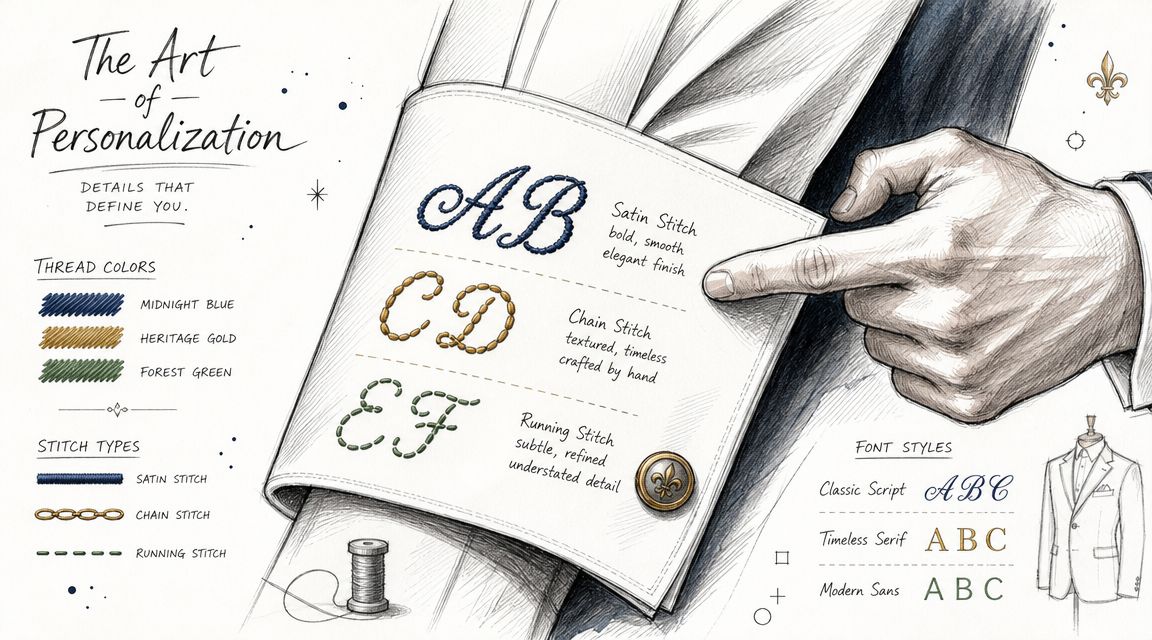
For a first shirt, tonal embroidery is usually the wisest route. White on white, pale blue on sky blue, navy on a mid-blue ground, or silver-grey on white all produce a result that looks considered rather than loud. Contrast has its place, but it belongs on shirts with more relaxed intent.
Thread sheen also changes the effect. Even a restrained colour can catch light strongly if the thread has a polished finish. That can be attractive on eveningwear or ceremonial shirts, but on everyday business shirting it often pays to keep the lustre controlled.
The cloth matters too. Fine broadcloth takes embroidery differently from brushed cotton or linen. When clients compare thread against a variety of cotton fabric, the best choice usually emerges from seeing the tone on the actual shirt cloth, not from choosing the thread in isolation.
Stitch type
A satin stitch creates a fuller, denser appearance. It gives initials and simplified motifs a rich surface and clean edge. This is often the best choice when you want the embroidery to read clearly and feel substantial.
A running stitch is lighter and more understated. It suits delicate line work and can feel more refined on very fine shirting, though it won't carry bold shapes as confidently.
A denser fill isn't always superior. On light or delicate shirting, too much density can create stiffness. Good embroidery respects drape.
Practical rule: the finer the shirt and the more formal the use, the more restraint you usually want in both thread colour and stitch density.
Font and character
For monograms, lettering style changes the whole mood:
- Traditional script suits wedding shirts, formal gifts, and old-school elegance.
- Serif lettering brings clarity and discipline, especially on business shirts.
- Modern minimal lettering can work on casual luxury shirts, provided the placement is equally restrained.
The right combination often isn't the most eye-catching one on a sample card. It's the one that still feels right after the novelty has worn off.
The Consultation and Proofing Process
A proper embroidery consultation feels less like ordering an add-on and more like refining a finishing detail. The conversation usually starts with use. Is the shirt for business, a wedding morning, travel, a gift, or a recurring wardrobe signature? That answer eliminates many poor choices immediately.
Once the role is clear, the design gets translated into something the machine can sew. That step matters. Vector artwork is cleaner to work from, and monograms still require careful setup because spacing, stitch direction, and density all affect the result on cloth.
For a bespoke commission such as custom shirts made, the proofing stage should never be rushed. High-quality embroidery guidance stresses the need for a test sew-out on the final shirt fabric so the maker can check puckering, thread tension, and stabiliser choice before committing to the finished garment. Skipping test runs is a common cause of delays and remakes, as explained in this guide to embroidered shirts.
What to check on the proof
Before approval, verify these points carefully:
- Spelling and order of initials: this sounds obvious, but it's the easiest mistake to overlook when several monogram styles are in play.
- Placement: ask to see precisely where the embroidery will sit in relation to cuff edge, collar point, pocket line, or hem.
- Scale: a digital proof can look balanced on screen and too dominant on the actual garment.
- Colour: compare thread against the chosen cloth in realistic light, not only studio light.
What a good proofing process feels like
It should feel measured. No guessing, no vague assurances, no “it will probably be fine”. The shirt fabric, thread, stabiliser, and design all need to agree with one another.
That's the difference between embroidery that looks merely added and embroidery that looks properly integrated into the garment's final identity.
Understanding Embroidery Pricing and Lead Times
Clients often assume embroidery pricing is based only on size. It isn't. A small but intricate crest can demand far more preparation than a larger, simple monogram. The machine only tells part of the story. The setup tells the rest.
A common benchmark in the trade is about £1 per 1,000 stitches, so a 10,000-stitch chest logo would come to roughly £10 before garment and setup charges, according to this embroidery pricing guide. For single bespoke items, that benchmark must be blended with non-sewing time such as digitising, machine setup, alignment, hooping, and handling. That is why one-off shirt embroidery can never be judged fairly on stitch count alone.
What you're actually paying for
In a one-shirt commission, the cost usually reflects three different kinds of work:
- Design preparation: turning artwork or initials into an embroidery-ready file.
- Technical setup: choosing stabiliser, test stitching, aligning the design on a finished shirt panel or near-finished garment.
- Execution: the stitching itself, plus inspection and any correction required before delivery.
This is also why simple designs often represent better value than complex ones in bespoke shirting. Not because complexity is wrong, but because the shirt may not benefit from that extra intricacy once the design is reduced to a refined scale.
Lead times in real terms
Embroidery adds time because it adds decision points. The design has to be prepared, approved, tested, and then sewn. If any of those steps reveal a problem, the shirt should pause until the issue is corrected.
For a single high-quality commission, patience is part of the result. Fast embroidery is possible. Careful embroidery is preferable.
If timing matters for a wedding or event, approve the design early. Embroidery problems are easiest to solve before the shirt is finished, not after.
Long-Term Care for Your Embroidered Shirt
Once the shirt is finished, care becomes part of the craft. Embroidery is durable, but durability doesn't mean indifference. The stitched area has texture and structure, so it deserves gentler handling than a plain panel of cloth.
Washing and drying
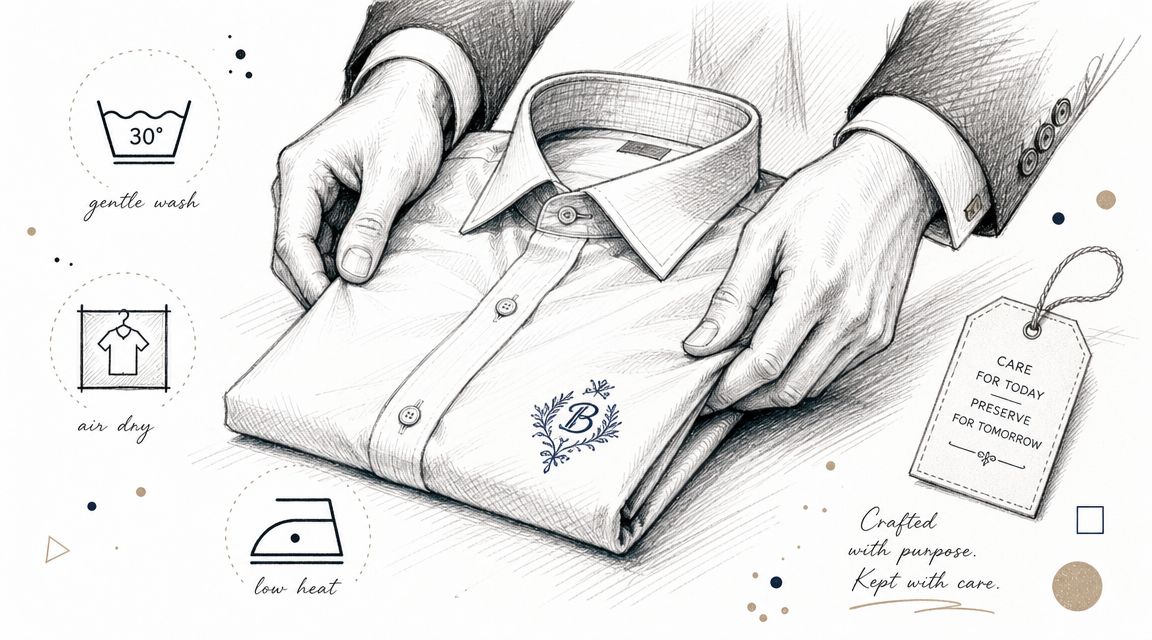
Turn the shirt inside out before washing. That reduces abrasion on the thread surface and helps preserve sharpness. Use a gentle cycle or careful hand washing when the shirt is especially fine or sentimental.
Avoid aggressive drying. High heat can stress both cotton and thread, and it can exaggerate any stiffness around dense embroidery. Air drying on a hanger is usually the safer choice.
Pressing and storage
Iron from the reverse side when possible. If you need to press directly over the embroidery, use a pressing cloth so the stitches don't get flattened or scorched. Steam can help, but pressure should stay controlled.
For storage, hang the shirt with enough room that the embroidered area isn't crushed against other garments. The same principles used when considering how often you should dry clean a suit apply here as well. Less unnecessary treatment usually means a longer life.
A well-made embroidered shirt should soften with wear while keeping its definition. That only happens if the owner cares for it with the same restraint used when designing it.
Your Personal Mark
The best embroidered shirt doesn't look customised in the crude sense. It looks finished. The cloth, cut, placement, and stitching all feel as though they belong together.
That is why the smallest decisions matter. A cuff instead of a collar. Tonal thread instead of contrast. A serif monogram instead of ornate script. Each choice moves the shirt closer to one of two outcomes. A piece with lasting character, or a shirt that feels tied to a passing whim.
For a first commission, restraint is usually the right instinct. Start with one detail, placed well, stitched cleanly, and chosen for a real reason. Once you've lived with that shirt, your preferences become much clearer.
Embroidery at its best doesn't change who you are. It clarifies it. On a bespoke shirt, that final mark can be the quietest detail in the room and still be the most personal one.
Frequently Asked Questions
Is embroidery suitable for a formal business shirt?
Yes, if it's handled with restraint. A small monogram in tonal thread on the cuff is usually the safest option for business dress because it remains discreet under a jacket and doesn't interrupt the shirt's clean line. Problems tend to begin when the design becomes too visible, too colourful, or too decorative for the office. For professional wardrobes, the best embroidery often reveals itself only at close range.
What's the best placement for a first embroidered shirt?
For most gentlemen, the cuff is the best starting point. It's traditional, balanced, and easy to live with because it doesn't dominate the shirt. A chest placement is more public and can quickly feel too informal or branded if the design is wrong. Collar embroidery can look sharp, but it demands more confidence and a more specific styling context than a first commission usually requires.
Can any design be embroidered onto a shirt?
Not well. Many designs look attractive on paper but lose clarity once translated into thread at shirt scale. Fine lines, dense detail, and awkward proportions often need simplification before they'll stitch cleanly. Good embroidery always involves some interpretation. The maker has to adapt the artwork to cloth, thread, and placement. That's especially true on fine shirting, where the garment itself won't forgive clumsy density or poor file preparation.
Will embroidery make the shirt uncomfortable?
It can if the design is too dense, too large, or placed in the wrong area. On a well-made shirt with considered stabilisation and sensible scale, embroidery shouldn't feel intrusive in normal wear. Cuffs, hems, and yokes usually carry stitched details comfortably. Areas that sit directly against the chest or neck need more judgement, especially on lighter fabrics. Comfort depends less on embroidery existing and more on how intelligently it's executed.
Is a monogram better than a motif?
Usually for a first shirt, yes. A monogram is easier to place, easier to size, and easier to keep elegant across different settings. A motif can be excellent, but it needs stronger editing and clearer personal intent. If there's any doubt, choose initials first and let your second or third embroidered shirt be the one that experiments more. The quieter choice is often the one you'll still enjoy years later.
How should I prepare for an embroidery consultation?
Bring clarity rather than lots of options. Know where you expect to wear the shirt, whether you want the embroidery to be seen easily or only occasionally, and whether you prefer tradition or something more individual. If you have reference ideas, keep them narrow and relevant. One or two strong examples are more useful than a folder full of conflicting images. The best consultations refine taste. They don't overwhelm it.
About the Author
Igor is the founder of Dandylion Style and a master tailor based in Ardingly, West Sussex. His work centres on bespoke and made-to-measure garments cut with precision and worn with ease, from business suits and wedding tailoring to shirts and finishing details. He's known for a calm, exacting approach to cloth, fit, and proportion, and for treating personal style as something built through small, intelligent decisions. For Igor, embroidery isn't decoration added at the end. It's the final conversation between garment and wearer, where craftsmanship meets identity in the most discreet and lasting way.
If you're considering an embroidered shirt and want guidance grounded in proper tailoring, Dandylion Style offers bespoke and made-to-measure commissions with fittings in the studio, at home, or at the office across Sussex, London, and the South East.