You probably know the feeling already. A ready-made shirt looks acceptable on the hanger, then starts to argue with your body the moment you wear it. The collar bites when you sit, the sleeves shorten when you reach forward, or the chest fits while the waist balloons.
That's usually the point at which men start looking for custom shirts made. Not because they want fuss, but because they want calm. A shirt that sits cleanly under a jacket, moves properly at the desk, and still looks right at dinner is a practical luxury. It removes distraction.
The Unrivalled Comfort of a Truly Personal Shirt
A proper shirt should disappear once it's on. You shouldn't have to keep tugging the cuffs down, opening the top button for relief, or accepting drag lines across the back as “just how shirts are”. A personal shirt changes that experience in a quiet way. It doesn't shout. It fits your life and your build.
That's the difference between buying fabric shaped for a hypothetical man and commissioning a garment shaped for you. Shoulder slope, neck posture, chest prominence, seat position, and the way you move all matter. When those points are considered early, comfort improves and the shirt gains a cleaner line.
For many clients, the first step is understanding what they want the shirt to do. Business shirts need a different balance from weekend shirts. Wedding shirts often need a softer hand, a more refined front, and close coordination with the jacket and tie. If you're exploring fitted shirts for a more personal cut, that clarity helps before any cloth is chosen.
Key takeaways
- Choose the consultation format that suits your schedule. In-studio, home, office, and remote appointments each solve a different problem.
- Start with cloth, then refine the details. Collar, cuff, placket, and button choices should follow the shirt's purpose.
- Fit comes from measurement and pattern judgment. A proper bespoke process accounts for posture and asymmetry, not only chest and neck size.
- Expect a measured timeline. A quality shirt takes time because fitting, adjustment, and finishing are part of the result.
- Care matters after delivery. Good laundering, pressing, and storage protect the shape and feel of the garment.
A fine shirt doesn't need to feel formal. It needs to feel correct.
Your Consultation In-Studio Home or Remote
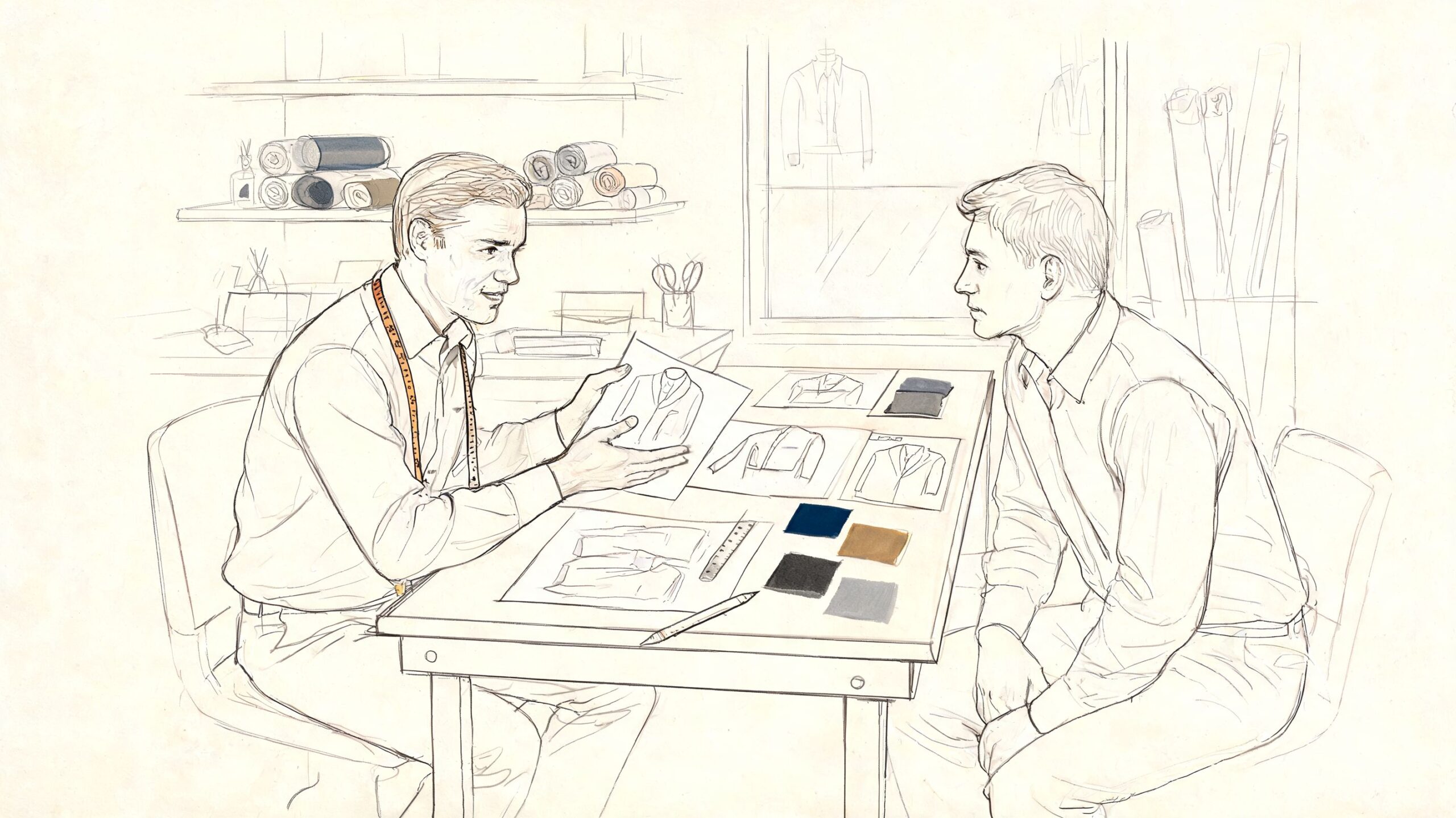
The consultation is less dramatic than many men expect. It's a conversation about use, taste, and practical constraints. The good tailor is listening for how you live in the garment, not only what colour you say you like.
In-studio appointments
An in-studio visit suits the client who wants the full tactile experience. You see cloth books in proper light, handle finishes side by side, and compare collars and cuffs without distraction. That's often the clearest route if you're commissioning shirts to sit with existing tailoring, because the whole wardrobe can be considered together.
It also allows easier discussion of proportion. A collar that appears elegant in isolation may feel wrong against a broader face or stronger shoulder line. In person, those decisions tend to become simpler.
Home or office fittings
For busy professionals, convenience often matters as much as craftsmanship. A report on at-home tailoring preferences in London and the South East notes that 74% of London and South East professionals prefer at-home tailoring consultations, which reflects how many clients now want bespoke service to adapt to their routine rather than interrupt it.
Home appointments are useful when a client wants to try shirts with his own suits, shoes, and ties. Office appointments work well for men replacing a run of business shirts with consistent collars and cuff settings. For local readers comparing options, tailor made shirts near me is often the practical starting point.
Remote consultations
Remote works best when the client values access and flexibility but still wants guidance. Swatches can be posted. Design decisions can be narrowed efficiently. Follow-up conversations are often sharper because the client has had time to handle the cloth in his own environment.
Remote does have limits. If your body is difficult to fit, or you know shirts usually twist on you, it's better to combine remote planning with an in-person measuring session later.
A simple rule helps here:
- Choose studio if you want full immersion and direct comparison.
- Choose home or office if time is tight and convenience matters most.
- Choose remote if location is the obstacle but you still want a considered process.
Choosing Your Cloth and Signature Details
Cloth does most of the talking. Before anyone notices your cuff shape or monogram, they notice whether the shirt looks crisp, soft, relaxed, substantial, or airy. That's why the fabric choice should come first.
Start with purpose, not pattern
Fine cotton remains the backbone of most shirting because it presses well, wears comfortably, and can be finished in many ways. The shirt for weekday business wear usually benefits from steadiness and clarity. The shirt for summer dinners or a country wedding can be softer, drier, and less formal.
British and European shirtings each have their place. Some clients want a clean business poplin. Others prefer a more textured Oxford or linen blend that looks better with an unstructured jacket. If you want a clearer sense of texture and handle before choosing, a useful starting point is this guide to a variety of cotton fabric.
Sustainable wedding choices
Wedding commissions often expose a gap in the market. Many grooms want custom clothing that aligns with their values, but shirt options are still often treated as an afterthought. A UK wedding report summary states that 68% of grooms now prioritise sustainability in their wedding suits, yet specialized shirt options that match that aim remain harder to find.
That matters because the shirt sits next to the skin. If a groom chooses British organic linen or a recycled wool blend for parts of the wider outfit, the shirt should feel part of the same conversation rather than a generic add-on.
Practical rule: For weddings, choose cloth that still feels good after hours of wear. Ceremony elegance matters, but comfort through the reception matters more.
Collar, cuff, and front
Once the cloth is settled, the architecture of the shirt can be refined.
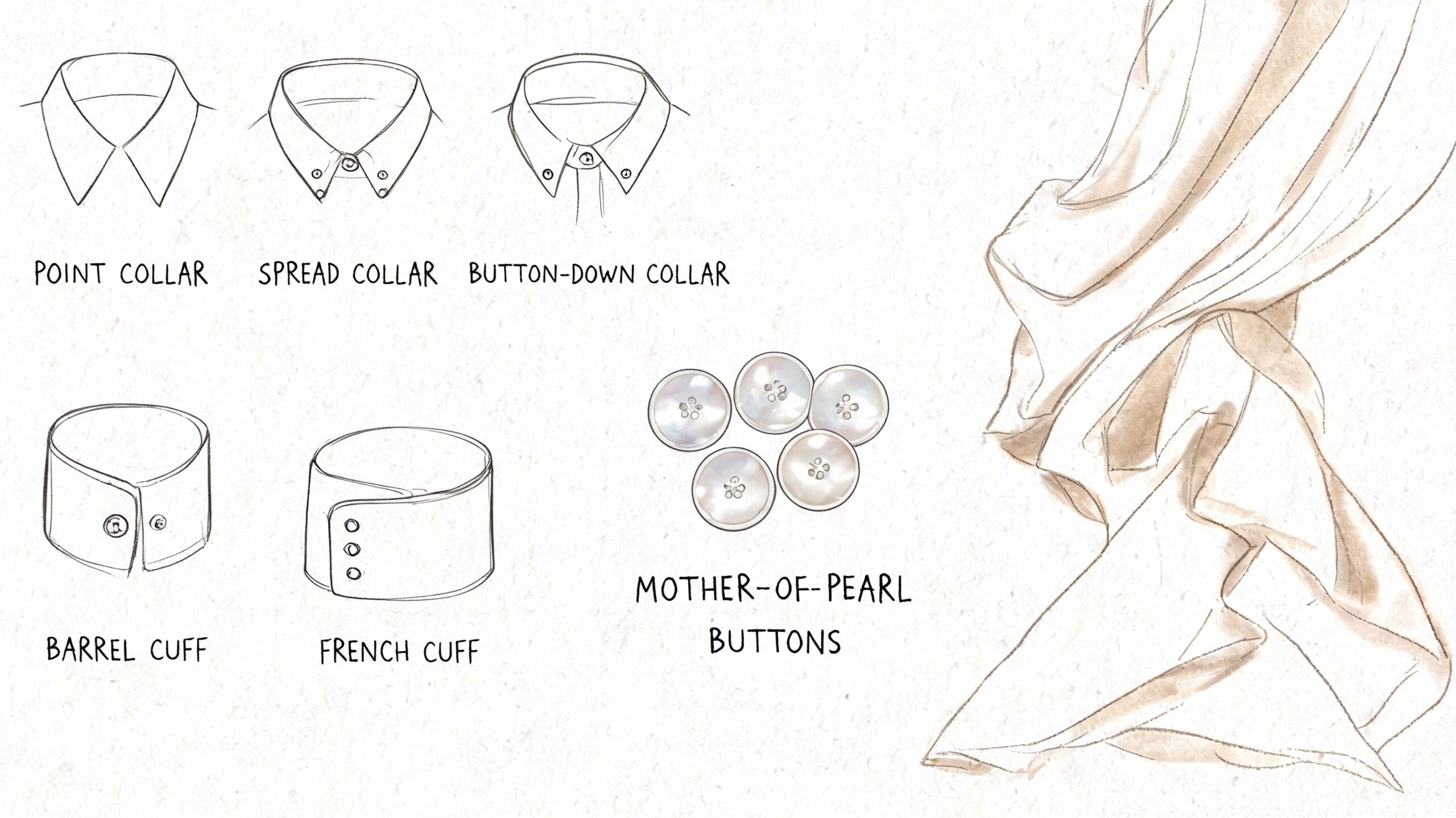
- Spread collar suits many business and occasion settings. It frames a tie well and keeps balance under structured jackets.
- Cutaway collar has more attitude. It can look elegant on a broader chest or stronger jawline, but it shouldn't be chosen only because it seems fashionable.
- Button-down collar is more relaxed. It works well for soft tailoring, knitwear, and business-casual dressing.
Cuffs need similar honesty. A single cuff is practical and versatile. A double cuff is more ceremonial and asks for proper cufflinks. The placket also matters more than men think. A plain front can feel cleaner and dressier. A standard placket often looks sturdier and a touch more casual.
Mother-of-pearl buttons, balanced collar interlining, and thoughtful cuff depth aren't decorative trivia. They change how the shirt ages and how it sits after repeated wear and laundering.
The Art of Measurement and Personal Fit
The phrase “custom” can mean several different things, and that's where many clients get confused. Not every shirt sold as personalised is built the same way. The practical difference is whether the maker is adjusting an existing template or drafting for your body from the ground up.
Made-to-measure and bespoke are not identical
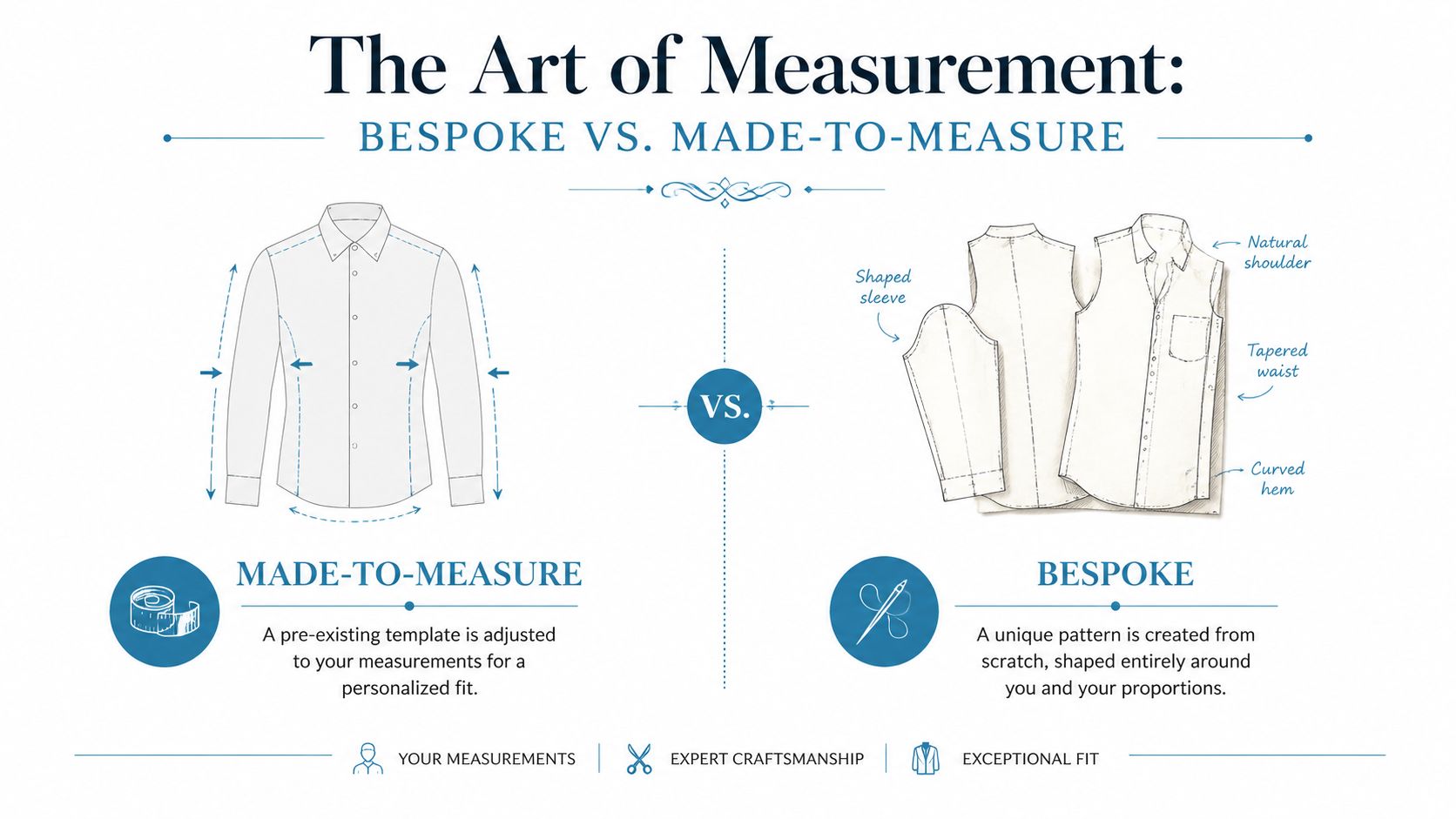
Made-to-measure begins with a house block. Measurements are used to amend that starting pattern. It can work well for men whose proportions sit reasonably close to standard assumptions.
Bespoke starts differently. A separate pattern is created for the individual, and the cutter can account for asymmetry, stance, shoulder drop, posture, and movement in a much more direct way. If you're comparing made to measure shirts in London, this distinction is worth understanding before you decide by price alone.
| Feature | Made-to-Measure (MTM) | Bespoke |
|---|---|---|
| Pattern | Adjusts a pre-existing block | Drafted specifically for the individual |
| Starting point | Standard house proportions | Personal body shape and posture |
| Asymmetry handling | Limited by the base pattern | Greater scope for correction |
| Fittings | Usually fewer | Usually more iterative |
| Best suited to | More standard builds | Clients needing nuanced fit |
| Design control | Good | Deeper, with more structural judgement |
Why measurement quality matters
A tape measure on its own doesn't create fit. Judgment does. The shirtmaker must decide which measure governs another, where ease belongs, and how posture alters line. A broad chest with sloping shoulders needs a different solution from a broad chest with an erect stance, even if the chest number looks similar.
One of the most useful pieces of trade data here comes from a tailoring process report discussing bespoke measurement pitfalls. It states that rushed measurements account for 68% of refit needs, and that true bespoke ateliers may take up to 25 measurement points, including details such as scapula angle. The same source notes error rates of 4% for fully bespoke compared with 18% for algorithm-based MTM systems.
That aligns with workshop reality. The difficult clients are rarely “hard to fit” in any dramatic sense. They're men whose bodies don't match a standard block closely enough.
Don't judge a measuring session by speed. Judge it by how closely the cutter is reading your posture and balance.
What a good measuring session notices
A careful shirt fitting usually considers more than neck, chest, waist, and sleeve.
- Shoulder expression affects sleeve hang and collar balance.
- Scapula shape can create drag lines across the back if ignored.
- Bicep and forearm shape matter if you want a neat sleeve that still moves properly.
- Seat posture changes the relationship between front and back lengths.
- Wristwatch habit may affect cuff circumference or left-right symmetry.
Bespoke earns its keep here. The point isn't complexity for its own sake. The point is to make the shirt look cleaner because it has been built with your real posture in mind.
From Pattern to Product The Bespoke Timeline
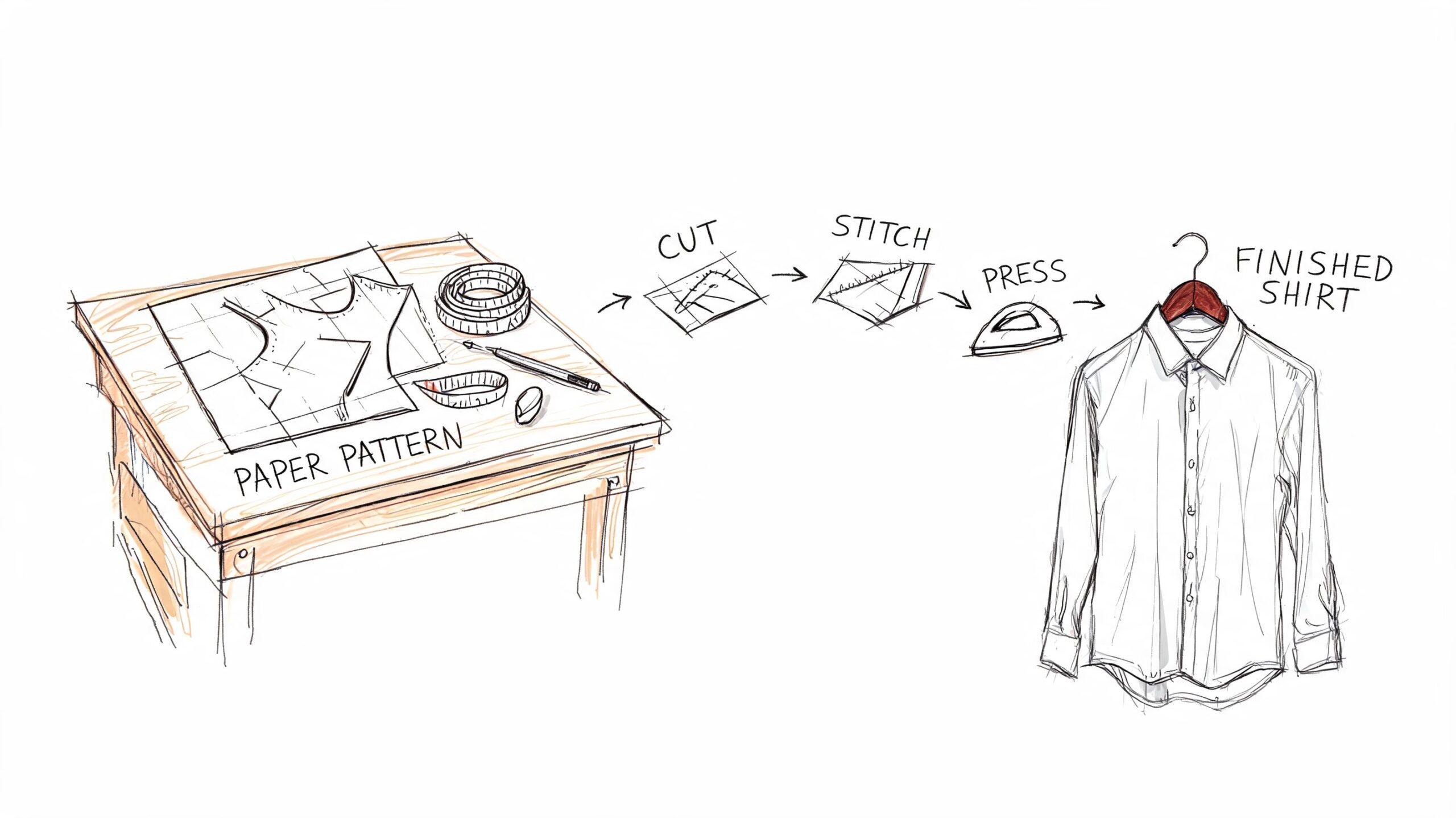
A fine shirt doesn't happen in one uninterrupted burst. It moves through stages, and each stage answers a different question. First the pattern asks, “Is the balance right?” Then the fitting asks, “Does the body agree?” Only after that should the final finish speak.
The working rhythm
A UK custom shirt production overview states that the production timeline for a high-end custom shirt averages 6 to 10 weeks, with a basted fitting around week 3 to 4 to ensure 95% accuracy. The same source notes that construction details such as a split yoke support ergonomic movement, and associates that standard with a 76% boost in client retention.
That timing makes sense when the process is done properly.
Initial drafting and cloth confirmation
The pattern is prepared against the chosen fabric and intended use. Formal shirting, casual linen, and wedding cloth all behave differently under the iron and under strain.Basted fitting
Temporary assembly reveals balance issues before final commitment. This stage is invaluable because small corrections here prevent permanent disappointment later.Forward production
The shirt is sewn in its final form, with collar, cuffs, front, sleeves, and yoke completed according to the approved pattern.Finishing and pressing Buttons, final pressing, and inspection complete the work. Details here either look settled and deliberate or slightly hurried.
Why clients should welcome the wait
A shirt for a marquee wedding is a good example. Outdoor conditions ask more of a garment. Heat, movement, and a longer day all expose poor balance quickly. If you're planning that sort of event, practical guidance on outdoor wedding services by Premier Marquee Hire is worth reading alongside wardrobe planning, because venue conditions often influence cloth and collar decisions more than clients expect.
For men who begin the process from a distance, custom shirts online can be a useful route for consultation and design development, provided the fitting stage is handled with care.
A proper timeline isn't delay. It's breathing space for correction.
The Final Fitting and Caring For Your Investment
The final fitting should feel calm and exact. You're not looking only for whether the shirt “fits”. You're checking whether it behaves properly when you stand, sit, turn, and reach.
What to check at the fitting
Start at the collar. It should feel secure without pinching, and it should sit neatly whether worn open or with a tie. Then check the shoulders. The seam placement and sleeve fall should look clean, without twisting or collapsing.
After that, pay attention to movement:
- Raise your arms and note whether the body pulls excessively from the waistband.
- Sit down and check whether the front strains or the collar presses into the neck.
- Bend the elbow to see whether cuff depth and sleeve length still look balanced.
- Wear it under a jacket if that's how it will be used most often.
Minor adjustment at this stage is normal. Good bespoke work doesn't pretend the first complete version must be sacred. It refines until the garment settles.
A final fitting is for confirmation, not politeness. If something feels wrong, say so while the correction is still simple.
Caring for the shirt afterwards
A bespoke shirt lasts better when it's handled gently and consistently. Wash with restraint rather than aggression. Avoid overloading the machine. Use a moderate setting, remove the shirt promptly, and shape collar and cuffs by hand before drying.
Press while the cloth still holds a little moisture, or use steam carefully. Start with collar and cuffs, then sleeves, then body. Store shirts with enough space in the wardrobe so the collar isn't crushed by heavier garments.
Rotation matters too. Don't wear the same shirt too frequently because it's become your favourite. Cloth rests better when it's given time between wears.
About the Author
Igor Srzic-Cartledge is the founder of Dandylion Style, a bespoke tailoring house based in Ardingly, West Sussex. He works with fine British fabrics and a calm, exact process to create one-of-a-kind garments for clients across Sussex, London, and the South East. His approach combines traditional tailoring judgment with modern convenience, including studio, home, office, and remote consultations, so bespoke clothing feels personal, practical, and enduring.
Frequently Asked Questions
Is a bespoke shirt only for formal occasions
Not at all. Many of the most useful bespoke shirts are everyday business or smart-casual pieces. The value is in comfort, balance, and consistency, not only ceremony. A shirt made for your posture and habits often becomes most noticeable on ordinary days, when you're sitting, travelling, or moving between meetings and don't want to keep adjusting your clothes.
How many shirts should I commission first
For most men, starting with one or two is sensible. That gives enough room to test cloth, collar proportion, and cuff preference without overcommitting. If the first commission is for regular workwear, it's often wise to begin with a versatile business cloth and a balanced collar. Once that pattern is proven, repeating and refining becomes much easier.
What should I bring to the consultation
Bring the items that affect how the shirt will be worn. That might mean your usual business jacket, a wedding tie, cufflinks, or a watch you wear daily. If you already own a shirt you like, bring that as well, but only as a reference point. The aim isn't to copy it blindly. The aim is to understand what works and what still bothers you.
If you're ready to commission custom shirts made with a more personal process, Dandylion Style offers consultations in the studio, at home or the office, and remotely with swatches by post. It's a measured way to build shirts that match your wardrobe, your schedule, and the way you actually wear clothes.