Most men are told an unstructured blazer is the relaxed option, the one you throw on when you want to look smart without trying too hard. That advice misses the point. Unstructured is not a mood, it's a construction choice, and in British tailoring that choice has a clear history, a clear purpose, and very specific trade-offs.
The modern shift began in the 1970s, when jackets started losing heavy linings, shoulder pads, and chest canvases in favour of a softer silhouette. That move matters because it changed how men in the UK could dress for work, travel, and social occasions. A well-cut soft blazer can look sharper than a stiff jacket that's fighting the body all evening.
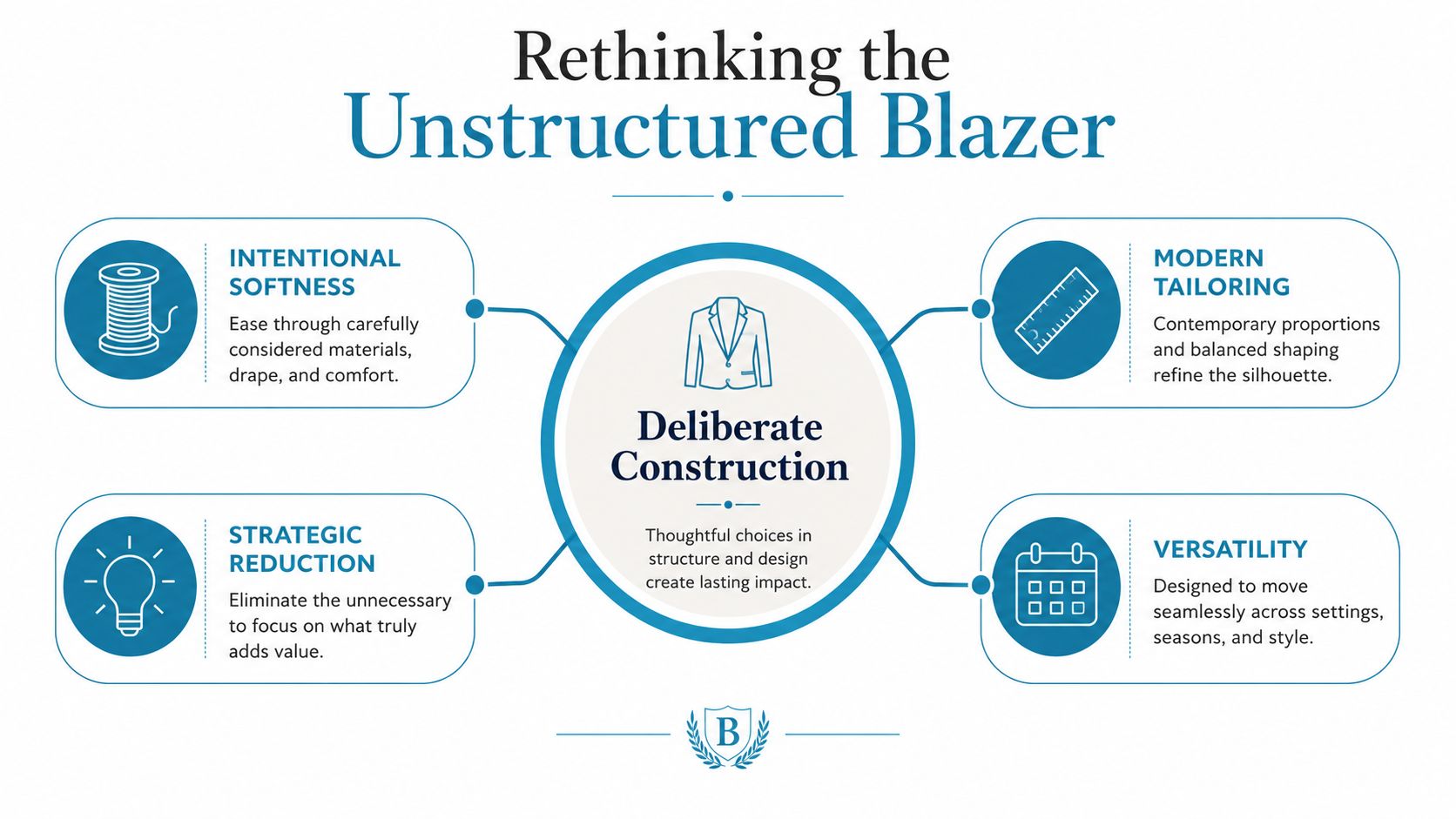
Rethinking the Unstructured Blazer
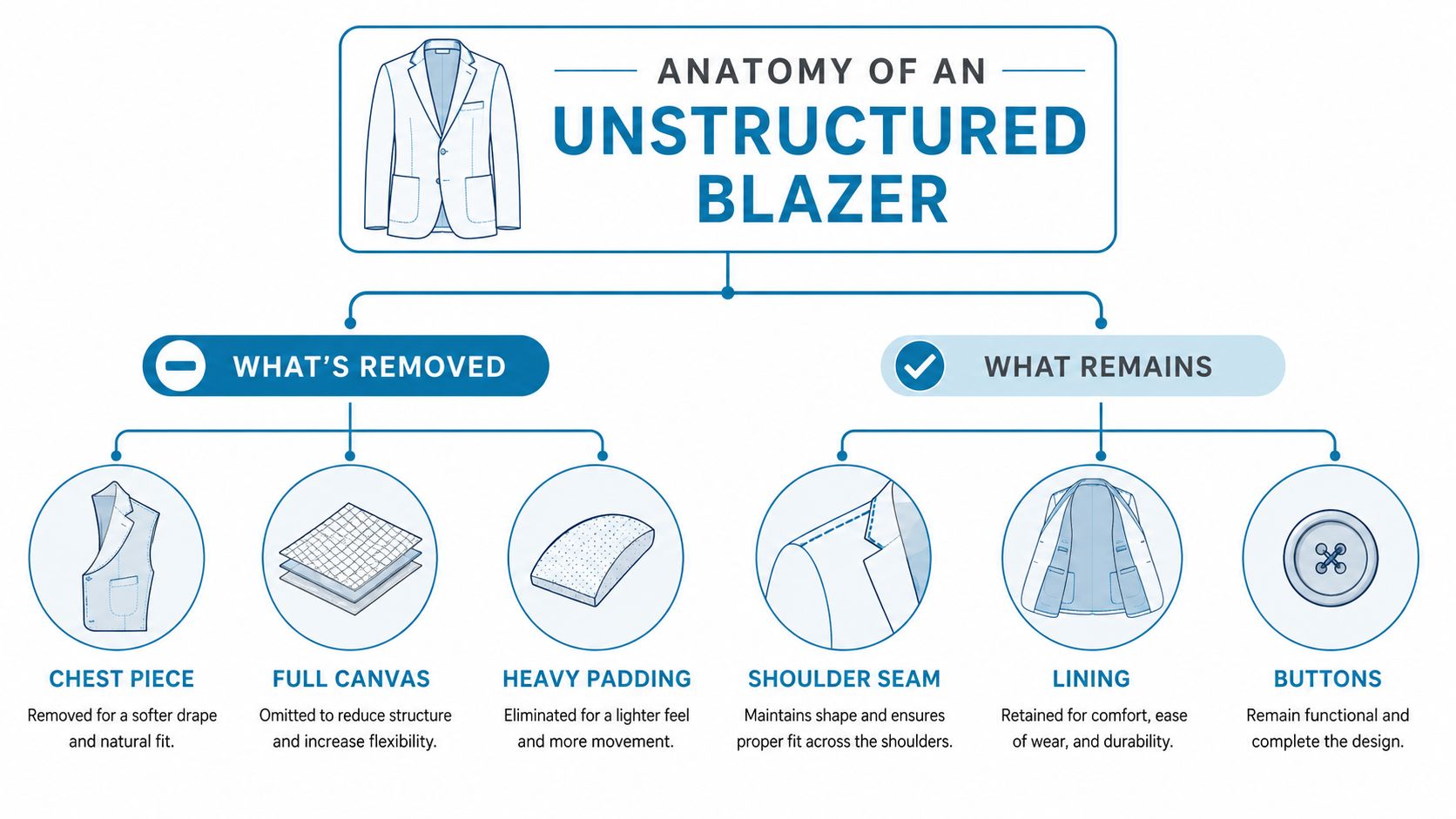
The biggest mistake is treating the unstructured blazer as a casual afterthought. It's better understood as a deliberate construction category, one that emerged when tailoring began to strip back the internal engineering that defined earlier jackets. In practical terms, the style is built by removing or reducing layers such as canvas, shoulder padding, lining, and sometimes the chest piece, which changes how the jacket moves and sits on the body. The result is softer, lighter, and easier to wear, not sloppy.
Softness was designed, not improvised
The historical shift in British menswear is important because it shows how the jacket evolved from formal engineering to relaxed refinement. The garment's defining features today, minimal internal structure, lighter weight, and freer movement, are exactly what set it apart from early 20th-century jacket construction. That's why the style settled into casual and semi-formal dressing instead of disappearing as a fleeting fashion idea.
A good soft blazer doesn't look underbuilt. It looks intentional, because the cut still respects the body even when the interior is stripped back.
For a British audience, that distinction matters. The jacket isn't “less structured”, it's constructed differently. When the proportions are right, the lack of internal stiffness can make the cloth drape more cleanly than a heavily padded jacket that hasn't been shaped well.
What Makes a Blazer Unstructured
Inside the jacket, the changes are straightforward, but each one affects how the garment behaves. An unstructured blazer usually has little to no shoulder padding, minimal canvassing, and partial or no lining. Some versions are partially lined, others are unlined, and the canvas may be very thin or absent altogether. That's why the garment feels lighter, breathes better, and follows the body with less resistance. See the difference in construction alongside a related breakdown of jacket types in this guide to the difference between sports coat and blazer.
Think of the jacket like a building
If the jacket were a building, the canvas would be the frame and the lining would be the internal finish. Remove enough of that hidden structure and the shell still exists, but it hangs with a softer edge. That's why the shoulder line often looks more natural and the chest doesn't project with the same rigid shape as a formal blazer.
The practical effect is easy to feel. The jacket is less bulky, so it moves more easily and sits closer to the shape of the wearer without clamping down on the torso. The trade-off is that the cloth has to do more of the work, which means the cutting has to be more disciplined, not less.
Practical rule: unstructured doesn't mean shapeless. It means the shape comes from cut and cloth, not from heavy internal scaffolding.
A proper soft blazer still follows the body's contours. It just does so with fewer hidden aids, which is why bad fit is more visible here than on a structured jacket. If the shoulder is off, you'll see it immediately.
Unstructured Versus Structured Jackets
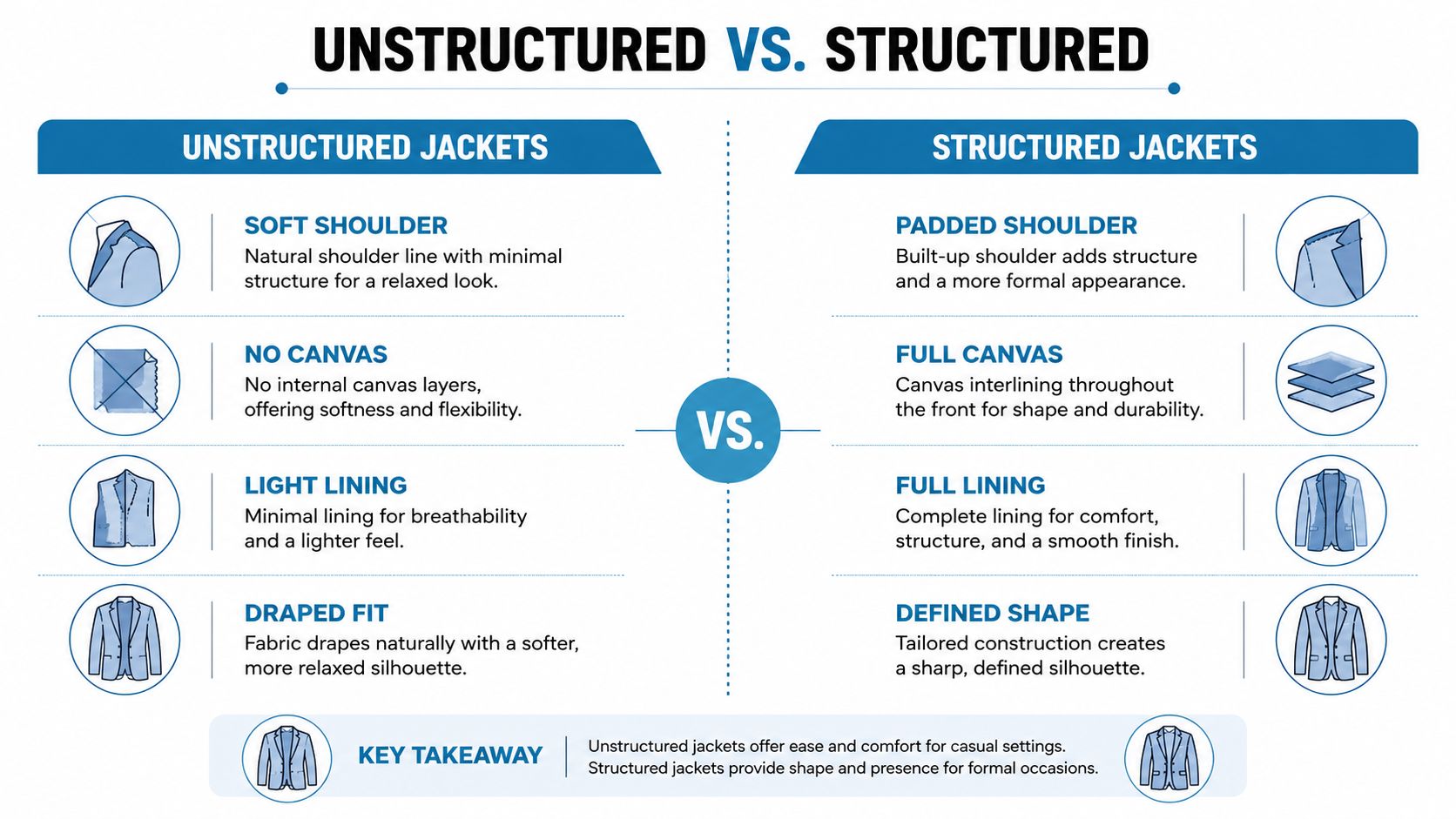
The comparison becomes clear once you look at the internals rather than the label. A structured jacket uses more canvas, more padding, and a firmer chest to hold a defined silhouette. An unstructured blazer reduces those layers, so it feels lighter, drapes more naturally, and moves with less resistance. For a plain-language comparison of blazer categories in British menswear, see blazer vs suit jacket.
Where each jacket earns its place
Structured jackets still win when the room demands formality. Boardrooms, formal weddings, and conservative dress codes call for the cleaner architecture of a more engineered jacket. The visual message is firmer, and in those settings that's exactly what you want.
Unstructured blazers are better in spaces where ease matters as much as polish. Smart-casual offices, summer events, travel, and creative industries all reward a softer shoulder and less visual weight. The jacket reads as considered rather than severe, which is why it works so well with chinos, knitwear, and open-neck shirts.
The common assumption that soft tailoring is cheaper isn't reliable. A beautifully made unstructured blazer in fine cloth can cost as much as, or more than, a structured one because the quality is coming from cloth, cut, and finishing rather than visible internal build. The core decision isn't price alone, it's the level of formality, the season, and how much shape you want the jacket to enforce.
Choosing the Right Cloth
Once the internal structure is reduced, fabric choice matters even more. The cloth now carries more responsibility for drape, wrinkle behaviour, and how sharp the jacket still looks after a few hours of wear. That's why a soft blazer that works in one fabric can look limp or overworked in another.
Cloth that suits the construction
Linen is the obvious summer choice because it breathes well and wears its creases with honesty. Cotton works well for travel and everyday smart-casual use because it sits comfortably and feels less precious than wool. Wool and wool-silk blends are the most versatile year-round options, especially when you want the jacket to move easily without collapsing. For texture, hopsack and lightweight tweed give the soft silhouette more visual depth, which helps in cooler weather. For a broader cloth reference point, the same logic applies in this guide to the best fabrics for suits.
The wrong cloth can overwhelm the whole idea. Heavy fabric can make an unstructured jacket hang bluntly instead of flowing, while overly delicate cloth can lose presence and look tired very quickly. That's why cloth weight and lining choices have to be considered together, not separately.
A soft blazer needs cloth with character. If the fabric is too stiff, it fights the jacket's purpose. If it's too limp, the whole silhouette collapses.
Colour works with the same logic. Lighter, more relaxed cloths suit spring and summer dressing, while textured browns, greys, and muted blues give the jacket enough depth for autumn and winter. The cloth should support the garment's relaxed construction, not apologise for it.
Getting the Fit Right
Fit becomes less forgiving when the jacket has less internal architecture. There's nowhere for a weak cut to hide. The shoulder, chest, sleeve pitch, and length all have to work together because the garment isn't relying on padding or canvas to correct the line.
The shoulder decides everything
The shoulder line should follow the natural bone structure, not sit outside it like armour. If the shoulder is too wide, the jacket loses its clean drape immediately. If it's too narrow, the sleeve and upper chest start to pull, which is harder to forgive on a soft jacket because the construction gives you less visual buffering.
The chest should close without tension and without a boxy gap. A soft blazer can be a little more forgiving through the torso than a highly structured jacket, but only if the cut respects posture and movement. Sleeve pitch matters too, because the arm has to swing without dragging the front of the jacket out of line.
For anyone comparing how jackets sit around the upper body, a useful companion reference is suit shoulder fit. The same principle applies here, and arguably more strongly.
A few practical checks help in the fitting room:
- Shoulders: the seam should end where your shoulder ends, no more.
- Chest: button it and move your arms, the fabric shouldn't pull hard across the front.
- Length: the jacket should balance your body, not chop it in half or swallow your frame.
- Back and seat: the jacket should skim, not cling or flare.
Practical rule: if the shoulders are wrong, don't talk yourself into it. Soft tailoring exposes shoulder mistakes faster than structured tailoring does.
A good soft blazer feels easy, but it isn't forgiving in the places that matter most. That's why alterations are best kept to minor refinements, not rescue work.
For a useful comparison on wearability and wrist fit, this trusted iced watch buyer Antwerp resource is a good reminder that scale matters in men's styling. The same principle applies here, the jacket and the body need to feel proportionate, not crowded.
Styling and Occasion Guide
An unstructured blazer earns its keep when the outfit underneath is clean and purposeful. The jacket should relax the look, not dilute it. That means the shirt, trouser, and shoe choices need enough clarity to keep the whole combination grounded.
Pairing it with the right clothes
For smart-casual wear, chinos and a roll-neck are a strong combination, especially when you want a softer, modern line. For business-casual dressing, a crisp shirt with fitted trousers keeps the jacket in the right lane without making it feel stiff. In summer, linen trousers and loafers make sense because the cloths speak the same language. On travel days, softer trousers and a breathable shirt keep the jacket useful rather than ceremonial.
The collar matters more than most men realise. A neat spread or semi-spread shirt collar sits comfortably under a softer lapel, while a shirt that's too rigid can make the whole outfit look over-pressed. A tie is optional, but when the setting is relaxed, skipping it usually feels more natural.
For event planning beyond menswear, the same principle of matching tone to setting comes through in this practical guide to find corporate catering Mississauga. Dressing works the same way, the outfit has to suit the room rather than overpower it.
The occasions are fairly clear:
- Creative meeting: an unstructured blazer signals polish without stiffness.
- Summer wedding: linen or lightweight wool keeps the silhouette airy.
- Evening dinner: darker cloth and a sharper shirt make the jacket feel deliberate.
- Travel: minimal lining and breathable cloth earn their place.
Footwear finishes the job. Loafers, clean derbies, and simple boots all work if the rest of the outfit stays disciplined. Heavy, overly formal shoes can fight the relaxed jacket, while overly casual trainers can make the whole look drift too far the other way.
Bespoke Ordering and the Fitting Process
Soft tailoring is where bespoke work really proves its worth. Because the jacket depends so much on the wearer's posture and shoulder shape, the cut has to start from the body rather than from a generic block. That's why made-to-measure and fully bespoke can produce very different results even when they look similar from a distance. For a fuller breakdown of commissioning, see what is bespoke tailoring.
What the process usually involves
A proper commission begins with consultation, where the cloth, purpose, and silhouette are discussed before anything is cut. After that comes pattern drafting, either on paper or digitally, followed by the first basted fitting. That fitting is where the shape is corrected against the body, and in soft tailoring, those adjustments matter a great deal because the jacket won't rely on hard internal structure to disguise imbalance.
Typical lead times are 8–12 weeks for completion, which gives enough room for fitting, refinement, and final finishing. Dandylion Style offers home and studio fittings across Sussex, London and the South East, with transparent pricing from £1,495 for a two-piece, but the main point is the process, not the label. The jacket has to be built around how you stand, move, and carry your shoulders.
Alterations also behave differently on this kind of jacket. Because the interior is lighter, some adjustments are simpler to access, while others need more caution because there's less hidden structure to absorb changes. That's one reason a soft blazer can be an excellent bespoke commission, the fit reads naturally when the pattern is right.
Why the soft silhouette suits individual bodies
Men with uneven shoulders, posture quirks, or a preference for comfort often get the best results from unstructured tailoring. The jacket doesn't try to impose a rigid shape over the body, it follows the body more naturally. That's a virtue if you want refinement without feeling armoured.
The danger is overcorrecting. A bespoke soft blazer should still be clean through the shoulder and chest. If the cloth is right and the fitting is careful, the jacket looks effortless without ever looking accidental.
Key Takeaways and Common Questions
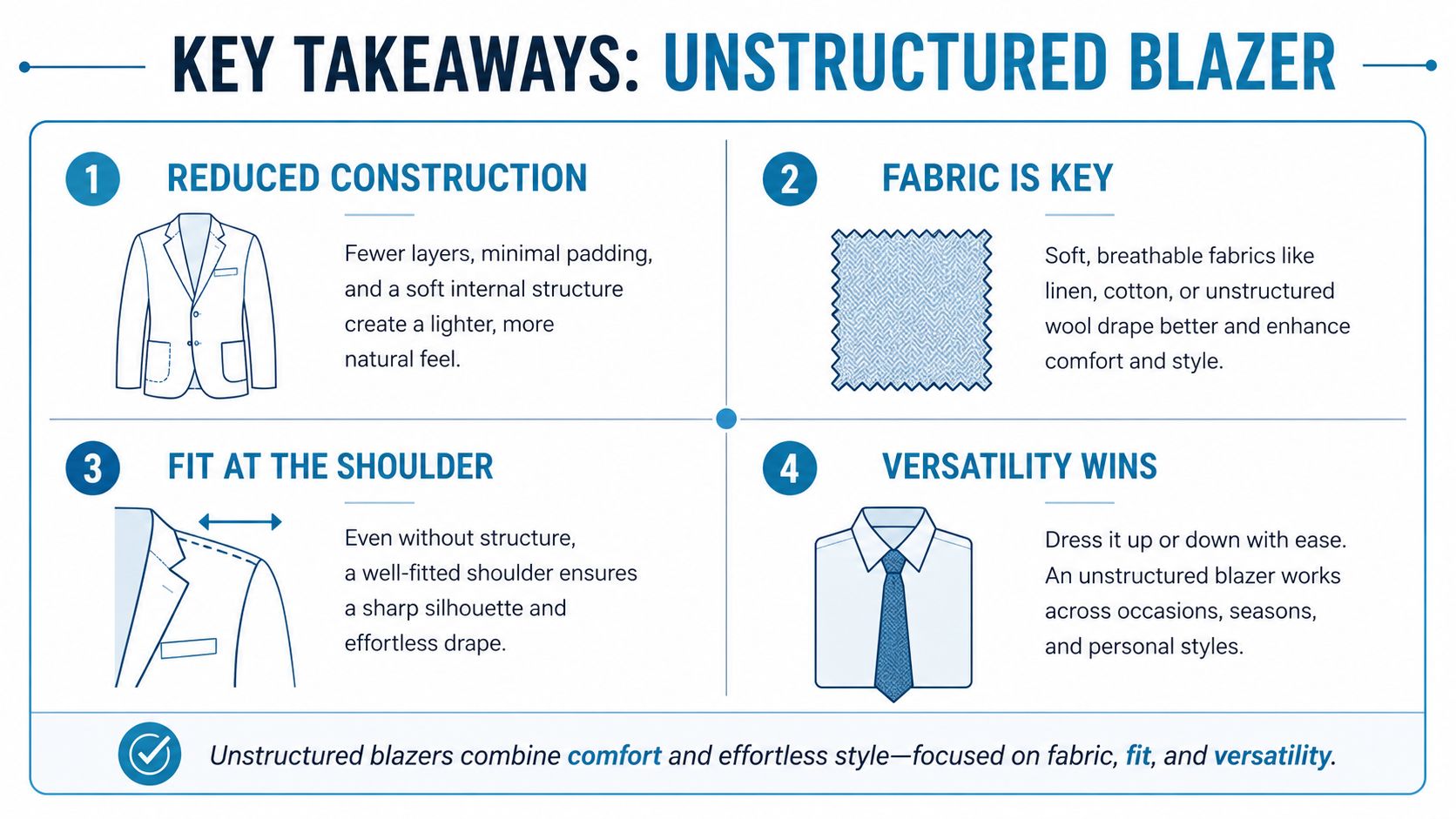
The best way to judge an unstructured blazer is simple. Reduced construction gives you softness and breathability, cloth choice does more of the visual work, and the shoulder fit has to be precise because there's less structure to hide mistakes. When those three elements line up, the jacket becomes one of the most versatile pieces in a man's wardrobe.
Quick answers for common buying questions
How do I wash an unstructured blazer?
Don't treat it like a shirt or knitwear. Most soft blazers need airing, brushing, and occasional professional care rather than routine washing. If the cloth is linen or cotton, spot cleaning and proper hanging matter even more because the lighter construction shows creasing and distortion quickly. Always check the care label before doing anything else.
Can I wear one to a wedding?
Yes, but only when the dress code and setting support it. A summer wedding, a relaxed country venue, or a smart-casual celebration can suit an unstructured blazer well, especially in linen or lightweight wool. For formal church weddings or black-tie-adjacent events, a more structured jacket usually feels safer and more appropriate.
How is it different from a safari jacket?
A safari jacket is a separate garment category with a more utilitarian character, often built around patch pockets, belts, and a more casual fieldwear look. An unstructured blazer still reads as suiting first. It keeps the blazer shape, but with reduced internal structure, so it belongs in the suiting wardrobe rather than the utility wardrobe.
Does it work for larger builds?
It can, but the shoulder and chest need careful handling. A soft blazer can be flattering because it removes bulk and avoids the boxy feel of some heavy jackets. The danger is going too loose and losing shape. Larger builds usually benefit from disciplined shoulder fit and a cloth with enough body to hold its line.
What should I look for first when buying one?
Start with the shoulder seam, then check the chest and the length. If those three are off, the rest of the jacket won't save itself. After that, look at the cloth and ask whether it suits the season and the way you'll wear it.
If you want a jacket that feels easier without looking careless, talk to Dandylion Style about a soft blazer cut for your build, your posture, and the way you really dress. A well-judged commission is the difference between owning another blazer and owning the one you keep reaching for.