You're probably at the stage where the suit already looks right. The cloth is chosen, the cut is settled, the lapel feels correct, and the fit has begun to look like you rather than a mannequin. Then one final question appears: should you add embroidery, and if so, where, how much, and will it still feel elegant in five years?
That's where most men get vague answers. They're shown attractive examples, but not the trade-offs. They're told embroidery is “personal” or “luxurious”, but not what kind of embroidery suits a wedding jacket, what disappears on dark wool, or how much time handwork adds.
As a tailor, I see designer suits embroidery as the final layer of authorship. It isn't decoration for decoration's sake. Done well, it gives a bespoke garment memory, identity, and restraint all at once.
The Ultimate Personal Touch An Introduction to Suit Embroidery
A bespoke suit already carries your measurements, your posture, your habits, and your taste. Embroidery takes that a step further. It adds something a cutter can't shape with cloth alone: a mark that is unmistakably yours.
In the UK, appetite for personalised clothing isn't a niche curiosity. The UK custom apparel market is projected to grow from USD 112.10 million in 2024 to USD 205.27 million by 2032, at a CAGR of 7.86%. That projection tells you what many tailors already feel at fittings. Clients want garments that can't be confused with off-the-peg luxury.
Key takeaways
- Embroidery works best when it supports the suit, not when it competes with it. Subtle placement usually ages better than obvious placement.
- Hand embroidery and machine embroidery create different effects. One brings character and irregular beauty, the other brings speed and consistency.
- Placement matters as much as design. A hidden lining message says something very different from a cuff monogram.
- Occasion should guide style. Wedding embroidery can be sentimental. Business embroidery should stay discreet. Eveningwear can carry a little more personality.
- Timelines and pricing are real considerations. Intricate embroidery changes both, and it's worth discussing before cloth is cut.
- The best embroidery feels discovered, not announced. That's often the line between sophistication and costume.
What embroidery adds that tailoring alone cannot
A suit can be technically superb and still stop just short of being memorable. Embroidery supplies that last note. It may be initials under the collar, a wedding date inside the jacket, or a family emblem on a waistcoat where only a few people will ever notice it.
Practical rule: If the embroidery would still feel appropriate when the event photographs are old, it's probably a sound choice.
Many clients also like to anchor embroidery in meaning, not trend. If you're thinking beyond initials and want symbolism that connects to family, heritage, or a milestone, this guide on how to select jewelry symbols for your story is useful because the same logic applies to thread. The symbol matters less than whether it belongs to your life.
The Language of the Needle Understanding Embroidery Types
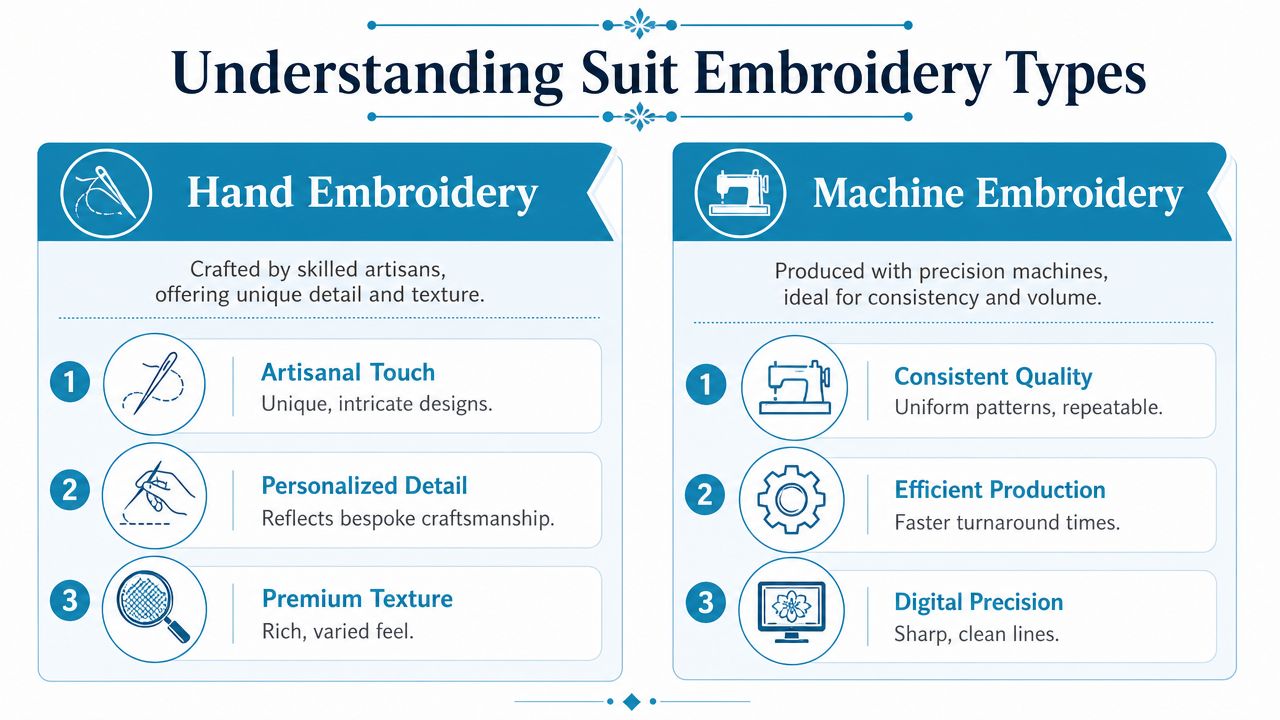
Embroidery on tailoring begins with one essential choice. Are you commissioning something with the warmth and variation of handwork, or something cleaner and more uniform through machine stitching? Neither is automatically better. The better option is the one that suits the garment, the budget, and the message.
Hand embroidery and machine embroidery
Hand embroidery is like a handwritten letter. Machine embroidery is like a typed one. The typed letter may be immaculate, but the handwritten one carries a trace of the maker.
Hand embroidery usually suits bespoke work because the tailor and embroiderer can respond to the cloth in real time. They can soften an edge, vary density, and place emphasis where the design needs it. On fine wool, cashmere blends, or a softer waistcoat cloth, that sensitivity matters.
Machine embroidery has strengths of its own. It gives consistency, crisp outlines, and repeatability. If a client wants a neat monogram, a clean inside-jacket motif, or multiple coordinated garments with the same emblem, machine work can be sensible and visually sharp.
Common embroidery styles on gentlemen's tailoring
Not every embroidered detail needs to be heraldic or theatrical. Most successful commissions fall into a few categories.
- Monograms: Initials remain the most popular choice because they're compact and flexible. They can sit inside the jacket, on the shirt cuff, or beneath the collar without disturbing the overall line.
- Family crests or personal emblems: These work best when simplified. The mistake is trying to reproduce every tiny feature from a full crest on a fine suiting cloth.
- Dates and messages: Wedding dates, names, or a short phrase inside the lining can be very personal without being seen by the room.
- Motifs: A bee, lion, thistle, rose, or geometric symbol can work beautifully if drawn for embroidery rather than copied awkwardly from a digital file.
For men considering embroidered shirting alongside suiting, it helps to look at examples where scale and thread weight are handled properly. A good reference point is this page on custom shirts embroidery, because shirts often reveal very quickly whether a monogram is refined or overdone.
Tonal versus contrast
Here, taste shows.
A tonal thread, navy on navy or burgundy on oxblood, gives a private effect. You notice it when light catches the stitching. That tends to please men who want detail without display.
Contrast thread creates more theatre. Cream on bottle green, gold on midnight blue, or silver on black can look superb in eveningwear or ceremonial use. It can also look gimmicky if the suit itself is already loud.
Good embroidery should reward a second look. If it shouts across the room, the suit has usually lost the argument.
Strategic Placement Where to Add Embroidery on Your Suit
Placement turns embroidery from an idea into a statement. The same initials can suggest discretion, romance, or vanity depending on where they sit. That's why placement should be decided with the whole garment in mind, not as an afterthought.
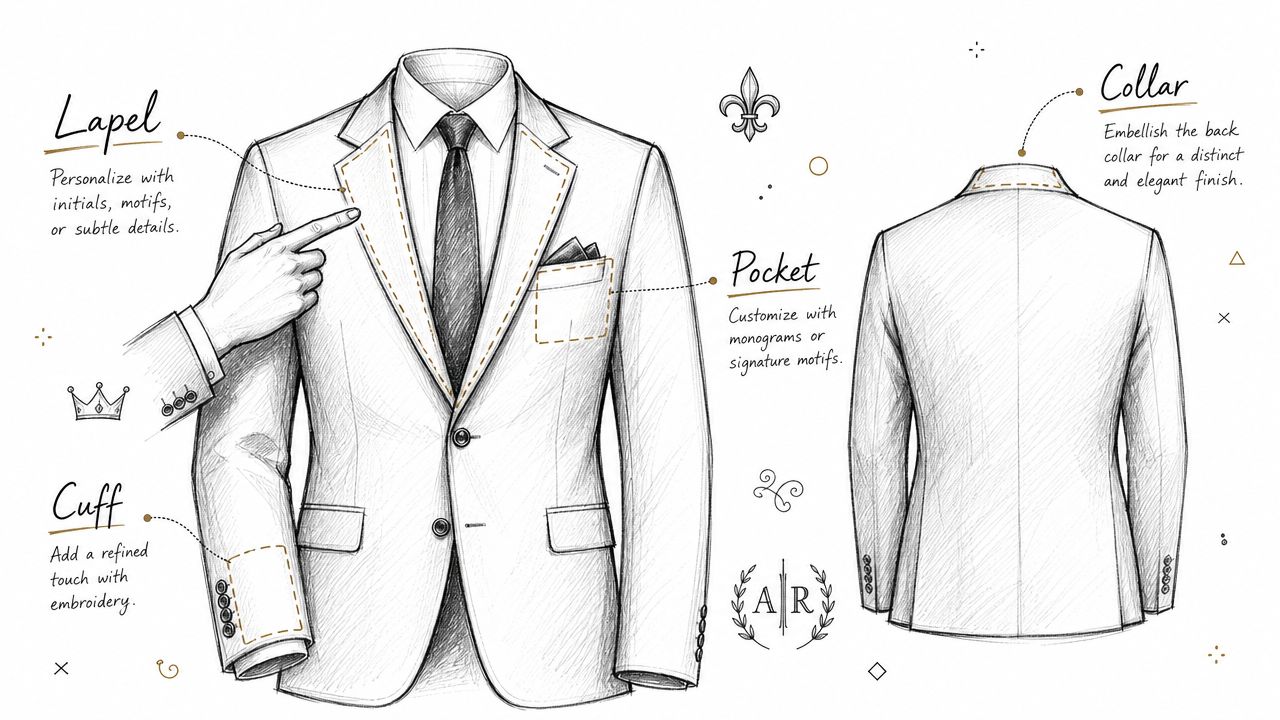
The most effective placements
Here are the placements that consistently work in gentlemen's tailoring.
- Inside the jacket lining: This is the most forgiving and often the most elegant location. It allows a message, date, crest, or initials to remain private until you choose to reveal it.
- Under the collar: Ideal for a hidden signature detail. It feels intimate and modern without changing the front view of the coat.
- On the shirt cuff: Best for restrained initials. It's visible only in motion, often when shaking hands or adjusting a cufflink.
- On a waistcoat: This works when the design is modest and balanced. It can be especially effective for weddings.
- Inside pocket facing: A smart place for initials or a small symbol. It's personal and protected.
For anyone weighing these areas against the construction of the garment itself, a visual guide to the parts of a suit helps clarify where embroidery complements structure rather than interrupts it.
What cloth allows
Placement isn't only aesthetic. It's technical.
A strong tweed tolerates bolder stitching and slightly more texture. A fine worsted wool asks for lighter handling, especially on visible outer areas. Cashmere blends and lighter summer cloths need even more discipline, because dense embroidery can pull or distort the surface if applied without care.
That's why I favour hidden or semi-hidden placement for finer suiting. The cloth remains clean from the outside, while the wearer still gets the satisfaction of something special.
What tends not to work
Some ideas fail for predictable reasons.
| Placement idea | Why clients ask for it | Why it often disappoints |
|---|---|---|
| Large chest motif | It feels distinctive | It fights the line of the jacket |
| Oversized cuff monogram | It seems traditional | It becomes the first thing people see |
| Dense embroidery on lightweight cloth | It looks rich in sketches | It can distort delicate fabric |
The right placement should feel intentional when the jacket is worn, and invisible to the eye until the moment it's noticed.
Styling Embroidery for the Man and the Moment
Embroidery should answer the occasion. The same design that feels moving on a wedding morning may feel misplaced in a boardroom. Men still dominate this area of tailoring, with 72.6% revenue share in the global bespoke suit market in 2025, while Europe holds 34.2% of global market share. That aligns with what British tailoring houses see every day: gentlemen want individuality, but they want it delivered with control.
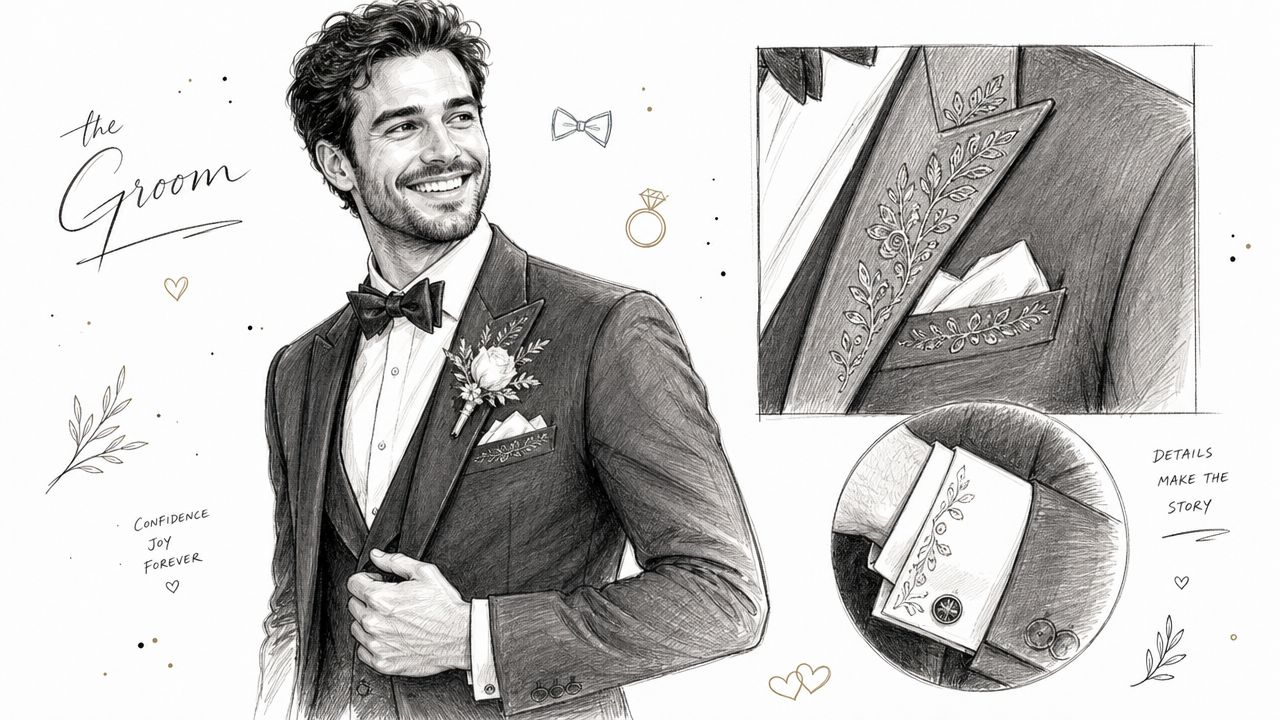
The groom
A wedding suit can carry emotion in a way business tailoring cannot. The best wedding embroidery isn't usually visible from the aisle. It's hidden inside the jacket, under the collar, or inside the waistcoat.
A wedding date stitched into the lining, a partner's initials near the heart, or a phrase with private meaning can transform the suit into an heirloom. What doesn't work as well is loading the garment with too many symbols at once. Date, initials, crest, floral motif, and contrast thread all together often create noise rather than sentiment.
The professional
The business client needs embroidery to behave differently. It should signal care, not self-advertisement.
For this man, I recommend tonal initials inside the jacket, on the shirt cuff, or on the inside pocket facing. Navy on navy, charcoal on graphite, or deep burgundy on plum can be superb. You know it's there. Your client may notice it later. Nobody thinks you came dressed for a costume fitting.
The black-tie guest
Formal eveningwear allows a little more flourish, but only where the cloth and setting permit it. A smoking jacket, dinner jacket lining, or formal waistcoat can carry a family crest or elegant monogram far better than a standard business suit.
If you're dressing for an evening event and want the embroidery to support rather than distract, it helps to think through the whole code of the outfit first. This guide on how to dress for a black tie event is useful because embroidery should sit inside the rules of black tie, not try to replace them.
Matching tone to moment
A simple way to judge suitability is to ask one question: who is the embroidery for?
- For you alone: hidden lining text, under-collar stitching, inside pocket initials.
- For close company: cuff monograms, waistcoat detail, subtle crest work.
- For public effect: stronger contrast, visible motifs, more expressive eveningwear details.
The suit should still be elegant if nobody comments on the embroidery. Approval from the room is optional. Good judgement isn't.
From Concept to Creation The Bespoke Commissioning Process
Most embroidered suits go wrong before the first stitch is made. Not because the embroiderer lacks skill, but because the brief is vague. “Something personal” is not a brief. Neither is a low-resolution crest pulled from an old email signature.
The commissioning process works best when the embroidery is treated as part of the garment from the beginning. It affects placement, backing, cloth behaviour, and timing. Bespoke work featuring meticulous hand-finishing commonly takes 12 to 16 weeks, and the labour behind it reflects specialist training that often involves 3 to 5 years of apprenticeship for coat tailoring specialisation, as noted by Permanent Style's discussion of bespoke tailoring lead times and labour.
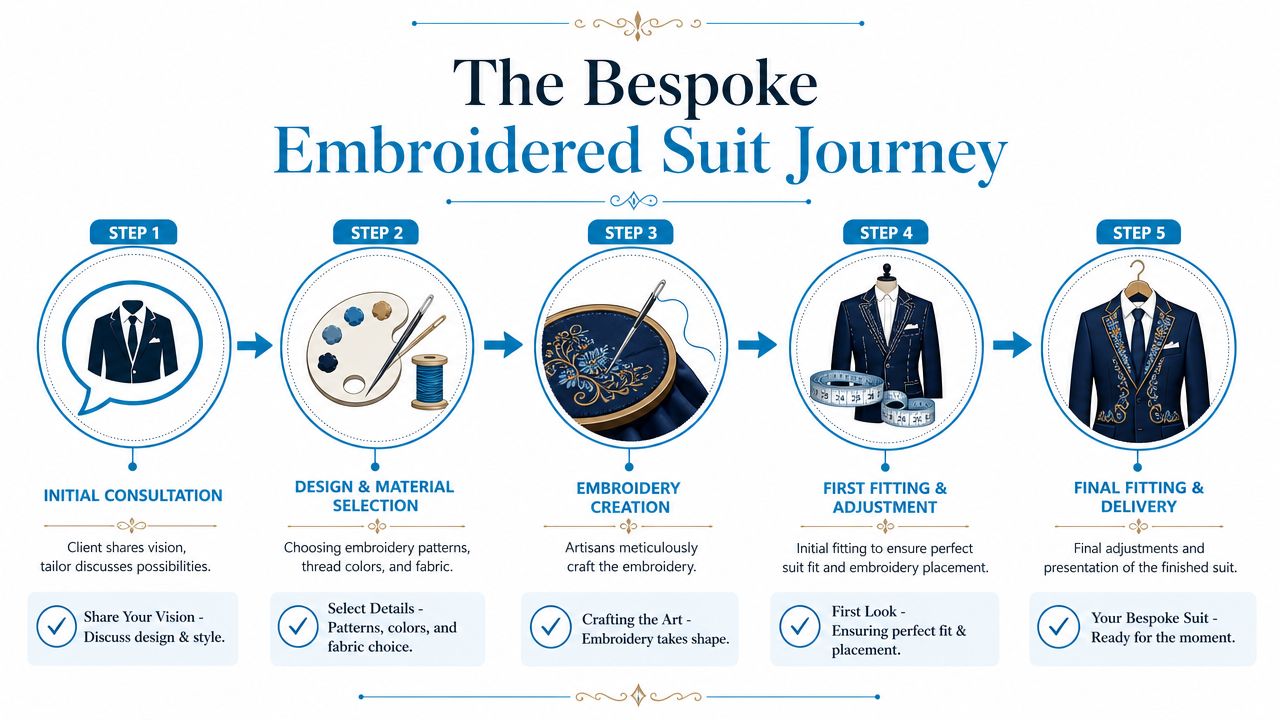
How the process usually unfolds
Consultation
The client brings the occasion, the cloth direction, and any personal references, which clarifies the embroidery's role.Design refinement
The motif is simplified if necessary. Scale, thread colour, and placement are tested against the chosen fabric.Garment cutting and preparation
The suit is planned with the embroidery in mind, especially if the detail affects the lining, collar, pocket area, or waistcoat.Embroidery execution
The artwork is stitched with attention to tension, visibility, and cloth behaviour.Fitting and final adjustment
Placement is reviewed in wear, not just on the table.
Clients who want to understand this process more concretely often find it helpful to explore what's involved when you design a suit, because embroidery decisions are strongest when they grow from the same design conversation as the cut.
Questions to ask your tailor
Bring these questions into the consultation and you'll get better answers.
- Will this design suit the cloth I've chosen? Some motifs look elegant on paper and clumsy on lightweight wool.
- Should the thread be tonal or contrasting? This changes the personality of the suit immediately.
- Will the embroidery sit on the outer cloth, lining, or a hidden internal area? Placement affects longevity and subtlety.
- Can the design be simplified? Heraldic or symbolic artwork often needs redrawing before it can be stitched well.
- What happens if I alter the garment later? Certain placements are easier to preserve than others.
What to bring to the appointment
A strong brief doesn't need to be elaborate. It needs to be clear.
| Bring this | Why it helps |
|---|---|
| A reference image | It shows style direction quickly |
| The exact initials, date, or wording | It avoids spelling and layout errors |
| A note on where you want it seen | Hidden and visible embroidery are designed differently |
Understanding the Investment Pricing Care and Long-Term Value
This is the question men ask most often, and rightly so. Embroidery changes both the bill and the delivery schedule. It shouldn't come as a surprise after the suit is already in work.
In the UK, custom embroidery can add 1 to 3 weeks to an 8 to 12 week bespoke timeline, typically adds £150 to £400, and artisan hand embroiderers may charge £45 to £65 per hour. The same source notes that 74% of clients ask about this cost-add, which tells you how often this part of the conversation is left too late.
What drives the price
Embroidery pricing usually follows complexity, time, and placement.
A small tonal monogram inside a jacket is one thing. A visible crest with multiple thread colours, denser fill, and a sensitive location on fine cloth is another. The design itself matters, but so does the preparation. Artwork may need simplifying, resizing, or redrawing so it stitches cleanly.
If you're comparing embroidery against the overall cost of the garment, this guide to bespoke suits cost is useful because it helps place embellishment within the wider economics of bespoke tailoring rather than treating it as an isolated fee.
What's worth paying for
The embroidery is worth paying for when it does one of three things well:
- Marks a personal event: wedding dates, initials, family references.
- Improves the ownership experience: a hidden detail that makes the suit feel distinctly yours each time you wear it.
- Adds quiet distinction: not visible to everyone, but beautifully executed for those who notice.
It is rarely worth paying for embroidery that copies a trend with no lasting relevance to the wearer.
Care and longevity
Embroidered tailoring deserves calm handling.
- Press carefully: Avoid crushing raised stitching directly with a hot iron.
- Dry clean sparingly: Use a cleaner who understands structured garments and point out embroidered areas.
- Store with shape: A proper hanger protects both the coat structure and any stitched detail near collar or shoulder lines.
- Alter cautiously: Some placements tolerate later changes well. Others may need more planning.
Embroidery lasts best when it's integrated into a good garment, not pasted onto a mediocre one.
Frequently Asked Questions and About the Author
Embroidery is at its best when it feels inevitable, as though the suit was always meant to carry that mark. The right design, on the right cloth, in the right place, gives a bespoke garment depth without making it theatrical. Most men don't need more embroidery. They need better judgement about where and why to use it.
For readers who like practical reference formats, broad consumer FAQ hubs such as EasyRegistry FAQs show how useful direct question-and-answer guidance can be. In tailoring, the principle is the same. Clear questions lead to better commissions.
Frequently Asked Questions
| Question | Answer | Note |
|---|---|---|
| Can embroidery be added to an existing suit? | Yes, sometimes, but it depends on access and cloth. Hidden areas such as lining, inside pockets, or certain collar positions are usually easier than visible outer-cloth placements. A finished suit gives the tailor less control over backing, tension, and distortion, so results can vary. If the fabric is fine or the jacket is tightly constructed, adding embroidery later may not be the best route. | Best assessed in person |
| What embroidery mistake do you see most often? | Oversizing. Men often choose a motif or monogram that looks balanced on a screen but dominates the garment once stitched. The second common mistake is using strong contrast on an already expressive cloth. Embroidery should support the architecture of the suit, not interrupt it. If you're unsure, reduce the scale first. A smaller detail nearly always looks more expensive and more intelligent. | Scale matters most |
| Is hand embroidery always better than machine embroidery? | No. Hand embroidery is more characterful and often more appropriate for deeply personal bespoke work, but machine embroidery can be the smarter choice for crisp monograms, repeat designs, and cleaner consistency. Better doesn't mean more romantic. Better means more suitable for the cloth, the design, and the purpose of the garment. The method should follow the result you want, not the other way round. | Choose by outcome |
| What thread colour is safest for a first embroidered suit? | Tonal thread is the safest and, in most cases, the most elegant place to begin. It gives you visibility up close without turning the embroidery into a talking point from across the room. Navy on navy, charcoal on dark grey, or burgundy on wine shades tend to age very well. Once you've worn tonal embroidery confidently, you'll know whether a stronger contrast suits your style. | Start understated |
About the author
Igor is the founder of Dandylion Style and a master tailor based in Ardingly, West Sussex. He specialises in bespoke garments cut from fine British cloths including tweed, wool, cashmere, linen, and mohair, with fittings available in the studio and across Sussex, London, and the South East. His approach combines measured restraint, technical precision, and practical advice so clients commission garments that feel personal, wearable, and built to last.
If you're considering an embroidered bespoke suit and want advice grounded in fit, cloth, and real wearability, Dandylion Style offers private consultations for gentlemen seeking wedding, business, black-tie, and one-of-a-kind tailoring.